The Western Brown Snake (Pseudonaja nuchalis, in the broad sense) is a medium-sized, highly venomous elapid native to inland and western Australia. Closely related to the Eastern Brown Snake, it is one of the most medically important snakes in arid and semi-arid regions, where it is widespread around farms, rangelands and open shrublands. Colour and pattern are extremely variable, ranging from pale sandy browns to dark chocolate or almost black individuals.
Taxonomy and naming
The Western Brown Snake belongs to Class Reptilia, Order Squamata, Suborder Serpentes, Family Elapidae and Genus Pseudonaja. This genus includes several highly venomous brown snakes such as the Eastern Brown Snake and Dugite. Traditionally, Western Brown Snakes have been referred to as Pseudonaja nuchalis, although recent taxonomic work suggests that the “Western Brown” complex may comprise multiple distinct species or regional forms. For general educational purposes, the name Western Brown Snake is still widely used for the arid-zone brown snakes of western and central Australia.
Physical characteristics
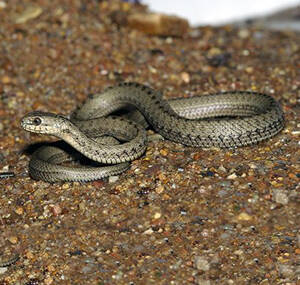
Western Brown Snakes are slender yet muscular, typically reaching 1–1.5 m in total length, with large individuals exceeding 1.8 m. Dorsal colouration is highly variable and may be pale yellow-brown, tan, sandy, orange-brown, chocolate brown or dark grey to nearly black. Some individuals show faint mottling or narrow crossbands, while others appear almost uniformly coloured. The head is relatively small and only slightly broader than the neck, and the eyes are of moderate size with round pupils. The belly is usually lighter—cream, pale yellow or greyish-pink—with few or no distinct markings. Overall, the snake presents a fast, slim brown appearance that can change noticeably between populations.
Distribution and habitat
In the broad sense, Western Brown Snakes occur across much of inland and western Australia, including large areas of Western Australia, the Northern Territory, South Australia and inland Queensland. They inhabit a wide range of arid and semi-arid environments, such as red sand and gibber plains, dry shrublands, mulga and acacia woodlands, open grasslands and the edges of agricultural and pastoral lands. The species favours areas that provide ground refuges, including soil cracks, animal burrows, rock piles, fallen timber and gaps in buildings, sheds and other human structures.
Behaviour and lifestyle
Western Brown Snakes are mainly diurnal or crepuscular, with activity patterns depending on local climate and season. In warm weather they are most active in the cooler parts of the day—morning and late afternoon—retreating to burrows or shaded refuges during the hottest hours. They are renowned for their speed and alertness, often retreating rapidly when disturbed. When escape is not possible, they may raise the front part of the body, slightly flatten the neck and hiss before delivering fast, repeated strikes. Their potent venom and rapid strike make them among the most dangerous snakes in inland Australia.
Diet
The Western Brown Snake is a carnivorous predator that feeds primarily on small vertebrates. Its diet is dominated by small mammals, especially rodents, but also includes lizards, other snakes, birds and eggs, and occasionally frogs and large insects. Around farms and storage facilities, Western Brown Snakes frequently hunt in and around grain sheds, poultry houses and hay stacks where mice and rats are abundant, thereby providing a degree of natural rodent control—albeit with significant snakebite risk for people working nearby.
Reproduction and life cycle
Unlike viviparous species such as Tiger Snakes, the Western Brown Snake is oviparous. Breeding generally takes place in spring and early summer. Males search for females and may engage in combat with rival males. After mating, females deposit clutches of soft-shelled eggs in sheltered sites such as burrows, soil cavities, rock crevices or spaces within human structures. Clutch size often ranges from about 10 to 25 eggs, depending on the size and condition of the female. Eggs incubate for several weeks to a couple of months, and the hatchlings emerge fully equipped with functional venom glands and fangs and are independent from birth. Wild individuals are thought to live for around a decade or more.
Relationship with humans
Because Western Brown Snakes are common around farms, pastoral stations and rural settlements in arid and semi-arid Australia, encounters with people are not rare. Their venom is extremely potent and can cause severe neurotoxic, myotoxic and coagulopathic effects, leading to paralysis, muscle breakdown, kidney damage and potentially death if not treated promptly. In many inland regions they are a major contributor to serious snakebite cases. People living and working within the range of the Western Brown Snake are encouraged to learn snake-safety practices and first-aid procedures. Any suspected bite should be treated as a medical emergency, with immediate application of the pressure immobilisation technique and rapid transport to hospital.
Conservation status and threats
Overall, the Western Brown Snake complex is regarded as widespread and relatively common, corresponding to a Least Concern status at a broad conservation scale. Local populations can be impacted by habitat degradation, road mortality, deliberate killing driven by fear of venomous snakes and predation by introduced animals such as cats and foxes. However, their ability to exploit a variety of arid and semi-arid habitats, including modified agricultural landscapes, has helped them remain relatively secure. Conservation of Western Brown Snakes is supported by maintaining native shrubland and woodland habitats, retaining natural refuges such as rock piles and burrows on farms and promoting public education that encourages safe coexistence rather than indiscriminate killing of snakes.