
Tasmanian Devil
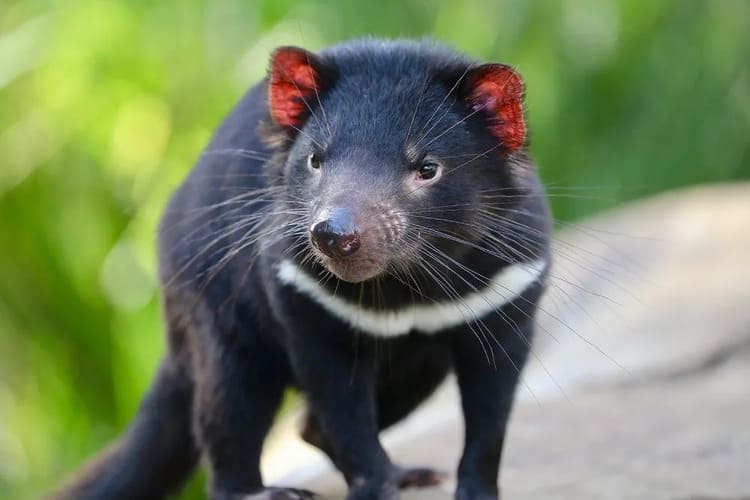
The Tasmanian devil is an iconic carnivorous marsupial endemic to the island of Tasmania and the largest living member of the dasyurid family. Known for its black coat, white chest patch, harsh screams, and powerful bite, it plays an important scavenging role by rapidly consuming carcasses and helpi...

Spotted-tailed Quoll
The spotted‑tailed quoll (also widely called the tiger quoll) is one of Australia’s most distinctive marsupial predators. Its dark coat is covered in white spots, and unlike other quolls those spots extend along the tail. Mostly nocturnal and highly athletic, it can hunt on the ground and climb tr...

Narrow-nosed Planigale
The narrow-nosed planigale (Planigale tenuirostris) is one of Australia’s tiniest marsupial predators—an animal that looks a bit like a mouse, yet belongs to the carnivorous dasyurid family. Adults typically weigh under 10 grams, but they are fast, bold hunters that take a wide range of invertebra...

Mulgara
The name “mulgara” refers to small desert‑dwelling carnivorous marsupials in the genus Dasycercus. Modern treatments commonly recognise two main species: the brush‑tailed mulgara (Dasycercus blythi) and the crest‑tailed mulgara (Dasycercus cristicauda). They can look very similar in the field,...

Common Dunnart
The common dunnart (Sminthopsis murina) is a small, insect-eating marsupial native to south-eastern Australia. Active mainly at dusk and at night, it hunts rapidly across the ground layer, using leaf litter, grass tussocks and fallen logs as cover. Although it can look superficially “mouse-like,”...

Brown Antechinus
The brown antechinus (Antechinus stuartii) is a small carnivorous marsupial from eastern Australia, belonging to the family Dasyuridae. Despite its tiny size, it is an energetic predator that feeds primarily on insects and other invertebrates and occasionally on small vertebrates. The species is fam...
Tasmanian Devil
Tasmanian devil (Sarcophilus harrisii) is the largest living carnivorous marsupial, native only toTasmania. With a powerful bite and robust skull, it scavenges and hunts small vertebrates, providing an importantecosystem service. Since the mid‑1990s a transmissible cancer—devil facial tumour dis...