Suids are members of the family Suidae, a group of even-toed ungulates that includes pigs, wild boars, warthogs, and their close relatives. They are best known for their sturdy bodies, four-toed hooves, and a highly mobile snout that ends in a firm, cartilaginous disc—an ideal tool for rooting and digging.
These animals have lived alongside humans for thousands of years, especially through the domestication of wild boars into modern domestic pigs. At the same time, wild suids have successfully diversified across very different landscapes, from African savannas to European forests and Indonesian islands.
What Are Suids?
Suids are the mammals classified in the family Suidae. A common source of confusion is with peccaries, which look similar but belong to a different family (Tayassuidae). One practical way to understand the split is geographic history: suids are native to the Old World (mainly Eurasia and Africa), while modern peccaries are native to the Americas.
Main Characteristics of Suids
1) Even-toed hooves with four digits
Suids are artiodactyls, meaning they have an even number of toes. They typically have four toes, but they mostly bear weight on the two central toes, giving them a “tiptoe-like” stance.
2) A powerful digging snout
The snout ends in a cartilaginous disc with forward-facing nostrils. This structure is flexible and strong, helping suids root in soil to find food such as roots, tubers, insects, and fallen fruit.
3) Medium to large body size
Most suids are medium-sized, but some species become impressively large, especially the biggest forest-dwelling forms.
4) Highly vocal and expressive
Grunts, squeals, and snorts are common. Many species also communicate with tooth-clicking and other jaw sounds.
5) Thick skin, variable hair
Skin tends to be thick. Hair coverage varies by species, from sparse coats to dense, bristly fur.
6) Short tail with a tuft
Many suids have a relatively short, thin tail ending in a small hair tuft.
7) Simple digestion compared with ruminants
Unlike deer, cattle, or sheep, suids are not ruminants. Their digestive system is generally simpler, which fits their typically omnivorous lifestyle.
Suidae: Major Groups and Genera
Modern suids are commonly described through several key genera:
Phacochoerus – warthogs
Babyrousa – babirusas (“deer-pigs”)
Sus – pigs and wild boars
Porcula – pygmy hog
Potamochoerus – river pigs / bushpigs
Hylochoerus – giant forest hog
Examples of Suids
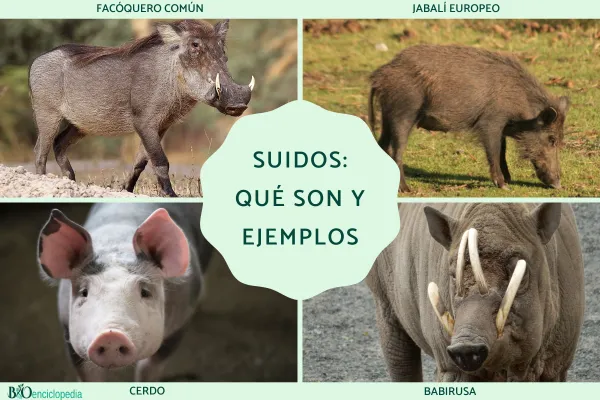
Common Warthog (Phacochoerus africanus)
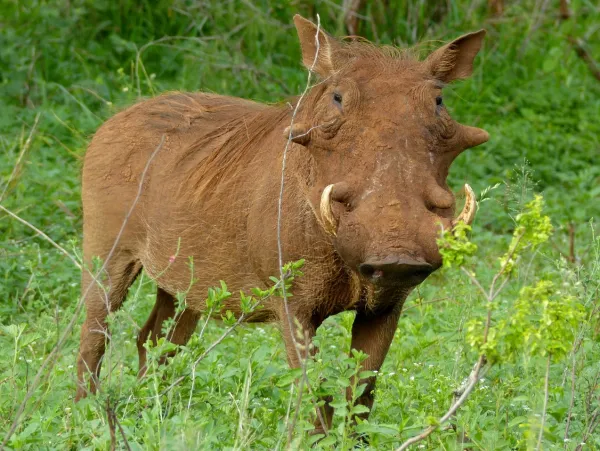
The common warthog is a rugged African suid built for open habitats. It has prominent facial “warts” that help protect the head during fights, especially among males. Its curved tusks are large and conspicuous, and its broad snout is well suited to grazing and rooting in grasslands. Warthogs are typical of sub-Saharan Africa, where their high-set eyes help them keep watch over tall grasses while feeding.
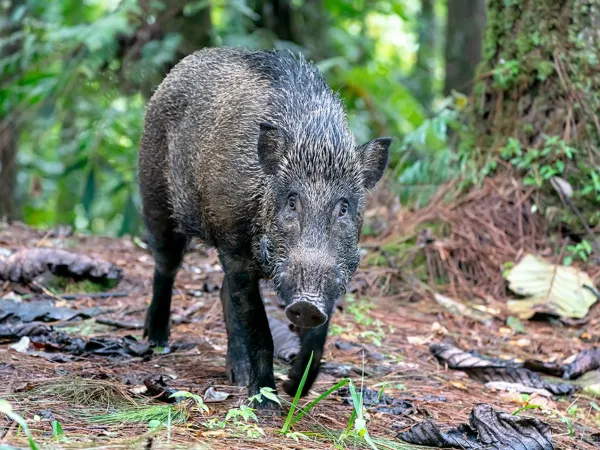
European Wild Boar (Sus scrofa scrofa)
This wild boar subspecies is native to Europe. It usually has a dense, dark brown coat and strong limbs adapted for moving through woodland and scrub. In hot conditions, it may rest through the day and become more active later in the afternoon and evening.
European wild boars are omnivores. They often eat fruit, shoots, leaves, and especially roots—which they uncover by digging. They can also take small vertebrates, carrion, eggs, and other animal matter when available. They are not naturally aggressive toward people, but they can defend themselves if threatened or cornered.
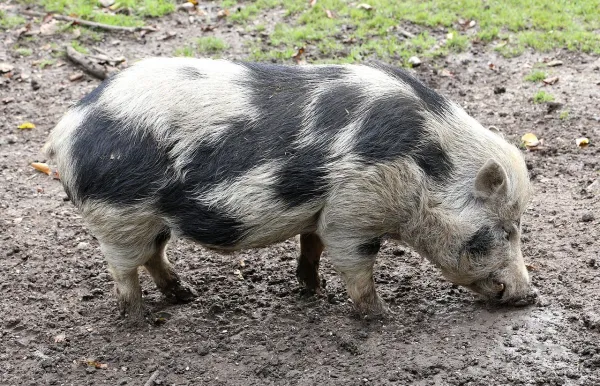
Domestic Pig (Sus scrofa domesticus)
Domestic pigs originated from the domestication of wild boars in regions such as the Near East and China, eventually producing the familiar pig breeds raised today. They were selected for rapid growth and reliable meat production.
Their hair is short, stiff, and bristly (often called bristles). Despite old stereotypes, domestic pigs are widely recognized for being intelligent, social, and capable of keeping clean when they have adequate space and conditions. Many breeds exist, developed to suit different climates and farming goals, including body shape and muscle distribution.
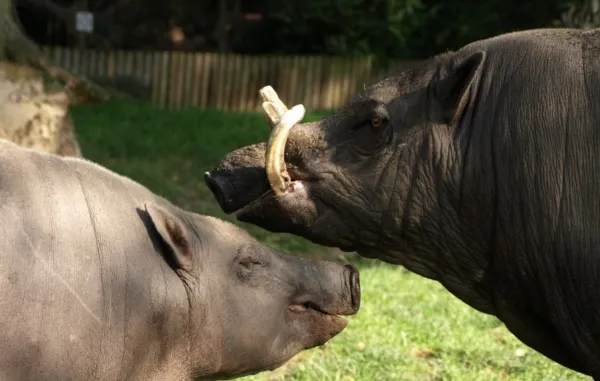
Babirusa (Babyrousa babyrussa)
Babirusas are wild pigs from Indonesia, especially associated with the region of Sulawesi and nearby islands. They are famous for their unusual tusks—particularly in males—where the upper tusks can curve upward in dramatic arcs, sometimes appearing as if they grow back toward the head.
They often stay close to water and may spend long periods cooling off by submerging themselves. Compared with many other suids, babirusas can have relatively sparse hair and a grayish skin tone.
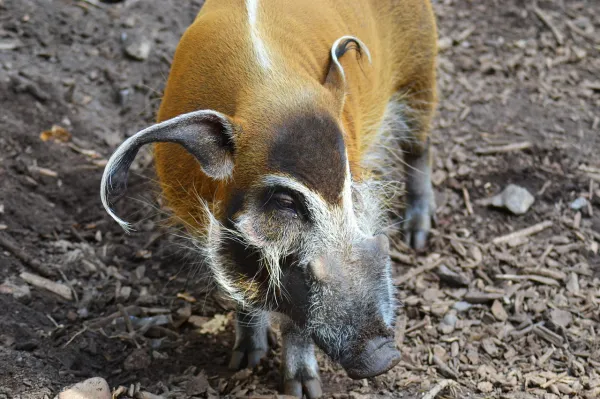
Red River Hog (Potamochoerus porcus)
The red river hog is one of Africa’s most striking suids. It typically shows a rich reddish-brown coat with contrasting markings. Many individuals have long white ear tufts, a darker face with pale lines, and a lighter stripe along the back that makes the outline stand out.
As the common name suggests, it is often associated with wet areas and tends to live near rivers, lakes, pools, and other water sources.
Giant Forest Hog (Hylochoerus meinertzhageni)
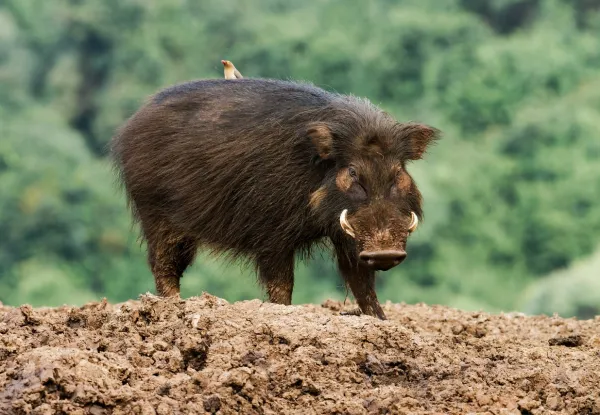
The giant forest hog is the largest living suid and the only species in its genus. Adults can reach around 2 meters in body length and stand roughly 1 meter tall at the shoulder. Its coat is often long and coarse, with darker tips and warmer brownish tones closer to the base. The tusks are prominent, matching its powerful build.
This species lives in parts of Africa, usually where there is enough vegetation cover to provide shade and protection. It is omnivorous, relying heavily on grasses and plants, but it may also take carrion when opportunities arise.
Why Suids Matter in Nature
Suids influence ecosystems in two major ways. First, their rooting behavior can reshape soil and vegetation patterns, changing how seeds germinate and how nutrients cycle. Second, as omnivores and scavengers in some contexts, they help move energy through food webs and can reduce the persistence of organic remains in the environment.