The ocean is full of strange, almost unreal creatures—organisms so transparent and delicate that you might not even notice them unless you’ve seen a bloom up close. Salps are one of those animals. They look like tiny drifting tubes of clear jelly, sometimes floating alone and other times forming long chains that can stretch for meters. But what exactly are they, what do they eat, why do they matter in marine ecosystems, and do they sting?

Below is an optimized English guide to salps: their biology, behavior, reproduction, ecological role, and the most common species people hear about.
Table of Contents
What Are Salps?
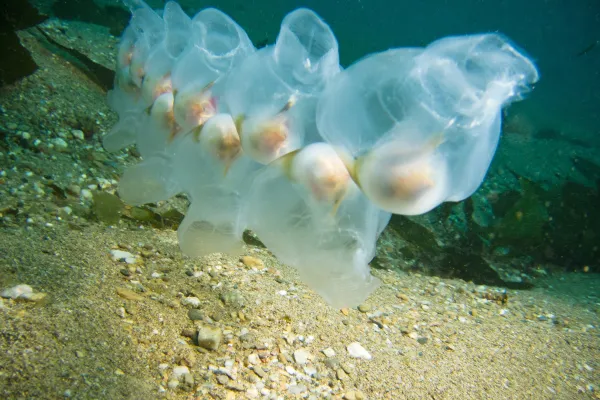
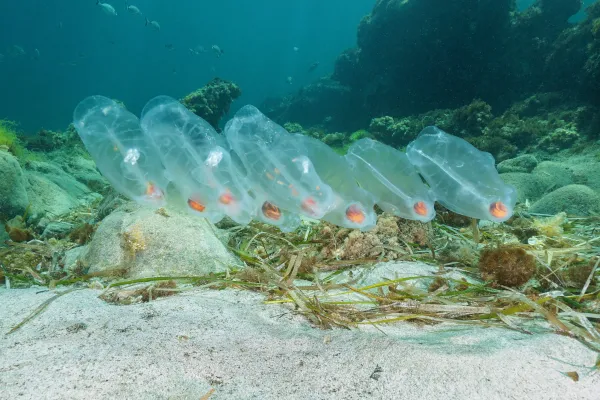
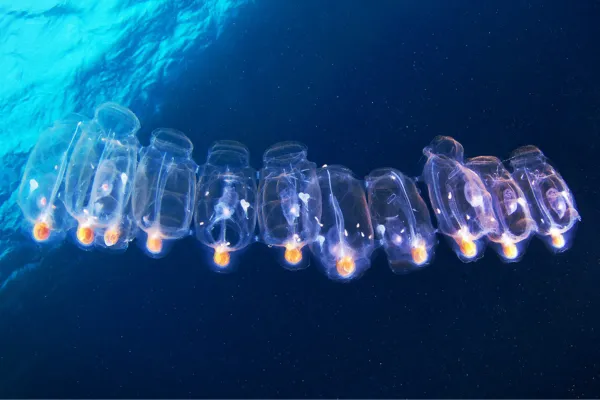
Salps are simple-looking marine animals with a gelatinous, transparent body that can resemble a jellyfish in texture—but salps are typically elongated and tube-shaped. In the water, they can be difficult to spot because you can often see straight through them. Many swimmers mistake them for drifting plastic or a clear “bubble” of gel.
They are invertebrates and move in a surprisingly smooth way, seeming to float as they travel. Their motion is often described as gentle “pulsing” that helps them glide through the water.
Key Characteristics of Salps
They are tunicates: Salps belong to the tunicates (Thaliacea). They have a protective outer covering often called a tunic.
Size: Many species measure roughly 1–10 cm long, though size varies by species and life stage.
A chordate connection: In early life stages, tunicates show traits related to chordates; after metamorphosis, some of those larval traits are reduced in the adult form.
Free-floating lifestyle: Salps are pelagic—they drift in open water rather than living attached to the seafloor.
Simple circulation: They have a basic circulatory system that includes a heart and vessels.
Ecological role: They are often described as “cleaners” of the sea because of their filtering activity and their role in ocean carbon cycling.
How salps move and “filter” the ocean
Salps draw water in through an opening, filter out food particles, and expel the water out the other end. This water flow also helps propel them forward—so feeding and movement are closely connected.
Types of Salps (Examples)
There are many species of salps. Here are a few examples mentioned in the source text, with simplified identifiers:
Pegea confoederata
Often associated with warm seas
Can reach about 120 mm
Long, tubular shape
Weelia cylindrica
Cylindrical body form
Around 16 mm long (as described in the source text)
Mouth and anus described as positioned on the dorsal side in the source
Thalia democratica
Described as one of the most abundant types
Reported across the Indian, Pacific, and Atlantic oceans
Barrel-like shape; around 15 mm long in the source text
Cyclosalpa pinnata
Can reach around 75 mm
Elongated tubular body, narrower at the ends
The source text notes internal luminous organs, making it easier to distinguish
Salpa fusiformis
Described as a very common, widely distributed salp
Often about 6–7 cm long (around “thumb-length”)
Very transparent, with a noticeable yellow eye-like spot mentioned in the source
Where Salps Live
Salps can be found in many oceans worldwide, spanning equatorial, temperate, and cold waters. The source text also notes that in some places—such as certain beaches of the Cantabrian Sea and the Mediterranean—they can appear in such large numbers that people call them a “plague” (meaning a nuisance bloom rather than a true disease).
Behavior and Swarming
Salps are generally peaceful drifters. You may see them:
Solitary, floating on their own
In huge blooms forming chains of many individuals—sometimes thousands—creating long strings that can extend for meters
Nearshore appearance
The source text suggests younger stages may be seen nearer to beaches, while adults that drift too close to shore may die. In general, salps are better suited to open-water conditions than to being stranded in shallow surf.
Diet: What Salps Eat
Salps are mainly filter feeders. Their diet is described as mostly herbivorous, because they feed largely on:
phytoplankton (microscopic algae and plant-like organisms in the sea)
Occasional extra particles
Depending on species and size—especially in larger salps—they may also capture extremely small organisms such as tiny crustaceans suspended in the water.
A note about toxic algae
The source text states that salps can consume Caulerpa taxifolia, a highly toxic alga that has spread in some regions. In that framing, salps may help regulate certain algae by filtering and ingesting them when present.

Reproduction and Alternation of Generations
Salps are famous for their unusual and highly efficient reproduction strategy. The source text describes them as hermaphroditic (having reproductive organs of both sexes) and capable of switching between:
sexual reproduction
Alternation of generations
This switching is often described as an alternation of generations. In one phase, reproduction results in many offspring produced from a sexual process; in another phase, a single individual can generate many new individuals asexually, often forming the long chains people notice during blooms.
Threats and Conservation
According to the source text, salps generally do not require special conservation attention. In fact, there are periods when they become extremely abundant and are considered a nuisance bloom because they reproduce quickly and can appear in massive numbers.
Interesting Facts
They can be so transparent that they look like clear plastic toys drifting in the water.
They have two main openings: one for intake and one for output.
Some descriptions highlight a single noticeable eye-like structure.
They are mainly herbivorous filter feeders.
They can reproduce incredibly fast through alternating reproductive modes.
The source text mentions they can help protect Mediterranean seagrass meadows (such as Posidonia) indirectly by influencing what gets eaten in the ecosystem.
They are often discussed in relation to ocean carbon cycling, which is why some articles say they can help “mitigate” climate change.
Do Salps Sting?
No. Salps do not sting and are harmless to humans. They are not like jellyfish that have stinging cells. Salps are filter feeders, and their main interaction with the environment is pumping water through their bodies to capture microscopic food, which helps support balance in marine ecosystems.
Bibliography
Rojas Catalán, G. A. (2009). Composición y distribución espacial de salpas (Thaliacea) en las zonas de transición costera y oceánica frente a Chile centro-sur. Universidad de Concepción (Chile).
Esnal, G. B. (1970). Contribución al conocimiento de las Salpas del Atlántico sur, en especial “Thalia democratica”. Impr. Coni (Argentina).