The Yeti Crab is one of the strangest animals ever discovered in the deep ocean. With its pale body and hair-like bristles covering its claws and underside, it looks so unusual that scientists and the public quickly gave it a memorable name. Despite being called a crab, the Yeti Crab is not a true crab in the strict scientific sense. It belongs to a small and highly unusual group of deep-sea crustaceans that live in some of the harshest environments on Earth.
The best-known Antarctic species is Kiwa tyleri, a member of the family Kiwaidae. Other related species have also been discovered in deep-sea vent and seep environments, but all of them share the same basic reputation: they are rare, bizarre, and perfectly adapted to life in darkness.
What Does the Yeti Crab Look Like?
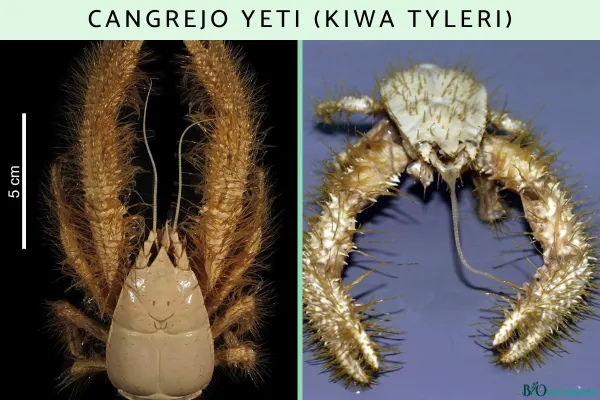
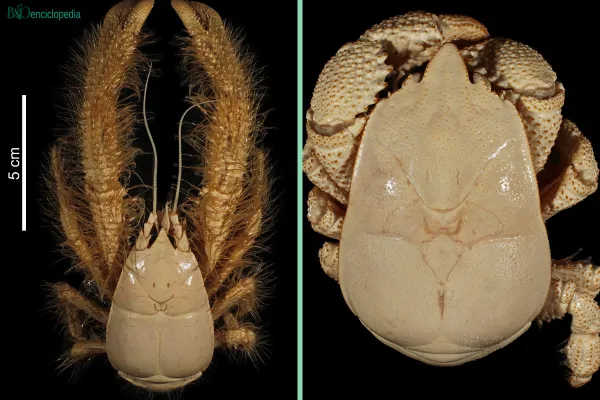
The Yeti Crab has a broad, compact body and stout claws, but its most striking feature is the covering of long, pale, hair-like structures on parts of the body. These are not true hairs. They are actually setae, or flexible bristles, which give the animal its shaggy appearance.
Its body is usually whitish or pale cream, a common trait in deep-sea creatures that live where sunlight never reaches. Because vision is far less useful in total darkness, the Yeti Crab has highly reduced eyes and depends more on other sensory cues than on sight.
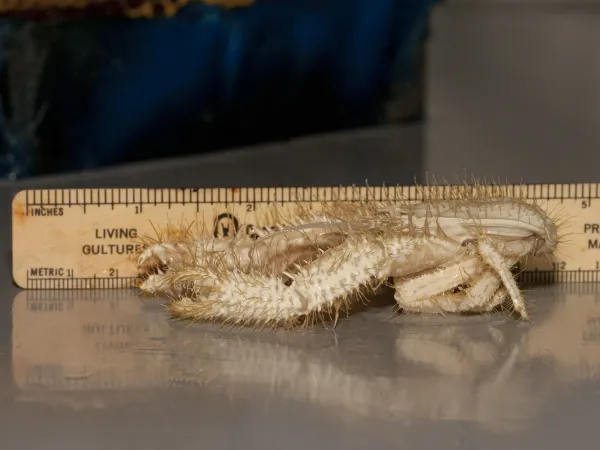
Although it looks like a large strange crab in photographs, it is actually quite small, usually measuring only a few centimeters across. What makes it visually impressive is not its size, but its unusual body covering and the dense colonies it can form around hydrothermal vents.
Why Is It Called a Yeti Crab?
The name “Yeti Crab” comes from its hairy appearance. The thick bristles on its claws and underside reminded people of the legendary Yeti, the so-called snowman of folklore. In some cases, certain species in this group have also received humorous nicknames because of the especially dense growth of bristles on the underside of the body.
The name is informal, but it has become widely used because it captures exactly what makes this animal so memorable: it looks like a fuzzy monster from the deep sea.
Where Does the Yeti Crab Live?
Yeti Crabs live in the deep ocean, especially around hydrothermal vents and similar chemically rich environments on the seafloor. The species Kiwa tyleri is known from hydrothermal vents in the Southern Ocean near Antarctica, where conditions are extremely harsh.
This habitat is one of the most extreme on the planet. The surrounding seawater is near freezing, but the vent fluids rising from the seafloor are intensely hot and full of chemicals. The Yeti Crab survives in the narrow zone between these extremes, where conditions are still dangerous but just tolerable enough for life.
These crabs often gather in dense groups around active vents. In some areas, hundreds of individuals can crowd together in a small space. They remain close to the vents because these places provide the chemical conditions that support their food source.
How Does the Yeti Crab Survive in Such Extreme Conditions?
The Yeti Crab survives through a combination of physical and behavioral adaptations.
Its enlarged body surfaces covered with bristles provide space for colonies of bacteria to grow. These bacteria are essential to its way of life. The crab positions itself in areas where the vent chemicals help nourish these microbes, which in turn become food.
The species also has to remain in a very narrow environmental range. If it moves too far away from the vent, it may become too cold and lose access to its food source. If it gets too close, it risks exposure to dangerously hot or toxic vent fluids. In this way, the Yeti Crab lives in a delicate balance between freezing cold and extreme heat.
What Does the Yeti Crab Eat?
The Yeti Crab is best known for its unusual feeding strategy: it effectively grows food on its own body.
The hair-like bristles on its claws and underside support colonies of bacteria. These bacteria use chemicals from the hydrothermal vent environment to grow. The crab then harvests and consumes them. This relationship is one of the most fascinating examples of life based on chemosynthesis rather than sunlight.
In the deep sea, most animals depend either on food drifting down from the surface or on specialized local food webs. The Yeti Crab belongs to the second group. Instead of relying mainly on plant-based food chains powered by sunlight, it depends on microbial life that uses chemical energy from the Earth itself.
It may also consume bits of organic matter or small available food items when possible, but its relationship with bacteria is what makes it truly unique.
Behavior of the Yeti Crab
The Yeti Crab is not a fast-moving hunter. Instead, it is a highly specialized deep-sea animal that stays closely associated with its vent habitat.
It often lives in large dense aggregations, crowding around vent openings where the right mix of temperature and chemistry exists. These groupings are thought to help individuals remain in the narrow zone they need for survival.
Its behavior is closely tied to bacterial farming. By holding or positioning its bristle-covered body parts in vent-rich water, it helps create the conditions needed for microbial growth. In this way, much of its daily life is connected to maintaining and harvesting its food source.
Reproduction of the Yeti Crab
The reproduction of the Yeti Crab is still not fully understood, which is common for deep-sea animals that live in remote and difficult-to-study habitats. However, scientists do know that it is egg-laying.
Females carry eggs attached to the underside of the body until they are ready to hatch. Like many deep-sea crustaceans, the species probably has a complex life cycle involving larvae, but many details remain uncertain.
One reason reproduction is still mysterious is that hydrothermal vent habitats are isolated and difficult to observe directly over long periods. Even today, researchers are still learning how these crabs mate, brood their eggs, and disperse between vent systems.
Threats and Conservation
The Yeti Crab is still poorly known from a conservation point of view. Because it lives in deep-sea habitats far below the surface, its total population size, long-term trends, and exact biological limits are still not well understood.
That said, its habitat may face growing threats from deep-sea industrial activity, especially seabed mining and disturbance to vent ecosystems. Animals like the Yeti Crab are especially vulnerable because they depend on very specific habitats and cannot easily move to ordinary seafloor environments if those sites are damaged.
Since hydrothermal vent communities are both fragile and highly specialized, protecting them is important not only for known species like the Yeti Crab, but also for many other deep-sea organisms that science may not yet fully understand.
Interesting Facts About the Yeti Crab
The Yeti Crab was only discovered in the 21st century, making it one of the most famous recently described marine animals. Its discovery drew major attention because it represented a very unusual deep-sea lineage.
Although it is called a crab, it is more closely related to squat lobster-like crustaceans than to typical shore crabs.
It lives in complete darkness, around toxic hydrothermal vents, and farms bacteria on its own body for food. Very few animals combine all of these characteristics.
Its hairy appearance is one of the main reasons it became so famous, but those bristles are not decorative. They are essential tools for supporting the bacteria that help keep the animal alive.
Conclusion
The Yeti Crab is one of the most extraordinary animals in the ocean. Strange-looking, nearly blind, and adapted to one of the harshest environments on Earth, it shows just how unusual deep-sea life can be. Its shaggy body, dependence on vent bacteria, and ability to survive between freezing seawater and superheated vent fluids make it a true marvel of evolution.
Although much about the Yeti Crab is still unknown, one thing is already clear: it is one of the most remarkable examples of how life can adapt to extreme conditions far beyond the reach of sunlight.
FAQ
What is a Yeti Crab?
A Yeti Crab is a deep-sea crustacean known for its pale body and hairy-looking bristles. It lives around hydrothermal vents and is famous for growing bacteria on its body as a food source.
Is the Yeti Crab a real crab?
Not exactly. It looks like a crab, but it does not belong to the true crab group in the strict scientific sense.
Where does the Yeti Crab live?
Yeti Crabs live in the deep ocean, especially around hydrothermal vents. One well-known species, Kiwa tyleri, lives near Antarctica.
Why is it called a Yeti Crab?
It is called a Yeti Crab because its hairy-looking bristles make it resemble the legendary Yeti.
What does the Yeti Crab eat?
It mainly feeds on bacteria that grow on the bristles covering parts of its body. It may also consume small organic material when available.
Can the Yeti Crab see?
Its eyes are highly reduced, and it is considered effectively blind because it lives in total darkness.
Is the Yeti Crab endangered?
Its conservation status is still not fully understood, but deep-sea habitat disturbance may become a serious threat in the future.