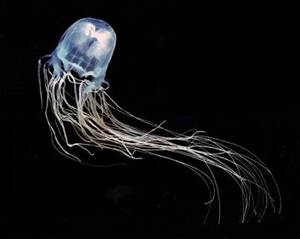
Box jellyfish are members of the class Cubozoa, a group of cnidarians named for their cube-shaped bell. Box jellyfish is not a single species, and the group includes a range of forms from large sea-wasp species (often referring to Chironex fleckeri in northern Australia) to small Irukandji-type species (associated with Carukia barnesi and relatives) that can still trigger intense whole-body symptoms. Cubozoans are notable for their active swimming ability and their relatively advanced sensory systems, including multiple eye types.
Ecologically, box jellyfish are nearshore predators that feed mainly on small fish and crustaceans. Their tentacles are armed with dense nematocysts that inject venom to immobilize prey. For people, the primary concern is stings. Mild cases can cause burning pain and whip-like welts, while high-risk species can cause severe systemic effects and may be life-threatening. In coastal areas where box jellyfish occur, it is important to follow local warnings, use protective gear when recommended, and apply first aid based on local authoritative guidance.
Taxonomy and naming
Box jellyfish belong to the phylum Cnidaria and the class Cubozoa. Because the term is a broad common name, safety guidance and ecological details often refer to specific families, genera or local hazardous species rather than the entire class.
Physical features
The bell is box-like, with tentacles emerging from muscular pads at the corners. Many individuals are clear or lightly tinted, making them difficult to spot. A distinctive feature of cubozoans is their eye-bearing sensory structures along the bell margin. These include multiple types of eyes that can detect light and shapes, supporting more directed movement and obstacle avoidance than many drifting jellyfish.
Range and habitat
Cubozoans are widespread in tropical and subtropical regions. They are commonly associated with shallow coastal habitats including seagrass beds, mangrove edges, lagoons and sheltered bays. They may move inshore with tides, and encounter rates often show seasonal peaks linked to temperature, winds and currents.
Behaviour and ecology
Many box jellyfish actively swim and can navigate within complex nearshore environments. Activity patterns vary with light levels, tides and prey availability, with some species more active at dawn, dusk or night. In calm bays and estuaries, local aggregations can form, which is why beach management often relies on seasonal monitoring and warnings.
Diet
They feed mainly on small fish, fish larvae and crustaceans. Venom delivered by nematocysts quickly subdues prey, which is then transferred to the mouth for ingestion. Predators can include some sea turtles and fishes, but interactions vary widely among species.
Reproduction and life history
Box jellyfish typically alternate between a benthic polyp stage and a free-swimming medusa stage. Polyps can reproduce asexually and later transform to produce juvenile medusae. Many species have relatively short life cycles, often completing a generation within months to about a year, and reproduction can be strongly seasonal.
Relationship with people
Box jellyfish are important from a public-safety perspective. First-aid recommendations differ by region, but common principles include avoiding rubbing the skin, removing visible tentacle material safely, and seeking medical care for severe pain or systemic symptoms. Some regions recommend vinegar to help prevent further nematocyst discharge for certain cubozoan stings, but you should follow local authoritative guidance. If there are signs of severe reaction such as breathing difficulty, chest pain, collapse or rapidly worsening symptoms, seek emergency help immediately.
Conservation status and threats
Because box jellyfish refers to a class-level group, there is no single IUCN status. Many species are poorly studied or unassessed. Coastal development, water-quality change, habitat loss and climate-driven shifts in temperature and currents may influence local abundance and encounter rates. Species-level monitoring and careful reporting of sting events are important for both ecology and public safety.