Yes, penguins have knees, even though you cannot normally see them. Like other birds, penguins have thighbones, knee joints, lower-leg bones, ankles, and feet. Their knees are positioned high on their bodies and are hidden beneath feathers, skin, and surrounding tissues. The short legs visible beneath a penguin's round body are only part of its complete leg structure. This unusual anatomy helps explain why penguins appear to waddle on land while moving so efficiently through water.
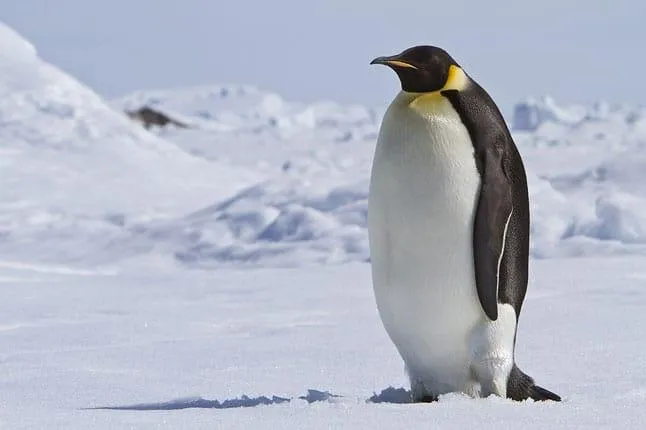
Penguins have knees, but their upper legs are concealed within the outline of their feather-covered bodies.
Where Are a Penguin's Knees?
A penguin's knees are located high on its body, between the thighbones and the lower-leg bones.
They are not found at the visible bend close to the feet.
Much of a penguin's upper leg is concealed by its streamlined body shape, surrounding tissues, and dense feathers.
This makes the legs appear much shorter than they actually are.
If you examine a penguin skeleton, you can identify the same basic leg components found in other birds:
Femur: The thighbone connecting the hip to the knee.
Knee joint: The articulation between the femur and the lower leg.
Tibiotarsus: The principal lower-leg bone, formed through the fusion of the tibia with certain ankle elements.
Fibula: A smaller bone associated with the lower leg.
Tarsometatarsus: A fused bone forming part of the lower ankle and foot region.
Toe bones: The bones supporting the penguin's webbed toes.
The actual knee sits much closer to the penguin's body than most people expect.
This arrangement is not unique to penguins. Other birds also have knees positioned high beneath their feathers.
What Does a Penguin's Leg Skeleton Look Like?
A penguin's leg skeleton is more complex than its outward appearance suggests.
The femur extends from the hip toward the knee, while the tibiotarsus connects the knee region to the lower leg.
Below that lies the ankle joint and the tarsometatarsus, followed by the toes.
The leg bones are generally held in a bent configuration rather than extending vertically in a straight line like a standing human leg.
Penguins also possess specialized muscles and tendons that help support walking, swimming, and maintaining balance.
Unlike many flying birds, penguins have relatively dense bones, an adaptation associated with diving and underwater movement.
Their complete skeleton reflects the evolutionary demands of living both on land and in the ocean.
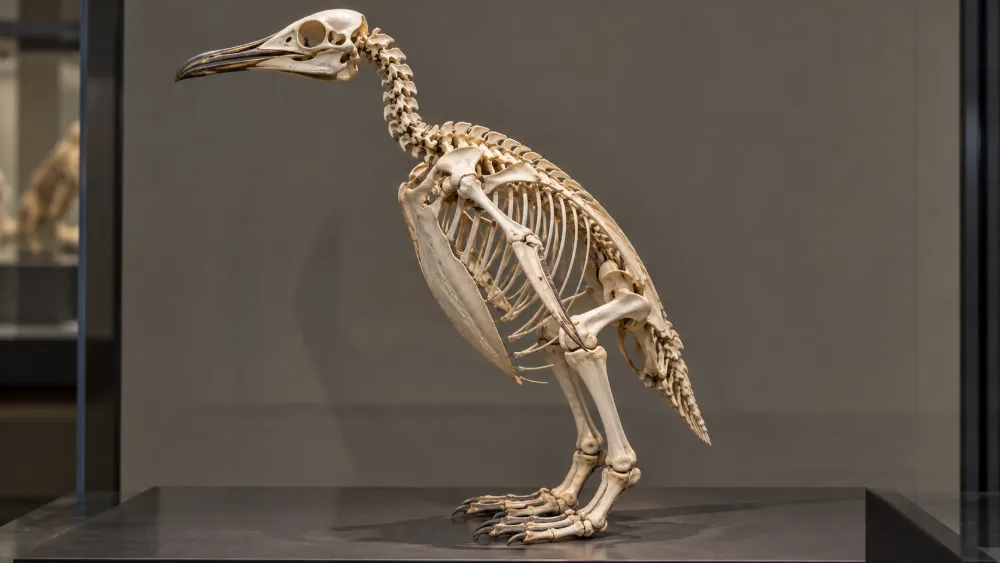
A penguin skeleton reveals the hidden femur and knee joint above the lower leg and foot.
Do Penguin Knees Bend Backward?
No. Penguin knees do not bend backward in the way people sometimes imagine.
The apparent backward-bending joint visible near a bird's foot is generally the ankle rather than the knee.
The actual knee is positioned higher and flexes in the same basic direction as the knee of other birds and mammals.
This misunderstanding is common because bird leg anatomy differs from the familiar appearance of human legs.
When watching a penguin walk, most of the upper leg is hidden beneath the body.
The visible lower portion therefore creates the illusion of an unusual backward knee.
Examining a complete penguin skeleton helps clarify the difference between the knee and ankle joints.
Why Do Penguins Have Such Short Legs?
Penguins have relatively short visible legs because their bodies are strongly adapted for swimming and diving.
Long, exposed legs would alter the streamlined shape that helps penguins move through water.
Instead, much of the upper leg remains enclosed within the body's overall contour.
The feet are positioned toward the rear of the body, where they can contribute to steering and maneuvering during swimming.
This arrangement provides several advantages in water:
It helps maintain a streamlined body profile.
It reduces unnecessary external projections.
It allows the feet to assist with underwater steering.
It supports coordinated movement between the legs, feet, and body.
However, the same anatomical arrangement creates challenges for walking on land.
Penguins compensate with their distinctive upright posture and waddling movements.
Why Do Penguins Waddle When They Walk?
Penguins waddle because of their short effective leg length, body proportions, upright posture, and the mechanics of walking.
During each step, a penguin shifts its body from side to side as it transfers weight between its feet.
This produces the characteristic rocking motion associated with penguin walking.
For many animals, excessive side-to-side movement would be considered inefficient. However, penguins use this movement in a way that can recover and transfer mechanical energy during walking.
A study published in Nature found that penguin waddling is not simply wasted movement.
The researchers concluded that the side-to-side motion can conserve mechanical energy, even though penguin walking remains metabolically expensive compared with locomotion in many similarly sized terrestrial animals.
Penguins are therefore not waddling because they lack knees.
Their gait reflects the challenges of moving a body specialized for swimming across solid ground.
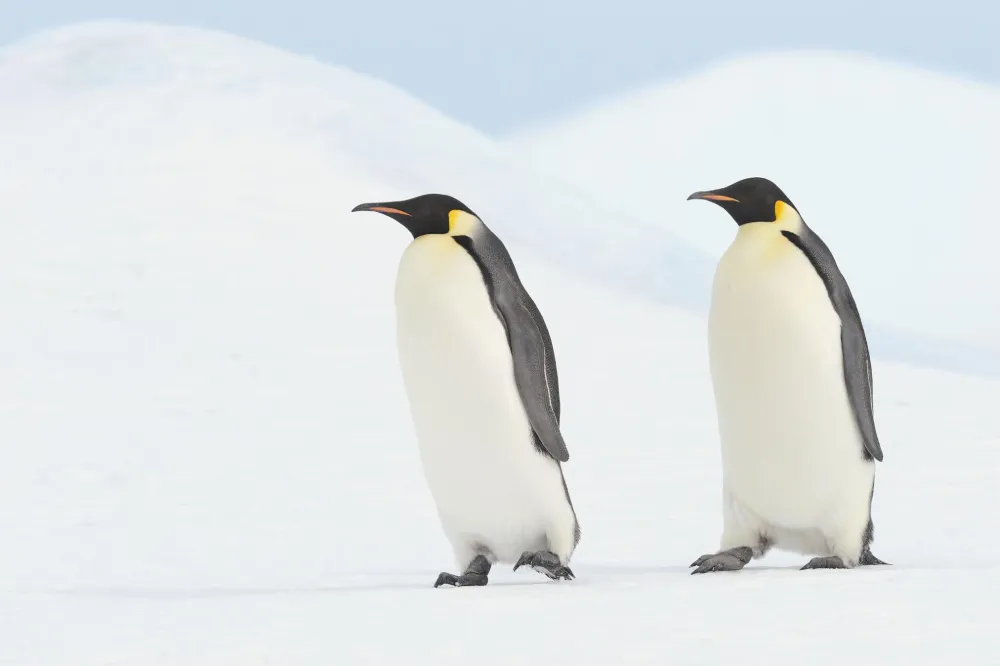
A penguin's side-to-side walking motion helps it maintain balance while moving on short, rear-positioned legs.
Is Penguin Waddling an Efficient Way to Walk?
Penguin walking is relatively costly in metabolic energy, but waddling itself offers mechanical advantages.
Research published in Science in 1977 found that penguins expend relatively high amounts of energy when walking compared with many similarly sized animals.
Later work published in Nature in 2000 demonstrated that the waddling motion can help conserve mechanical energy.
These findings are not contradictory.
Penguins may benefit from the mechanics of waddling while still experiencing high overall energy costs because of their short legs and the muscular demands of walking.
A separate study of penguin gait stability found that their step-width control can be remarkably consistent.
Thus, the familiar penguin waddle represents a specialized walking strategy rather than evidence of poor coordination.
Do All Penguins Have Knees?
Yes. All living penguin species possess knee joints.
Penguins belong to the bird family Spheniscidae, and their hindlimb anatomy follows the basic skeletal organization of other birds.
Although penguin species vary greatly in size and body proportions, they all retain the essential bones and joints required for walking and swimming.
Examples include:
Emperor penguins: Large penguins with substantial body mass and concealed upper legs.
King penguins: Tall, streamlined birds with specialized walking and diving adaptations.
Adelie penguins: Smaller Antarctic penguins that walk and frequently slide on their bellies.
African penguins: Temperate-climate penguins with the same fundamental knee anatomy.
Little penguins: The smallest living penguins, which also possess complete leg joints.
The external appearance of their legs may differ, but the presence of knees does not.
Do Penguins Have Kneecaps?
Penguins have specialized structures associated with the knee joint, including patellar anatomy.
The patella, commonly called the kneecap, is associated with the tendons and muscles acting around the knee.
Its shape and degree of development can vary among birds.
In penguins, the knee region forms part of a specialized locomotor system that must function during walking and other movements.
It is important not to assume that every bird has a kneecap identical in shape and proportions to the human patella.
Comparative anatomical studies are useful for understanding these differences.
Can Penguins Bend Their Knees?
Yes. Penguins can flex and extend their knee joints.
Their knees are functional components of the hindlimbs, contributing to posture and movement.
However, the range of motion and the mechanical role of the knee differ from those of a human walking upright.
Penguins maintain a characteristically bent-leg posture, with much of the upper leg concealed inside the body outline.
Their walking movements involve coordinated action at several joints, including the hips, knees, and ankles.
These movements are not always obvious when watching a living penguin because feathers conceal much of the underlying anatomy.
Do Penguins Have Ankles?
Yes. Penguins have ankle joints as well as knees.
The ankle plays an important role in how their feet move and contact the ground.
Like other birds, penguins have specialized lower-leg and foot bones formed through evolutionary fusion of several skeletal elements.
The tarsometatarsus, for example, is formed from fused elements associated with the ankle and foot.
This differs from the arrangement of the human foot and ankle.
Understanding these skeletal differences helps explain why the lower portion of a penguin's leg looks unusual.
Are Penguin Legs Longer Than They Look?
Yes. Penguin legs are longer than the small exposed sections suggest.
The thighbones and knee joints are largely concealed by the surrounding body tissues and dense feathers.
When the skeleton is examined without the external soft tissues, the full length and arrangement of the leg bones become apparent.
However, this does not mean penguins have extremely long legs relative to their bodies.
Their limbs remain specialized for their distinctive swimming and walking mechanics.
The important distinction is between the complete anatomical leg and the portion visible outside the body.
How Do Penguin Legs Help Them Swim?
Penguins use their flipper-like wings to generate most of their underwater propulsion.
Their legs and webbed feet contribute mainly to steering, stability, and maneuvering.
The rearward position of the feet helps penguins control their direction while swimming.
Although penguins cannot fly in the air, their powerful flippers move through water using motions that resemble underwater flight.
Their streamlined bodies, dense bones, strong swimming muscles, and specialized limbs help them pursue prey underwater.
Thus, penguin legs are part of a broader anatomical system adapted primarily for marine life.
Penguin Legs vs. Human Legs
| Feature | Penguins | Humans |
|---|---|---|
| Knee joints | Present | Present |
| Visible upper legs | Mostly concealed | Clearly visible |
| Typical leg posture | Strongly flexed | More extended when standing |
| Walking motion | Characteristic waddling | Alternating bipedal gait |
| Feet | Webbed and adapted for aquatic movement | Adapted for terrestrial walking |
| Main locomotor specialization | Swimming and diving | Walking and running |
Both humans and penguins are bipedal vertebrates, but their leg structures and locomotor strategies reflect very different evolutionary histories.
Do Other Birds Have Hidden Knees?
Yes. Many birds have knees that are less visible than people expect.
In birds such as chickens, ducks, and flamingos, the actual knee is positioned higher than the backward-bending joint commonly seen on the lower leg.
The prominent backward bend is usually the ankle region.
Penguins make this anatomical arrangement particularly noticeable because of their rounded bodies and short exposed legs.
However, the basic organization of the hindlimb is a general characteristic of birds rather than an adaptation unique to penguins.
Frequently Asked Questions
Do penguins really have knees?
Yes. Penguins have knee joints like other birds, but their knees are mostly concealed beneath feathers and surrounding body tissues.
Why can't you see penguin knees?
The knees are positioned high on the body, where the upper legs are hidden within the bird's external body outline.
Do penguins have legs or just feet?
Penguins have complete legs, including thighbones, knees, lower-leg bones, ankles, and feet.
Do penguin knees bend backward?
No. The visible backward-looking bend near the foot is generally the ankle. The actual knee sits higher and bends in the usual anatomical direction.
Do emperor penguins have knees?
Yes. Emperor penguins have the same basic knee and leg structures as other penguin species.
Do penguins have ankles?
Yes. Penguins possess ankle joints and specialized fused bones in their lower legs and feet.
Do penguins have kneecaps?
Penguins have patellar structures associated with their knee anatomy, although these differ in some respects from the human kneecap.
Why do penguins waddle instead of walking normally?
Their short effective leg length, upright bodies, and specialized limb mechanics produce a side-to-side gait that helps them maintain balance.
Can penguins walk without waddling?
Penguins can vary their walking speed and movement patterns, but side-to-side body motion remains characteristic of their terrestrial gait.
The Bottom Line
Penguins definitely have knees. Their thighbones and knee joints are hidden high within their feather-covered body outlines, making their legs appear much shorter than they really are.
The joints visible near their feet are primarily associated with the ankles, not backward-bending knees. Their distinctive waddling gait is a consequence of a body specialized for efficient swimming and diving.
Far from being anatomically incomplete, penguins possess highly specialized legs that allow them to move between the demands of land and ocean life.
Sources & Further Reading
The following conservation organizations and scientific publications provide information about penguin knee anatomy, skeletal structure, and walking biomechanics.
Penguins International — Do Penguins Have Knees?. Explains the position of penguin knees, skeletal anatomy, and adaptations for swimming.
Smithsonian Institution — A Comparative Study of the Appendicular Musculature of Penguins. Detailed anatomical research on penguin limb muscles and skeletal structures.
Griffin and Kram (2000) — Penguin Waddling Is Not Wasteful. Research published in Nature examining mechanical energy conservation during penguin walking.
The Penguin Waddling Gait Pattern Has a More Consistent Step Width Than Step Length. Biomechanical study of penguin gait stability.