Sea otters sometimes hold hands, or more accurately paws, while resting on the ocean surface to help prevent themselves from drifting apart. However, this behavior is much less common in the wild than popular photographs and videos suggest. Sea otters often rest together in floating groups called rafts, using visual contact, sounds, body contact, and small swimming movements to stay close. They may also wrap themselves in kelp to reduce drifting. Paw-holding is real, but it is not something every sea otter does whenever it sleeps.
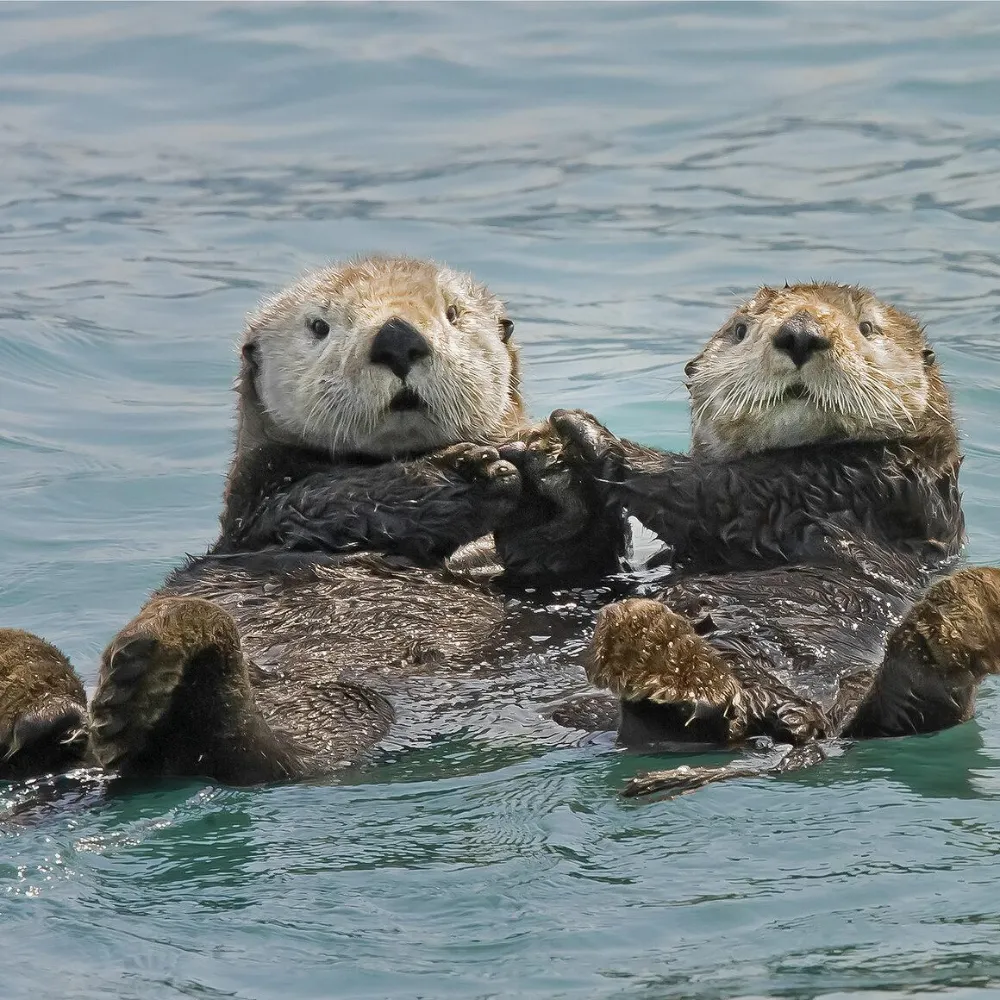
Sea otters sometimes make contact with each other's paws while resting, although this is not their most common method of staying together.
Why Do Sea Otters Hold Hands While Sleeping?
Sea otters can hold one another's paws while resting at the surface, helping them maintain physical contact as the water moves beneath them.
Unlike many terrestrial mammals, sea otters frequently rest while floating on their backs.
Because ocean currents, wind, and waves can move floating animals, maintaining contact with another otter may help reduce separation.
The Seattle Aquarium confirms that wild sea otters sometimes engage in paw-holding behavior while sleeping. However, its animal experts also explain that the behavior is relatively uncommon in large wild groups.
Other methods of staying together are often more important.
For example, sea otters can:
Monitor the location of nearby otters.
Respond to sounds produced by other individuals.
Maintain occasional body contact.
Use their hind flippers and tails to adjust their positions.
Rest within the same protected coastal area.
Therefore, paw-holding should be understood as one possible social resting behavior rather than a universal survival technique.
Do All Sea Otters Hold Hands?
No. Not all sea otters hold hands, and many wild individuals may rarely or never display this behavior.
Some of the widely circulated images of otters holding paws come from animals living in aquariums.
These images show genuine behavior, but they do not establish how frequently the same behavior occurs throughout wild populations.
According to the Seattle Aquarium, paw-holding may be a learned behavior associated with particular individuals.
It is possible for some otters to find physical contact reassuring, but researchers cannot simply assume that the animals experience human-like affection whenever they touch paws.
Wild sea otters have diverse social relationships and resting habits that vary with age, sex, location, and environmental conditions.
What Is a Raft of Sea Otters?
A group of sea otters resting together on the water is called a raft.
Rafts can include only a few animals or much larger gatherings.
Sea otters sometimes form separate male and female groups, and females may rest with dependent pups.
Grouping can help otters remain in suitable resting habitats while maintaining awareness of nearby animals.
Large rafts often occur in protected coastal waters, including kelp forests, sheltered bays, and estuaries.
In 2023, NOAA documented unusually large sea otter rafts around Monterey, California. Some estimates exceeded 200 otters in the largest gatherings.
However, the size and composition of a raft are not fixed. Groups can change as individuals leave to forage or return to rest.
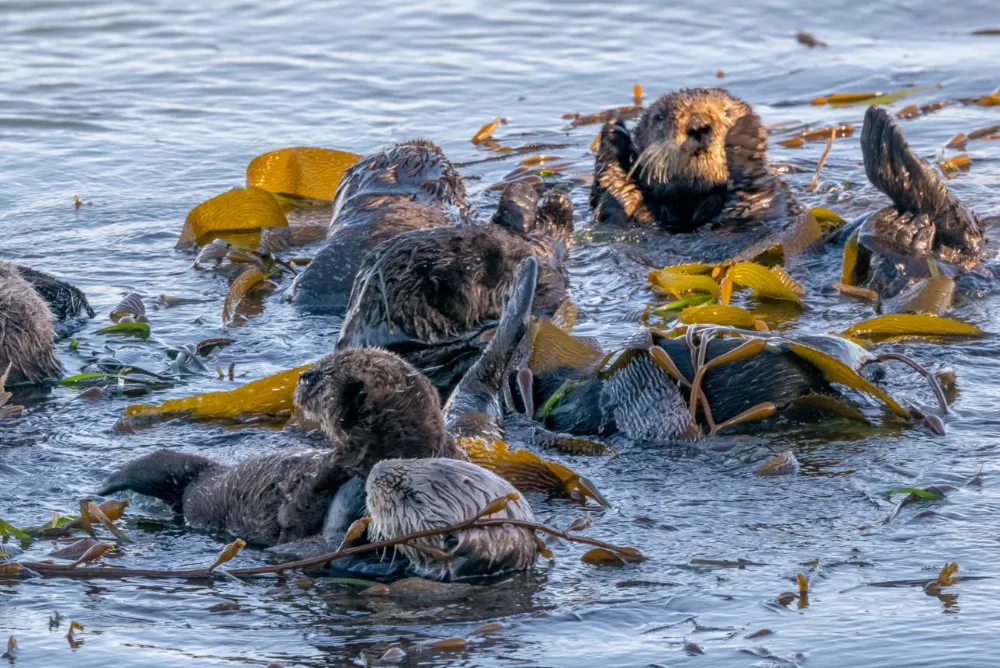
A raft is a group of sea otters resting together, sometimes among floating kelp in sheltered coastal waters.
How Do Sea Otters Sleep Without Drifting Away?
Sea otters use several behaviors to remain in suitable locations while resting on the water.
One important method is resting within kelp beds.
Sea otters may wrap kelp or other seaweed around their bodies to help anchor themselves and reduce drifting.
They can also rest close to other otters and adjust their position using their tails and hind flippers.
These behaviors are particularly valuable in marine environments where currents and waves continually move floating objects.
Not every sea otter uses kelp every time it rests. Availability of vegetation, local currents, and individual behavior influence the resting strategy.
Why Do Sea Otters Wrap Themselves in Kelp?
Sea otters sometimes wrap themselves in kelp to help remain in place while resting.
Giant kelp can form extensive floating canopies near the ocean surface. Its long, flexible fronds provide natural structures that otters can hold or become loosely entangled with.
By remaining among the kelp, an otter may reduce the risk of being carried away from its resting area by ordinary water movement.
Kelp forests also provide important feeding habitats.
Sea otters hunt animals such as sea urchins, crabs, clams, and other invertebrates in coastal ecosystems.
The relationship between sea otters and kelp forests extends beyond resting behavior. By consuming sea urchins, otters can help reduce grazing pressure on kelp in certain ecosystems.
This makes sea otters important predators whose presence can influence the structure of coastal marine communities.
Do Sea Otters Hold Hands Because They Love Each Other?
It is tempting to interpret paw-holding as a sign of romantic affection, but the scientific evidence does not support treating every instance as a human-like display of love.
Sea otters are social mammals that can maintain relationships with other individuals.
Physical contact may occur during resting, interaction, and care of young.
However, the motivations behind individual paw-holding events are not always known.
In some cases, maintaining contact may be the most straightforward explanation.
In others, learned behavior or the presence of familiar companions may contribute.
Understanding animal behavior requires distinguishing observable actions from interpretations of internal emotions.
The behavior can still be fascinating without assuming it has exactly the same meaning as holding hands in humans.
Do Baby Sea Otters Hold Hands With Their Mothers?
Sea otter mothers and their pups maintain close physical contact, particularly during early development.
A mother frequently carries her young pup on her chest while floating on her back.
Very young sea otter pups have exceptionally buoyant fur and are initially unable to dive effectively.
While the mother searches for food, she may leave the pup floating at the surface in a relatively safe location.
Mothers also groom, nurse, carry, and protect their offspring.
Although mothers and pups may touch or grasp one another, maternal care is much more complex than the popular description of sea otters simply holding hands while sleeping.
Monterey Bay Aquarium has documented extensive maternal care and has developed a specialized program for rehabilitating orphaned sea otter pups.
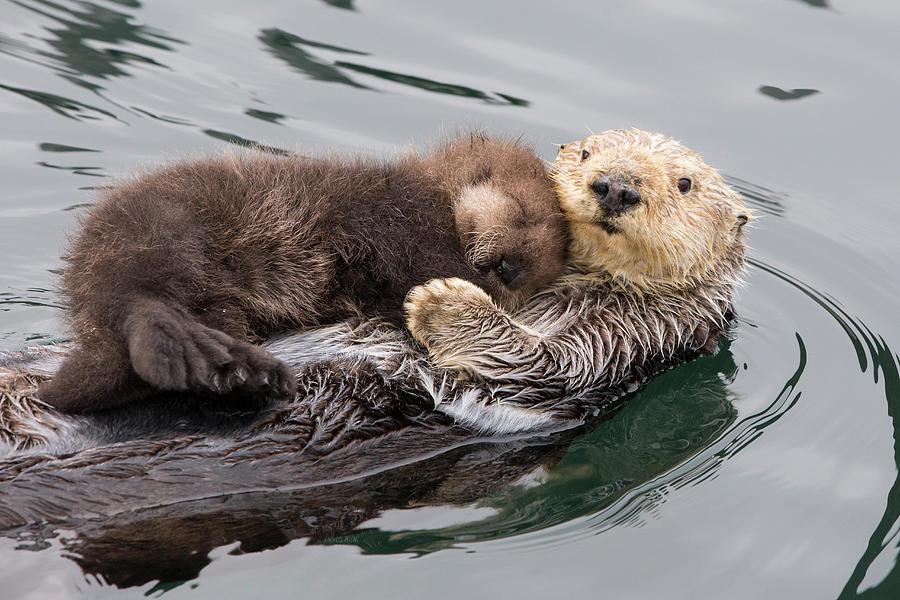
Sea otter mothers carry and groom their pups while floating, providing essential care during early development.
Do Sea Otters Sleep in the Water?
Yes. Sea otters commonly sleep and rest while floating on their backs at the ocean surface.
Their exceptionally dense fur traps air and helps provide insulation and buoyancy.
Unlike seals and sea lions, sea otters do not depend on a thick insulating layer of blubber.
Instead, they rely heavily on their fur and a high metabolic rate to maintain body temperature in cold coastal waters.
While resting, an otter may hold its paws or hind flippers above the water to reduce heat loss.
Sea otters spend much of their lives in the water, although the amount of time spent resting, feeding, grooming, or moving varies among individuals and conditions.
Do Sea Otters Sleep on Land?
Sea otters can sometimes haul out onto land, rocks, or other suitable surfaces to rest.
However, floating at the ocean surface is a common resting behavior, particularly in coastal habitats with protected waters.
Resting patterns can differ among populations and locations.
River otters, which are related to sea otters, are generally more accustomed to using terrestrial resting places.
Therefore, descriptions of sea otters sleeping on their backs in the ocean should not automatically be applied to every otter species.
Do River Otters Hold Hands?
The widely known paw-holding behavior is associated primarily with sea otters, not river otters.
River otters spend substantial time on land and commonly rest in dens or other sheltered locations.
Because they do not normally sleep in large floating ocean rafts, they do not face the same need to maintain contact while drifting on the water.
River otters can interact physically with one another, but this should not be confused with the characteristic images of sea otters linking paws while floating.
How Do Sea Otters Stay Warm While Sleeping?
Sea otters have extremely dense fur that helps trap air close to their skin.
This trapped air provides insulation, reducing heat loss in cold marine environments.
Sea otters spend considerable time grooming to maintain the insulating properties of their coats.
They also have high metabolic demands and consume substantial quantities of food relative to their body weight.
While resting, otters may keep parts of their bodies, including their hind flippers and paws, out of the water.
Sea otters depend on a combination of insulation, behavior, and energy intake to remain warm.
Sea Otters vs. River Otters: Resting Behavior
| Feature | Sea Otters | River Otters |
|---|---|---|
| Typical resting habitat | Ocean surface and sometimes land | Land-based shelters and other sites |
| Sleeping while floating | Common | Not their usual resting pattern |
| Floating groups called rafts | Yes | Not characteristic |
| Occasional paw-holding | Documented | Not a characteristic documented resting behavior |
| Use of kelp while resting | Documented | Not typical |
| Maternal care | Yes | Yes |
These differences reflect the distinct environments and lifestyles of marine and freshwater otters.
Are Sea Otters Social Animals?
Sea otters have a complex social system and frequently interact with other individuals.
Some sea otters spend time in groups, particularly while resting.
However, they do not necessarily hunt or travel together as a tightly coordinated social unit.
Many individuals forage independently and maintain their own feeding preferences.
Male and female sea otters may occupy different social groups outside mating interactions.
Mothers form especially important relationships with dependent pups.
Sea otter social behavior varies across populations and habitats, so a large raft should not automatically be viewed as a permanent family group.
Why Are Sea Otters Important to Kelp Forests?
Sea otters can play an important role in maintaining the ecological balance of coastal kelp forests.
In some ecosystems, sea urchins graze heavily on kelp.
By feeding on sea urchins, sea otters may reduce grazing pressure and help kelp forests remain healthy.
Healthy kelp forests provide habitat and food-web support for many other marine organisms.
This ecological relationship is one reason sea otters are often described as a keystone species.
However, their effects depend on local ecological conditions, prey communities, and the presence of other predators.
Frequently Asked Questions
Do sea otters really hold hands?
Yes. Sea otters sometimes hold each other's paws while resting, but this behavior is not as common in the wild as popular videos may suggest.
Why do otters hold hands in the water?
Maintaining paw contact can help sea otters stay together while floating. Other methods, including body contact and swimming adjustments, are also important.
What is a group of sea otters called?
A group of sea otters resting together on the water is called a raft.
Do sea otters hold hands every night?
No. There is no evidence that all sea otters routinely hold hands every night. The behavior varies among individuals.
Why do sea otters wrap themselves in seaweed?
Sea otters may use kelp or other seaweed to help anchor themselves while resting so they are less likely to drift away.
Do sea otters sleep together?
Yes. Sea otters can rest in groups called rafts, although group size and composition vary.
Do mother otters hold their babies?
Yes. Sea otter mothers frequently carry young pups on their chests and provide grooming, nursing, and protection.
Do otters hold hands because they are in love?
There is no scientific basis for assuming that every paw-holding interaction represents romantic love. Maintaining contact and individual social behavior are more cautious explanations.
The Bottom Line
Sea otters sometimes hold hands while resting, but the behavior is not universal. Wild otters often stay together through visual awareness, vocalizations, casual contact, and swimming adjustments.
They may also wrap themselves in kelp or gather in floating rafts. These adaptations allow sea otters to rest in coastal waters while maintaining contact with their surroundings and other animals.
The famous paw-holding behavior is real, but the complete story is more interesting than the popular myth.
Sources & Further Reading
The following aquarium, university, and government resources provide information about sea otter paw-holding, group resting, maternal care, and kelp forest ecology.
Seattle Aquarium — Sea Otter. Explains why some otters hold paws and why this behavior is relatively uncommon in large wild rafts.
Monterey Bay Aquarium — Sea Otter. Covers sea otter behavior, resting, feeding, fur insulation, and marine ecology.
UC Davis Wildlife Health Center — Sea Otter Facts. Describes sea otter rafts, floating rest, kelp use, and biological adaptations.
NOAA National Marine Sanctuary — Sea Otter Viewing Etiquette and Protection. Documents large sea otter rafts and responsible wildlife viewing in Monterey Bay.