Yes, some crabs can breathe out of water, but their survival depends on the species and environmental conditions. Most aquatic crabs breathe through gills that absorb dissolved oxygen from water. Many shore crabs can also obtain oxygen from air for a limited time, provided their respiratory surfaces remain moist. Land crabs have more specialized adaptations, including lung-like structures that allow them to spend much of their lives on land. However, not every crab can survive prolonged exposure to air, and some highly terrestrial crabs may struggle or even drown if submerged for too long.
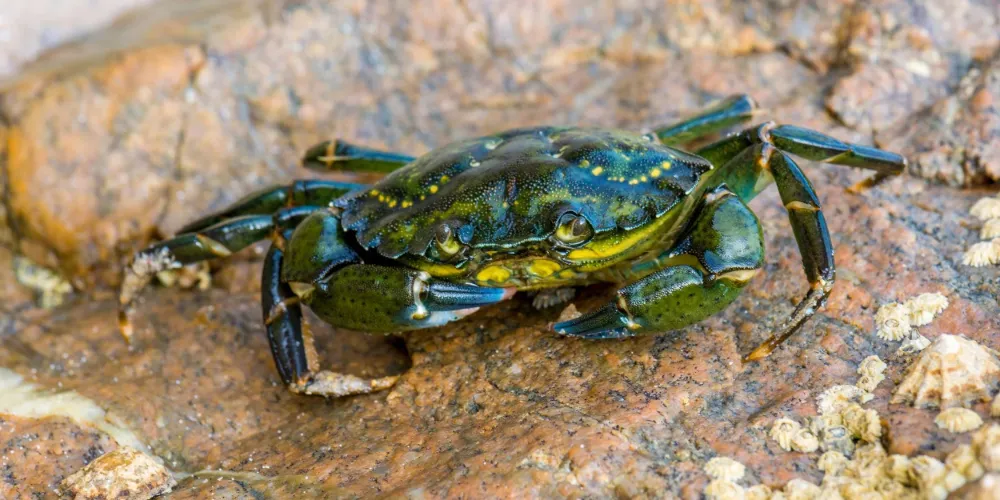
Shore crabs regularly encounter both water and air as tides rise and fall along rocky coastlines.
How Do Crabs Breathe?
Most crabs breathe using specialized respiratory organs called gills.
These gills are typically located inside protected chambers beneath the crab's hard outer shell, or carapace.
In aquatic crabs, water flows across the gill surfaces. Dissolved oxygen moves from the water into the crab's circulating fluid, called hemolymph, while carbon dioxide moves in the opposite direction.
Many crabs use specialized mouthpart structures called scaphognathites to help move water through their gill chambers.
These structures act as small pumps, maintaining a flow of water over the respiratory surfaces.
Unlike humans, crabs do not normally use hemoglobin inside red blood cells to transport oxygen. Many species use a copper-containing respiratory protein called hemocyanin, which is dissolved in their hemolymph.
However, the precise respiratory system varies among aquatic, amphibious, and terrestrial crabs.
Can Crabs Really Breathe Air?
Yes. Several crab species can obtain oxygen from the air.
For many shore-dwelling crabs, this ability depends on keeping their gills moist enough to function outside water.
When gills dry out, their ability to exchange respiratory gases decreases.
Some crabs retain water inside their gill chambers or use specialized structures to maintain suitable respiratory conditions during exposure to air.
Other species have developed additional respiratory surfaces that function more like lungs.
Air-breathing ability therefore varies considerably across the crab group.
How Do Crab Gills Work Outside Water?
Aquatic crab gills normally function while surrounded by water, but some species can continue exchanging gases during temporary exposure to air.
To function effectively, the respiratory surfaces must remain sufficiently moist and structurally supported.
In some shore crabs, water retained within the branchial chamber helps maintain the conditions needed for oxygen absorption.
However, exposure to air creates several challenges.
Drying: Moisture can evaporate from the respiratory surfaces.
Structural changes: Gill surfaces may lose effective contact area when they are no longer supported by water.
Temperature stress: Warm conditions can increase physiological demands and water loss.
Gas exchange limitations: Some aquatic crabs are poorly adapted to maintaining oxygen uptake in air.
Crabs that regularly experience low tides have evolved different ways of coping with these problems.
How Long Can Crabs Live Out of Water?
There is no single survival time that applies to all crabs.
Some primarily aquatic crabs tolerate only limited periods out of water, especially under hot or dry conditions.
Many intertidal species regularly remain exposed to air during low tide, while terrestrial species can spend extensive periods away from standing water.
Survival depends on several factors:
The species and its natural habitat
Air temperature and humidity
The condition of the gills or lung-like respiratory surfaces
Access to moisture and shelter
Body size and physiological condition
The duration of exposure
Consequently, claims that every crab can survive a fixed number of hours or days outside water are misleading.
A crab that tolerates an entire low-tide period in a shaded rock crevice may have very different survival prospects when exposed to direct sunlight on a hot, dry beach.
Can Shore Crabs Breathe Out of Water?
Yes. Many shore crabs are adapted to living in the intertidal zone, where seawater periodically covers and exposes the shoreline.
The European green crab (Carcinus maenas) is an example of a species commonly found in coastal environments that include shallow water, tidal pools, rocks, and sheltered shorelines.
Shore crabs may spend time beneath seaweed, between rocks, or in other damp locations during low tide.
Such habitats reduce exposure to drying conditions and can help crabs maintain respiratory function.
Scientific studies have documented physiological and behavioral adaptations that allow several intertidal crabs to tolerate air exposure.
However, individual species differ in how efficiently they obtain oxygen from air.
Do Land Crabs Have Lungs?
Some land crabs possess specialized respiratory surfaces that function as lungs.
These are not identical to human lungs. They are typically modified, highly vascularized surfaces associated with the crab's branchial chambers.
In strongly terrestrial species, these lung-like structures can become especially important for oxygen uptake from the atmosphere.
Some land crabs retain gills as well, but their relative importance for respiration may change as terrestrial adaptations become more developed.
The Christmas Island red crab (Gecarcoidea natalis) is an example of a terrestrial crab with specialized air-breathing adaptations.
Researchers studying land-crab physiology have documented changes in respiratory structures, circulation, and gas exchange that support life on land.
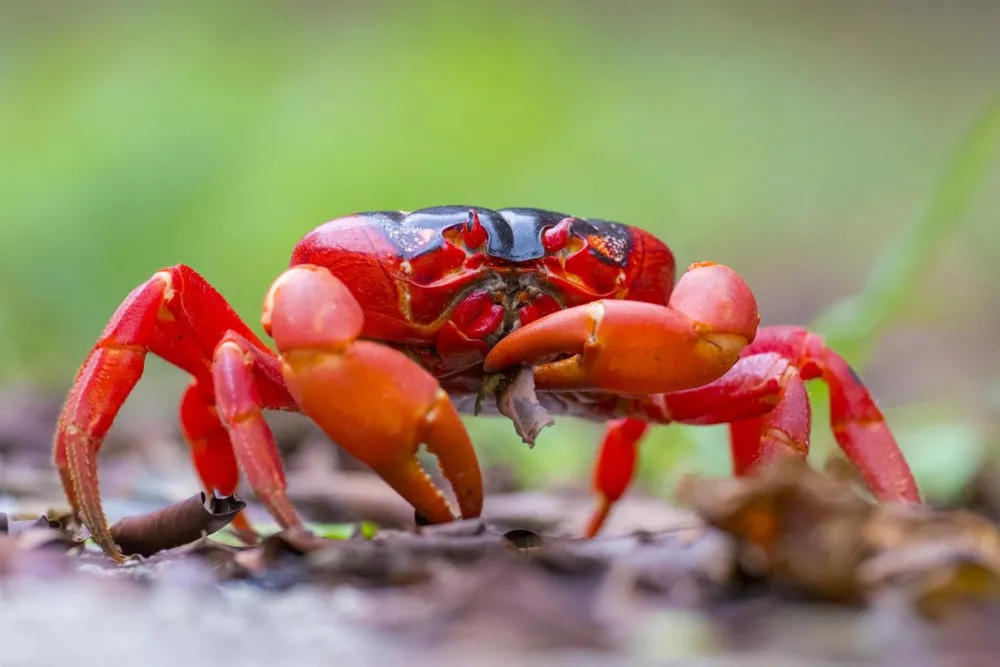
Christmas Island red crabs are highly adapted to terrestrial life and spend much of their time on the rainforest floor.
Can Land Crabs Drown in Water?
Yes. Some highly terrestrial crabs can drown if they remain submerged for too long.
This may seem surprising because crabs originally evolved from aquatic ancestors.
However, species that have become highly adapted to breathing air may no longer be efficient at obtaining enough oxygen while fully submerged.
Their respiratory structures and circulation may be better suited to atmospheric oxygen than to extracting oxygen from surrounding water.
Different land-crab species vary in their ability to tolerate immersion.
Therefore, it is incorrect to assume that every crab can survive equally well in water and on land.
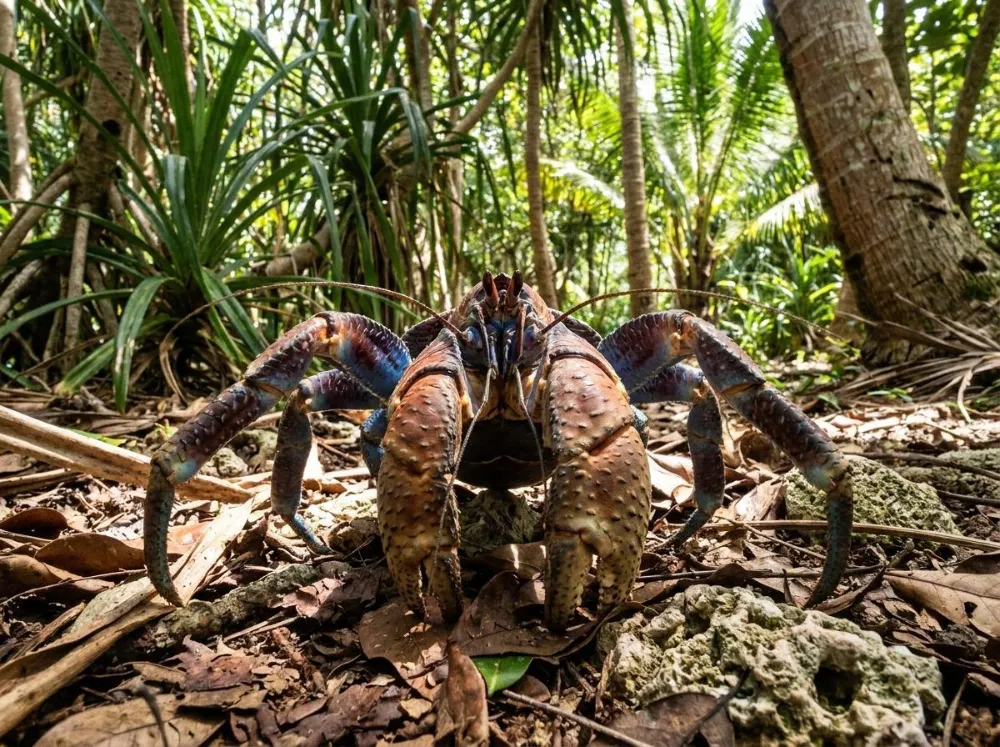
Can Coconut Crabs Breathe Underwater?
Adult coconut crabs (Birgus latro) are highly terrestrial and cannot breathe underwater effectively.
They possess specialized branchiostegal lungs that allow them to obtain oxygen from air.
Although coconut crabs belong to a lineage with aquatic ancestry, adults are not adapted to remaining submerged.
Prolonged immersion can cause drowning.
Their life cycle nevertheless retains a strong connection to the ocean.
Female coconut crabs release developing eggs into seawater, and the larvae spend part of their early development in the marine environment.
After further development, young individuals gradually transition toward life on land.
This distinction between larval and adult habitats illustrates how respiratory adaptations can change during an animal's life cycle.
Can Blue Crabs Breathe Out of Water?
Blue crabs (Callinectes sapidus) are primarily aquatic animals that breathe through gills.
They may tolerate temporary exposure to air, particularly when their gills remain moist and conditions are favorable.
However, blue crabs are not as specialized for terrestrial life as land crabs.
Research comparing aquatic, amphibious, and terrestrial crabs has demonstrated important differences in their ability to consume oxygen in air and water.
For blue crabs, prolonged exposure to hot, dry conditions can be harmful.
They should not be considered capable of living permanently on land.
Why Do Crabs Come Out of Water?
Crabs leave the water for several different reasons, depending on the species.
Common reasons include:
Foraging: Some crabs search for food on exposed shorelines.
Tidal movement: Intertidal habitats naturally become exposed during low tide.
Shelter: Crabs may move into rock crevices, burrows, or vegetation.
Reproduction: Some land crabs migrate between terrestrial habitats and the coast.
Environmental conditions: Certain crabs may move toward areas with more favorable temperature or oxygen availability.
Not every crab that emerges from water is searching for air.
Movement between water and land is often part of the animal's normal habitat use and behavior.
Do Crabs Need Water to Survive?
All crabs require water for normal physiological functions, but not every species needs to remain submerged.
Aquatic crabs depend heavily on water for respiration and other essential processes.
Terrestrial crabs require suitable moisture conditions to maintain body fluids and respiratory function.
Even species with highly developed air-breathing structures can become dehydrated when exposed to excessively dry environments.
Many land crabs therefore seek humid burrows, shaded vegetation, or other protected microhabitats.
Water requirements also vary during reproduction and development.
Some terrestrial crabs must return to coastal waters to release their larvae, while other species have different reproductive strategies.
Do Crabs Breathe Through Their Shells?
No. Crabs do not normally obtain oxygen directly through the hard outer surface of their shells.
The carapace primarily serves as a protective exoskeleton.
The respiratory organs are located in specialized spaces beneath or within the shell-covered body.
Water or air reaches the respiratory surfaces through openings and ventilation pathways.
Some species use movements of specialized mouthparts to circulate water or air within their branchial chambers.
Therefore, the shell protects the breathing apparatus, but it is not itself the main respiratory surface.
Crab Breathing: Aquatic vs. Shore vs. Land Crabs
| Crab Type | Main Respiratory Adaptation | Life Out of Water |
|---|---|---|
| Aquatic crabs | Gills adapted to water | Often limited |
| Intertidal shore crabs | Gills and species-specific air-exposure adaptations | Regular temporary exposure |
| Terrestrial crabs | Modified gills and/or lung-like surfaces | Extensive terrestrial activity |
| Adult coconut crabs | Specialized branchiostegal lungs | Primarily terrestrial |
This comparison summarizes broad patterns rather than strict rules for every species.
What Happens When a Crab's Gills Dry Out?
When the respiratory surfaces of a crab dry out, gas exchange becomes less effective.
Water is important for maintaining the conditions needed for many gills to function properly.
As moisture is lost, oxygen uptake may decline and normal physiological processes can become disrupted.
Severe drying can cause stress, impaired movement, and eventually death.
Species adapted to terrestrial conditions often have structures and behaviors that reduce these risks.
However, even highly terrestrial crabs generally depend on suitable humidity or access to moisture.
Can Hermit Crabs Breathe Out of Water?
It depends on the kind of hermit crab.
Marine hermit crabs primarily rely on aquatic gills and are generally adapted to living in seawater.
Terrestrial hermit crabs have modified respiratory structures that allow them to breathe air, provided appropriate humidity is maintained.
These two groups should not be treated as having identical environmental requirements.
Keeping a marine hermit crab out of water or completely submerging a terrestrial hermit crab can be dangerous.
Species identification is essential when considering the care of any captive hermit crab.
Frequently Asked Questions
Can all crabs breathe out of water?
No. Some crabs are highly adapted to air exposure, while others are primarily aquatic and cannot tolerate prolonged periods out of water.
How long can a crab survive without water?
Survival varies by species and environmental conditions. There is no reliable universal number of hours or days that applies to all crabs.
Do crabs have lungs or gills?
Most aquatic crabs breathe with gills. Some terrestrial species also possess specialized lung-like respiratory structures.
Can crabs breathe underwater?
Many aquatic crabs can breathe underwater using their gills. However, some highly terrestrial species are poorly adapted to prolonged submersion.
Can a crab drown?
Yes. A crab can drown if it cannot obtain enough oxygen in its environment. This can happen to highly terrestrial species during prolonged submersion.
Why do crabs blow bubbles?
In some crabs, bubbling or foaming around the mouth occurs when air and moisture are moved through the respiratory chambers. Its significance depends on the species and conditions.
Can crabs breathe on the beach?
Many shore crabs can breathe during temporary exposure on wet beaches or rocky shorelines, especially when their respiratory surfaces remain moist.
Do coconut crabs have gills?
Adult coconut crabs possess highly reduced gills and rely primarily on specialized branchiostegal lungs for air breathing.
The Bottom Line
Some crabs can breathe out of water, but their ability to do so varies considerably.
Aquatic crabs mainly rely on gills, shore crabs often tolerate temporary air exposure, and specialized land crabs have evolved structures that allow them to obtain oxygen from the atmosphere.
There is no universal survival time outside water. A crab's respiratory anatomy, habitat, temperature, humidity, and access to moisture all determine how successfully it can live on land.
Sources & Further Reading
The following museum resources and scientific publications explain crab respiration, gill function, and adaptations to terrestrial life.
Smithsonian National Museum of Natural History — Expedition to the Island of the Land Crabs. Educational discussion of aquatic gills and the lung-like structures of terrestrial crabs.
Smithsonian Ocean — A Green Crab's Super Power: Eating Through Its Gills. Explains the respiratory and additional physiological functions of crab gills.
Morris (2002) — The Ecophysiology of Air-Breathing in Crabs. Scientific review of terrestrial respiratory adaptations, including specialized lung-like structures.
O'Mahoney and Full (1984) — Respiration of Crabs in Air and Water. Comparative research involving terrestrial, amphibious, and aquatic crabs.