No, owls cannot move their eyes from side to side like humans can. Their unusually large, tube-shaped eyes are held in place by specialized structures within their skulls. Instead of rolling their eyes to look in different directions, owls turn their heads. Many owls can rotate their heads through an arc of approximately 270 degrees, allowing them to see much of their surroundings without moving their bodies. This remarkable adaptation helps compensate for their fixed eyes while preserving the excellent vision needed for hunting.
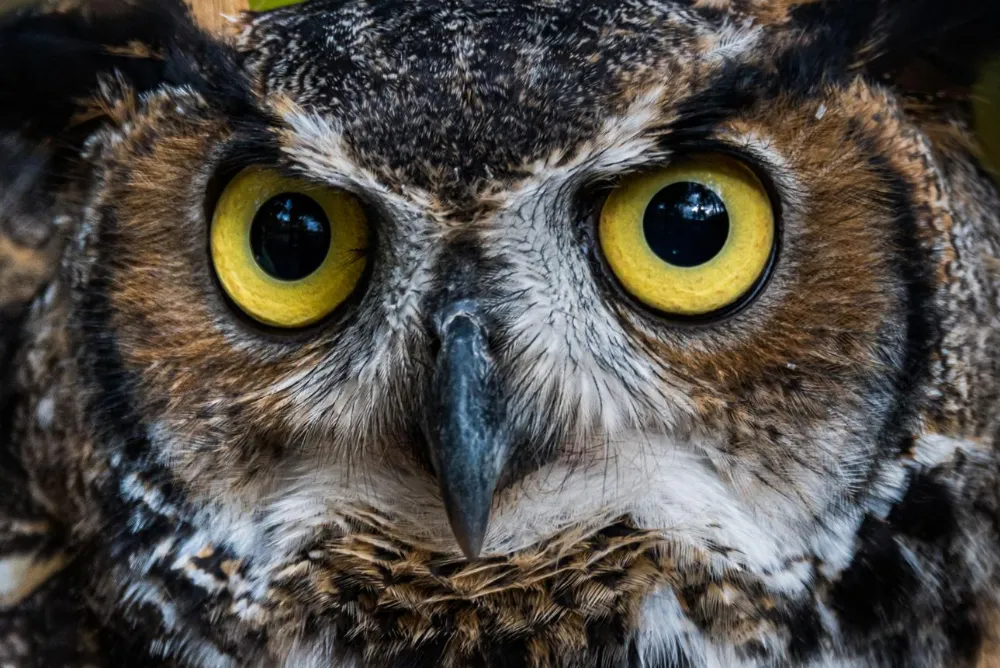
A great horned owl's large, forward-facing eyes provide excellent binocular vision but cannot rotate freely inside the skull.
Why Can't Owls Move Their Eyes?
Owls cannot move their eyes normally because their eyes are extremely large relative to their skulls and have an unusual tubular shape.
Human eyeballs are approximately spherical and can rotate within their sockets. This allows us to look left, right, up, and down without turning our heads.
Owl eyes are different. They extend deeply into the skull and are supported by rigid bony structures called sclerotic rings, also known as scleral ossicles.
These structures help stabilize the eyes, which are too large and elongated to move freely within their sockets.
Consequently, an owl must reposition its head to change where it is looking.
Although owls possess muscles associated with their eyes, these muscles are specialized largely for stabilizing the eyes and supporting other eye functions rather than producing the extensive eye movements seen in humans.
Are Owl Eyes Really Tubes Instead of Balls?
Yes. Owl eyes are often described as tubular because they are elongated rather than approximately spherical.
Their shape is one of the most important adaptations behind their excellent visual abilities.
Large eyes can collect substantial amounts of light, while the elongated optical structure helps produce a bright image on the retina.
This is especially useful for species that hunt in dim light.
The tubular shape has several important consequences:
Large light-gathering capacity: The eyes can capture more available light than smaller eyes.
Reduced eye movement: The eyes are held firmly within the skull.
Strong forward focus: Their position supports overlapping visual fields.
Dependence on head movement: Owls turn or tilt their heads to examine different areas.
Owl eyes are still functional vertebrate eyes with a cornea, lens, retina, iris, and other familiar structures. Describing them as tubes refers to their overall shape, not the absence of normal eye anatomy.
How Far Can Owls Turn Their Heads?
Owls can turn their heads through an arc of approximately 270 degrees, depending on the species and circumstances.
This means an owl can look behind itself by turning its head far beyond the normal range of human neck movement.
However, an owl cannot continuously rotate its head through a complete 360-degree circle.
The movement is possible because of specialized adaptations involving the neck vertebrae, muscles, blood vessels, and surrounding tissues.
Owls typically have 14 cervical vertebrae, compared with seven in humans. Their neck anatomy provides considerable flexibility while supporting the head.
Specialized vascular arrangements also help accommodate extreme head movements without disrupting the blood supply as easily as comparable movements might in humans.
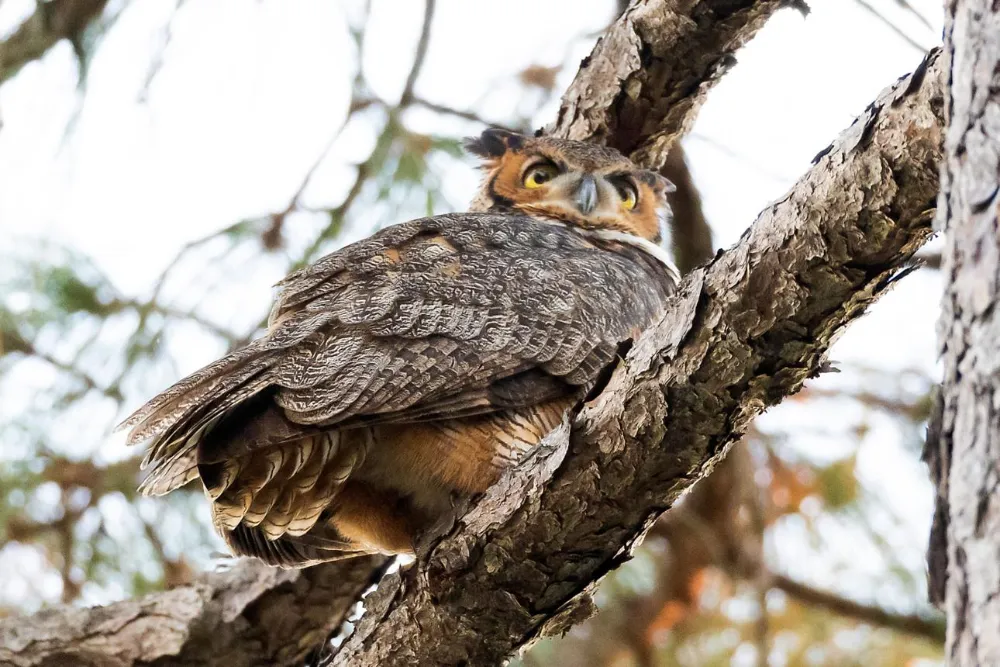
An owl can rotate its head dramatically to look behind itself without turning its entire body.
Why Do Owls Turn Their Heads So Much?
Owls turn their heads because their fixed eyes cannot independently scan their surroundings.
Head rotation allows an owl to redirect its visual field toward potential prey, predators, or other objects.
This is particularly valuable when hunting from a perch.
An owl can remain relatively still while adjusting the direction of its gaze, which may help it observe the environment without drawing unnecessary attention.
Head movements also contribute to evaluating the distance and position of nearby objects.
When an owl shifts its head slightly, objects at different distances appear to move relative to one another. This visual effect is called motion parallax.
Motion parallax provides information about depth and distance, complementing the owl's binocular vision.
Why Do Owls Bob Their Heads?
Owls sometimes move their heads from side to side, forward and backward, or in small circular motions.
This behavior can look amusing, but it serves important visual functions.
By changing the position of its head, an owl changes its viewing angle. Nearby objects shift across its visual field differently from distant objects.
These differences help the bird evaluate spatial relationships.
Head bobbing can be especially noticeable in young owls as they explore their surroundings and develop hunting skills.
However, not every head movement is specifically for judging distance. Owls also move their heads while listening, tracking movement, and responding to environmental disturbances.
Can Owls See Behind Them?
Yes. Owls can see what is behind them by turning their heads.
Their eyes themselves remain directed forward relative to the skull. It is the rotation of the head that changes where those eyes point.
For example, an owl perched facing one direction may rotate its head far enough to inspect an area almost directly behind its body.
This does not mean an owl has a permanent 360-degree field of vision.
It means the bird can scan a very wide area by combining normal forward-facing vision with extraordinary neck flexibility.
Do Owls Have Better Vision Than Humans?
Owls have exceptional visual adaptations, particularly for detecting objects in low-light conditions.
However, whether an owl has "better" vision depends on what aspect of vision is being compared.
Many nocturnal owls have large eyes and retinas containing numerous rod photoreceptors, which are specialized for detecting light under dim conditions.
Humans have relatively strong color vision and excellent daytime visual detail, while many owls are particularly well adapted for finding prey during twilight or at night.
| Visual Feature | Owls | Humans |
|---|---|---|
| Eye shape | Elongated and tubular | Approximately spherical |
| Eye movement | Extremely limited | Extensive |
| Head rotation | Up to about 270 degrees | Much more limited |
| Binocular vision | Well developed | Well developed |
| Low-light adaptation | Highly developed in many species | More limited |
| Color vision | Varies; often less developed | Well developed |
Both humans and owls have sophisticated visual systems, but they are adapted to different environments and activities.
Can Owls See in Complete Darkness?
No. Owls cannot see through ordinary vision when absolutely no light is available.
Even highly sensitive eyes require some light to produce visual information.
Owls are excellent at using faint moonlight, starlight, or other available illumination.
They also rely on their hearing to locate prey, especially under conditions where visual information is limited.
Some owl species have asymmetrically positioned ear openings that help them determine the direction and elevation of sounds.
Therefore, an owl's success as a nighttime hunter depends on a combination of vision, hearing, silent flight, and hunting behavior.
Do All Owls Have Yellow Eyes?
No. Owl eye color varies among species.
Some owls have bright yellow eyes, while others have orange, dark brown, or nearly black-looking irises.
Examples include:
Great horned owl: Typically has bright yellow eyes.
Eurasian eagle-owl: Commonly has vivid orange eyes.
Barn owl: Has dark brown eyes that often appear black.
Barred owl: Usually has dark brown eyes.
Snowy owl: Has conspicuous yellow eyes.
Eye color is useful for identifying certain species, but it should not be treated as a completely reliable indicator of hunting time or behavior.
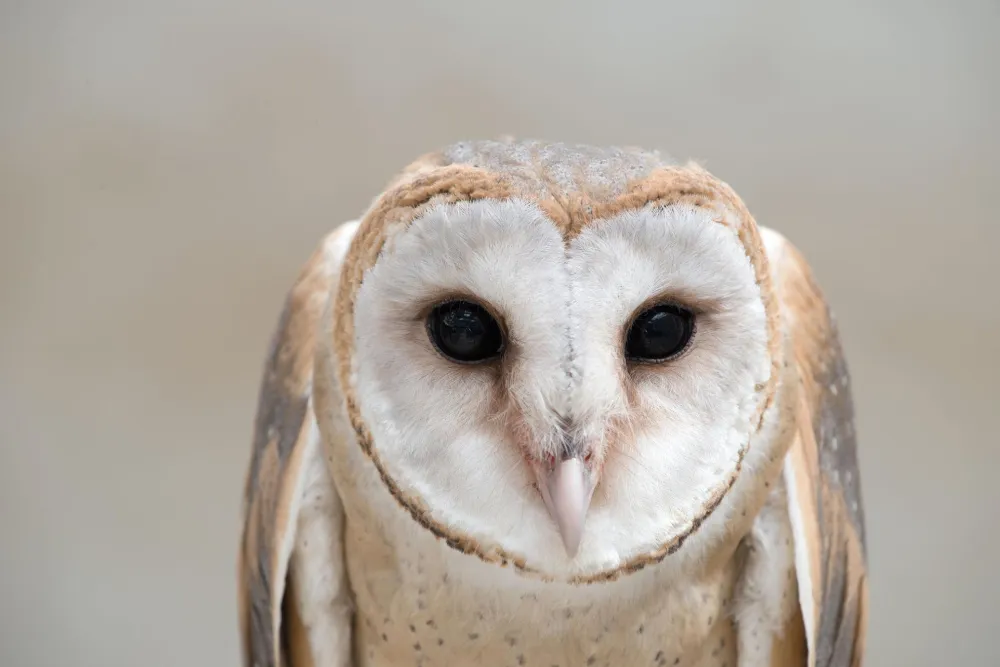
Barn owls have dark eyes and distinctive heart-shaped facial discs, showing how owl appearance varies among species.
Can Owls Blink Their Eyes?
Yes. Although owls cannot rotate their eyes normally, they can blink.
Owls possess upper and lower eyelids as well as a transparent or translucent third eyelid called the nictitating membrane.
The nictitating membrane moves across the surface of the eye and helps protect and clean it.
It can also help maintain moisture on the eye's surface.
The inability to move the eyeballs should not be confused with an inability to move the eyelids.
Can Owls Move Their Eyes Up and Down?
Owls cannot significantly move their eyeballs vertically or horizontally within their sockets.
To look toward something above or below them, they usually tilt or reposition their heads.
However, their pupils can still respond to changes in light.
Changing pupil size is different from rotating the eyeball, and the two functions should not be confused.
Are Owl Eyes Bigger Than Human Eyes?
Some large owl species have eyes approaching the size of human eyes, despite having much smaller heads and bodies.
Relative to their skulls, owl eyes are exceptionally large.
The exact dimensions depend on the species.
It would therefore be misleading to claim that every owl has eyes larger than those of a human.
The important biological point is that owl eyes occupy an unusually large proportion of the head and provide strong light-gathering ability.
Frequently Asked Questions
Can owls roll their eyes?
No. Owls cannot roll their eyes like humans. Their eyes are largely fixed within the skull, so they move their heads instead.
Can an owl turn its head 360 degrees?
No. Owls can rotate their heads through an arc of approximately 270 degrees, but they cannot continuously spin their heads through a complete circle.
Why are owl eyes fixed?
Owl eyes are large, elongated, and supported by specialized bony structures. This arrangement makes substantial eye movement impossible while supporting their visual adaptations.
Do owls have eyeballs?
Yes. Owls have eyes with the usual major vertebrate eye structures, but their eyeballs are elongated and tube-shaped rather than approximately spherical.
Can baby owls move their eyes?
Young owls also have extremely limited eyeball movement. Like adults, they depend on head movements to change the direction of their gaze.
Do owls have peripheral vision?
Yes, but their forward-facing eyes emphasize overlapping binocular fields. They use head movement to expand the area they can inspect.
Can owls see during the day?
Yes. Owls are not blind in daylight. Some owl species are regularly active during the day, while many others hunt primarily at dusk or night.
Why do owls stare at people?
An owl may appear to stare because its eyes are fixed and directed forward. The behavior may reflect observation, curiosity, vigilance, or attention to movement rather than a single specific emotion.
The Bottom Line
Owls cannot move their eyes freely because their unusually large, tubular eyes are held firmly within their skulls. Instead, they rely on remarkable head and neck mobility to look around.
With the ability to rotate their heads through approximately 270 degrees, owls can observe a wide area while keeping their bodies relatively still. Combined with powerful low-light vision, binocular depth perception, and sensitive hearing, this adaptation makes them exceptionally effective hunters.
Scientific information reference:
- British Trust for Ornithology — Owl Vision
- Audubon — Why Do Owls Bob Their Heads?
- PubMed — Extraocular Muscle Architecture in Hawks and Owls