No, jellyfish do not have brains, but they do have nervous systems. Instead of a centralized brain like those found in humans, fish, and many other animals, jellyfish possess networks of nerve cells distributed throughout their bodies. These nerve networks help them sense their surroundings, coordinate swimming movements, capture prey, and respond to environmental changes. Some jellyfish even have sophisticated eyes, and scientific research has shown that certain species can enter a sleep-like state despite having no brain.
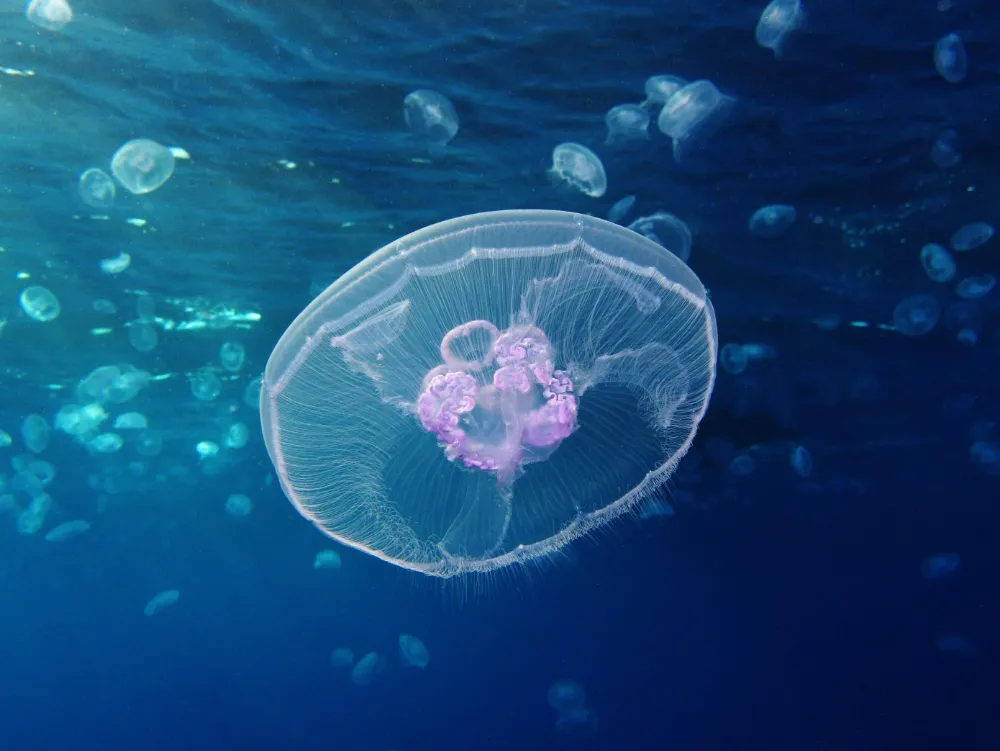
Jellyfish have no centralized brain, but their distributed nervous systems coordinate movement and responses to the environment.
Why Don't Jellyfish Have Brains?
Jellyfish have a very different body organization from vertebrates such as fish, birds, and mammals.
They belong to the phylum Cnidaria, an ancient animal group that also includes corals and sea anemones.
Instead of concentrating most of their nerve cells into a single central organ, jellyfish possess neurons distributed through their bodies.
This arrangement is often called a nerve net.
A nerve net allows signals to travel between different parts of the animal without requiring a centralized brain to control every response.
Jellyfish evolved nervous systems suited to their particular body structures and lifestyles.
They generally do not need to perform the same range of complex sensory and motor tasks as animals with large centralized brains.
However, describing jellyfish as completely simple or unresponsive would be misleading. Their nervous systems can coordinate sophisticated patterns of activity.
What Is a Jellyfish Nerve Net?
A nerve net is a distributed network of interconnected neurons that communicate through electrical and chemical signals.
In jellyfish, neurons are found in different regions of the body, including the bell and structures associated with feeding and sensation.
These neural connections help coordinate several functions:
Swimming: Neural signals help coordinate contractions of the bell.
Feeding: Sensory and motor responses help jellyfish capture and handle prey.
Touch detection: Jellyfish respond to physical contact and mechanical stimulation.
Environmental sensing: Specialized receptors detect light, orientation, and other signals.
Behavioral rhythms: Neural circuits contribute to recurring patterns of activity.
The nervous system is not necessarily a completely uniform mesh.
Different groups of jellyfish possess specialized nerve rings, sensory organs, and localized neural structures.
For example, research on upside-down jellyfish has identified marginal ganglia involved in controlling rhythmic bell contractions.
How Do Jellyfish Move Without a Brain?
Jellyfish swim by repeatedly contracting and relaxing their bell-shaped bodies.
During a contraction, muscles cause the bell to change shape, pushing water backward and helping move the animal forward.
When the bell relaxes, it returns toward its original shape and prepares for another pulse.
The nervous system helps coordinate these rhythmic movements.
In many jellyfish, specialized neural circuits and pacemaker regions regulate the timing of muscle contractions.
The resulting movement may look simple, but it requires organized communication between nerve cells and muscle tissue.
Jellyfish can also be carried by ocean currents. Their ability to control their overall direction and position varies considerably among species.
Some jellyfish are more active swimmers than others.
Do Jellyfish Have Nerves?
Yes. Jellyfish possess nerve cells, or neurons, even though they lack centralized brains.
These neurons communicate using mechanisms that share some important features with nervous systems in more complex animals.
Neurons can transmit electrical signals and use chemical messengers to communicate with other cells.
The distribution of these cells allows the jellyfish to coordinate movement and respond to its environment.
Some jellyfish species also possess concentrated neural structures that contribute to specific behaviors.
Therefore, the statement that jellyfish have no brains should not be confused with the claim that they have no nerves.
How Do Jellyfish Sense Their Environment?
Jellyfish use specialized sensory structures to detect environmental information.
Depending on the species, these structures can respond to light, gravity, water movement, touch, and certain chemical signals.
Some jellyfish possess sensory structures called rhopalia, which are located around the margins of their bells.
Rhopalia may contain several types of receptors and neural structures.
These can include:
Ocelli: Light-sensitive structures that detect illumination.
Statocysts: Balance-related structures that help detect orientation.
Neural concentrations: Groups of nerve cells involved in sensory processing and behavioral control.
The exact sensory anatomy differs among jellyfish groups.
Some have relatively simple light-sensitive structures, while others possess more elaborate visual systems.
Do Jellyfish Have Eyes?
Some jellyfish have eyes, but their visual abilities differ greatly among species.
Many jellyfish possess simple photoreceptors that help them detect changes in light.
Box jellyfish are especially notable because some species have multiple eyes, including eyes with lenses and retinas.
These structures allow certain box jellyfish to respond to more complex visual information than would be possible with simple light detectors alone.
Research indicates that visual information contributes to some box jellyfish behaviors, including navigation and obstacle avoidance.
However, their visual processing does not require a centralized brain like the one found in vertebrates.
Instead, their specialized sensory organs and associated neural circuits help coordinate responses.
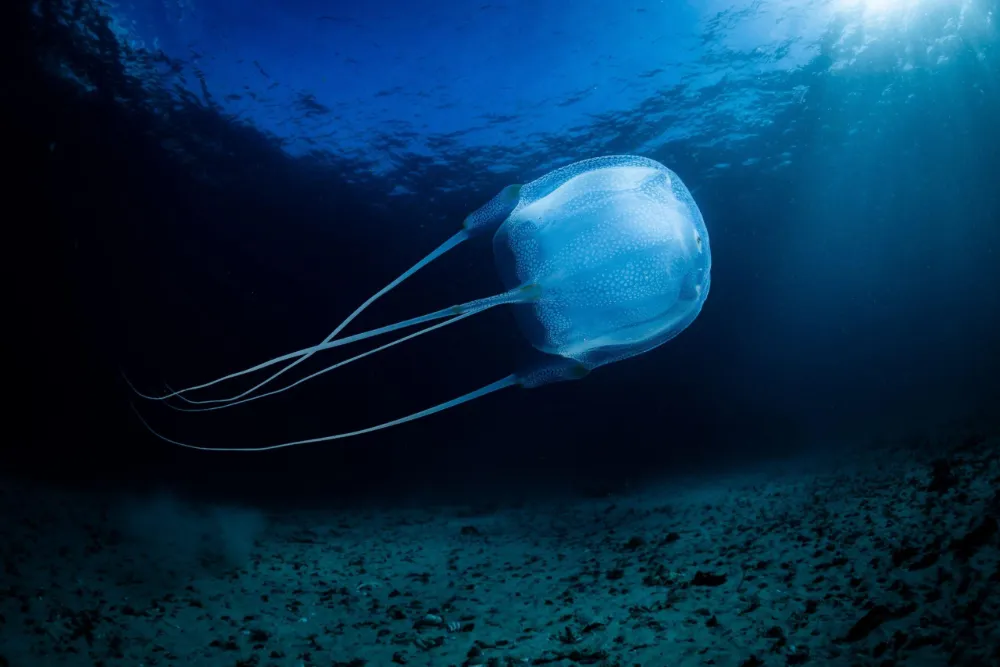
Some box jellyfish possess complex eyes, demonstrating that sophisticated sensory structures can exist without a centralized brain.
Can Jellyfish Think Without Brains?
Jellyfish can process sensory information and produce coordinated responses, but this is not the same as demonstrating human-like thinking.
The word "thinking" can refer to many different biological and psychological processes.
For animals with distributed nervous systems, scientists typically study observable behaviors and the neural mechanisms that produce them.
Jellyfish can respond to light, contact, environmental changes, and food-related signals.
Some species also show behavior that changes according to previous experiences or physiological conditions.
However, these findings do not establish that jellyfish possess thoughts, emotions, or conscious experiences comparable to those of humans.
Researchers continue to investigate how much information can be processed by relatively simple or decentralized nervous systems.
Can Jellyfish Learn?
There is evidence that some jellyfish can modify their behavior in response to experience.
Learning does not always require a large centralized brain.
In biological research, learning generally refers to changes in behavior resulting from experience rather than from immediate stimulation alone.
Experimental studies have shown that at least some jellyfish species can adjust their responses under controlled conditions.
However, learning abilities should not automatically be generalized to every jellyfish species.
Different jellyfish have different sensory systems, neural structures, and ecological requirements.
Scientific evidence for a particular form of learning in one species does not necessarily establish the same ability across the entire group.
Do Jellyfish Feel Pain?
Whether jellyfish experience pain in a subjective sense remains uncertain.
Jellyfish can detect and respond to potentially harmful stimuli, but responsiveness alone does not demonstrate a conscious experience of pain.
Scientists distinguish between nociception, which involves detecting damaging or potentially damaging stimuli, and pain, which includes a subjective experience.
A nervous system can produce protective responses without necessarily supporting the same kind of pain experience found in humans.
Because jellyfish lack centralized brains and have very different neural organization, their potential for subjective experiences remains an open scientific question.
It would be inaccurate to claim either that jellyfish definitely feel human-like pain or that their responses conclusively prove they cannot experience anything.
Do Jellyfish Sleep Without Brains?
Yes. Research has demonstrated sleep-like behavior in upside-down jellyfish of the genus Cassiopea.
A 2017 study published in Current Biology found that these jellyfish displayed several characteristics commonly used to identify sleep.
During resting periods, the jellyfish showed:
Reduced bell-pulsing activity
Slower responses to certain stimuli
Reversible periods of inactivity
Changes consistent with increased sleep pressure after disturbance
These observations demonstrated that a centralized brain is not necessary for animals to exhibit important features of sleep.
Subsequent research has explored the neural mechanisms involved in regulating these sleep-like states.
What Did Scientists Discover About Jellyfish Sleep in 2026?
Research published in Nature Communications in January 2026 provided further evidence about sleep in animals without centralized brains.
The study investigated upside-down jellyfish (Cassiopea andromeda) and the starlet sea anemone (Nematostella vectensis).
Researchers examined daily activity patterns, sleep regulation, and changes associated with cellular stress.
The results suggested that sleep in these animals may help protect nervous-system function and support the maintenance of DNA integrity.
Experiments showed that certain forms of cellular stress were associated with increased sleep pressure, while sleep was linked to processes supporting genome stability.
These findings are important because they suggest that some basic functions of sleep may have evolved before the appearance of centralized brains.
However, the findings do not mean that all jellyfish have identical sleep patterns or that their sleep is exactly the same as human sleep.
How Do Jellyfish Catch Food Without Brains?
Jellyfish capture food using specialized cells called cnidocytes, which contain stinging structures known as nematocysts.
When appropriately stimulated, these microscopic structures can discharge rapidly and help immobilize or capture prey.
Many jellyfish feed on small crustaceans, fish larvae, plankton, and other organisms.
The tentacles and oral arms help bring captured food toward the mouth.
Neural and muscular coordination assists with these feeding movements.
However, the discharge of individual nematocysts does not require a conscious decision by a centralized brain.
These highly specialized cellular mechanisms are part of the evolutionary adaptations that make jellyfish effective predators.
Do Jellyfish Have Hearts or Blood?
Jellyfish do not have hearts or blood circulatory systems like those of vertebrates.
Instead, many essential substances move through their bodies by diffusion and through the gastrovascular system.
Their relatively thin tissues and high water content allow oxygen and dissolved substances to move across short distances.
According to NOAA, jellyfish are approximately 95 percent water.
They have a body structure that includes an outer epidermis, an inner gastrodermis, and a gelatinous layer called the mesoglea.
This anatomical organization differs dramatically from animals that rely on hearts, blood vessels, and centralized organ systems.
How Do Jellyfish Survive Without Major Organs?
Jellyfish survive because their bodies are organized differently from those of many other animals.
They do not need human-style organs to perform every essential biological function.
Instead, they rely on specialized tissues and cells distributed throughout relatively simple body structures.
For example:
Nerve cells: Coordinate movement and responses.
Muscle cells: Produce swimming movements.
Stinging cells: Help capture prey and provide defense.
Digestive tissues: Break down and absorb food.
Body surfaces: Permit important exchanges with surrounding seawater.
These systems are effective within the environmental and biological conditions for which jellyfish have evolved.
The absence of a centralized brain or heart does not make jellyfish incomplete animals.
Jellyfish Nervous Systems vs. Human Nervous Systems
| Feature | Jellyfish | Humans |
|---|---|---|
| Centralized brain | Absent | Present |
| Nerve cells | Present | Present |
| Main neural organization | Distributed networks with some specialized structures | Central and peripheral nervous systems |
| Sensory organs | Vary by species | Highly specialized senses |
| Coordinated movement | Yes | Yes |
| Sleep | Documented in certain species | Well documented |
| Complex language | No evidence | Present |
This comparison illustrates how nervous systems can differ greatly while still supporting essential animal behaviors.
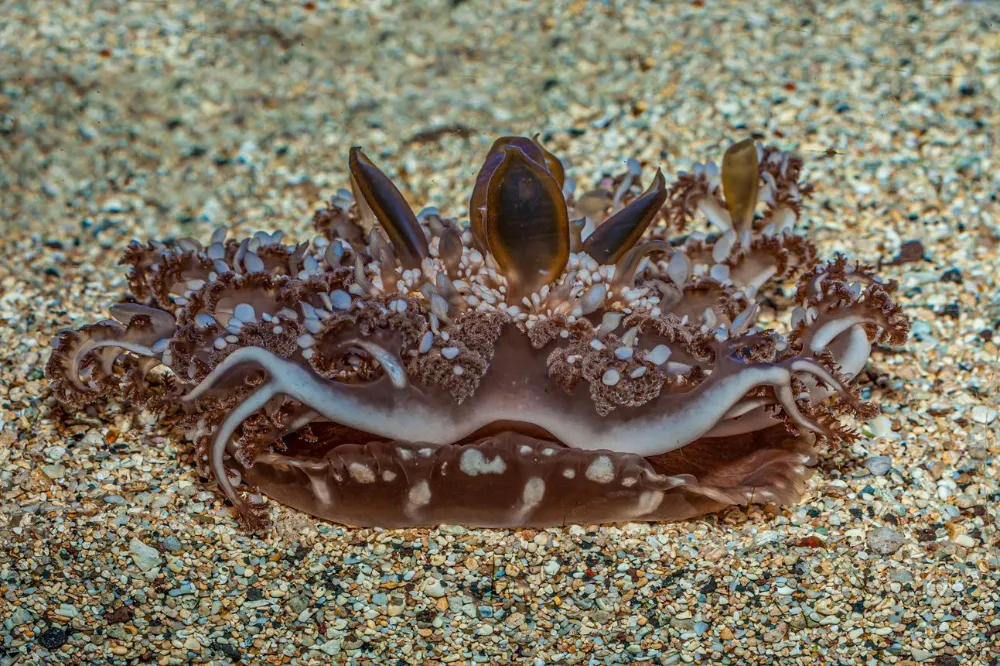
Upside-down jellyfish have helped scientists investigate sleep and neural activity in animals without centralized brains.
Do All Jellyfish Have the Same Nervous System?
No. Jellyfish species differ in their nervous-system organization and sensory abilities.
Some possess relatively diffuse neural networks, while others have specialized sensory organs and concentrations of neurons.
Box jellyfish are particularly notable for their visual systems.
Upside-down jellyfish have been studied extensively because their rhythmic pulsing and identifiable neural structures are useful for investigating behavior.
Different jellyfish also occupy different environments, including coastal waters, shallow lagoons, and the deep ocean.
Their nervous systems reflect different evolutionary histories and ecological requirements.
Therefore, describing all jellyfish as neurologically identical would oversimplify the diversity of these animals.
Frequently Asked Questions
How many brains does a jellyfish have?
Jellyfish have no centralized brains. Instead, they use distributed networks of nerve cells and, in some species, specialized neural structures to coordinate their behavior.
Do jellyfish have neurons?
Yes. Jellyfish have neurons that transmit signals and help control movement, feeding, and responses to environmental stimuli.
How do jellyfish know where to go?
Some jellyfish use sensory information about light, orientation, and other environmental conditions. Ocean currents also strongly influence their movement.
Can jellyfish remember things?
Some jellyfish can change their behavior based on experience, but the extent and mechanisms of memory vary among species and remain an active research topic.
Do box jellyfish have brains?
No. Box jellyfish lack centralized brains, but they possess specialized sensory organs and neural circuits associated with their complex eyes.
Do jellyfish feel emotions?
There is no established scientific evidence that jellyfish experience emotions comparable to human emotions. Their subjective experiences, if any, remain uncertain.
Can jellyfish sleep?
Yes. Sleep-like behavior has been demonstrated experimentally in upside-down jellyfish, including Cassiopea species.
Do jellyfish have hearts?
No. Jellyfish lack centralized hearts and blood circulatory systems. They rely on alternative mechanisms for transporting substances through their bodies.
Are jellyfish intelligent?
Jellyfish can coordinate movement, respond to stimuli, and show specialized behaviors. However, intelligence is difficult to define across very different animals, and jellyfish should not be judged solely by the absence of a centralized brain.
The Bottom Line
Jellyfish do not have brains, but they are far from biologically inactive. Their distributed nervous systems coordinate swimming, feeding, sensing, and responses to changing environmental conditions.
Some jellyfish possess complex eyes, while others have provided important evidence that sleep can occur without a centralized brain.
These remarkable animals demonstrate that nervous systems can function in very different ways, offering scientists valuable clues about the evolution of animal behavior and sleep.
Sources & Further Reading
The following government, aquarium, museum, and peer-reviewed scientific resources provide additional information about jellyfish nervous systems, sensory organs, and sleep research.
Smithsonian Ocean — Jellyfish and Comb Jellies. Explains jellyfish nerve nets, sensory organs, anatomy, and the absence of centralized brains.
Monterey Bay Aquarium — Jellies. Describes jellyfish movement, rhopalia, and environmental sensing.
NOAA National Ocean Service — What Are Jellyfish Made Of?. Explains the jellyfish body plan, high water content, and lack of centralized organs.
Nath et al. (2017) — The Jellyfish Cassiopea Exhibits a Sleep-like State. Peer-reviewed experimental research on sleep-like behavior in jellyfish without centralized brains.
Aguillon et al. (2026) — DNA Damage Modulates Sleep Drive in Basal Cnidarians with Divergent Chronotypes. Research on sleep regulation, neuronal DNA damage, and genome stability in jellyfish and sea anemones.