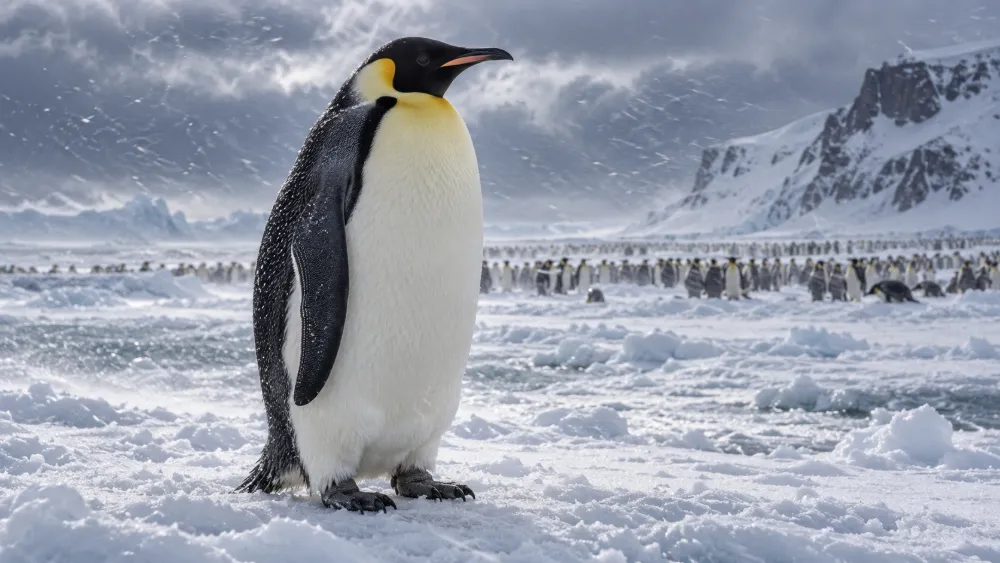
An emperor penguin can stand on Antarctic ice for hours while air temperatures fall far below freezing.
Yet its bare-looking feet do not simply freeze solid.
The secret is not that penguin feet stay warm.
In fact, penguins allow their feet to become very cold—only a few degrees above freezing.
They survive by carefully reducing blood flow to the feet and using a system called countercurrent heat exchange, which recovers heat from warm blood before it reaches the ice.
This lets the penguin keep its core body warm without wasting huge amounts of heat through its feet.
Why Don't Penguins' Feet Freeze?
Penguins use several adaptations at the same time:
They reduce blood flow to their feet when it is cold.
Arteries and veins in the legs exchange heat with each other.
The feet are allowed to stay much colder than the penguin's core.
Cold-adapted tissues help the feet continue functioning at low temperatures.
Behavior can reduce the amount of foot surface touching the ice.
Together, these adaptations prevent excessive heat loss while keeping enough blood circulating to the tissues.
Penguin Feet Are Supposed to Be Cold
This is the most important point.
A penguin does not try to keep its feet at the same temperature as its internal organs.
Its core body temperature is roughly 38°C to 39°C (100–102°F).
If that same warm blood flowed freely through the feet, huge amounts of body heat would move directly into the snow and ice.
Instead, blood flow is restricted.
The feet may remain only a few degrees above freezing.
That is warm enough to keep living tissue functioning but cold enough to greatly reduce heat transfer into the environment.
What Is Countercurrent Heat Exchange?
Countercurrent heat exchange is one of the most important cold-weather adaptations in penguin legs.
Arteries carrying warm blood from the body toward the feet run close to veins carrying colder blood back toward the body.
Because the vessels are close together, heat moves from the warm arterial blood into the cooler venous blood.
| Blood Flow | What Happens |
|---|---|
| Warm blood moves toward feet | Transfers heat to nearby returning blood |
| Blood reaches feet | Already much cooler, so less heat is lost to ice |
| Cold blood leaves feet | Absorbs heat from nearby arteries |
| Blood returns to body | Already partially warmed before reaching the core |
The result is an efficient heat-recycling system.
Why Does Countercurrent Exchange Save Heat?
Heat naturally moves from warmer objects toward colder ones.
Antarctic ice may be tens of degrees colder than the inside of a penguin.
If 38°C blood reached the feet unchanged, the temperature difference between the feet and the ice would be enormous.
That would cause rapid heat loss.
Countercurrent exchange cools the blood before it reaches the feet.
A foot that is only slightly warmer than the ice loses much less heat than a warm foot would.
Do Penguins Stop Blood Flow to Their Feet?
No.
They reduce blood flow but do not permanently shut it off.
The tissues still require:
oxygen;
nutrients;
removal of metabolic waste;
and enough circulation to remain alive.
The cardiovascular system balances two competing needs:
protect the feet while conserving as much body heat as possible.
Do Penguins Get Frostbite?
Penguin feet are highly adapted to cold, but that does not mean living tissue is physically incapable of cold injury under every possible condition.
The important difference is that Antarctic penguins have evolved physiological mechanisms that allow their feet to function safely at temperatures that would quickly become dangerous for human feet.
Blood-flow regulation, heat exchange and specialized cold-tolerant tissues work together to reduce the risk of freezing injury.
Do Penguins Have Antifreeze in Their Feet?
Not in the simple sense of having automotive-style antifreeze circulating through their feet.
However, emperor penguin feet do have specialized biochemical adaptations suited to extremely low temperatures.
The Australian Antarctic Program notes that special fats in emperor penguin feet help prevent the tissues from freezing.
This works alongside circulation control rather than replacing it.
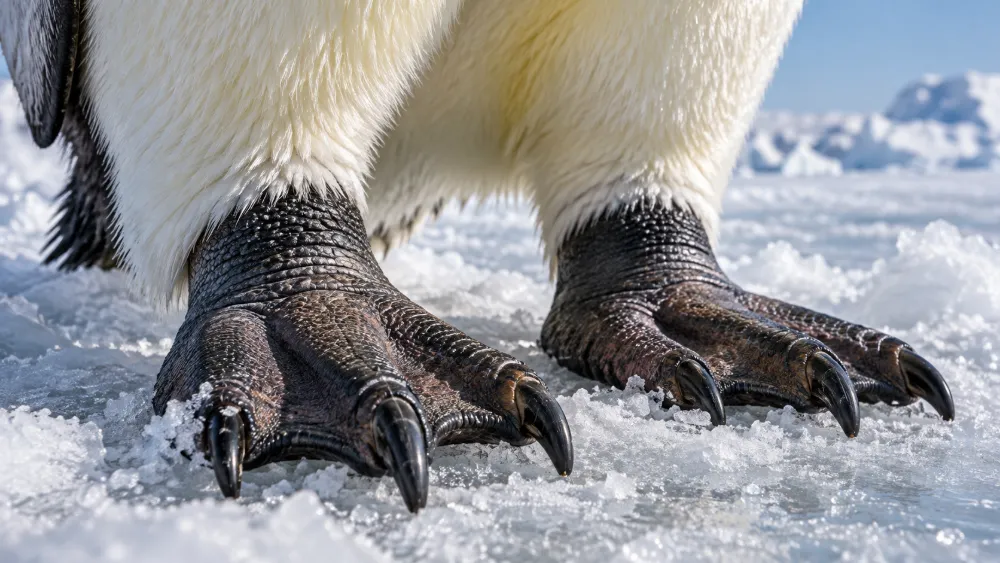
Why Don't Penguins Have Feathers on Their Feet?
Penguin legs and feet are less insulated than the main body.
That may sound like a disadvantage, but exposed extremities can play an important role in controlling body temperature.
Penguins need to conserve heat in extreme cold, but they also need a way to release excess heat when they become too warm.
Blood flow to relatively uninsulated areas such as the feet and flippers can be increased when heat needs to be lost.
So the same structures that conserve heat in winter can also contribute to cooling under warmer conditions.
Can Penguins Overheat?
Yes.
Penguins are so well insulated that overheating can sometimes become a bigger problem than staying warm.
Their dense feathers and body fat are excellent at slowing heat loss.
When environmental temperatures rise, penguins can increase circulation to poorly insulated body areas.
Some penguin species also have exposed skin around the face that helps release excess heat.
This demonstrates that penguin circulation is not permanently set to “keep everything warm.”
It is actively regulated.
How Do Emperor Penguins Reduce Contact With the Ice?
Emperor penguins can change posture to reduce heat loss through the feet.
They may rock backward and rest more of their weight on their heels and stiff tail feathers.
This reduces how much foot surface is pressed directly against the frozen ground.
Behavior therefore complements their physiological adaptations.
Do Penguins Stand on One Foot?
Penguins can shift weight and change how their feet contact the ground.
The general principle is similar to cold-adapted birds that tuck one leg into their feathers or alternate which foot carries weight.
Reducing exposed surface area can reduce heat loss.
Emperor penguins also use their heels and tail as additional support when standing for long periods on sea ice.
How Do Emperor Penguins Keep Their Eggs Warm?
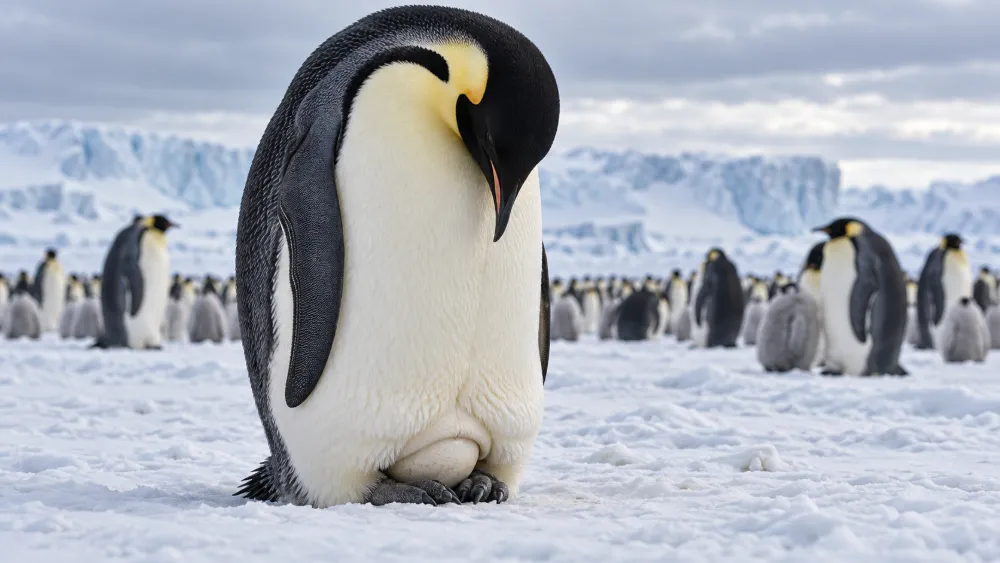
Male emperor penguins incubate their single egg during the Antarctic winter.
The egg is balanced on the tops of the feet and covered by a warm fold of skin and feathers called the brood pouch.
The egg does not simply sit exposed on frozen ice.
British Antarctic Survey reports that this protection can keep the egg dramatically warmer than the surrounding environment.
This is essential because dropping the egg onto Antarctic ice for too long can be fatal to the developing embryo.
Why Doesn't the Egg Freeze If the Penguin's Feet Are Cold?
The egg rests on top of the feet but is enclosed beneath the parent's brood pouch.
The important heat source is the parent's warm abdominal region and brood pouch rather than the cold lower surface of the feet.
The adult therefore acts like a living incubator.
How Do Penguins Keep the Rest of Their Bodies Warm?
Cold-resistant feet are only one piece of the system.
Penguins also rely on:
dense overlapping feathers;
down-like insulating feather layers;
subcutaneous body fat;
compact body shape;
small extremities;
specialized circulation;
and behavioral huddling.
Emperor penguins have proportionally small bills and flippers, reducing exposed surface area.
Why Do Emperor Penguins Huddle?
Huddling reduces the amount of body surface exposed directly to cold wind.
Large groups of emperor penguins pack together and continually shift position.
Birds that spend time on the cold exterior can gradually move toward warmer positions inside the group.
The Australian Antarctic Program reports that huddling can reduce heat loss by as much as approximately 50 percent.
What Temperature Can Emperor Penguins Survive?
Emperor penguins breed through the Antarctic winter, where temperatures can fall below -50°C (-58°F).
They also face extremely strong winds.
Maintaining an internal temperature near 38°C under those conditions requires exceptional control of heat loss.
That makes keeping warm blood away from exposed feet especially important.
Do All Penguins Live on Ice?
No.
This is another common misconception.
Penguin species live in environments ranging from Antarctica to:
South America;
southern Africa;
Australia;
New Zealand;
and the Galápagos Islands.
Many penguins never experience Antarctic winter conditions.
Cold-adaptation strategies therefore vary among species.
Emperor and Adélie penguins provide the most extreme examples of adaptation to ice and severe cold.
Why Are Penguin Feet Pink, Red or Dark?
Foot color varies among penguin species.
Blood flow can also influence how exposed skin appears.
When circulation increases to help release excess heat, exposed areas can become more flushed.
Color therefore should not be used as a simple thermometer for the bird.
Why Don't Ducks' Feet Freeze Either?
Penguins are not the only birds using countercurrent heat exchange.
Ducks, geese and many other cold-adapted birds also have arteries and veins positioned close together in their legs.
Warm outgoing blood transfers heat to cold returning blood before reaching exposed feet.
The same basic engineering principle has evolved because it is extremely effective at limiting heat loss.
FAQ
Why don't penguins' feet freeze on the ice?
Penguins restrict blood flow to their feet and use countercurrent heat exchange in the legs. This keeps the feet only slightly above freezing while conserving heat in the body's core.
Are penguin feet warm?
No. Penguin feet are deliberately kept much colder than the core body. Keeping them cold reduces the amount of heat transferred to the ice.
What is countercurrent heat exchange in penguins?
Warm arteries traveling toward the feet run close to colder veins returning toward the body. Heat moves between them, cooling outgoing blood and warming returning blood.
Do penguins get frostbite?
They are highly resistant to cold injury because of specialized circulation and tissue adaptations, although their tissues are still living biological structures rather than literally impossible to freeze.
Do penguins have antifreeze in their blood?
Penguin cold tolerance is mainly based on circulation, insulation and physiological adaptations rather than a simple antifreeze chemical circulating like automotive antifreeze.
How cold are penguin feet?
They can be only a few degrees above freezing, far colder than the penguin's core body temperature of approximately 38°C.
Why do penguins stand on their heels?
Emperor penguins can rock backward onto their heels and tail feathers, reducing the surface area of the feet in direct contact with ice.
How do emperor penguins keep eggs from freezing?
The male balances the egg on his feet and covers it with a warm brood pouch, keeping it isolated from direct contact with the ice.
Do all penguins live in freezing weather?
No. Many penguin species live in temperate regions, and Galápagos penguins even live near the equator.
Can penguins overheat?
Yes. Dense feathers and fat make penguins so well insulated that some species must increase blood flow to exposed areas such as feet and facial skin to release excess heat.
Final Answer
Penguins prevent their feet from freezing by keeping them cold—but not quite frozen.
When temperatures fall, blood flow to the feet is reduced.
A countercurrent heat-exchange system in the legs transfers heat from warm outgoing blood to cold blood returning from the feet.
As a result, very little core heat reaches the ice, while enough circulation remains to keep the tissues alive.
Emperor penguins add behavioral adaptations, including changing how their feet contact the ground and huddling with other birds.
The result is an elegant biological compromise: the penguin's body stays near 38°C while its feet remain only a few degrees above freezing.
Sources Used for Fact Checking
British Antarctic Survey — Penguins: Why Don't Penguins' Feet Freeze?
Smithsonian Ocean — Penguins
Australian Antarctic Program — Emperor Penguin
Australian Antarctic Program — Antarctic Animals Adapting to the Cold