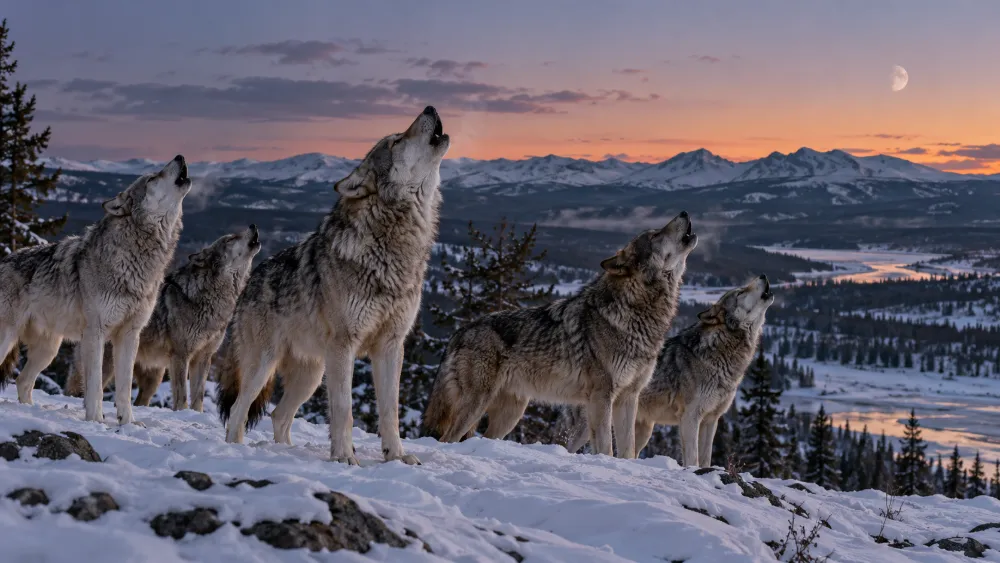
Wolves are famous for raising their heads and howling beneath a bright moon, but the moon is not actually what makes them howl.
Wolves howl to communicate with other wolves. A howl can help pack members locate one another, bring the group together, warn neighboring packs, signal alarm and maintain contact across long distances.
Wolves can howl during the day or night and under any phase of the moon.
The connection with the moon probably became popular because wolves are often active during the evening and early morning, while their calls are much easier for people to hear across a quiet nighttime landscape.
Do Wolves Really Howl at the Moon?
No.
There is no evidence that wolves direct their howls toward the moon or that a full moon causes them to howl.
A wolf may happen to howl while the moon is visible, but the call is directed toward other wolves rather than toward an object in the sky.
Wolves howl during:
daylight;
twilight;
nighttime;
cloudy weather;
new moons;
and full moons.
The behavior is fundamentally about communication.
Why Do Wolves Howl?
There is no single reason.
Wolf howling serves several social and territorial functions.
| Reason for Howling | What It May Accomplish |
|---|---|
| Locate pack members | Helps separated wolves find one another |
| Rally the pack | Brings wolves together before movement or activity |
| Territory defense | Warns neighboring wolves that an area is occupied |
| Alarm or disturbance | Signals excitement or potential danger |
| Social bonding | Maintains contact within the family group |
| Before or after hunting | May coordinate or reunite pack members |
1. Wolves Howl to Find One Another
Wolf packs can spread over enormous areas.
Individuals may become separated while:
hunting;
patrolling territory;
exploring;
or traveling through forest and rough terrain.
A long howl can announce a wolf's location to pack members that are too far away to see or smell it directly.
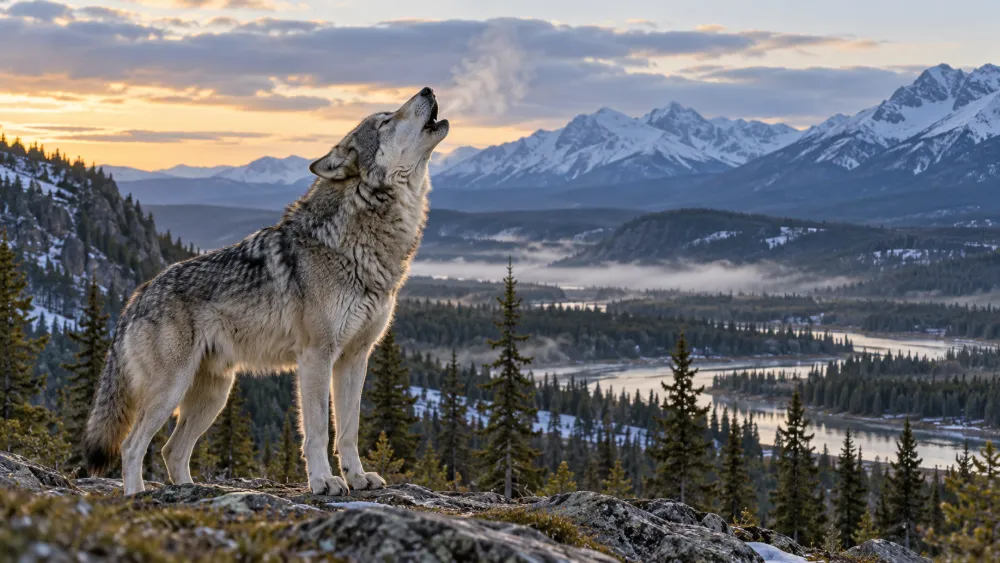
A separated wolf may howl and then pause to listen.
If its pack responds, the calls can help the animals maintain contact over distance.
2. Wolves Howl to Defend Territory
A wolf howl is also a message to animals outside the family.
Wolf packs occupy territories and defend them from neighboring packs.
A distant chorus can effectively communicate:
“This area is occupied.”
That can reduce the need for direct physical encounters.
This matters because fights between neighboring wolf packs can result in serious injury or death.
Howling therefore has both a social function within the pack and a defensive function between packs.
3. Wolves Howl to Rally the Pack
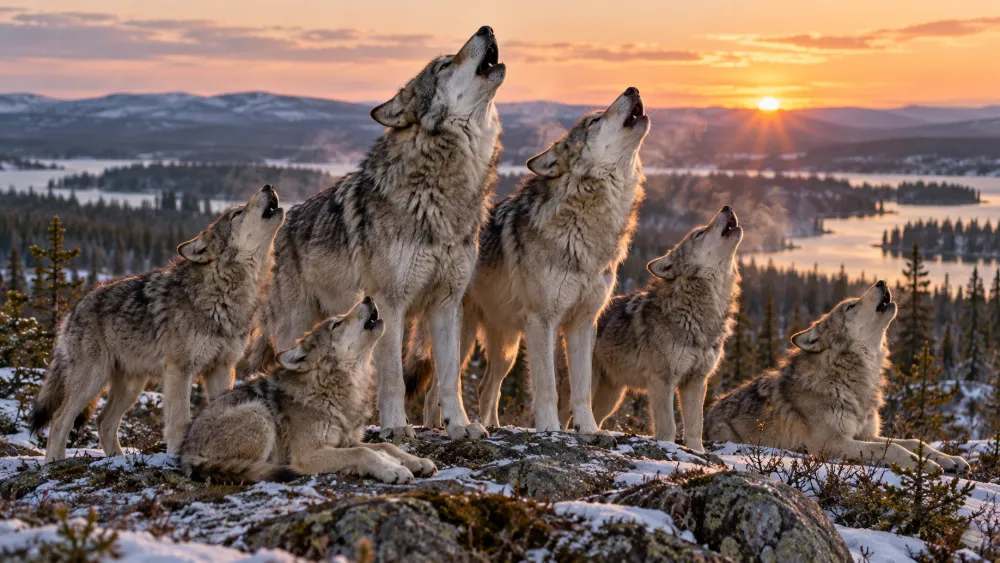
One wolf may begin howling and other family members may join it.
This group response is sometimes called a chorus howl.
Pack howling can occur before wolves begin traveling or after members have been separated.
However, researchers studying Yellowstone wolves have found that howling does not have one perfectly predictable meaning.
Sometimes wolves howl before moving.
At other times they begin traveling without making a sound.
Animal communication depends on context rather than functioning like a fixed human sentence.
4. Wolves May Howl When Alarmed or Disturbed
Wolves can also howl during periods of disturbance.
Researchers in Yellowstone have documented howling associated with:
unfamiliar wolves;
vehicles;
humans;
and other disruptions.
The call may reflect excitement, stress or an attempt to gather the pack.
Wolves also use other sounds such as barking, growling and whimpering depending on the situation.
5. Wolves Howl as Social Communication
A wolf pack is primarily a family.
In a typical wild pack, the central adults are a breeding pair accompanied by offspring from one or more years.
Communication is important because family members cooperate in:
raising pups;
defending territory;
traveling;
and obtaining food.
Howling helps maintain social contact across distances where body language is impossible to see.
Why Do Wolves Raise Their Heads When They Howl?
The upward head position is another reason people imagine wolves are calling toward the moon.
But raising the muzzle is better understood as part of producing and projecting a long-distance call.
The posture opens the throat and directs the sound outward rather than toward a celestial object.
The moon may simply be behind the animal from a human observer's perspective.
Why Do Wolves Howl More at Night?
Wolves do not only howl at night.
However, several factors make nighttime howling more noticeable.
Wolves are often especially active around:
dusk;
night;
and early morning.
At the same time, human-generated noise generally decreases after dark.
With less traffic, machinery and daytime activity, a distant howl becomes much easier to hear.
This may have helped create the widespread belief that wolves howl specifically at the moon.
How Far Can a Wolf Howl Be Heard?
Wolf howls are designed for long-distance communication.
Under favorable conditions, a howl may carry for several miles.
The International Wolf Center notes that calls may sometimes be audible roughly 6 to 7 miles away.
The real distance varies according to:
wind;
terrain;
forest density;
humidity;
background noise;
and the strength of the individual call.
A howl traveling across an open frozen valley may carry farther than one produced in dense forest or strong wind.
Can Wolves Recognize Each Other's Howls?
Evidence indicates that wolf howls contain individual acoustic characteristics.
Research discussed by the National Park Service has found differences in harmonic structure that can allow wolves to distinguish individual callers.
That makes biological sense.
A distant wolf needs to know more than simply that “a wolf” is calling.
The difference between hearing:
a pack member;
a familiar mate;
a separated youngster;
or an unfamiliar neighboring wolf
could dramatically change how an animal responds.
Why Does One Wolf Start and the Whole Pack Join?
Wolf howls are often contagious within a social group.
One animal begins calling and other members respond until a chorus develops.
The result helps announce the presence and location of the pack.
A chorus can sound surprisingly large and complex because individuals change pitch and overlap one another.
To a human listener, a relatively small group can therefore sound like many more animals.
Do Wolves Howl Before Hunting?
Sometimes.
National Park Service information notes that wolves may howl before or after a hunt.
But it would be inaccurate to say that wolves must howl every time they hunt.
They can begin moving, stalking or hunting in silence.
Howling is one communication tool among many rather than a required hunting ritual.
Do Wolves Howl After a Kill?
They may.
Howling around feeding areas can help maintain contact and may have a territorial or defensive role.
A carcass is a valuable resource that can attract:
other wolves;
bears;
ravens;
and other scavengers.
However, the meaning of any particular howl depends on the surrounding circumstances.
Do Wolf Pups Howl?
Young wolves begin developing the vocal behaviors used by adults.
Pups make a variety of sounds as they mature, including whines, barks and eventually howls.
Participating in group vocalizations helps young animals become part of the pack's communication system.
Early calls may sound higher and less powerful than those of adults.
Do Wolves Howl More During Certain Seasons?
Yes.
Long-term observations from Yellowstone show strong seasonal variation in wolf howling.
One National Park Service summary based on more than 11,000 recorded howls reported that howling was about four times more common in February than in May.
This pattern appears to be connected partly with reproductive state and the annual breeding cycle.
Wolves also howl frequently during periods associated with breeding and pup rearing.
Do Wolves Howl When They Are Sad?
It is tempting to interpret a lone wolf howl as sadness because it sounds emotional to human ears.
Wolves certainly possess emotional and motivational states, but translating one particular howl directly into a human feeling such as sadness is too simplistic.
A lone wolf may be:
trying to locate its pack;
responding to another wolf;
defending territory;
reacting to disturbance;
or expressing another internal state.
Context matters.
Why Do Dogs Howl?
Domestic dogs inherited much of their basic vocal biology from canid ancestors.
Some dogs howl in response to:
sirens;
music;
other dogs;
separation;
or exciting sounds.
Dog breeds differ greatly in how frequently they howl.
Howling in domestic dogs therefore shares evolutionary roots with wolf communication, even though modern household environments create very different triggers.
Do Coyotes Howl Like Wolves?
Coyotes also use long-distance vocal communication, but their vocalizations often sound different.
Coyote group calls may include:
howls;
yips;
barks;
and rapid changes in pitch.
Wolf howls are generally longer and deeper.
For a closer look at the two species, see our Coyote vs. Wolf guide.
Why Is the Full Moon Associated With Wolves?
The moon-wolf connection is primarily cultural rather than biological.
Several things probably helped create the image:
Wolves are frequently active at night.
Their calls travel across dark, quiet landscapes.
A wolf naturally raises its muzzle while howling.
The silhouette of a wolf against a bright moon is visually dramatic.
Folklore, paintings, films and werewolf stories reinforced the image.
Over time, the visual symbol became so familiar that many people assumed it represented real wolf behavior.
FAQ
Why do wolves howl at the moon?
They do not actually howl at the moon. Wolves howl to communicate with other wolves, locate pack members, defend territory, rally the group and respond to disturbances.
Does a full moon make wolves howl?
No evidence shows that a full moon itself triggers wolf howling. Wolves howl during all moon phases and at different times of day.
Why do wolves howl at night?
Wolves are often active during evening and early morning, and their calls are easier for people to hear when nighttime surroundings are quiet.
How far away can a wolf howl be heard?
Under favorable conditions, a wolf howl may travel several miles. The International Wolf Center notes that calls can sometimes be heard from roughly six to seven miles away.
Can wolves recognize individual howls?
Yes. Wolf howls contain acoustic differences that can help other wolves recognize individual callers.
Do wolves howl before hunting?
They sometimes howl before or after hunts, but wolves can also begin hunting or traveling without howling.
Why does the whole wolf pack howl together?
A group chorus can rally pack members, maintain social contact and advertise the pack's presence to neighboring wolves.
Do wolves howl because they are sad?
Not necessarily. A lone howl can have many functions, including locating pack members or territorial communication. Human emotions should not automatically be assigned to every call.
Do wolf pups howl?
Yes. Young wolves develop howling and other vocal behaviors as they grow and participate increasingly in pack communication.
Do wolves howl more during breeding season?
Wolf howling shows seasonal variation, and research in Yellowstone found particularly high howling rates during winter around the breeding period.
Final Answer
Wolves do not howl at the moon.
The howl is a powerful long-distance communication signal used to locate family members, rally the pack, warn neighboring wolves, respond to danger and maintain social contact.
Wolves can howl during the day or night and during any phase of the moon.
We associate them with moonlit nights because wolves are often active around dusk and dawn, nighttime landscapes are quieter, and a wolf naturally raises its head when projecting a howl.
The result is one of nature's most recognizable images—but the real message is traveling horizontally across the landscape to other wolves, not upward toward the moon.
Related Reading
Sources Used for Fact Checking
U.S. National Park Service — Why Wolves Howl
U.S. National Park Service — Wolf Ecology Basics
Smithsonian's National Zoo — Why Do Wolves Howl?
International Wolf Center — Wolf Communication