Spider mating is very different from reproduction in mammals.
A male spider does not usually transfer sperm directly from his abdomen into the female.
Instead, he first deposits sperm onto a small silk structure called a sperm web. He then draws the sperm into specialized mating organs on his pedipalps—the short paired appendages beside his mouth.
When a female accepts him, the male inserts one or both pedipalps into her reproductive openings and transfers the stored sperm.
Before any of that happens, however, he normally has to convince the female that he is a mate rather than prey.
How Do Spiders Mate?
Spider mating usually follows several stages:
The male produces sperm.
He deposits the sperm onto a small sperm web.
He loads the sperm into his pedipalps.
He locates a female.
He performs a courtship display.
If the female accepts him, he uses his pedipalps to transfer sperm.
The female may store the sperm until she is ready to fertilize her eggs.
The exact behavior varies enormously among the tens of thousands of spider species.
What Are a Male Spider's Pedipalps?
Pedipalps are a pair of appendages located near a spider's mouth.
Both male and female spiders have pedipalps, and they can help with sensing and handling food.
In sexually mature males, however, the ends of the pedipalps develop into complex reproductive organs.
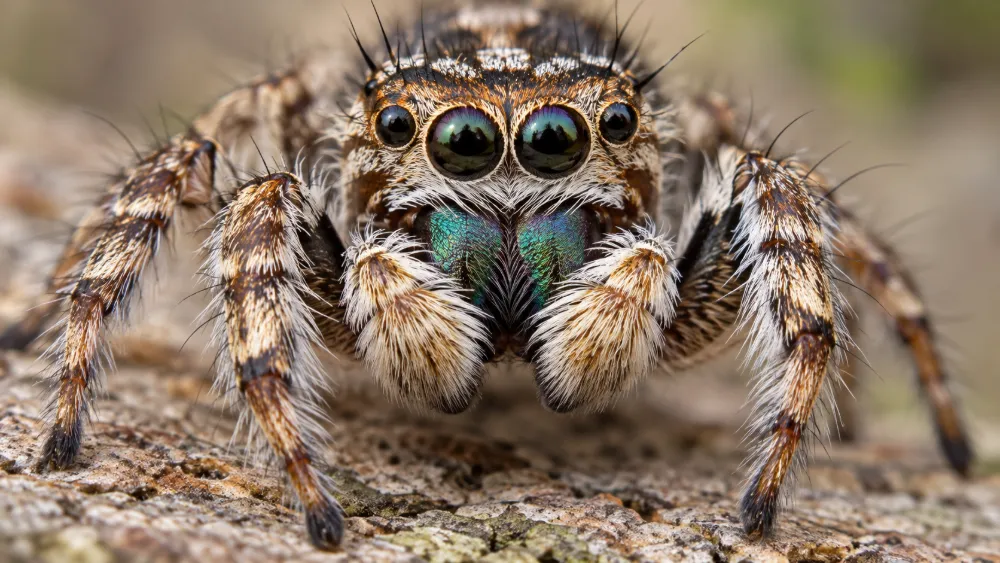
In many adult male spiders, the enlarged tips look a little like tiny boxing gloves.
These structures contain ducts and other specialized parts that allow the male to store and deliver sperm.
The shape of the male palp can be extremely species-specific and is frequently used by arachnologists to identify closely related spiders.
Why Do Male Spiders Make a Sperm Web?
A spider's primary genital opening is located on the underside of the abdomen, but the reproductive organs used to inseminate the female are on the pedipalps near the front of the body.
That creates an unusual anatomical problem.
The male solves it by spinning a small silk sperm web.
He deposits a droplet of sperm from the abdominal genital opening onto the silk and then uses the pedipalps to take up that sperm.
Once the pedipalps are charged, he is ready to search for or court a female.
How Does a Male Spider Find a Female?
Many male spiders become much more mobile after reaching maturity.
They may use several types of information to locate potential mates, including:
chemical signals called pheromones;
silk left by females;
web vibrations;
visual signals;
and direct contact cues.
Male funnel-web spiders, for example, can detect chemical cues in a female's silk and follow them toward her burrow.
Why Do Spiders Have Courtship Displays?
Courtship is extremely important because a male approaching another spider faces an obvious danger.
He needs to communicate:
“I am a potential mate, not prey.”
Different spiders solve that problem in very different ways.
Jumping Spiders
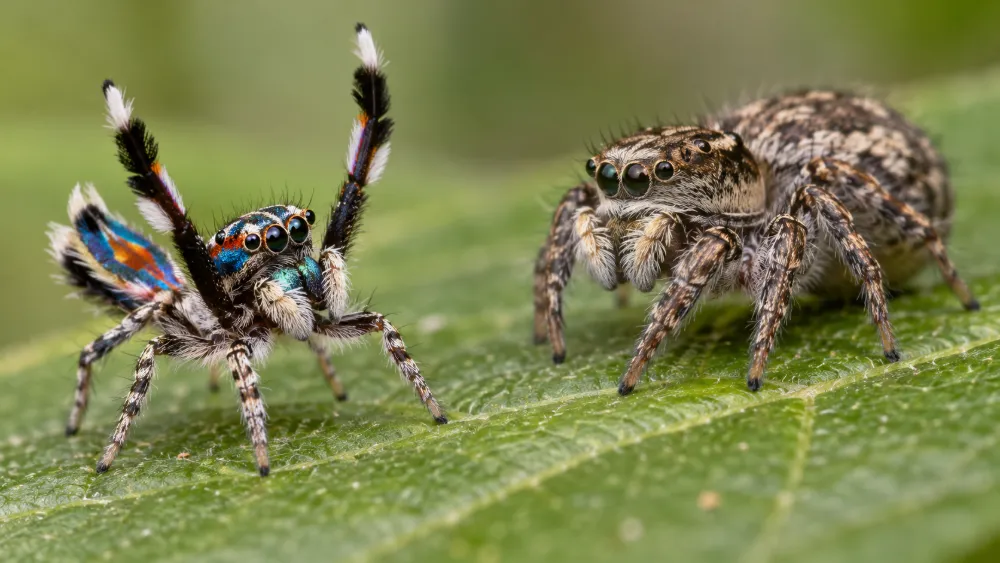
Male jumping spiders often perform elaborate visual displays.
They may:
raise and wave their front legs;
move from side to side;
display brightly colored body parts;
vibrate their bodies;
and produce vibrations through the surface beneath them.
Some species combine visual and vibrational signals into remarkably complex courtship performances.
Web-Building Spiders
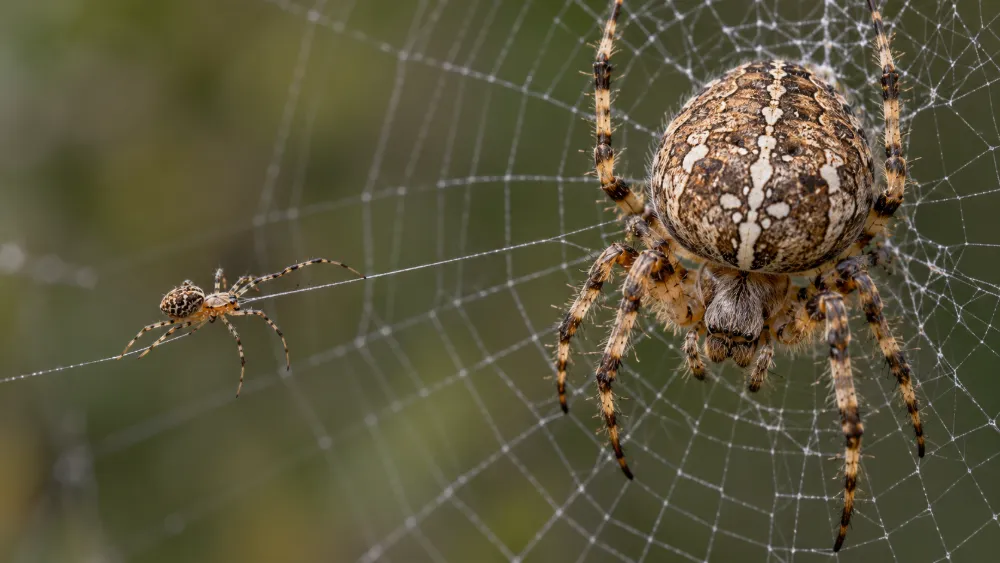
A male approaching a female sitting in a web may produce characteristic vibrations in the silk.
These signals can distinguish him from struggling prey.
Male St Andrew's Cross spiders, for example, may construct a mating thread in the female's web and vibrate it during courtship.
How Does the Actual Mating Work?
Once the female is receptive, the male positions himself so that he can reach the reproductive opening on the underside of her abdomen.
He then inserts the reproductive structure of a pedipalp into the female.
Many female spiders have two reproductive openings, and males possess two pedipalps.
Depending on the species, the male may use both palps during a mating encounter or may transfer sperm in several separate insertions.
The entire mating process can last seconds in some species and much longer in others.
Do Female Spiders Store Sperm?
Yes.
Female spiders commonly possess structures called spermathecae that can store sperm after mating.
The female does not necessarily fertilize her eggs immediately.
Stored sperm may later be used as eggs pass through the reproductive system.
This means mating and egg-laying can occur at different times.
Do Female Spiders Really Eat the Male?
Sometimes—but the popular image of every female spider immediately eating her mate is wrong.
Sexual cannibalism occurs in some spider species, not all of them.
It can happen:
before mating;
during mating;
or after mating.
The likelihood varies greatly by species and circumstances.
In some spiders, a hungry or unreceptive female may treat an approaching male as prey.
In others, males have evolved elaborate behaviors that reduce the risk of being eaten.
Why Would a Female Spider Eat a Male?
There is no single explanation that applies to every species.
Possible factors include:
hunger;
the female rejecting a poor mate;
extreme size differences;
normal predatory behavior;
and reproductive strategies unique to particular species.
A male spider is ultimately another small arthropod, so the boundary between potential mate and potential meal can be biologically complicated.
Do Black Widow Females Always Eat the Male?
No.
The common name “black widow” helped create the popular belief that females always kill and consume their mates.
Sexual cannibalism can occur in widow spiders, but it is not an inevitable ending to every mating.
Laboratory conditions, hunger and limited escape space can also affect how frequently cannibalism is observed.
Male behavior is designed in part to reduce the chance that the female mistakes him for prey.
Do Male Spiders Have Ways to Avoid Being Eaten?
Yes, and some strategies are extraordinary.
Depending on the species, males may:
approach only when the female is receptive;
signal repeatedly through the web;
restrain parts of the female's body;
mate quickly and escape;
offer food or silk-wrapped gifts;
or take advantage of moments when the female is less likely to attack.
Some species have evolved highly specialized reproductive tactics that occur nowhere else.
Can a Male Spider Lose His Pedipalps During Mating?
In a few unusual species, yes.
Researchers have documented male spiders whose palps break off during mating.
In species such as Nephilengys malabarensis, a detached palp can remain in the female reproductive opening and continue transferring sperm for a period of time.
This can also reduce the female's ability to mate immediately with another male.
This behavior is highly specialized and should not be treated as typical spider reproduction.
How Do Jumping Spiders Mate?
Jumping spiders are especially famous for courtship.
The male usually approaches a female carefully and performs a combination of:
leg waving;
body movements;
color displays;
and vibrations.
If she becomes receptive, he approaches closely, climbs over or beside her, and uses his pedipalps to transfer sperm.
If she is not receptive, he may retreat—or risk being attacked.
How Do Web Spiders Mate?
For a male entering a female's web, communication through silk is especially important.
Random vibrations could make him resemble trapped prey.
Instead, males often produce species-specific courtship vibrations.
Some create special mating threads or areas of silk within the female's web.
The female's response tells the male whether it is relatively safe to approach.
What Happens After Spiders Mate?
After mating, the male and female may separate immediately.
The female later produces eggs and encloses them in a silk egg sac.
Depending on the species, she may:
attach the sac to vegetation;
hide it in the web;
guard it;
carry it;
or abandon it after construction.
The eggs eventually hatch into young spiders called spiderlings.
Do Spiders Lay Eggs?
Yes.
Female spiders generally produce eggs enclosed in silk egg sacs.
The number of eggs varies enormously.
A small species may produce relatively few, while large species or highly fecund spiders may produce hundreds in one sac.
Some females make several egg sacs during their lives.
Can Spiders Mate More Than Once?
Many can.
Females of numerous species may mate with more than one male and store sperm.
Males may also attempt to mate with multiple females if they survive previous encounters.
However, reproductive strategies differ so greatly among spiders that there is no universal rule.
Do Tarantulas Mate the Same Way?
The basic principle is similar.
A male tarantula transfers sperm to his pedipalps and uses them to inseminate a receptive female.
He also performs courtship behavior before approaching closely.
Male tarantulas often possess specialized structures on the legs that help control the female's fangs or body position during mating.
After sperm transfer, the male typically attempts to retreat quickly.
FAQ
How do spiders reproduce?
Male spiders deposit sperm onto a sperm web, draw it into specialized pedipalps, court a female and then transfer the sperm into her reproductive openings with those pedipalps.
Do spiders mate directly?
They physically pair during mating, but sperm is not transferred directly from the male's abdominal genital opening. It is first loaded into his pedipalps.
Do male spiders have penises?
No. Adult male spiders use modified pedipalps as sperm-transfer organs rather than a penis.
Why do male spiders have boxing gloves?
The swollen “boxing gloves” seen on many adult male spiders are enlarged pedipalps containing specialized reproductive structures.
Do female spiders always eat males after mating?
No. Sexual cannibalism occurs in some species and circumstances, but it is not universal among spiders.
Why do spiders dance before mating?
Courtship displays help males identify themselves as potential mates, allow females to assess them and reduce the chance that the male is mistaken for prey.
Do spiders lay eggs after mating?
Yes. Females later produce eggs and generally protect them inside silk egg sacs.
Can female spiders store sperm?
Yes. Many females store sperm in internal structures called spermathecae and can use it later when fertilizing eggs.
Can spiders mate more than once?
Yes, many species can mate multiple times, although mating systems vary substantially among spider groups.
Final Answer
Spider mating begins before the male ever touches the female.
He first places sperm onto a small sperm web and loads it into specialized reproductive structures on his pedipalps.
He then finds a female and performs a courtship display using movements, vibrations, pheromones or combinations of signals.
If the female accepts him, the male inserts a pedipalp into her reproductive opening and transfers sperm.
The female can often store that sperm and use it later to fertilize eggs that she places inside silk egg sacs.
And although sexual cannibalism is real in some spiders, the idea that every female kills and eats her mate is a myth.
Related Reading
Sources Used for Fact Checking
Australian Museum — Spider Structure
Australian Museum — Australian Funnel-web Spiders
Australian Museum — St Andrew's Cross Spider
Australian Museum — Tasmanian Cave Spider
Smithsonian Institution — Research on Spider Pedipalps and Mating
University of Florida — Jumping Spider Courtship Research