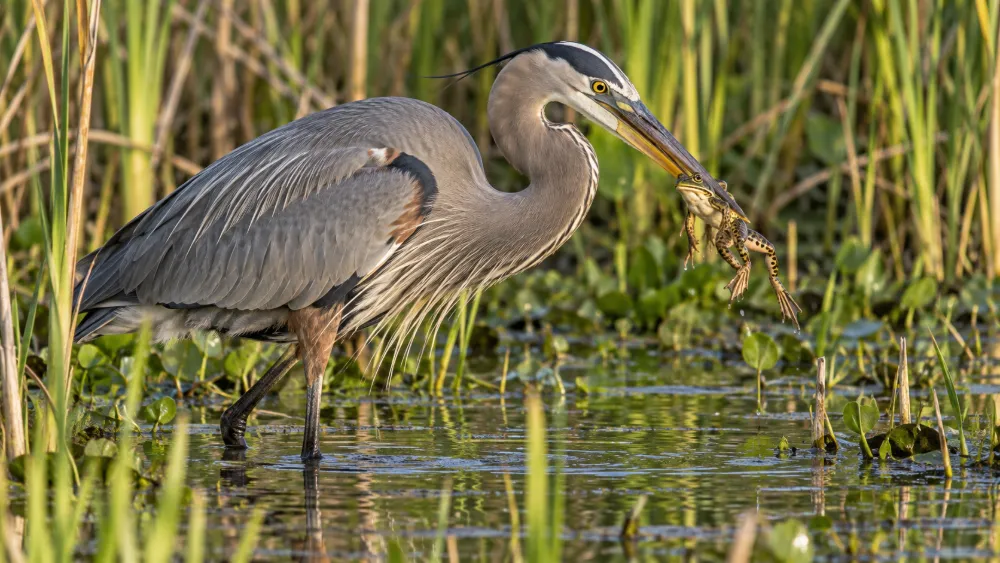
Gorillas may look powerful enough to hunt almost anything, but their diet is surprisingly plant-heavy.
Gorillas are primarily herbivorous. Most of what they eat consists of leaves, stems, shoots, bark, roots and fruit.
However, “primarily herbivorous” is more accurate than saying that every gorilla is a strict plant eater.
Some gorillas also consume small amounts of ants, termites and other invertebrates.
So the simplest answer is: gorillas eat overwhelmingly plant-based diets, with occasional insects depending on the species, habitat and food availability.
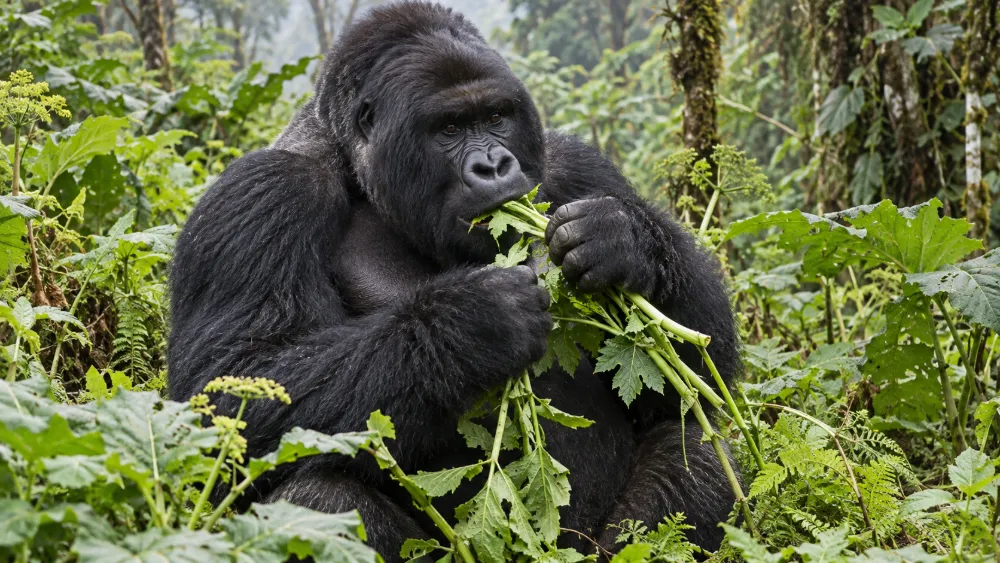
Are Gorillas Herbivores?
Yes, gorillas are generally classified as primarily herbivorous great apes.
The vast majority of their food comes from plants.
Depending on the gorilla population, important foods include:
leaves;
young shoots;
stems;
vines;
bark;
roots;
pith;
bamboo;
fruit;
and other forest vegetation.
Gorillas may also accidentally or deliberately consume ants, termites and other small invertebrates while foraging.
That means their real diet is more complicated than the simple statement “gorillas only eat plants.”
What Do Gorillas Eat?
| Food | Importance |
|---|---|
| Leaves and stems | Major food source, especially for mountain gorillas |
| Fruit | Especially important to western lowland gorillas when available |
| Shoots and pith | Common plant foods |
| Bark and roots | Eaten by some populations |
| Ants and termites | Small supplemental part of the diet |
| Meat from large animals | Not a normal component of the gorilla diet |
Do Gorillas Eat Meat?
Wild gorillas are not regular hunters of vertebrate animals.
This separates them from chimpanzees, which sometimes actively hunt monkeys and other mammals.
Most gorilla feeding involves vegetation and fruit.
The animal matter they consume is generally much smaller and is usually limited to insects and other invertebrates.
For that reason, calling gorillas “meat-eaters” gives a very misleading impression of their natural ecology.
Do Gorillas Eat Insects?
Yes.
Gorillas have been documented eating ants and termites.
San Diego Zoo Wildlife Alliance notes that gorillas eat leaves, stems, fruits, seeds, roots, ants and termites.
Insects contribute some protein but represent a very small proportion of the total diet compared with plant material.
The exact amount varies between gorilla populations.
Mountain Gorilla Diet
Mountain gorillas live in high-elevation forests where fleshy fruit is less abundant than in many lowland tropical forests.
Their diet is therefore especially rich in vegetation.
They eat large quantities of:
leaves;
stems;
shoots;
wild celery;
nettles;
bamboo shoots;
and other herbaceous plants.
Fruit is eaten when available, but it generally contributes less to the diet than it does for western lowland gorillas.
Western Lowland Gorilla Diet
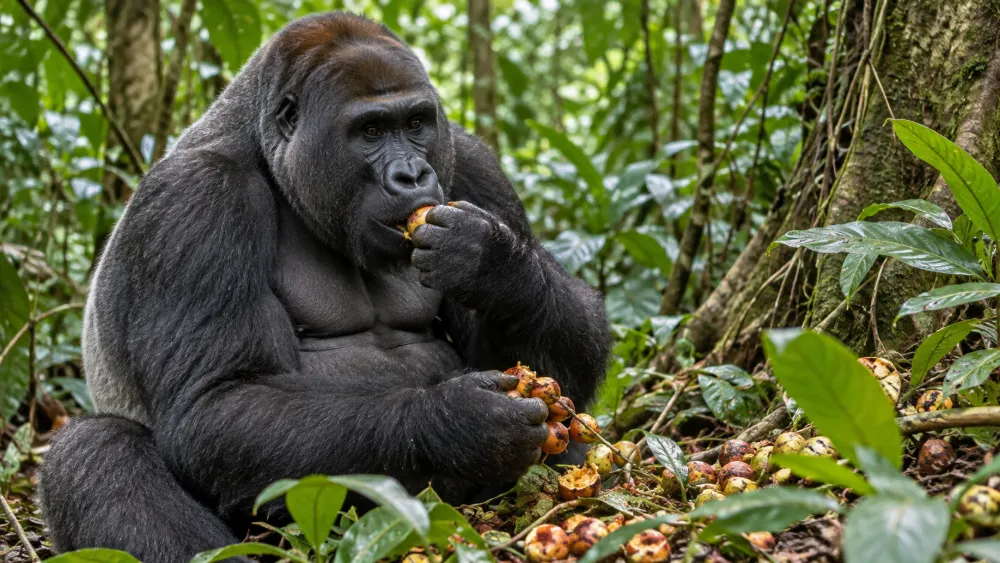
Western lowland gorillas live in warmer, fruit-rich forests across western and central Africa.
They still consume leaves, stems and other plant material, but fruit can form a much larger part of their diet when seasonal fruit is available.
Smithsonian's National Zoo reports that western lowland gorillas eat the fleshy fruits of close to one hundred seasonally fruiting tree species.
This makes them more strongly fruit-eating than many mountain gorilla populations.
Do All Gorillas Eat the Same Foods?
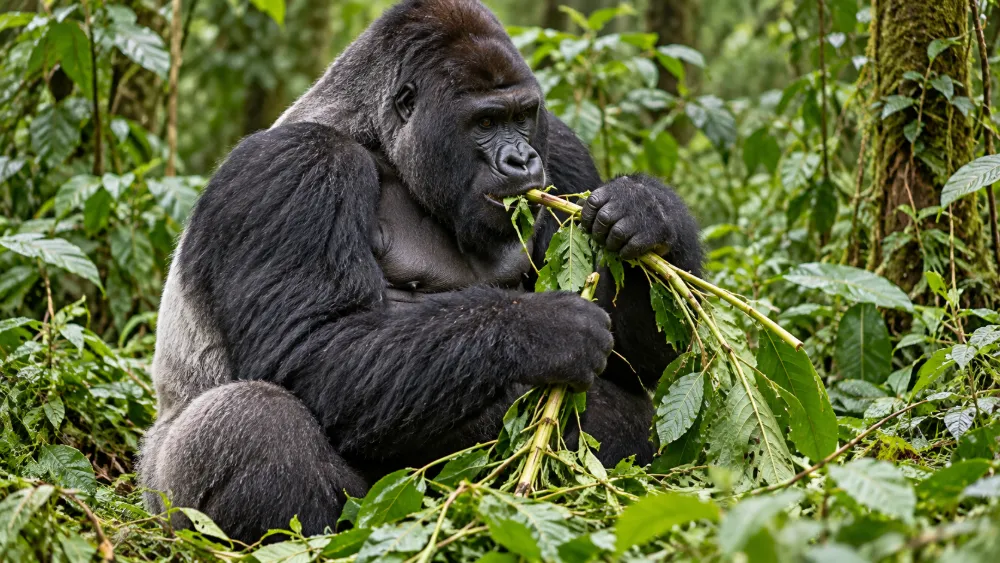
No.
Diet depends heavily on habitat.
A gorilla living in a montane forest has access to a different menu than one living in a lowland rainforest filled with seasonal fruit trees.
This is why researchers often describe gorilla diets by population or subspecies rather than giving a single universal food list.
Grauer's gorillas provide another example.
Research summarized by the Dian Fossey Gorilla Fund found that one studied population consumed at least 100 plant species, with stems, leaves, bark, pith and roots forming nearly 90 percent of the diet and fruit making up most of the remainder.
They also occasionally consumed ants, termites and fungi.
How Much Does a Gorilla Eat in a Day?
Gorillas must consume large amounts of food because most of their diet is fibrous and relatively low in calories.
Smithsonian reports that an adult male western lowland gorilla can eat roughly 45 pounds of food per day.
Females eat about two-thirds as much.
Other sources give similar estimates of roughly 40 to 50 pounds for large adult males.
A gorilla therefore spends a substantial portion of its day:
searching for food;
selecting edible plants;
stripping stems;
chewing;
and resting between feeding periods.
How Can Gorillas Get So Big Without Eating Meat?
This is one of the most common questions about gorillas.
Muscle does not require an animal to eat meat directly.
A gorilla obtains:
protein;
carbohydrates;
minerals;
fat;
and energy
from the large quantity of plant foods it consumes.
Leaves and other vegetation contain protein, and gorillas process enormous volumes of food each day.
Their digestive system is also adapted to handling large amounts of fibrous material.
Do Gorillas Eat Bananas?
Gorillas can eat bananas, especially in human care, but bananas are not the foundation of a wild gorilla's diet.
The image of a gorilla constantly eating supermarket-style bananas is misleading.
Wild gorillas consume locally available forest fruits along with huge quantities of leaves, stems, bark and shoots.
Zoo diets are also carefully managed rather than consisting of unlimited sweet fruit.
What Do Gorillas Eat in Zoos?
Modern zoos attempt to provide diets that reflect the gorilla's natural feeding biology.
Foods commonly include:
leafy greens;
vegetables;
limited fruit;
browse such as fresh tree branches;
hay;
and nutritionally formulated primate foods.
Browse is especially important because it lets gorillas strip leaves and bark in ways similar to natural foraging.
Are Gorillas Omnivores?
This depends partly on how strictly the term is being used.
If an omnivore is defined as any animal that deliberately consumes both plant and animal matter, occasional insect eating can make gorillas technically omnivorous.
But ecologically, most zoological sources describe gorillas as primarily herbivorous because plants overwhelmingly dominate their diet.
That description is more informative than simply labeling them omnivores.
Are Gorillas Vegetarians?
“Vegetarian” is a human dietary term rather than a precise zoological category.
Gorillas eat overwhelmingly plant-based foods, but wild animals do not follow intentional human dietary rules.
Because some gorillas eat insects, describing them as strictly vegetarian or vegan is not completely accurate.
Do Gorillas Hunt Animals?
Regular hunting is not considered a normal gorilla feeding strategy.
This is a major difference between gorillas and chimpanzees.
Chimpanzees have been observed organizing hunts and consuming vertebrate prey.
Gorillas instead spend most of their feeding time searching for vegetation, fruit and occasionally insects.
Why Do Gorillas Have Such Large Bellies?
The large abdomen of an adult gorilla is partly related to processing a high-fiber diet.
Bulky plant food requires a large digestive tract.
Microorganisms in the gut help break down difficult plant material and extract energy from fiber.
A large gorilla belly therefore should not automatically be interpreted as obesity.
Do Silverback Gorillas Eat Different Food?
Silverbacks generally eat the same types of foods as other adult members of their population.
The biggest difference is quantity.
A large adult male requires far more food than an infant or smaller adult female.

FAQ
Are gorillas herbivores or omnivores?
Gorillas are best described as primarily herbivorous. Plants make up the overwhelming majority of their diet, although some populations also eat small amounts of ants, termites and other invertebrates.
Do gorillas eat meat?
Gorillas are not regular vertebrate hunters. Their diet consists mainly of vegetation and fruit, with occasional insects.
What is a gorilla's favorite food?
There is no single favorite food for all gorillas. Mountain gorillas eat large amounts of leaves, shoots and stems, while western lowland gorillas consume considerably more seasonal fruit.
Do gorillas eat bananas?
They can, especially in human care, but wild gorillas do not live primarily on bananas. They eat a wide diversity of native forest plants and fruits.
Do gorillas eat insects?
Yes. Ants and termites are documented in gorilla diets, although they make up only a small part of overall food intake.
How much does a silverback gorilla eat?
A large adult male can consume roughly 40 to 50 pounds of food per day depending on the individual and food type.
Why are gorillas muscular if they do not eat meat?
Plants still contain protein and energy. Gorillas consume large amounts of vegetation and have digestive adaptations that allow them to obtain nutrients from a high-fiber diet.
Are mountain gorillas vegetarian?
Their diet is overwhelmingly plant-based, but “vegetarian” is not a perfect scientific term. Small amounts of animal matter such as insects may occasionally be consumed.
Final Answer
Gorillas are primarily herbivores.
Most of their food consists of leaves, stems, shoots, bark, roots and fruit.
Mountain gorillas rely especially heavily on leafy vegetation, while western lowland gorillas eat considerably more fruit when it is available.
Some gorillas also consume ants, termites and other small invertebrates, so describing them as 100-percent plant-eating is slightly too absolute.
Nevertheless, plant material overwhelmingly dominates the gorilla diet, and gorillas do not normally hunt large animals for meat.
Related Reading
Sources Used for Fact Checking
Smithsonian's National Zoo — Western Lowland Gorilla
San Diego Zoo Wildlife Alliance — Gorilla
Dian Fossey Gorilla Fund — Gorilla Diet Research