If you see a long black snake crossing your yard, your first question may be simple: Is it dangerous?
In the United States, many of the snakes commonly described as “black snakes” are non-venomous.
Black racers, several ratsnakes, eastern indigo snakes and kingsnakes are examples of dark-colored snakes that do not pose a serious venom risk to people.
However, color alone is not a safe identification method.
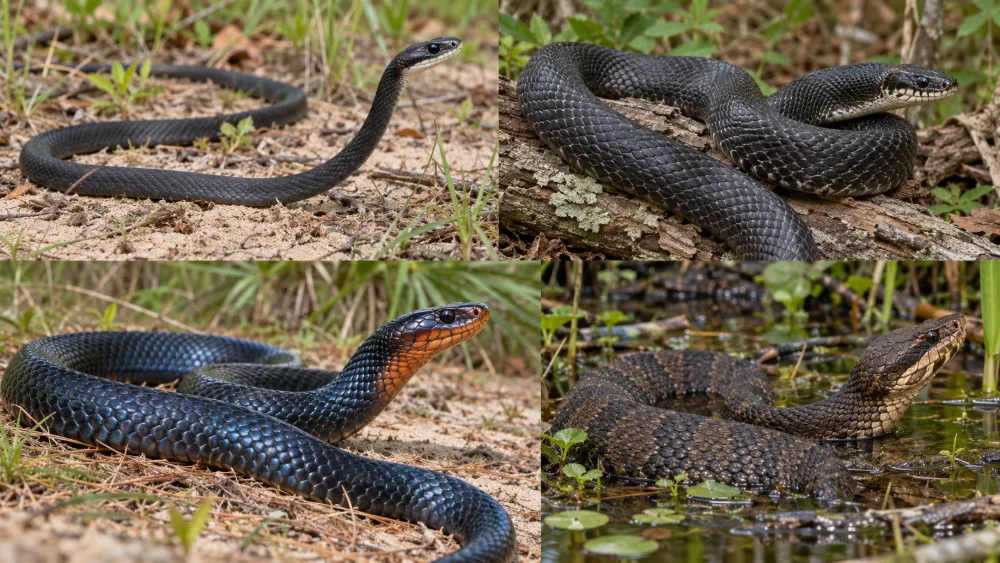
Some venomous snakes—especially older cottonmouths—can become extremely dark or nearly black.
So the safest answer is: most black snakes are harmless, but never assume an unidentified snake is safe simply because it is black.
Are Black Snakes Poisonous?
Usually, people asking whether a black snake is “poisonous” actually mean venomous.
The distinction is useful:
Venomous animals deliver toxins through a bite, sting or similar mechanism.
Poisonous animals cause harm when their toxins are eaten, touched or otherwise absorbed.
For snakebite safety, “venomous” is therefore the more accurate term.
Most familiar black snakes encountered around homes in the eastern and southeastern United States are considered non-venomous to people.
But “black snake” is not one biological species. It is a casual description applied to many unrelated snakes.
Common Black Snakes at a Glance
| Snake | Venom Risk to People | Useful Clues |
|---|---|---|
| North American Racer | Non-venomous | Very slender, smooth black body, white chin, large eyes |
| Eastern Indigo Snake | Non-venomous | Large, glossy blue-black body, often reddish chin |
| Ratsnake | Non-venomous | Strong climber, heavier than racer, often weakly keeled scales |
| Eastern Kingsnake | Non-venomous | Black or dark body with pale chain-like markings |
| Eastern Hognose | Not dangerous to people | Some individuals entirely black, upturned snout |
| Cottonmouth | Venomous | Heavy body, keeled scales, dark facial stripe, wetland association |
1. North American Racer — Common “Black Snake”
Scientific name: Coluber constrictor
The North American racer is one of the snakes most often called a black snake, especially in the southeastern United States.
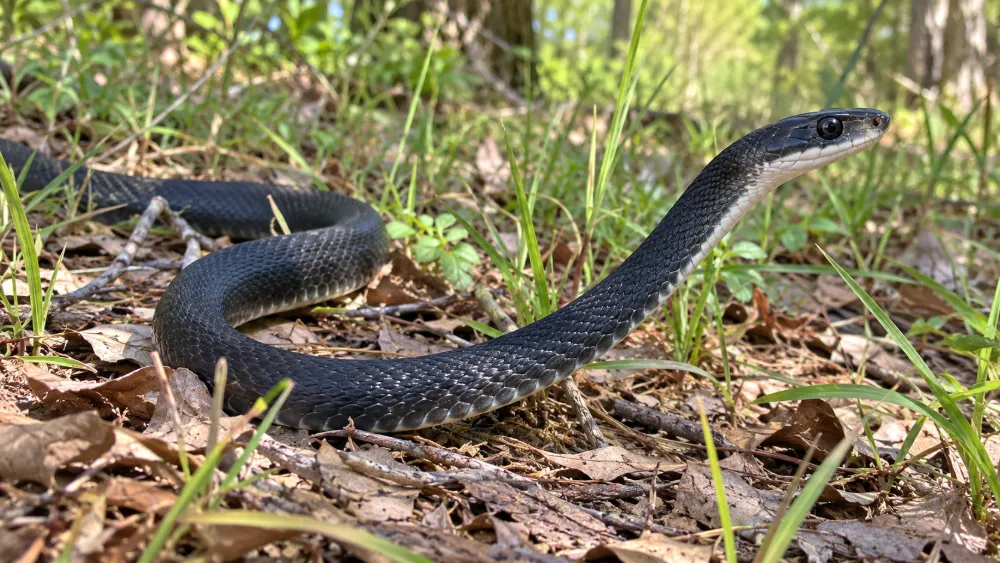
Adults are typically:
long and slender;
black or bluish-black;
smooth-scaled;
large-eyed;
and marked with a white or whitish chin and throat.
Most adults are roughly 20 to 56 inches long, although exceptional individuals may be larger.
Black racers are non-venomous.
They usually flee rapidly when approached, which explains the name “racer.”
If cornered or handled, however, they may strike repeatedly and can bite hard enough to draw blood.
A defensive bite does not mean the animal is venomous.
Why Does a Baby Black Racer Look Different?
Juvenile racers look surprisingly unlike adults.
Instead of solid black, young snakes are gray with reddish-brown blotches running along the back.
The pattern gradually disappears as the snake matures.
This causes young racers to be mistaken for venomous snakes such as pygmy rattlesnakes.
It is another reason color alone is unreliable for snake identification.
2. Eastern Indigo Snake
Scientific name: Drymarchon couperi
The eastern indigo snake is one of the most impressive black snakes in North America.
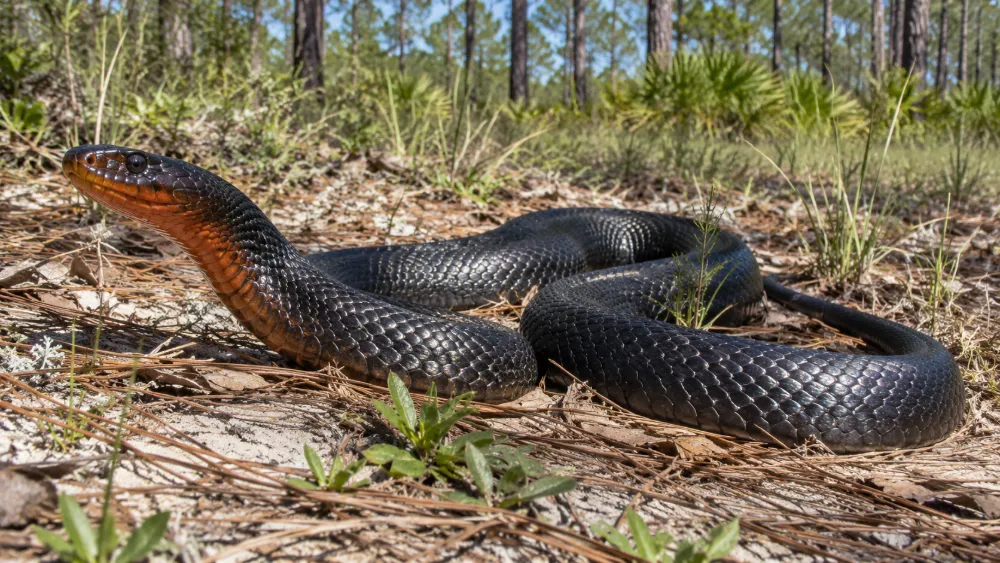
Adults typically have:
smooth, glossy black scales;
blue or purple iridescence in sunlight;
a relatively large body;
and often a reddish, orange or cream-colored chin and throat.
They commonly measure around 60 to 82 inches and can exceed eight feet.
The eastern indigo is the longest native snake in the United States.
It is non-venomous and not considered dangerous to people.
Unlike a racer, which tends to look lean and matte black, an indigo snake usually appears heavier-bodied and noticeably glossy.
3. Black Rat Snake and Other Ratsnakes
The name “black rat snake” is still widely used, although modern ratsnake taxonomy is more complicated than older field guides suggest.
Depending on location, dark ratsnakes may belong to different species or populations within the genus Pantherophis.
Ratsnakes are non-venomous constrictors.
They prey heavily on rodents but may also eat:
Ratsnakes are excellent climbers and are sometimes seen in trees, roof spaces, barns or chicken coops.
If threatened, they may vibrate their tails, assume an S-shaped posture and strike.
This behavior can look intimidating, but it does not turn them into venomous snakes.
See our Black Racer vs. Black Rat Snake guide for a closer comparison.
4. Eastern Kingsnake
Scientific name: Lampropeltis getula
Eastern kingsnakes are another dark North American snake that people sometimes casually call a black snake.
They are usually black to dark brown with white or yellowish bands forming a chain-like pattern.
Eastern kingsnakes are non-venomous.
They are famous for eating other snakes, including some venomous species, because kingsnakes have resistance to certain snake venoms.
They also eat rodents, lizards, frogs and eggs.
5. Can Eastern Hognose Snakes Be Black?
Yes.
The eastern hognose snake, Heterodon platirhinos, is extremely variable in color.
Some individuals have obvious blotches, while others are almost completely black.
The easiest structural feature is the distinctly upturned snout.
When threatened, hognose snakes may flatten the neck, hiss loudly and perform dramatic defensive displays.
Despite the frightening appearance, they are not considered dangerous to people.
6. Can a Cottonmouth Be Black?
Yes—and this is the most important safety exception.
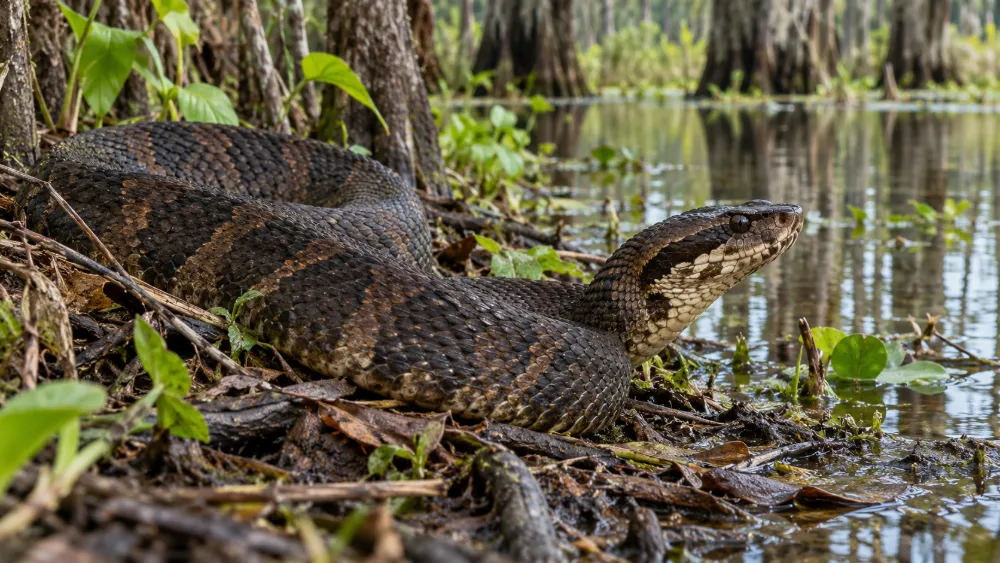
Cottonmouths, also called water moccasins, are venomous pit vipers.
Younger animals usually show obvious brown crossbands, but the pattern can darken significantly with age.
Some adults may appear almost uniformly black.
Typical cottonmouth characteristics include:
a much heavier body than a racer;
keeled rather than smooth-looking scales;
a broad dark stripe passing through the eye;
and a strong association with wetlands and waterways.
When threatened, a cottonmouth may open its mouth and expose the pale white interior that gives the species its common name.
Do not rely on that behavior to identify one, because a cottonmouth is not required to gape before biting.
Black Racer vs. Cottonmouth
| Feature | Black Racer | Cottonmouth |
|---|---|---|
| Venomous? | No | Yes |
| Body | Long and slender | Heavy and robust |
| Adult scales | Smooth | Strongly keeled |
| Chin | Usually white or whitish | Usually pale but often associated with darker facial markings |
| Eyes | Large and prominent | Eye partly obscured by dark facial stripe |
| Typical behavior when approached | Often flees quickly | May remain still, move away or display defensively |
Can You Identify a Venomous Snake by Its Head Shape?
Not reliably.
The common rule that “triangular heads mean venomous” is too simplistic.
Many harmless snakes flatten or widen their heads defensively and can suddenly look triangular.
Likewise, trying to inspect pupil shape requires getting far closer to a snake than is sensible.
Use several characteristics together—body build, pattern, scales, geographic range and habitat—and maintain a safe distance.
Are Black Snakes Aggressive?
Most snakes do not seek confrontations with people.
Black racers, ratsnakes and indigo snakes generally try to escape when given room.
A snake that is trapped, stepped on or grabbed may defend itself by:
striking;
biting;
vibrating its tail;
flattening its body;
or releasing foul-smelling musk.
These are defensive behaviors, not evidence that the snake is hunting or attacking humans.
Are Black Snakes Good to Have Around?
Non-venomous black snakes can play useful ecological roles around farms, gardens and wooded properties.
Ratsnakes consume rodents.
Racers eat rodents, frogs, lizards and small snakes.
Kingsnakes can consume other snakes as well as rodents.
Killing harmless snakes can therefore remove predators that naturally control other animals around a property.
What Should You Do If You Find a Black Snake in Your Yard?
If you cannot confidently identify the animal, the safest option is simple:
Stay several feet away.
Keep children and pets away.
Do not grab, pin or kill the snake.
Give it an open escape route.
If removal is genuinely necessary, contact a qualified wildlife professional.
Many snakebites happen when people intentionally try to catch or kill snakes.
What Should You Do If a Black Snake Bites You?
If you know with certainty that the snake was a harmless racer or ratsnake, wash the wound with soap and water and seek medical advice if the bite is deep, contaminated or shows signs of infection.
If the snake was unidentified or could be venomous, treat the situation more seriously.
Seek prompt medical evaluation.
Do not:
cut the wound;
attempt to suck out venom;
apply ice;
or use a tight tourniquet.
Do not attempt to capture the snake for identification.
Are Black Snakes Dangerous to Dogs or Cats?
Non-venomous racers, ratsnakes and indigo snakes generally pose little serious danger to ordinary dogs or cats.
They may bite defensively if attacked.
A venomous cottonmouth is different and can cause a medical emergency in a pet.
If a pet has been bitten by an unidentified snake and develops swelling, pain, weakness or other abnormal signs, contact a veterinarian immediately.
FAQ
Are black snakes venomous?
Most snakes commonly called black snakes in the United States are non-venomous, including racers, ratsnakes and eastern indigo snakes. However, venomous cottonmouths can become very dark or nearly black, so color alone cannot determine safety.
Are black racers poisonous?
No. Black racers are non-venomous and pose little danger to people, although they may bite if grabbed or cornered.
Are black rat snakes venomous?
No. Ratsnakes are non-venomous constrictors that commonly feed on rodents, birds and eggs.
What black snake has a white chin?
An adult North American racer commonly has a black or bluish-black body with a distinctive white or whitish chin and throat.
What black snake has a red chin?
Eastern indigo snakes often have reddish, orange or cream coloration around the chin and throat.
Are black snakes dangerous to humans?
Many common black snakes are harmless to people. The important exception is that some venomous snakes, especially cottonmouths in the southeastern United States, may become very dark as adults.
Can a water moccasin be completely black?
Older cottonmouths can become extremely dark and may look nearly uniform black, although close examination may reveal faint crossbands or other features.
Do black snakes chase people?
Racers can move extremely quickly, which sometimes creates the impression that they are chasing someone. Their normal defense is escape rather than pursuit of humans.
Should I kill a black snake in my yard?
No. If you do not know the species, keep your distance and let it leave. Many black snakes are harmless native predators that help control rodents and other small animals.
Final Answer
Most black snakes commonly encountered around U.S. homes are not venomous.
A long, slender black snake with a white chin may be a North American racer. A larger glossy snake with reddish coloration on the chin may be an eastern indigo snake. Dark ratsnakes and kingsnakes are also non-venomous.
But black coloration by itself never proves that a snake is harmless.
Venomous cottonmouths can darken dramatically with age and may sometimes appear nearly black.
If you cannot confidently identify a dark snake, do not handle it. Give the animal space and use geographic range, body build, pattern and other features—not color alone—to determine what species you are seeing.
Related Reading
Sources Used for Fact Checking
University of Florida IFAS Extension — “Black Snakes”: Identification and Ecology
Florida Museum of Natural History — North American Racer
Florida Museum of Natural History — Florida Cottonmouth
Florida Museum of Natural History — Eastern Indigo Snake
Florida Museum of Natural History — Eastern Ratsnake
Florida Museum of Natural History — Eastern Kingsnake