Camels are famous for surviving where water is scarce, but the common claim that a camel can go for weeks without drinking needs some explanation.
In hot desert conditions, a healthy camel can often go roughly 7 to 10 days without drinking water.
Under cooler conditions, with moist vegetation available, or in controlled studies, some camels have gone considerably longer.
However, there is no single maximum number of days that applies to every camel.
Temperature, workload, diet, pregnancy, milk production, body condition and species all affect how quickly a camel becomes dehydrated.
How Long Can a Camel Go Without Water?
A practical answer for a healthy adult camel in very hot conditions is approximately one week to 10 days between drinks.
But that is not a strict biological deadline.
| Conditions | Possible Time Without Direct Drinking |
|---|---|
| Very hot desert conditions | Often around 7–10 days |
| Controlled dehydration studies | 11–20 days have been studied |
| Bactrian camel in exceptional conditions | Up to roughly 2–3 weeks reported |
| Cool weather with moist green forage | Potentially much longer without directly drinking |
Importantly, surviving without drinking does not mean the camel is unaffected.
As dehydration becomes severe, food intake falls, body weight drops and physiological stress increases.
Do Camels Store Water in Their Humps?
No.
This is probably the most famous camel myth.
A camel's hump stores fat, not liquid water.
The fat provides an energy reserve when food is scarce.
Concentrating much of that fat in the hump also leaves less insulating fat distributed beneath the skin over the rest of the body, which can help the camel release heat more effectively.
When a camel uses its fat reserves, the hump may become smaller or lean to one side.
It becomes full again when the animal rebuilds those fat stores.
So Where Does a Camel Store Water?
Camels do not carry a large internal water tank.
Instead, their survival depends on three strategies:
losing water very slowly;
tolerating unusually severe dehydration;
and replacing water extremely quickly when it becomes available.
This combination is much more important than storing water in one particular organ.
How Do Camels Survive So Long Without Water?
1. They Allow Their Body Temperature to Change
Humans try to maintain a relatively narrow body-temperature range.
A water-deprived camel can allow its body temperature to rise during the hot part of the day and fall again during the cooler night.
This reduces the need to sweat continuously.
Because sweating causes water loss, delaying evaporative cooling can save large amounts of water.
2. They Produce Very Concentrated Urine
Camel kidneys are highly effective at conserving water.
During dehydration, urine volume drops dramatically and the urine becomes strongly concentrated.
Studies of dehydrated camels have shown major reductions in daily urine production.
3. Their Feces Become Very Dry
Camels also recover water efficiently in the digestive tract.
As water becomes scarce, feces can become extremely dry.
This reduces another route through which mammals normally lose body water.
4. They Reduce Evaporative Water Loss
A camel's ability to tolerate changing body temperature reduces its dependence on sweating.
Its coat also helps shield the skin from intense solar radiation.
The animal's long legs and body shape keep much of its body away from the extremely hot desert surface.
5. They Change Their Behavior
Camels can also reduce water loss behaviorally.
During extreme heat they may:
seek shade;
reduce activity;
orient their bodies to reduce solar exposure;
and feed during cooler periods.
How Much Water Can a Camel Lose?
Camels tolerate dehydration far better than most large domestic mammals.
Experimental studies have documented dromedaries losing approximately 25 to 30 percent of body weight during severe dehydration.
Much of that lost weight is water.
This would represent dangerous or fatal dehydration for many other large mammals.
But extreme dehydration is still a major physiological challenge for a camel and should not be interpreted as a comfortable or desirable state.
How Much Water Can a Camel Drink at Once?
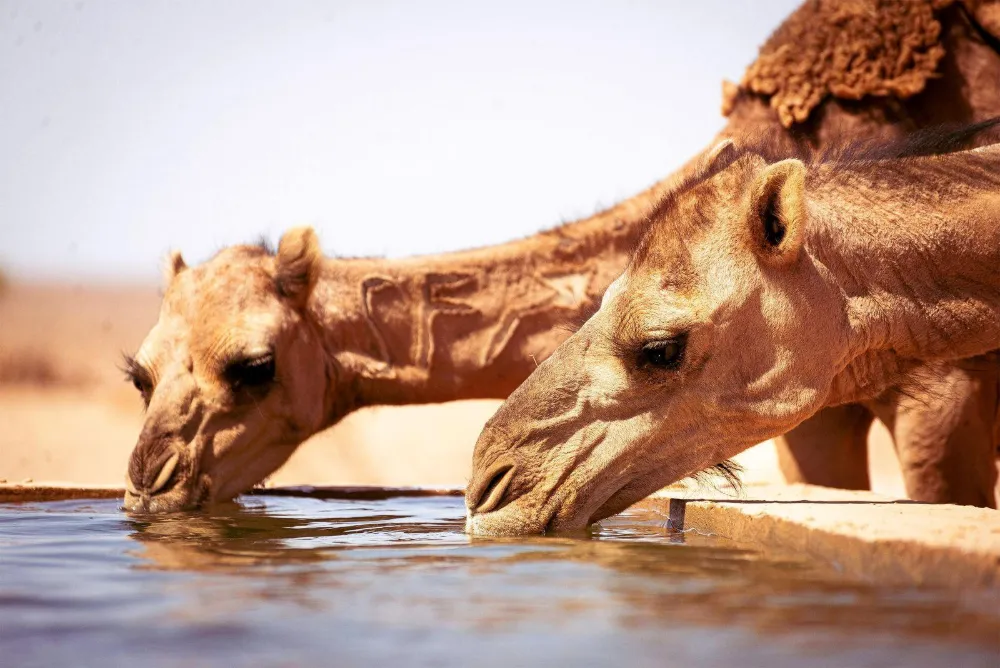
A severely dehydrated camel can drink an extraordinary amount of water very quickly.
In one controlled study, camels deprived of water for 11 days drank approximately 97 liters within a few minutes.
Other observations document roughly 100 liters or more during rapid rehydration.
The water is then absorbed quickly into the body.
This ability allows camels to replace a large fraction of their lost body water during a brief visit to a watering point.
Can a Camel Really Drink 100 Liters of Water?
Yes.
Large dehydrated camels have been documented drinking around 100 liters in a relatively short period.
However, the amount depends on:
body size;
degree of dehydration;
temperature;
diet;
and whether the animal is lactating.
A well-hydrated camel does not automatically drink 100 liters every time it reaches water.
Why Doesn't a Camel's Blood Become Too Diluted?
Rapid rehydration creates a difficult physiological problem.
After severe dehydration, a camel may suddenly introduce tens of liters of water into its digestive system.
Its circulatory and digestive systems are adapted to handle this rapid change much better than many other mammals.
Research shows that water is rapidly absorbed after drinking and that camel blood and hormonal systems adjust during rehydration.
This lets the animal recover from severe water loss remarkably quickly.
Can Camels Go Two Weeks Without Water?
Yes, under some conditions.
Scientific studies have subjected dromedary camels to approximately 14 days of water deprivation, and other controlled research has extended deprivation to 20 days.
However, those animals experienced substantial dehydration and physiological changes.
That means “a camel can survive two weeks without water” should not be interpreted as “two weeks without water is normal or harmless.”
Can Camels Go a Month Without Water?
Not normally in hot desert conditions without obtaining water from somewhere.
Claims that camels routinely survive a month or more without any water intake are usually oversimplified.
However, a camel feeding on moisture-rich green vegetation in mild weather may go a very long time without visiting a drinking source.
In that situation, it is still obtaining water through food.
So “not drinking from a waterhole” is not the same as “receiving no water at all.”
Do Dromedary and Bactrian Camels Differ?
Yes.
There are two main domestic camel species:
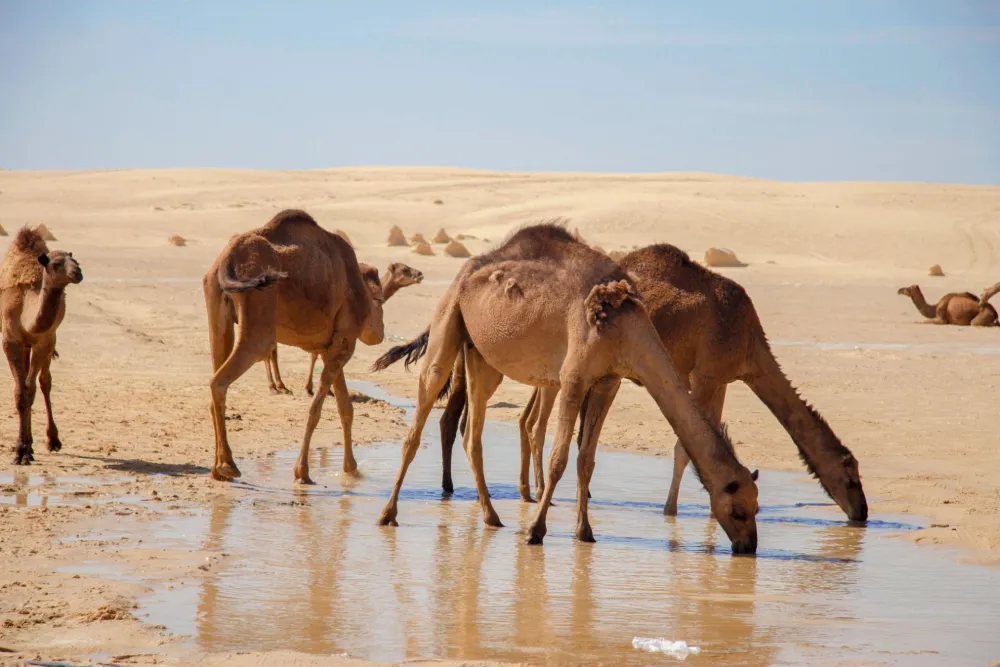
Dromedary camel (Camelus dromedarius) — one hump and strongly associated with hot deserts of Africa, Arabia and South Asia.
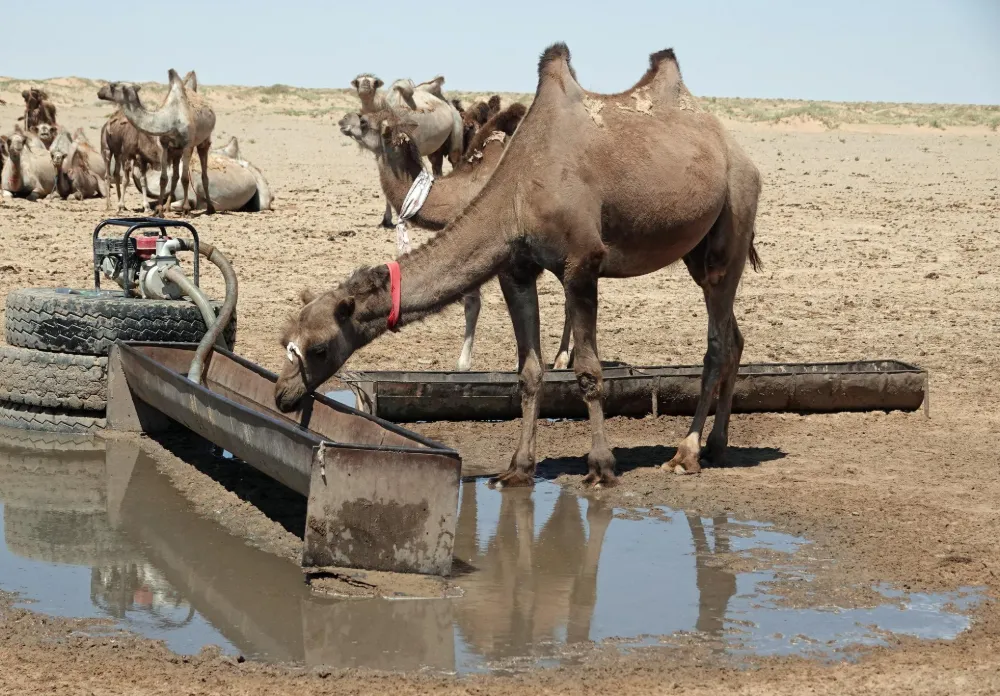
Domestic Bactrian camel (Camelus bactrianus) — two humps and adapted to colder, more continental environments of Central Asia.
Both conserve water exceptionally well.
FAO material reports that Bactrian camels may survive roughly two to three weeks without water in exceptional circumstances.
Environmental conditions make direct comparisons difficult.
Does a Camel's Hump Help It Survive Without Water?
Yes—but indirectly.
The hump stores fat.
When food is scarce, this fat can be metabolized for energy.
Fat metabolism also produces a small amount of metabolic water.
But this does not mean the hump acts like a canteen.
The camel's remarkable drought tolerance comes mainly from conserving body water and tolerating dehydration rather than from releasing stored liquid from the hump.
Do Camels Sweat?
Yes.
Camels are capable of sweating.
The myth that camels never sweat is incorrect.
The important adaptation is that a dehydrated camel can allow its body temperature to rise significantly before relying heavily on evaporative cooling.
This delays sweating and conserves water.
Do Camels Need Water Every Day?
No.
Healthy adult camels adapted to arid conditions do not necessarily need to drink every day.
That is one of the reasons they have been so valuable to people living in dry regions.
But domestic camels should still be given appropriate access to clean water whenever possible.
Survival adaptations are not a reason to intentionally keep animals dehydrated.
FAQ
How long can a camel survive without water?
In very hot conditions, approximately 7 to 10 days is a useful practical range. Camels can sometimes survive two weeks or longer under particular conditions, but severe dehydration causes physiological stress.
Can a camel go 40 days without water?
Not normally in hot desert conditions with no other source of water. Very long periods without directly drinking are more plausible in cool weather when camels obtain moisture from green forage.
Do camels store water in their humps?
No. Camel humps store fat, not liquid water.
How much water can a camel drink at one time?
A severely dehydrated camel may drink close to 100 liters or more in a short period. One controlled study recorded approximately 97 liters within a few minutes after 11 days without water.
Why can camels survive dehydration?
They conserve water through concentrated urine, dry feces, reduced evaporative loss, flexible body-temperature regulation and behavioral adaptations to desert heat.
Can camels survive two weeks without water?
Yes, this has been demonstrated under controlled conditions, but significant dehydration develops and it should not be considered harmless.
Do camels sweat?
Yes. They delay heavy sweating by allowing their body temperature to rise during the day, which helps conserve water.
How much body water can a camel lose?
Camels have survived dehydration associated with roughly 25 to 30 percent body-weight loss in scientific studies, much of it from water.
Which can go longer without water, a camel or a horse?
A camel. Camels possess far stronger physiological adaptations for conserving water and tolerating dehydration than horses.
Does the hump shrink when a camel is thirsty?
The hump changes mainly according to fat reserves rather than immediate hydration. A depleted or poorly nourished camel may have a smaller or leaning hump because stored fat has been used.
Final Answer
A camel can commonly go about 7 to 10 days without directly drinking water in hot desert conditions.
Some camels can survive two weeks or even longer under special circumstances, but there is no universal maximum.
The famous hump does not store water. It stores fat.
The real secret to camel survival is an entire collection of adaptations: highly efficient kidneys, extremely dry feces, reduced sweating, flexible body temperature, tolerance of major dehydration and the ability to drink enormous quantities very quickly once water becomes available.
That combination—not a hidden tank inside the hump—is what makes camels among the world's most remarkable desert mammals.
Related Reading
Sources Used for Fact Checking
FAO — The Camel and Its Adaptations to Arid Environments
Smithsonian's National Zoo — Camel Care and Hump Adaptations
Von Engelhardt et al. — Camel Water Deprivation and Rehydration
Goumi et al. — Hormonal Control During Camel Dehydration
PubMed — Long-Term Dehydration in Dromedary Camels