The Danger of ATO Malfunctions
An automatic top-off system is one of the most useful tools in modern reef aquariums, but it is also one of the few devices that directly controls the water level of your tank.
When an ATO fails, the consequences can range from minor inconvenience to major aquarium damage.
| ATO Problem | Possible Consequence |
|---|---|
| Overfilling | Diluted salinity, overflowing sump, water damage |
| Not adding water | Increasing salinity, stressed corals and marine animals |
| Pump running continuously | Burned-out pump, excessive freshwater addition |
| False sensor readings | Unstable aquarium conditions |
Saltwater aquariums are especially sensitive because evaporation removes freshwater but leaves dissolved salts behind. If evaporation is not replaced correctly, salinity gradually increases.
On the other hand, adding too much freshwater can suddenly lower salinity and disrupt the osmotic balance that reef organisms depend on.
Why Is My Aquarium ATO Beeping?
Most ATO systems use alarms to warn the owner about abnormal operation. A beeping alarm usually means the controller has detected one of these conditions:
Maximum pump running time exceeded
Water level did not change as expected
Sensor problem detected
Pump cannot deliver water
Reservoir emptied
Safety protection activated
The exact meaning depends on the manufacturer, but troubleshooting usually starts with the same basic checks.
Common Cause #1: Siphon Effect Causing Continuous Water Flow
The siphon effect is one of the most common and overlooked ATO problems.
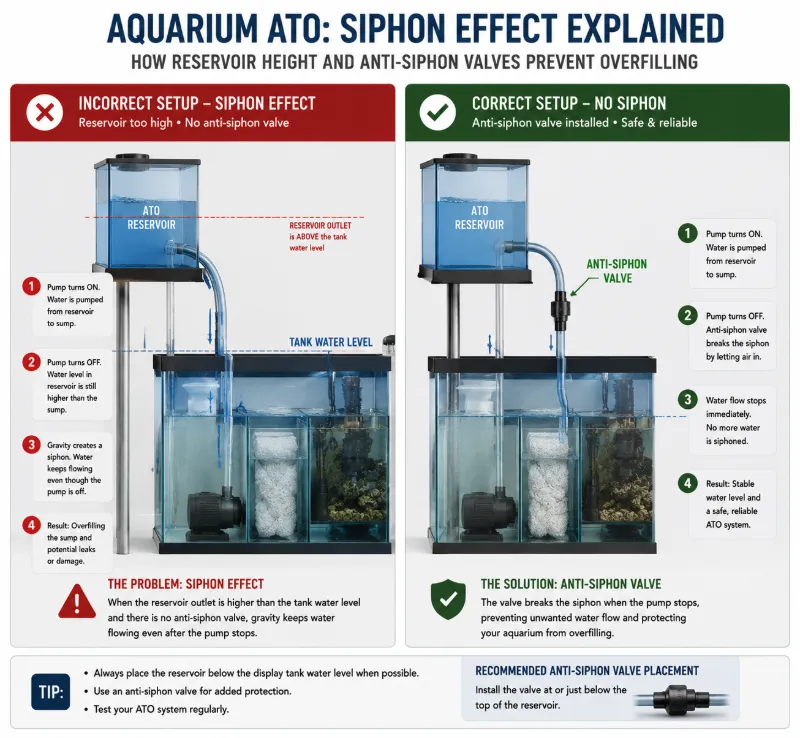
A siphon occurs when the refill tube from the freshwater reservoir is positioned incorrectly. If the tube outlet sits below the water level inside the reservoir, gravity can continue pulling water into the aquarium even after the pump stops.
This means the ATO pump may be working correctly, but water continues flowing because of the physical siphon created by the tubing.
Signs of a Siphon Problem
The aquarium continues filling after the pump turns off.
The ATO reservoir empties faster than expected.
The pump runs normally but water keeps entering the tank.
The controller reports repeated high-water alarms.
How to Fix the Siphon Effect
Check the position of the ATO refill tube.
Keep the tube outlet above the highest water level of the reservoir whenever possible.
Create an air gap between the tube end and aquarium water.
Install an anti-siphon valve if the tubing design requires it.
Why an Anti-Siphon Valve Helps
An anti-siphon valve allows air into the line when the pump stops, breaking the continuous water flow.
This simple accessory can prevent one of the most dangerous ATO failures because it stops freshwater from entering the aquarium uncontrollably.
Common Cause #2: Dirty Optical Sensor
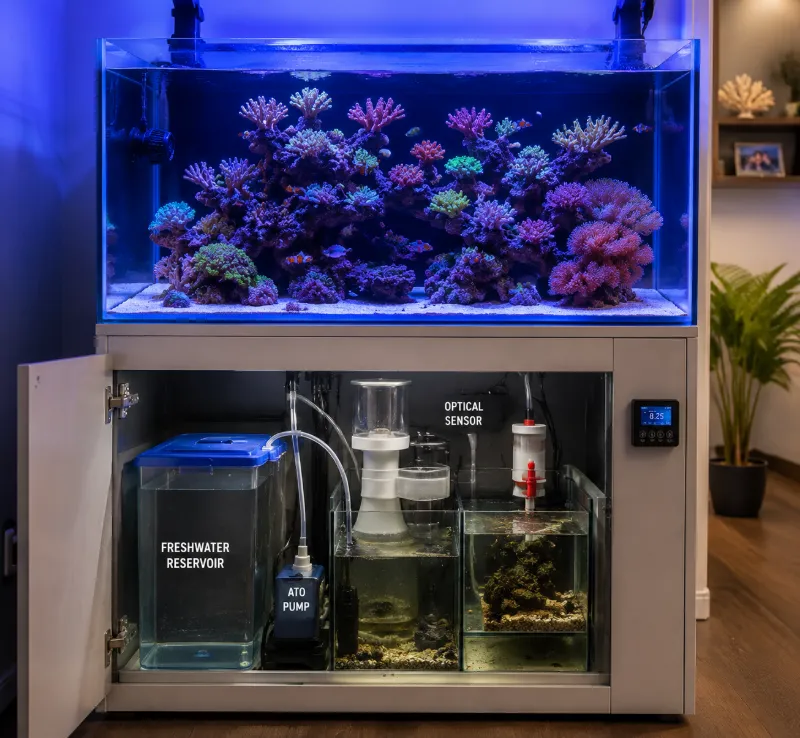
Many modern ATO systems use optical sensors instead of traditional mechanical floats. These sensors detect changes in water level by measuring light reflection.
Although optical sensors are accurate, they can become unreliable when covered with:
Algae growth
Salt creep
Mineral deposits
Biofilm
Protein residue
A dirty sensor may incorrectly detect that the water level is low, causing the ATO pump to continue running.
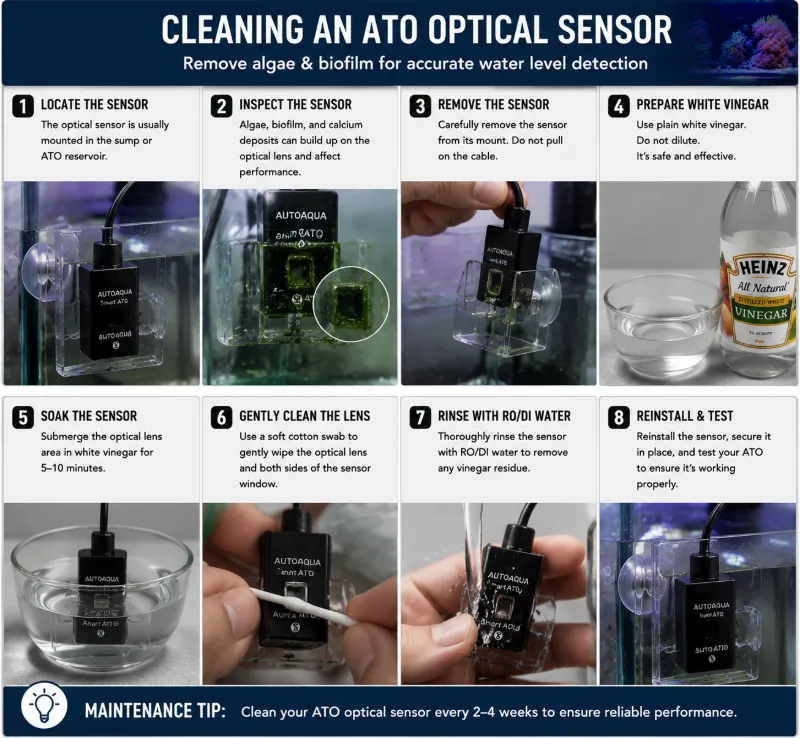
How to Clean an Optical Sensor
Turn off the ATO system.
Remove the sensor from the aquarium.
Inspect the optical surface for buildup.
Soak the sensor area in diluted white vinegar.
Gently wipe away deposits with a soft cloth or cotton swab.
Rinse thoroughly with freshwater.
Reinstall and test operation.
Never use aggressive cleaners or abrasive tools because scratches on optical surfaces can affect sensor accuracy.
Common Cause #3: Air Lock in the Micro Pump
If your ATO keeps beeping because the aquarium water level is low, the problem may not be the sensor. The small pump inside the freshwater reservoir may have lost its ability to move water.
A micro pump can develop an air lock when:
The reservoir becomes nearly empty.
The pump intake is exposed to air.
The tubing contains trapped air bubbles.
The pump was removed and reinstalled incorrectly.
How to Fix an ATO Pump Air Lock
Turn off the ATO controller.
Check that the pump is completely submerged.
Remove visible air bubbles from the tubing.
Confirm that the intake is not blocked.
Restart the system.
If the pump makes noise but no water moves, inspect the impeller for debris or mineral buildup.
Other ATO Problems and Solutions
| Problem | Possible Cause | Solution |
|---|---|---|
| ATO never turns on | Power issue or sensor detecting full level | Check power and sensor position |
| Pump runs but no water moves | Air lock or blocked tubing | Remove bubbles and clean pump |
| Frequent alarms | Sensor contamination | Clean optical sensor |
| ATO fills too much | Siphon effect | Add anti-siphon protection |
| ATO stops randomly | Controller safety timer activated | Check pump performance and water level change |
ATO Installation Mistakes That Cause Failures
1. Freshwater Reservoir Positioned Too High
A high reservoir can increase the risk of unwanted siphoning. Always consider the height relationship between the reservoir, tubing, and aquarium.
2. Refill Tube Placed Too Deep
The end of the refill tube should not create a continuous underwater connection that allows gravity to keep pulling water.
3. Sensor Installed Near Turbulence
Strong water movement from return pumps or wavemakers can cause unstable readings.
4. Ignoring Regular Cleaning
Even high-quality sensors require maintenance. Saltwater environments naturally create deposits over time.
How Often Should You Maintain an ATO?
| Maintenance Task | Recommended Frequency |
|---|---|
| Inspect sensor | Weekly |
| Clean optical sensor | Every few weeks or when buildup appears |
| Check tubing | Monthly |
| Clean pump | Every few months |
| Test alarm function | Regularly |
When Should You Replace Your ATO System?
If your ATO repeatedly overfills, produces unexplained alarms, or fails after cleaning and troubleshooting, replacement may be safer than continuing repairs.
This is especially true for older systems where:
The controller has become unreliable.
The pump repeatedly fails.
Sensors require frequent adjustment.
Replacement parts are difficult to find.
Best High-Reliability ATO Systems with Overflow Protection
1. AutoAqua Smart ATO Micro / Smart ATO Duo
Best for: Reef keepers wanting compact automatic operation with advanced sensor protection.
AutoAqua Smart ATO systems are popular among marine aquarium hobbyists because of their optical sensor technology, compact design, and built-in safety features.
Optical sensor technology
Automatic safety timer
Compact controller design
Designed for nano and medium reef systems
Low-maintenance operation
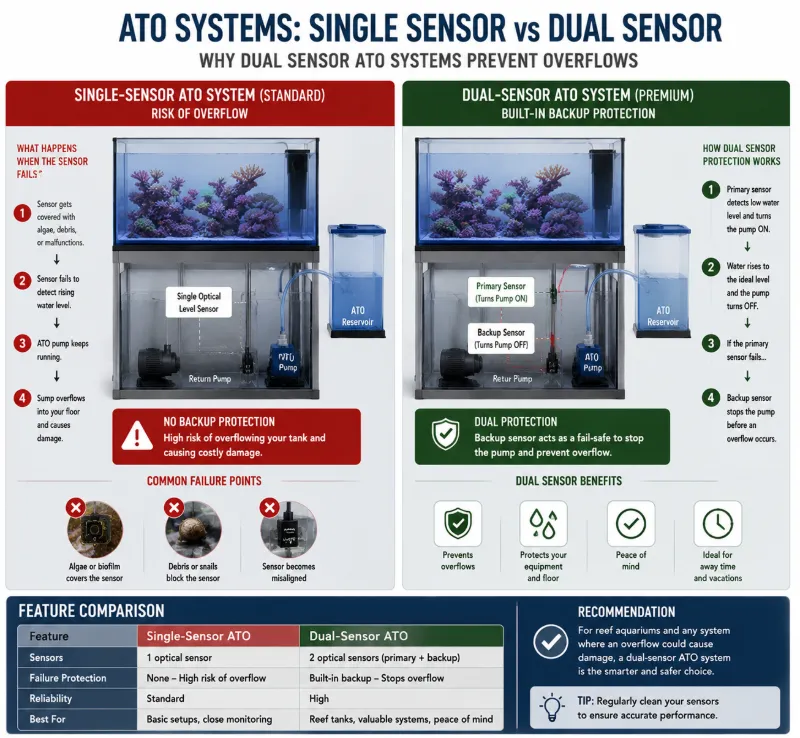
The Smart ATO Duo adds additional redundancy by using multiple sensing points, helping reduce the risk of a single sensor failure causing overfilling.
2. Tunze Osmolator Universal 3155
Best for: Premium reef systems where reliability is the highest priority.
The Tunze Osmolator is considered one of the most trusted ATO systems in the marine aquarium hobby. It uses a combination of sensors and safety controls designed to prevent runaway filling.
Dual-sensor safety design
Primary water-level sensor
Independent emergency sensor
Maximum pump running-time protection
Suitable for demanding reef aquariums
The additional safety layer makes it especially attractive for expensive reef systems where an ATO failure could cause significant livestock damage.
3. Neptune Systems ATK (Automatic Top-Off Kit)
Best for: Aquarists using Neptune Apex automation.
Optical sensors
Integrated Apex monitoring
Automatic shutoff protection
Remote aquarium alerts
Expandable aquarium automation
For hobbyists already invested in the Neptune ecosystem, integration and monitoring can provide an additional layer of confidence.
How to Choose a Safer ATO System
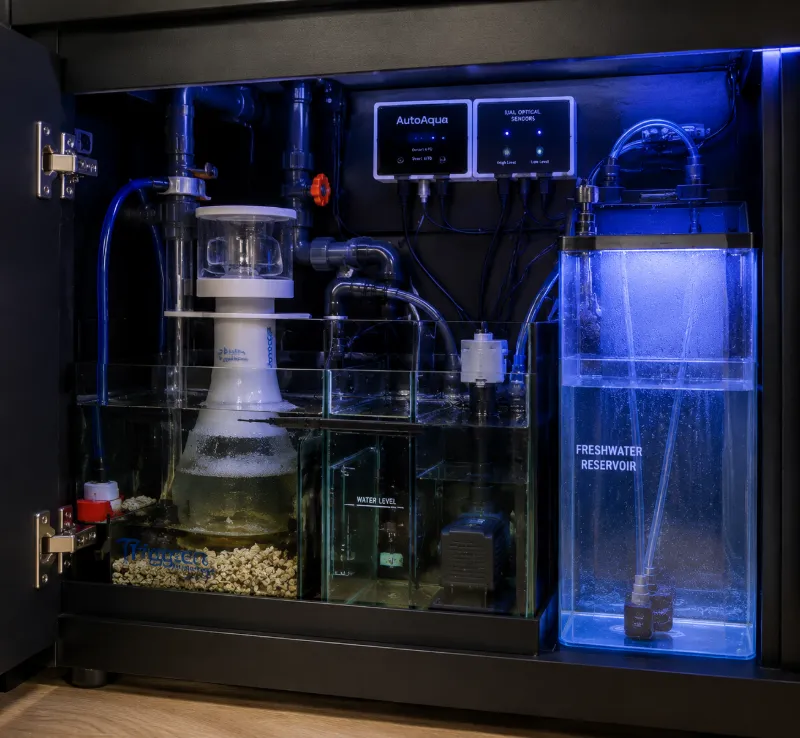
The most important features are not just convenience features. They are safety features.
Look for:
Dual sensors or backup protection
Maximum runtime cutoff
Reliable pump quality
Easy sensor cleaning
Replacement parts availability
Alarm notifications
Final Recommendation
A properly functioning ATO should quietly maintain water level without constant attention. If your system keeps beeping or overfilling, start with the most common causes: eliminate siphon effects, clean the optical sensor, and check the micro pump for air locks.
For valuable reef tanks, upgrading to a dual-sensor ATO system is often a worthwhile investment. Models such as the AutoAqua Smart ATO, Tunze Osmolator, and Neptune Systems ATK provide additional safety features designed to reduce the risk of freshwater accidents.
The best ATO is not simply the one that adds water automatically—it is the one that protects your aquarium when something goes wrong.
FAQs
Why does my ATO keep beeping?
A beeping ATO usually indicates a sensor problem, pump issue, empty reservoir, or safety timer activation. Check the sensor, tubing, and pump first.
Why is my ATO overfilling my aquarium?
The most common causes are siphon effects, dirty sensors, or failed water-level detection. An anti-siphon valve and proper tube placement can prevent many overflow problems.
How do I clean an ATO optical sensor?
Remove the sensor and clean mineral deposits or biofilm using diluted white vinegar and a soft cloth. Rinse thoroughly before reinstalling.
Can an ATO pump create a siphon?
Yes. Even when the pump stops, water may continue flowing if the tubing creates a continuous siphon path.
Are dual-sensor ATO systems safer?
Yes. Dual-sensor systems provide backup protection if the primary sensor becomes dirty, stuck, or inaccurate.
How often should I replace my ATO pump?
Small ATO pumps often last several years, but lifespan depends on usage, cleaning, and mineral buildup. Replace them if flow becomes weak or unreliable.