Quick answer: There is no official worldwide price ranking for goldfish, and individual value depends on variety, breeder, body shape, color, finnage, size, age, show quality, and rarity. Some of the most highly prized fancy goldfish varieties include Ranchu, Tosakin, Jikin, Oranda, Ryukin, Black Moor/Telescope, Bubble Eye, Celestial Eye, Pearlscale, and Pompon. Exceptional show-quality individuals from respected bloodlines can command far more than ordinary pet-store fish, but fixed claims such as “this breed always costs $15,000” or “this variety is worth $70,000” are not reliable without a documented sale.
Goldfish are all domesticated forms of Carassius auratus. In the hobby, the word variety is usually more accurate than “species,” and many named color forms or breeder strains exist within a recognized variety. This guide focuses on established varieties recognized by goldfish societies rather than unverified internet price lists.
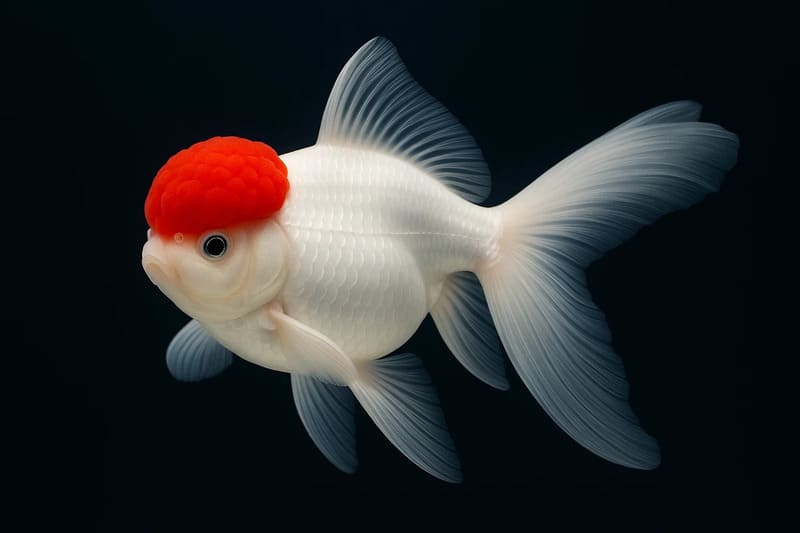
High-quality Orandas are valued for balanced body shape, finnage, and well-developed head growth. Redcap Orandas have a white body with red head growth concentrated on the crown.
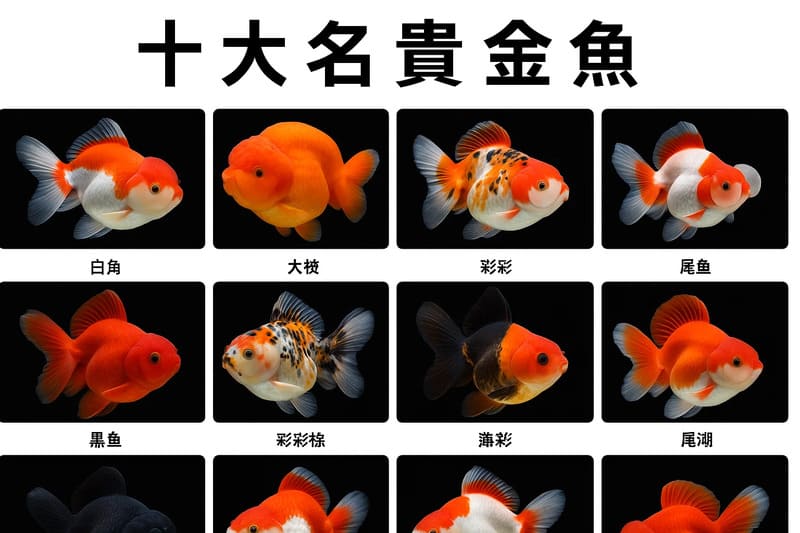
10 Valuable Goldfish Varieties at a Glance
| Goldfish variety | Defining feature | Why collectors value it | Availability |
|---|---|---|---|
| Ranchu | No dorsal fin, rounded back, head growth | Highly developed show standards and prized body form | Common as a type; elite specimens are much rarer |
| Tosakin | Single fused double tail spreading forward | Distinctive top-view form and demanding breeding standard | Uncommon to rare outside specialist circles |
| Jikin | X-shaped tail, traditionally white body with red points | Strict coloration and unusual tail conformation | Uncommon |
| Oranda | Dorsal fin plus prominent head growth | Wide range of show strains and dramatic wen development | Common overall; top show fish are selective |
| Ryukin | Deep body with pronounced shoulder hump | Powerful body profile and elegant double tail | Widely available, but elite specimens are selective |
| Black Moor / Telescope | Protruding telescope eyes | Strong visual identity and difficult color/shape consistency | Common as pets; high-quality show forms less common |
| Bubble Eye | Large fluid-filled sacs beneath the eyes | Extreme specialized form requiring careful selection | Specialist variety |
| Celestial Eye | Upturned telescopic eyes, no dorsal fin | Unusual form and relatively limited mainstream availability | Uncommon |
| Pearlscale | Raised pearl-like scales and rounded body | Distinctive scale texture and compact show form | Moderately available |
| Pompon | Enlarged frilly nasal septa | Rare ornamental feature and traditional show interest | Less common |
Important: this is not a fixed auction-price ranking. A mediocre Ranchu may sell for less than an exceptional Oranda, and a champion fish with documented breeder provenance may be worth far more than a typical example of the same variety.
What Is the Most Expensive Goldfish?
There is no permanently recognized “most expensive goldfish breed” because goldfish are usually sold as individual animals rather than standardized commodities.
Price depends on factors such as:
body proportions and conformation;
tail shape and symmetry;
head growth in varieties such as Oranda and Ranchu;
color quality and pattern;
size and age;
rarity of the variety in a particular country;
breeder reputation and bloodline;
show awards or competition potential;
health and swimming ability.
For that reason, claims that one named goldfish “always costs $40,000” or that another “normally costs $15,000” should be treated cautiously unless the source documents a real sale, auction, breeder, date, and individual fish.
Ranchu
Ranchu are among the most famous high-end fancy goldfish and are especially important in Japanese and Asian show culture.
The variety has no dorsal fin. A good specimen has a smooth curved back, a broad body, strong peduncle, balanced tail placement, and well-developed head growth. Show standards differ somewhat between top-view and side-view traditions.
Ranchu value can vary enormously. Pet-quality fish are widely available, while carefully bred show-quality fish with excellent conformation may be far more valuable.
The key point is that “Ranchu” itself does not determine price. Individual quality does.
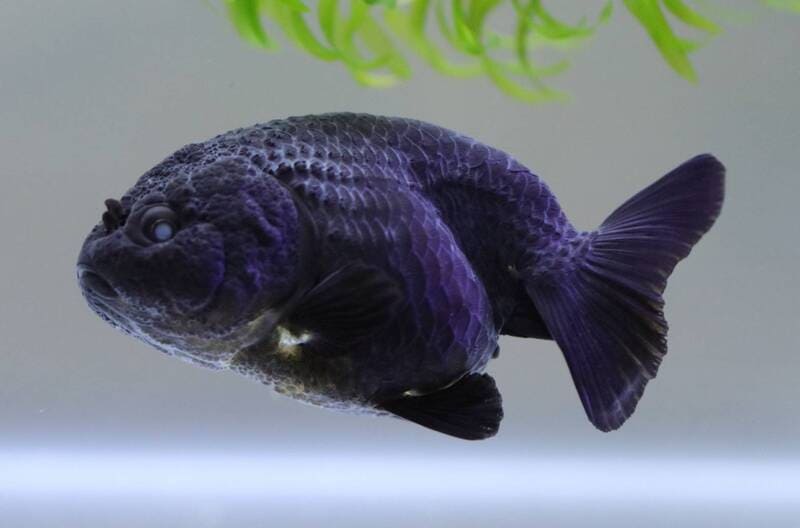
Ranchu are judged heavily on body contour, tail position, head growth, balance, and overall swimming form rather than color alone.
Tosakin
Tosakin are one of the most distinctive Japanese goldfish varieties.
Their defining feature is the caudal fin. Instead of trailing straight behind the body, the fused double tail spreads horizontally and curls forward at the outer edges, creating a dramatic shape when viewed from above.
The Goldfish Society of Great Britain notes that Tosakin were traditionally kept in shallow water, partly because their unusual tail makes swimming more difficult.
Tosakin are not as commonly encountered in ordinary aquarium stores as Fantails, Orandas, or Black Moors. Their unusual morphology and specialist breeding tradition help explain why high-quality examples attract serious collectors.
Jikin
Jikin are another Japanese variety with a highly recognizable standard.
The tail spreads into an X shape when viewed from behind. Traditional show fish are predominantly white with red restricted to specific points such as the lips and fins.
This strict pattern makes producing ideal specimens more difficult than simply breeding a red-and-white goldfish.
Bristol Aquarists' Society describes Jikin as rare in the United Kingdom and less common in several other regions. Rarity by itself does not guarantee a high price, but limited availability can increase collector interest.
Oranda
Orandas combine a dorsal fin with prominent head growth known as the wen or hood.
The variety includes many color and body strains. Goldfish Council standards recognize categories including metallic Orandas, Red Cap Orandas, Calico Orandas, and Azuma Nishiki.
High-quality Orandas are selected for balance between the body, tail, dorsal fin, and head growth. Excessive or uneven wen development can obstruct vision or interfere with normal function, so bigger head growth is not automatically better.
The redcap form is one of the best-known Oranda patterns: the body is white while the red head growth is concentrated on the top of the head.
Because Orandas are widely bred internationally, ordinary specimens may be affordable, while selected large show-quality fish from respected breeders can be much more expensive.
Ryukin
Ryukin are deep-bodied fancy goldfish known for a pronounced shoulder hump behind the head and a high, compact body.
The tail may be short or long depending on strain and show tradition. High-quality specimens are prized for a strong body profile, symmetrical tail, upright dorsal fin, and balanced movement.
Ryukin are not inherently rare, which is another reason a “most expensive breed” list can be misleading. The difference between an ordinary pet-quality Ryukin and an elite competition-quality animal can be substantial.
Black Moor and Telescope Goldfish
Black Moor goldfish are a dark-colored telescope-eye variety. Their protruding eyes are the defining feature, while good Black Moors also maintain deep black coloration and balanced finnage.
Bristol Aquarists' Society describes the traditional Moor as a veiltail-type fish with telescopic eyes and deep velvety black coloration.
Black color can change as goldfish mature, and some fish develop bronze, orange, or lighter areas. For breeders seeking a strong show-standard Black Moor, stable dark coloration is therefore an important selection trait.
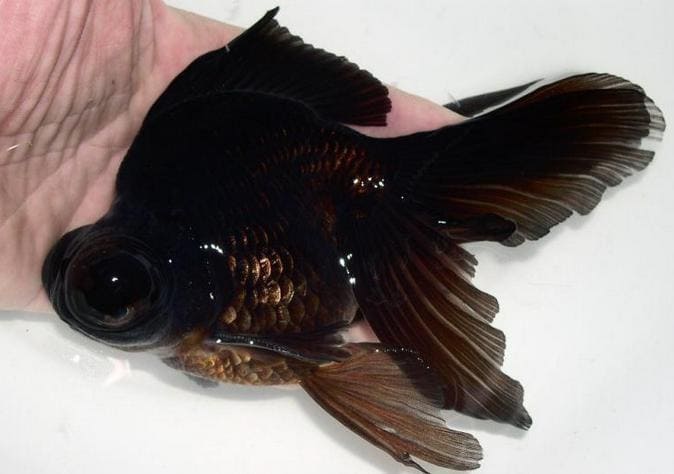
Black Moors belong to the telescope-eye group. Exceptional specimens are selected for eye symmetry, body form, finnage, and stable dark coloration.
Bubble Eye
Bubble Eye goldfish have large fluid-filled sacs beneath the eyes and usually lack a dorsal fin.
The sacs are delicate and can be injured by sharp decorations, aggressive tankmates, or strong equipment intakes. This means the extreme feature that makes the variety visually distinctive also creates special welfare and husbandry considerations.
From a show perspective, breeders look for symmetry in the eye sacs, balanced body shape, and correct finnage.
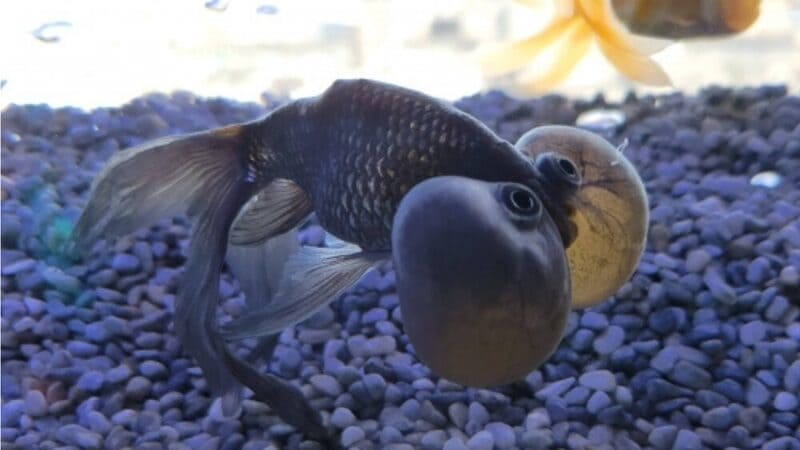
Bubble Eye goldfish have extremely specialized eye sacs, making both symmetry and careful husbandry especially important.
Celestial Eye
Celestial Eye goldfish have protruding eyes that point upward and a body without a dorsal fin.
They are one of the more unusual traditional fancy varieties and are less common in many mainstream aquarium stores than Fantails, Orandas, or Black Moors.
As with Bubble Eyes, unusual eye structure affects normal vision and should be considered from a welfare perspective as well as an ornamental one.
A rare appearance does not automatically make every Celestial expensive, but well-bred specimens that closely match show standards may attract specialist buyers.
Pearlscale
Pearlscale goldfish are recognized by raised, domed scales that create a pearl-like texture over a compact, rounded body.
Bristol standards describe the body as approaching a sphere, with the unusual scale structure as the defining feature.
Collectors look for even scale development, a balanced round body, correct fins, and healthy movement.
Pearlscales can be found in several colors and patterns. Some specialist head-growth forms are also produced, but not every novelty name represents a separate standardized breed.
Pompon Goldfish
Pompon goldfish are named for the enlarged frilly nasal septa that form pompon-like growths near the nostrils.
They may be metallic or calico and can occur in different body forms depending on breeding tradition.
The nasal growth should be balanced and should not be confused with the wen of an Oranda or Lionhead. It develops from tissue associated with the nostrils rather than from the top of the head.
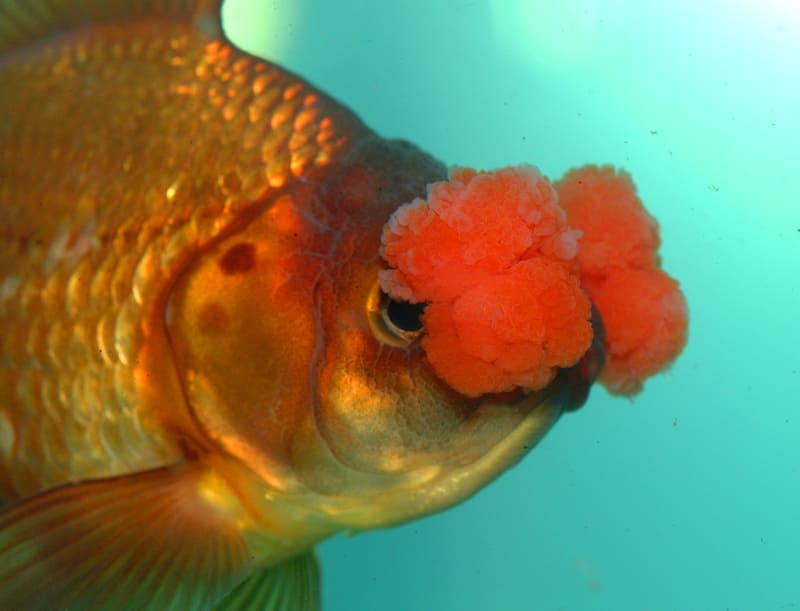
Pompon goldfish are defined by enlarged nasal growths rather than the head wen seen in Orandas and Ranchu.
Why Some Goldfish Cost Much More Than Others
Show Quality
Goldfish competitions use detailed variety standards. Body depth, back curvature, tail angle, eye position, head growth, scale quality, color, and swimming balance can all influence how a fish is judged.
Two fish sold under the same variety name can therefore have dramatically different collector value.
Breeder Reputation
Established breeders may spend generations refining a line for body shape, color stability, tail form, or head growth. Proven bloodlines can carry more value than mass-produced fish with unknown ancestry.
Rarity in a Particular Market
A fish that is common in East Asia may be difficult to obtain in Europe or North America, and the reverse can also occur.
Import costs, transport risk, legal requirements, and limited breeder availability can increase price without changing the biology of the variety.
Age and Size
Large, mature fancy goldfish represent years of feeding, water management, selection, and space. Older fish that retain strong conformation and color can therefore be more valuable than small juveniles.
Color and Pattern
Some show standards favor very specific color placement. Jikin provide a good example because traditional red-and-white patterning is tightly defined.
However, attractive color alone cannot compensate for poor body structure, damaged fins, weak swimming, or health problems in a serious show fish.
Are Purple Robe, Jade Seal, and Similar Names Official Goldfish Breeds?
Not necessarily.
Goldfish keeping has a long history in China, Japan, and other parts of Asia, and breeders create many local strains, color forms, marketing names, and descriptive names.
A name used by one breeder, market, social-media account, or regional hobby community may refer to a particular strain rather than an internationally standardized variety.
This is why names such as “Purple Robe with Red Cap,” “Jade-Seal Head,” or other translated Chinese trade names should not automatically be presented as globally recognized breeds with fixed market prices.
When comparing goldfish internationally, recognized categories such as Ranchu, Oranda, Ryukin, Tosakin, Jikin, Telescope, Bubble Eye, Celestial, Pearlscale, and Pompon provide a more stable framework.
Is a Redcap Oranda the Same as a Red-Crowned Crane Goldfish?
The widely recognized English variety name is Redcap Oranda.
It has a white or silvery body with red head growth concentrated on the crown. Descriptive names comparing the fish to a red-crowned crane may appear in translation or regional hobby usage, but “Redcap Oranda” is the clearer standard English term.
Is Black Ranchu a Separate Breed?
Black Ranchu are Ranchu selected for black coloration. They are not a separate biological species.
Within the goldfish hobby, color strains can become highly specialized, and some breeders maintain distinct lines. However, the underlying show variety remains Ranchu.
This distinction is useful because internet lists often turn every color strain into a separate “breed,” making the total number of goldfish breeds appear much larger than recognized show standards support.
How Much Does a Rare Goldfish Cost?
There is no single answer. Goldfish prices range from inexpensive pet-store animals to costly imported or show-quality specimens.
Before trusting a dramatic price claim, ask:
Was this a documented sale or only an asking price?
Which breeder produced the fish?
What variety and bloodline was it?
Was it an award-winning show fish?
What size and age was it?
Did the price include international shipping or import costs?
Without those details, a precise dollar figure is usually not meaningful.
Goldfish vs Koi: Which Is More Expensive?
Exceptional koi can sell for extremely high prices at major auctions, and verified high-value koi sales are much more widely documented than sensational goldfish price claims.
Goldfish and koi are different domesticated fish with different show cultures. A large koi auction price should not be used as evidence for the value of a goldfish variety.
Do Expensive Goldfish Need Special Care?
The price of a fish does not change its basic biological needs.
Goldfish require substantial water volume, effective filtration, oxygenation, stable water quality, and appropriate food. The RSPCA specifically warns against small bowls and notes that goldfish need far more water than many new keepers expect.
Fancy goldfish can be less robust than common single-tailed forms because selective breeding has emphasized unusual body shapes, eyes, fins, scales, or head growth.
Very expensive fish are therefore not suitable for an undersized ornamental bowl simply because they are valuable.
Are Fancy Goldfish Healthy?
Some fancy varieties can live healthy lives when well bred and properly cared for, but extreme traits may increase welfare risks.
The RSPCA notes that selective breeding can make fancy goldfish more vulnerable to inherited health problems. Traits such as extreme eye structures, very short bodies, oversized head growth, or unusual fins can affect swimming, feeding, vision, or injury risk.
A responsible buyer should therefore prioritize health, balanced conformation, normal swimming, and good husbandry over the most exaggerated appearance.
Frequently Asked Questions
What is the most valuable goldfish breed?
There is no official global ranking. Ranchu, Tosakin, Jikin, Oranda, and other high-quality fancy varieties can all be valuable, but the price depends more on the individual fish, breeder, rarity, and show quality than on the variety name alone.
What is the most expensive goldfish ever sold?
Many dramatic goldfish price claims circulate online, but they often lack a verifiable auction record, breeder, date, or sale documentation. It is safer to discuss individual documented sales rather than declare an unsupported world record.
Why are Ranchu goldfish expensive?
High-end Ranchu require careful selective breeding for back shape, head growth, tail placement, body balance, and swimming form. Elite show-quality specimens are much harder to produce than ordinary pet-quality Ranchu.
Are Tosakin goldfish rare?
They are relatively uncommon outside specialist breeding circles. Their highly unusual tail form and top-view standard make them much less common than Fantails or Orandas.
Are Jikin goldfish rare?
They are considered uncommon or rare in some countries. Their distinctive X-shaped tail and strict traditional red-and-white color pattern increase breeder selectivity.
Is a Black Moor a Telescope goldfish?
Yes. The Black Moor is a dark-colored telescope-eye variety characterized by protruding eyes and traditionally deep black coloration.
Is a Redcap Oranda the same as a Red-Crowned Crane goldfish?
“Redcap Oranda” is the widely recognized English variety name. Red-crowned-crane descriptions are often regional or translated names for the white-bodied Oranda with red head growth.
How long do goldfish live?
With appropriate care, goldfish can live far longer than the few years often associated with bowls. RSPCA guidance notes that goldfish are known to live for up to around 25 years.
Can expensive goldfish live in a bowl?
No. A high price does not reduce space or water-quality needs. Bowls are too small and unstable for proper long-term goldfish care.
Are goldfish breeds different species?
No. Fancy goldfish varieties are domesticated forms of the same species, Carassius auratus. Their dramatic differences come from centuries of selective breeding.
Reference Sources
Final Takeaway
There is no trustworthy fixed ranking of the world's most expensive goldfish breeds. The most collectible fish are usually exceptional individuals from established fancy varieties such as Ranchu, Tosakin, Jikin, Oranda, Ryukin, Telescope, Bubble Eye, Celestial Eye, Pearlscale, and Pompon.
For SEO and for readers, the useful distinction is simple: a variety name tells you what type of goldfish you are looking at, while individual quality, breeder reputation, rarity, size, health, and show standard determine value. That is much more reliable than repeating unsupported five-figure prices attached to translated strain names.