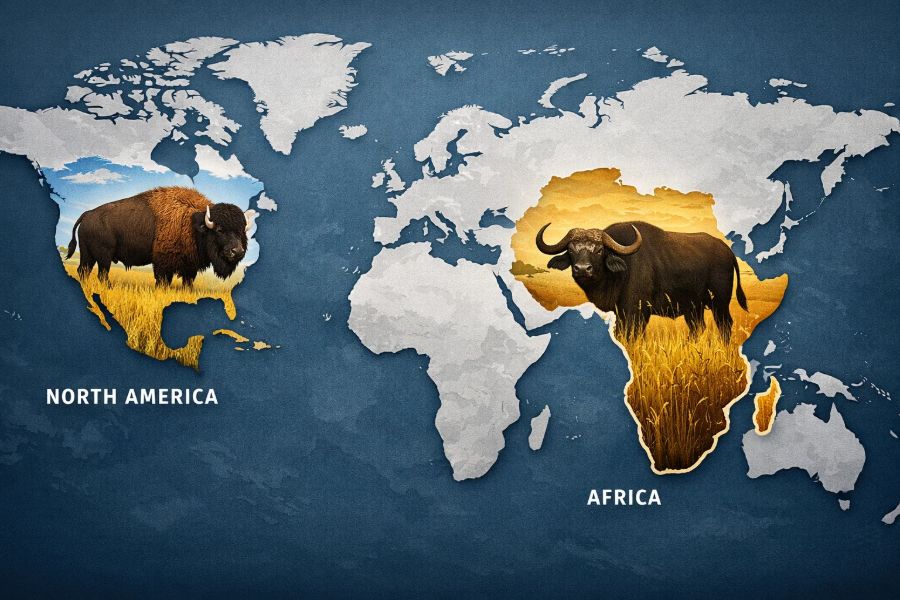
Bison and buffalo are different animals, and the names get mixed up because “buffalo” became a common nickname for bison in North America.
The simplest answer
Bison = the shaggy, hump-backed animals of North America and parts of Europe (American bison and European bison/wisent).
Buffalo = African buffalo (Cape buffalo) and Asian buffalo (water buffalo)—different species in different genera.

Quick comparison
| Feature | Bison (e.g., American bison) | Buffalo (African or water buffalo) |
|---|---|---|
| Where they naturally live | North America (and Europe for wisent) | Africa (Cape buffalo) / Asia (water buffalo) |
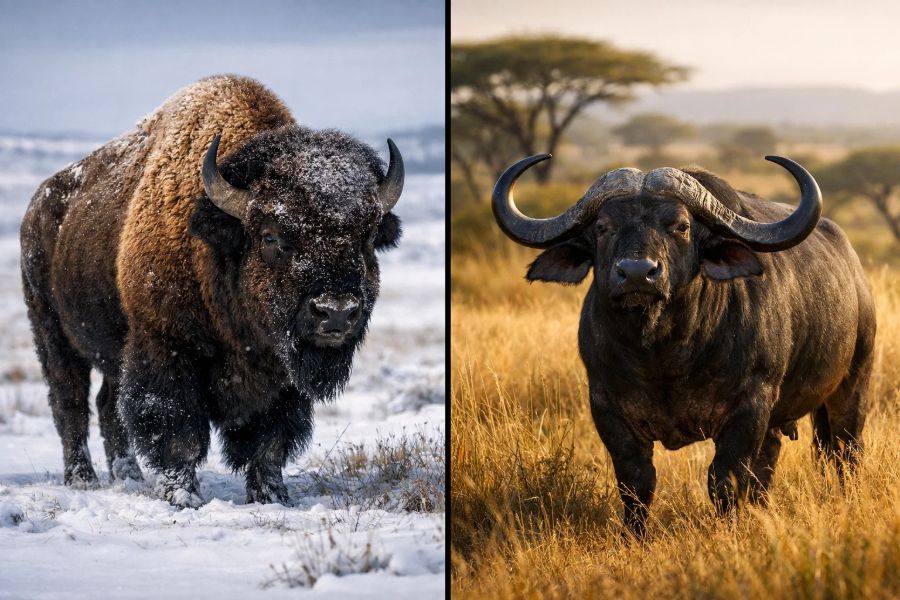
| Body silhouette | Big shoulder hump, front-heavy | No big hump, more even profile |
| Coat | Thick, shaggy fur, especially head/shoulders | Shorter hair (water buffalo can look sparse-haired) |
| Head & shoulders | Massive head, thick neck | Less shaggy head; overall sleeker look |
| Horns | Shorter, curved, usually not wide-spreading | Often longer and wider; African buffalo can have a heavy “boss” at the base |
| Domestication | Not truly domesticated (though ranched) | Water buffalo are widely domesticated (milk, meat, work) |
| Scientific grouping | Genus Bison | Genus Syncerus (African) / Bubalus (water buffalo) |
Visual “tell” in 2 seconds
If it has a huge shoulder hump and looks like it’s wearing a winter coat year-round → bison.
If it has big sweeping horns and a smoother body line → buffalo.
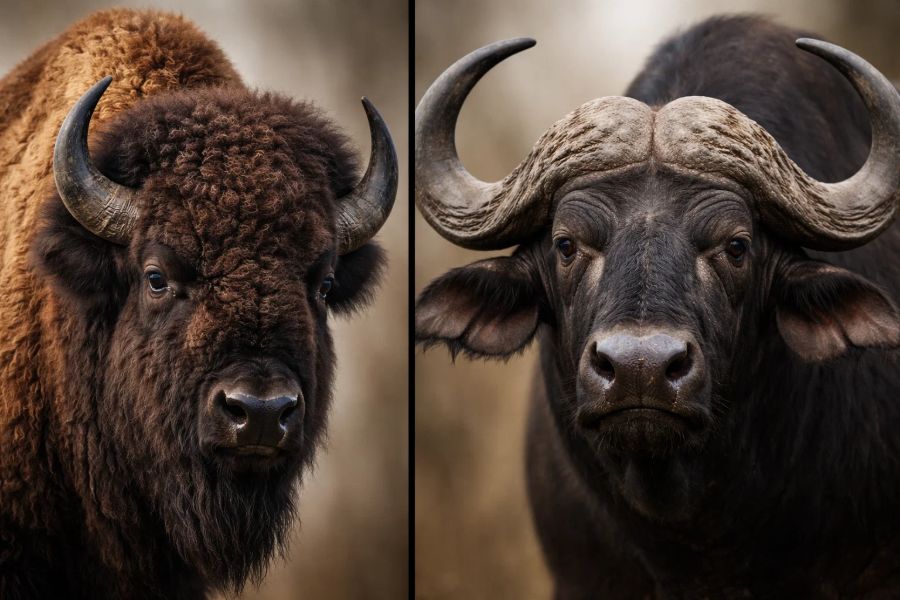
Why people say “buffalo” in North America
Early settlers and traders commonly called American bison “buffalo,” and the nickname stuck—hence names like Buffalo, New York and “buffalo nickel.”
If you want, describe the animal you saw (location + horn shape + whether it had a hump), and I’ll tell you which it most likely was.