Zebra stripes are one of nature’s most recognizable patterns—and one of the most tested in modern behavioral ecology. Over the last two decades, researchers have systematically evaluated the classic ideas (camouflage, predator confusion, social recognition, thermoregulation) against field data and experiments. The consensus emerging from this work is clear:
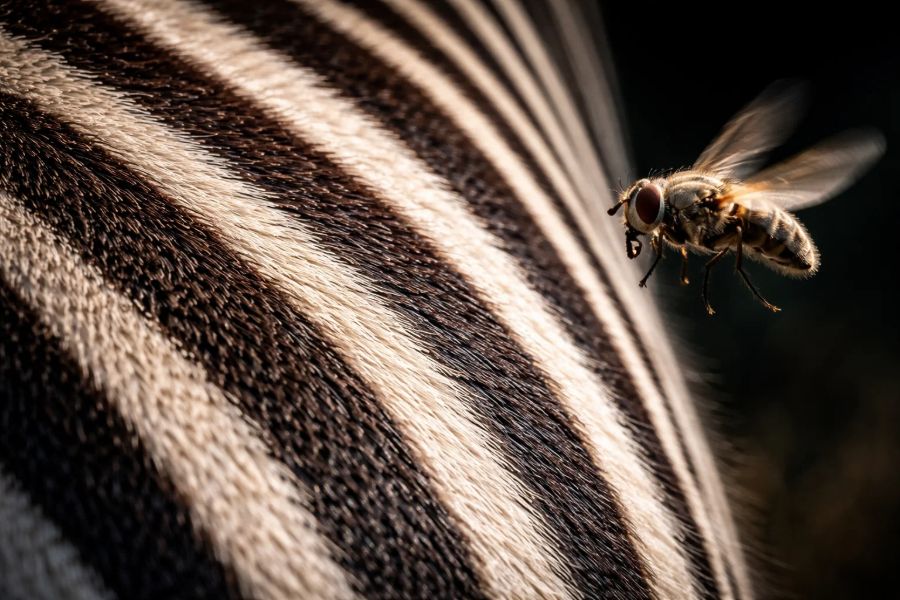
The strongest supported primary function of zebra stripes is deterring biting flies—especially horseflies (tabanids) and potentially other blood-feeding flies that harass zebras and can transmit disease.
That doesn’t mean stripes can’t have secondary effects. But when you ask “why did stripes evolve?”, the weight of evidence points most strongly to fly pressure rather than predators or temperature control.

1) The leading hypothesis: stripes reduce biting fly landings
The key finding
In controlled and semi-natural experiments, biting flies are attracted toward zebras and horses similarly from a distance, but they land far less successfully on striped surfaces. In other words, stripes don’t necessarily stop flies from approaching—but they disrupt the final “touchdown.”
What the experiments show
Researchers tested fly behavior around:
real zebras vs horses,
horses wearing striped coats vs solid coats,
and patterned panels/rugs in experimental setups.
Across these designs, a consistent pattern appears: stripes reduce or prevent controlled landings, leading to more “bump-and-go” contacts rather than feeding.
Why landing disruption matters biologically
For a zebra, “a few fewer bites” is not trivial:
it reduces blood loss and irritation (which affects feeding time and vigilance),
and may reduce exposure to fly-borne pathogens in landscapes where biting flies are abundant.
2) How might stripes repel flies? The best-supported mechanism is close-range visual disruption
Biting flies use multiple cues (odor, movement, contrast, heat) to locate hosts. The stripe effect appears strongest at close range, which narrows the likely mechanisms.
A) “Bad runway” effect (flight control failure)
High-contrast stripes may interfere with a fly’s visual control systems during the final approach, making it harder to decelerate and land smoothly. This is supported by detailed video analyses showing different approach and contact patterns on striped vs non-striped targets.
B) The “aperture effect” and motion processing
One proposed explanation is that repetitive stripes can scramble motion perception in insects (and other visual systems), affecting how they judge speed and distance during landing. Experimental work has tested stripe-like patterns and reported reduced landing/approach performance under certain conditions.
C) Polarized light hypotheses (still debated)
Some biting flies are attracted to polarized light reflections. Zebra stripes may reduce or alter polarized reflections compared with uniform dark coats—but quantitative analyses and experiments suggest polarization alone is unlikely to be the entire story for why zebras evolved stripes.
Bottom line: most evidence points to a close-range visual mechanism that disrupts landing, not simply a long-distance repellent effect.
3) Why not camouflage? Predator-vision studies say “unlikely”
A long-standing idea is that stripes camouflage zebras or confuse predators. But when researchers model what stripes look like through predator vision at realistic distances, the camouflage explanation performs poorly.
A predator-vision analysis concluded it is highly unlikely that zebra stripes primarily evolved as anti-predator camouflage.
Additional work and summaries from the same research tradition report no support for camouflage as the main driver.
This doesn’t mean stripes can’t create visual effects under some conditions; it means the best data do not support camouflage as the main evolutionary reason.
4) Thermoregulation: interesting, but not the best-supported driver
Another famous hypothesis is that stripes help zebras manage heat (by altering surface temperatures and air flow). This idea continues to be tested and debated, but recent scholarly discussion treats it as less supported than fly deterrence, and evidence remains mixed across methods and conditions.
A fair scientific stance is:
thermoregulation might offer small or context-dependent benefits,
but it does not explain the overall pattern as strongly as biting-fly selection does.
5) Social signaling and individual recognition: plausible secondary roles
Zebras can likely recognize one another using multiple cues (vision, smell, sound). Stripes could help with individual identification at close range, but this hypothesis has less direct experimental support as a primary evolutionary driver compared with the biting-fly evidence.
Many traits in nature end up doing more than one job; the key is distinguishing:
primary selection pressure (what most strongly drove evolution), from
secondary uses (what the trait can also help with once it exists).
6) Evidence scorecard table: the main hypotheses compared
| Hypothesis | What it predicts | What studies find | Current support |
|---|---|---|---|
| Biting-fly deterrence | Fewer bites/landings on striped coats; strongest effect where biting flies are common | Strong experimental support: flies approach but land less; patterned targets reduce successful landings | High |
| Camouflage / predator avoidance | Stripes reduce detectability or targeting by predators | Predator-vision modeling and field reasoning find camouflage unlikely as main function | Low |
| Predator confusion (“dazzle”) | Stripes disrupt predator pursuit and capture success | Some theoretical/experimental work on motion dazzle exists, but zebra-specific evolutionary support is weaker than fly evidence | Low–moderate (not primary) |
| Thermoregulation | Stripes measurably improve cooling or heat handling | Mixed results; debated; not as consistently supported as fly deterrence | Moderate–low |
| Social recognition | Stripes improve individual recognition or group cohesion | Plausible, but limited direct evidence as the main driver | Low–moderate (secondary possible) |
7) So why zebras and not all horses?
Evolution is about local costs and benefits. Zebras evolved in regions and ecological contexts where biting fly pressure is intense, and the repeated experimental pattern—stripes reduce fly landings—provides a clear route for natural selection to favor striping even if it carries small costs (visibility, development, etc.).
A concise modern answer is:
Zebra stripes are an evolutionary “anti-fly technology” that works at close range by disrupting how biting flies land.
References (cited)
Caro, T. et al. (2014). The function of zebra stripes. Nature Communications.
Caro, T. et al. (2019). Benefits of zebra stripes: Behaviour of tabanid flies around zebras and horses. PLOS ONE 14(2): e0210831.
How, M. J. & colleagues (2020). Zebra stripes, tabanid biting flies and the aperture effect. Proceedings of the Royal Society B.
Tombak, K. J. et al. (2022). Zebras of all stripes repel biting flies at close range. Scientific Reports.
Britten, K. H. et al. (2016). Zebras and Biting Flies: Quantitative Analysis of Reflected Light… PLOS ONE.
Melin, A. D. et al. (2016). Zebra stripes through the eyes of their predators… PLoS ONE / Vision modeling (open access on PMC).
Ireland, H. M. (2025). Zebra stripes: the questions raised by the answers. Review (PMC).
UC Davis (2016). Zebra stripes not for camouflage, new study finds.