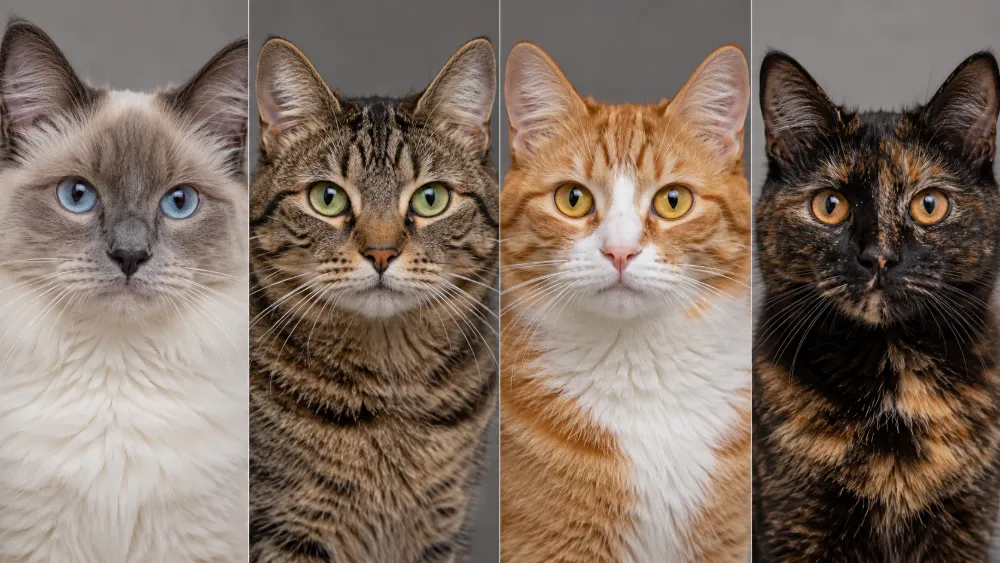
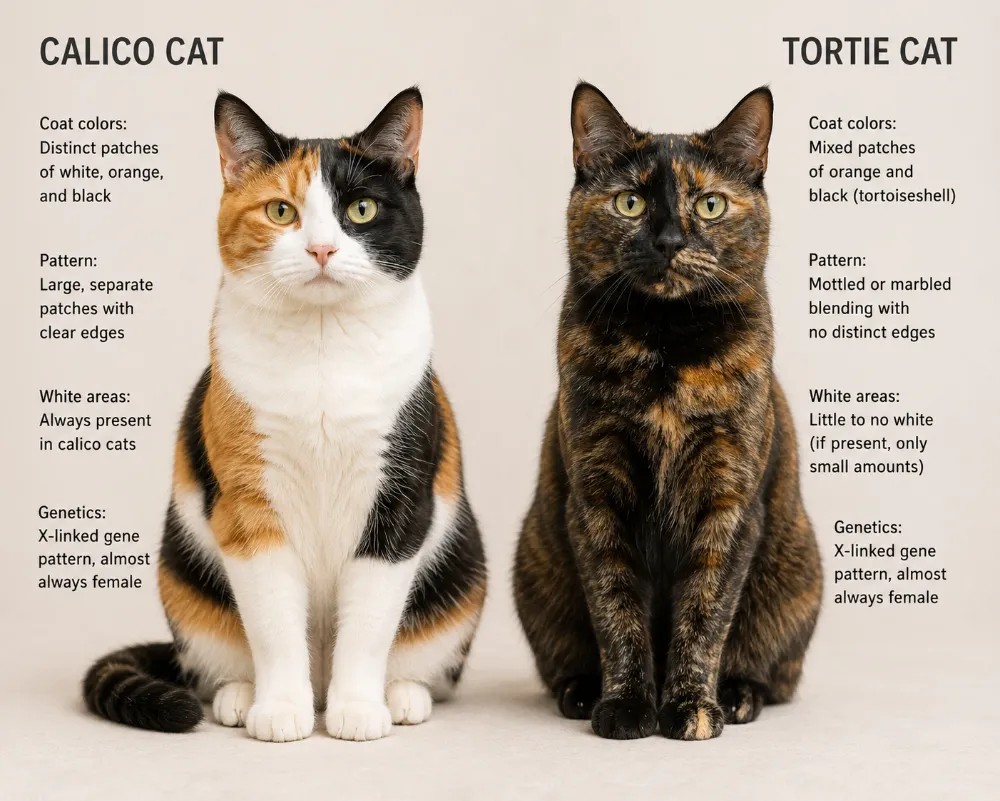
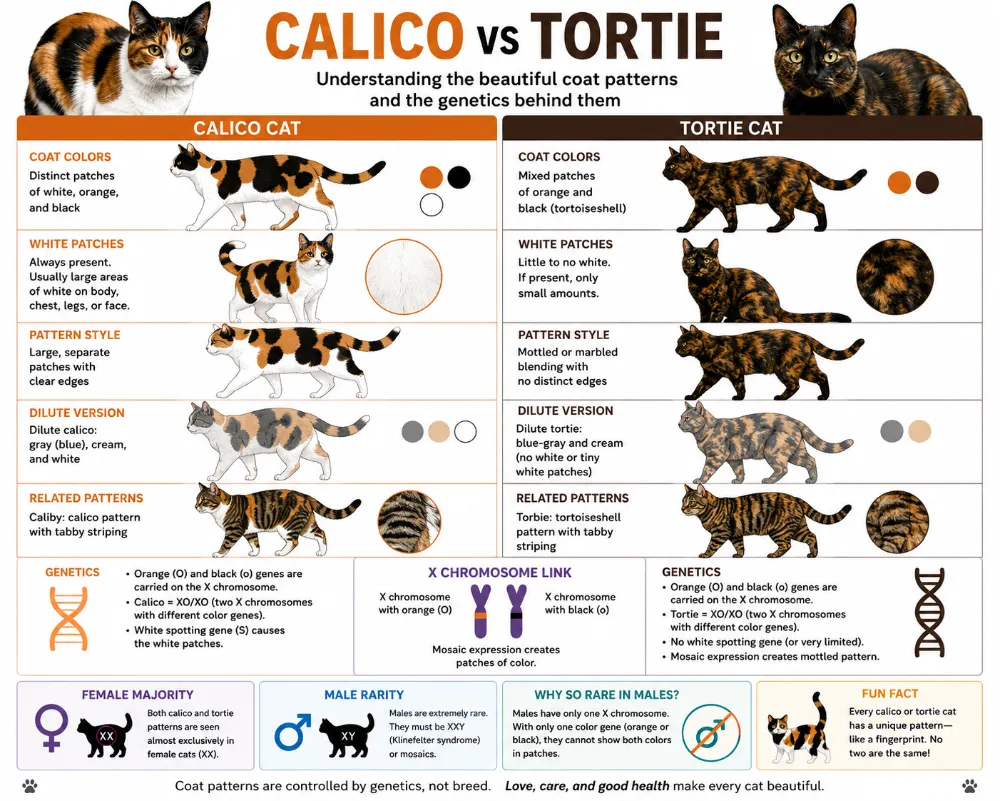
Calico and tortie cats are not different breeds; they are different coat color patterns. A calico cat has three colors with clear white areas, usually white, orange, and black. A tortie, or tortoiseshell cat, has orange and black colors blended or mottled together with little to no white. The fastest rule is simple: calico has obvious white patches; tortie usually looks marbled, brindled, or mixed.
Quick Comparison Table
| Feature | Calico Cat | Tortie Cat |
|---|---|---|
| Full meaning | Tri-color cat with white patches | Tortoiseshell cat with mixed orange and black coloring |
| Breed or pattern? | Coat pattern, not a breed | Coat pattern, not a breed |
| Main colors | White, orange, and black | Orange and black, often blended |
| White fur | Usually obvious and often extensive | Little to none |
| Pattern style | Large, separate patches | Mottled, brindled, marbled, or speckled |
| Dilute version | White, cream, and gray/blue | Cream and gray/blue mixed together |
| Typical sex | Almost always female | Almost always female |
| Male rarity | Rare, usually due to unusual chromosomes or chimerism | Rare, usually due to unusual chromosomes or chimerism |
| Personality | Depends on individual cat, breed, socialization, and environment | Depends on individual cat, breed, socialization, and environment |
| Fastest identification clue | Three colors with clear white areas | Orange and black mixed with little or no white |
What Is a Calico Cat?
A calico cat is a cat with a tri-color coat pattern. The classic calico pattern includes white, orange, and black. The white areas are usually clear and easy to see, while the orange and black appear as separate patches across the body, head, tail, or legs.
Calico is not a breed. A calico cat can be a domestic shorthair, domestic longhair, Persian, Maine Coon, Japanese Bobtail, Manx, American Shorthair, or another breed that allows the genetic conditions for this coat pattern. When people say “a calico,” they are usually describing the cat’s coat, not its ancestry.
Calico patterns can vary widely. Some calicos are mostly white with a few orange and black patches. Others have less white and more colored areas. As long as the cat clearly shows white plus orange-based and black-based patches, it is usually called calico.
What Is a Tortie Cat?
A tortie cat, short for tortoiseshell cat, has a coat that mixes orange-based and black-based colors. Instead of large white areas, a tortie’s colors are usually blended together in a mottled, marbled, brindled, or speckled pattern. The name “tortoiseshell” comes from the resemblance to old-fashioned tortoiseshell material, which had warm brown, amber, black, and orange swirls.
Like calico, tortie is not a breed. It is a coat color pattern that can appear in many cat breeds and mixed-breed cats. A tortie may have short hair, long hair, a slim body, a round face, or any number of breed-related features. The tortie label only describes the coat.
Most classic torties have little or no white fur. If a cat has tortoiseshell-like mixed orange and black fur but also has white patches, many people call it a “tortie and white” or “tortico.”
The Main Difference Between Calico and Tortie
The main difference is white fur and pattern separation.
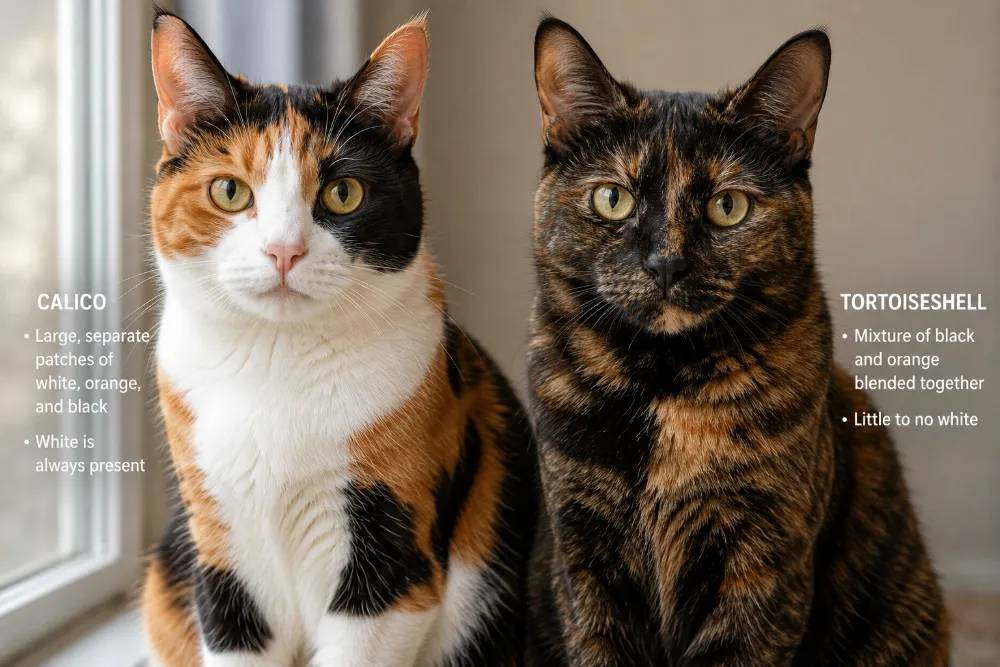
A calico cat has white fur plus orange and black patches. The colors are usually separated into distinct blocks or patches. The white areas may cover the belly, chest, paws, face, legs, or much of the body.
A tortie cat usually has orange and black blended together with little or no white. The colors may look swirled, flecked, brindled, or marbled. Instead of large clean patches, torties often look like their colors were mixed with a brush.
The simplest rule is: calico equals white plus patches; tortie equals mixed orange and black with little white.
Calico and Tortie Are Coat Patterns, Not Breeds
One of the most common mistakes is thinking calico and tortie are cat breeds. They are not. They are coat color patterns produced by genetics.
A breed describes ancestry, body type, coat length, head shape, and a standard set by cat registries. A coat pattern describes how colors appear on the fur. This means a cat can be both a recognized breed and a calico or tortie. For example, a Maine Coon can be calico, and a Persian can be tortoiseshell.
Mixed-breed domestic cats can also be calico or tortie. In fact, many calicos and torties seen in homes and shelters are domestic shorthairs or domestic longhairs.
Color Patterns and Patch Size
Calico cats usually have larger, clearer patches. The white areas are often the most visible part of the pattern. Orange and black patches may appear on the back, tail, face, ears, and sides. Some calicos have a dramatic split-face pattern, where one side of the face is orange and the other side is black.
Tortie cats usually have smaller, more blended patches. Their orange and black areas may be so mixed that the coat looks like a dark background with orange sparks. Some torties have a “chimera-like” split face, but this is not required for the tortie pattern.
Patch size can create confusing middle forms. A cat with mostly tortoiseshell coloring and some white may be called tortie-and-white, calico, or tortico depending on how much white is present and how separate the colored patches are.
What Is a Tortico?
A tortico is an informal term for a cat that looks partly tortie and partly calico. It usually describes a cat with tortoiseshell-style mixed orange and black fur plus noticeable white patches.
In simple terms, a tortico sits between a classic tortie and a classic calico. It may not have the large clean color blocks of a calico, but it has more white than a typical tortie.
Different cat owners, shelters, and veterinarians may use these labels differently. If the cat has strong white areas, many people will call it calico. If the orange and black are heavily blended, others may call it tortie-and-white or tortico.
Dilute Calico vs Dilute Tortie
Dilute versions occur when the strong black and orange colors are softened by dilution genes. A dilute calico usually has white, cream, and gray-blue patches instead of white, orange, and black.
A dilute tortie has cream and gray-blue mixed together, usually with little or no white. The pattern may look soft, smoky, pastel, or muted compared with a classic tortie.
The same identification rule still works. If the cat has clear white plus separate cream and gray patches, it is likely a dilute calico. If the cream and gray are blended together with little white, it is likely a dilute tortie.
Why Are Most Calico and Tortie Cats Female?
Most calico and tortie cats are female because the genes for orange and black coat color are linked to the X chromosome. Female cats usually have two X chromosomes, so they can carry one version for orange and another version for black. During early development, cells randomly activate one X chromosome or the other, creating patches of different color.
Male cats usually have one X chromosome and one Y chromosome. Because they usually have only one X chromosome, they are typically either orange-based or black-based, not both in a patchy pattern.
This is why calico and tortie males are rare. A male with calico or tortie coloring often has an unusual chromosome pattern, such as XXY, or another rare biological situation such as chimerism.
Are Male Calico and Male Tortie Cats Always Sterile?
Many male calico and male tortie cats are sterile, especially when the pattern is caused by an XXY chromosome pattern. However, it is best not to say “always” because rare exceptions can occur depending on the underlying cause.
If a male cat has calico or tortie coloring, a veterinarian can evaluate his health and reproductive status. The color pattern itself does not automatically tell the full medical story.
For general animal education, the safest explanation is: male calico and male tortie cats are very rare, and many are sterile, but individual veterinary evaluation is needed.
Do Calico and Tortie Cats Have Different Personalities?
Many cat owners describe calicos and torties as bold, opinionated, energetic, or “sassy.” Tortie owners often use the playful word “tortitude” to describe a tortoiseshell cat’s strong personality.
However, coat color is not a reliable scientific way to predict an individual cat’s behavior. A cat’s personality is shaped by genetics, breed background, early socialization, handling, environment, health, age, and individual temperament.
A calico can be shy or outgoing. A tortie can be gentle or feisty. The best way to understand a cat is to observe that individual animal, not assume behavior from coat color alone.
Can Calico and Tortie Cats Be Tabby Too?
Yes. Some calico and tortie cats also show tabby striping. A calico with tabby patches is sometimes called a caliby, which means calico plus tabby. These cats may have white areas plus orange tabby and brown or gray tabby patches.
A tortie with tabby markings is often called a torbie, meaning tortoiseshell plus tabby. Instead of solid black and orange mottling, a torbie shows tabby stripes mixed with tortie coloring.
These names are informal but useful. Caliby means calico-like with tabby markings. Torbie means tortie-like with tabby markings.
Calico vs Tortie in Different Cat Breeds
Calico and tortie patterns can appear in many breeds, but not every breed standard accepts every color pattern. Some breeds commonly show tortoiseshell or calico patterns, while others are known for different coat colors.
Domestic shorthairs and domestic longhairs are among the most common calico and tortie cats because they have broad genetic diversity. Longhaired calicos can look especially dramatic because the white, orange, and black patches spread across a fluffy coat. Longhaired torties may look smoky, blended, or richly marbled.
Because these patterns are not breeds, two calico cats can look very different in body type, face shape, coat length, and personality.
Health and Care
Calico and tortie cats do not need special care just because of their color pattern. Their health risks depend more on breed, genetics, age, diet, lifestyle, and veterinary care than on whether they are calico or tortie.
Longhaired calicos and torties need regular grooming to prevent mats. Shorthaired cats usually need less brushing, but grooming still helps reduce shedding and hairballs. Indoor cats need enrichment, scratching surfaces, play, clean litter boxes, and routine veterinary care.
If a calico or tortie cat is male, a veterinary checkup is especially useful because rare chromosome patterns may be associated with reproductive differences or other health considerations.
How to Identify a Calico Cat
To identify a calico cat, look for three colors: white, orange-based fur, and black-based fur. The patches are usually clear and separate. The white fur may cover a small area or a large part of the body, but it should be obvious enough to stand out.
Classic calicos often have white legs, white chest, white belly, or a white face with orange and black patches on the head, back, and tail. Dilute calicos show the same pattern, but the orange becomes cream and the black becomes gray-blue.
If you can easily point to separate white, orange, and black areas, the cat is probably calico.
How to Identify a Tortie Cat
To identify a tortie cat, look for a coat that mixes orange and black without large white areas. The colors may appear marbled, speckled, streaked, brindled, or swirled.
Some torties are mostly dark with small orange flecks. Others have more balanced orange and black mixing. Dilute torties show cream and gray-blue instead of orange and black.
If the coat looks like orange and black were blended together and there is little to no white, the cat is probably tortie.
Simple Identification Checklist
| Question | Likely Calico | Likely Tortie |
|---|---|---|
| Is there obvious white fur? | Yes, usually clear white areas | No, or only very little white |
| Are the colors separated? | Usually large separate patches | Usually blended or mottled |
| How many main colors? | Three: white, orange, black | Two main colors: orange and black |
| Dilute version? | White, cream, gray-blue | Cream and gray-blue mixed |
| Breed? | Any breed that can show the pattern | Any breed that can show the pattern |
| Fast visual rule | White background with colored patches | Marbled orange-black coat |
Final Verdict: Calico vs Tortie
Calico and tortie cats are both beautiful examples of feline coat genetics, but they are not the same pattern. A calico cat has a tri-color coat with obvious white, orange, and black patches. A tortie cat has orange and black colors blended together with little or no white.
The fastest identification rule is: calico cats have white patches; tortie cats look mottled or marbled. Both patterns are usually female, both can appear in many breeds, and neither pattern can reliably predict personality by itself.
FAQs About Calico and Tortie Cats
Is a calico cat the same as a tortie?
No. A calico cat has white, orange, and black patches. A tortie cat has orange and black colors blended together with little or no white.
Are calico and tortie cat breeds?
No. Calico and tortie are coat color patterns, not breeds. These patterns can appear in many breeds and mixed-breed cats.
What is the biggest difference between calico and tortie?
The biggest difference is white fur. Calico cats have obvious white areas, while tortie cats usually have little or no white.
Can a tortie have white fur?
Yes, but if the white is obvious, the cat may be called tortie-and-white, tortico, or calico depending on the pattern and how the colors are arranged.
What is a dilute calico?
A dilute calico is a softer-colored calico with white, cream, and gray-blue patches instead of white, orange, and black.
What is a dilute tortie?
A dilute tortie has cream and gray-blue colors blended together, usually with little or no white.
Why are most calico and tortie cats female?
The orange and black coat colors are linked to the X chromosome. Female cats usually have two X chromosomes, which allows orange and black patches to appear through random X chromosome inactivation.
Can male cats be calico or tortie?
Yes, but it is rare. Male calico and male tortie cats usually have unusual chromosome patterns or rare developmental conditions such as chimerism.
Are male calico cats sterile?
Many male calico cats are sterile, especially when they have an XXY chromosome pattern. However, individual veterinary evaluation is needed because rare exceptions can occur.
Do tortie cats really have “tortitude”?
“Tortitude” is a popular nickname for bold or sassy tortie behavior, but personality cannot be reliably predicted from coat color alone. Each cat should be judged as an individual.
What is a torbie cat?
A torbie is a tortie cat with tabby markings. The name combines “tortie” and “tabby.”
What is a caliby cat?
A caliby is a calico cat with tabby markings in its colored patches. The name combines “calico” and “tabby.”