Cat years do not convert to human years by a simple “multiply by 7” rule. Cats mature much faster in their first two years: a 1-year-old cat is roughly like a 15-year-old human, and a 2-year-old cat is roughly like a 24-year-old human. After that, each cat year equals about 4 human years. This is only an estimate, not an exact biological clock.
Cat Years vs Human Years Quick Answer
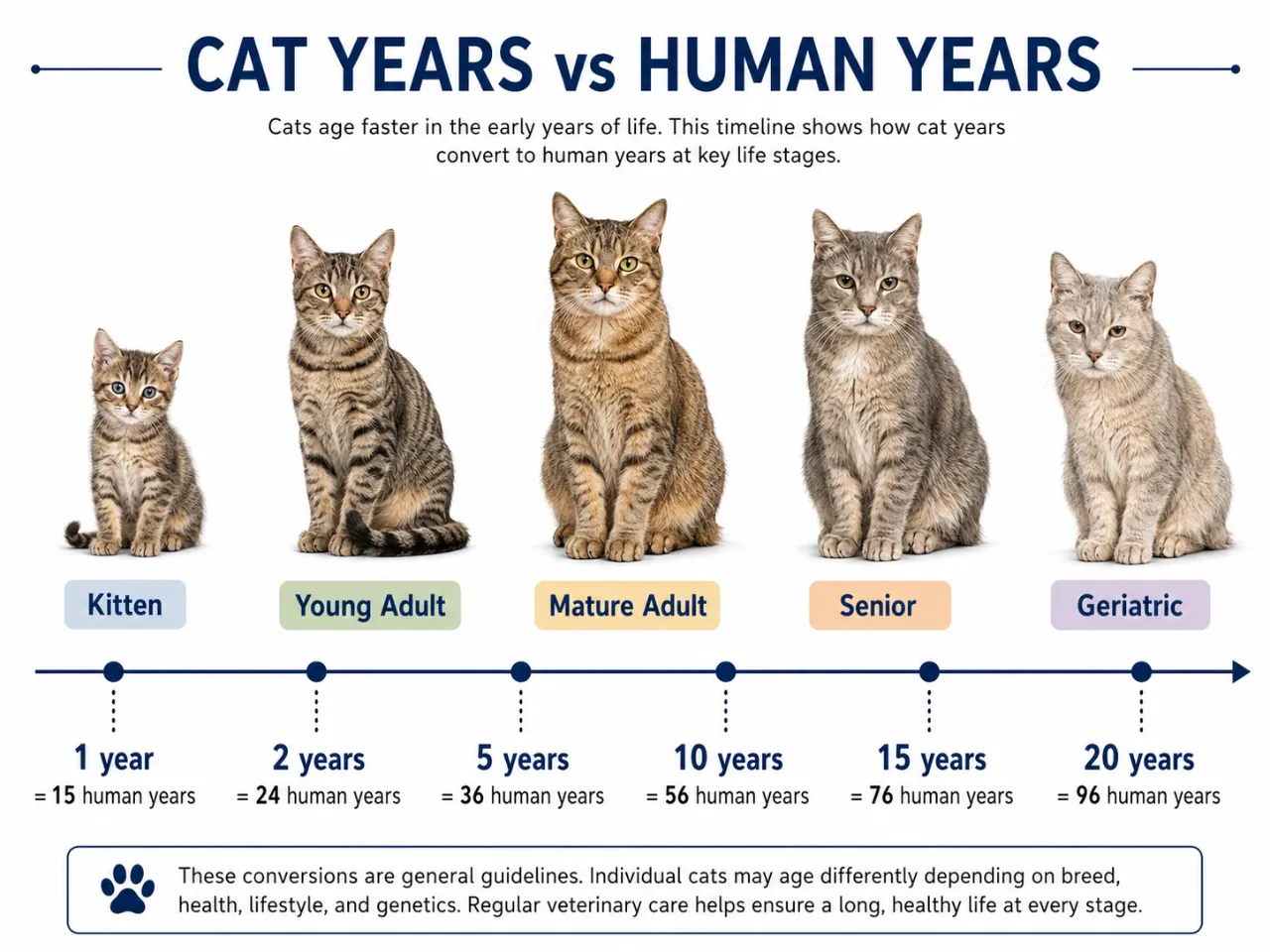
The most common cat-age formula is simple: the first cat year equals about 15 human years, the second cat year brings the cat to about 24 human years, and every year after that adds about 4 human years. For example, a 5-year-old cat is roughly equivalent to a 36-year-old human, while a 10-year-old cat is roughly equivalent to a 56-year-old human.
Cat Years vs Human Years Summary Table
| Cat Age | Approximate Human Age | Life Stage | General Meaning |
|---|---|---|---|
| 1 month | About 1 human year | Kitten | Rapid growth, nursing or early weaning stage |
| 3 months | About 4 human years | Kitten | Playful, curious, learning social behavior |
| 6 months | About 10 human years | Kitten / adolescent | Near sexual maturity, high energy |
| 1 year | About 15 human years | Junior | Physically close to adult size, still mentally young |
| 2 years | About 24 human years | Young adult | Fully mature adult cat |
| 5 years | About 36 human years | Prime adult | Healthy adult stage for many cats |
| 10 years | About 56 human years | Senior | Older adult, needs closer health monitoring |
| 15 years | About 76 human years | Geriatric | Advanced age, more likely to have age-related conditions |
| 20 years | About 96 human years | Very old / geriatric | Exceptional age, careful veterinary care important |
Why the “One Cat Year Equals Seven Human Years” Rule Is Wrong
The old idea that one cat year equals seven human years is too simple. Cats do not age at the same pace throughout life. Their first year includes kittenhood, adolescence, and much of their physical development. By 12 months, many cats are already near adult size and may be sexually mature.
The second year is also important. A 2-year-old cat is not like a 14-year-old human. It is more like a young adult human in the early to mid-twenties. After that, aging slows into a steadier pattern, and each additional cat year is often estimated as about 4 human years.
So the better rule is:
First cat year: about 15 human years
Second cat year: about 9 more human years, reaching about 24
Each year after age 2: about 4 human years
Cat Years to Human Years Chart
| Cat Age | Approximate Human Age |
|---|---|
| 1 year | 15 years |
| 2 years | 24 years |
| 3 years | 28 years |
| 4 years | 32 years |
| 5 years | 36 years |
| 6 years | 40 years |
| 7 years | 44 years |
| 8 years | 48 years |
| 9 years | 52 years |
| 10 years | 56 years |
| 11 years | 60 years |
| 12 years | 64 years |
| 13 years | 68 years |
| 14 years | 72 years |
| 15 years | 76 years |
| 16 years | 80 years |
| 17 years | 84 years |
| 18 years | 88 years |
| 19 years | 92 years |
| 20 years | 96 years |
| 21 years | 100 years |
| 22 years | 104 years |
| 23 years | 108 years |
| 24 years | 112 years |
| 25 years | 116 years |
How to Calculate Cat Years in Human Years
If your cat is 2 years old or older, you can use this simple formula:
Human age equivalent = 24 + 4 × (cat age - 2)
For example, a 7-year-old cat would be:
24 + 4 × (7 - 2) = 44 human years
This formula is useful for quick estimates, but it should not be treated as exact science. Cats age differently depending on genetics, body condition, diet, veterinary care, dental health, indoor or outdoor lifestyle, and underlying medical conditions.
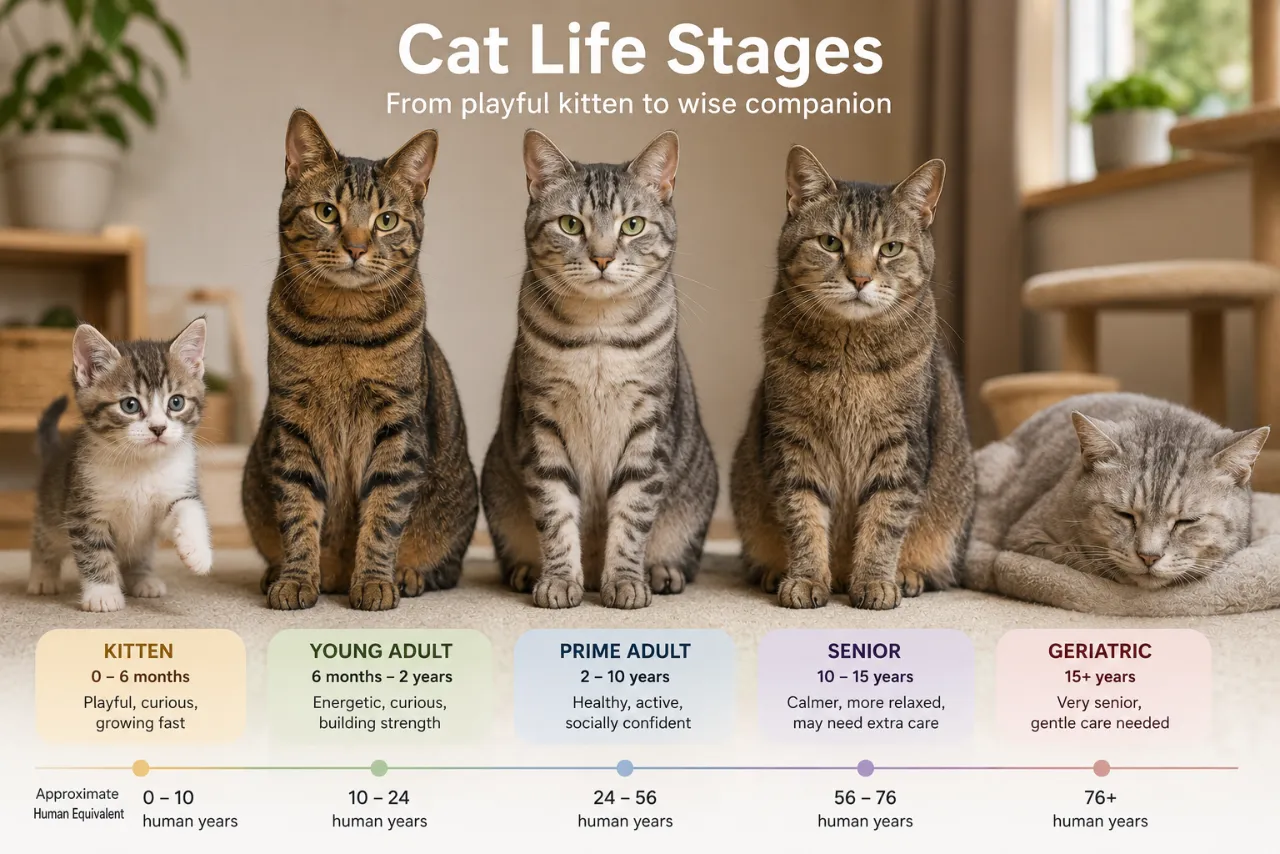
Cat Life Stages Explained
Cat aging is easier to understand when divided into life stages. These stages are more useful than exact human-year comparisons because they help owners understand behavior, health needs, and veterinary priorities.
| Cat Life Stage | Approximate Cat Age | What It Means |
|---|---|---|
| Kitten | Birth to 6 months | Rapid growth, social learning, vaccination series, early training |
| Junior | 7 months to 2 years | Adolescent energy, sexual maturity, adult body development |
| Prime adult | 3 to 6 years | Physical maturity, stable adult behavior, peak condition for many cats |
| Mature adult | 7 to 10 years | Middle age, early monitoring for weight, teeth, kidneys, and joints |
| Senior | 11 to 14 years | Older age, more frequent health checks recommended |
| Geriatric | 15 years and older | Advanced age, higher risk of chronic disease and mobility changes |
Kitten Age in Human Years
Kittens develop extremely quickly. A newborn kitten is blind, deaf, and completely dependent on its mother or human caregivers. Within a few weeks, it begins walking, playing, exploring, and learning social behavior.
By 3 months, a kitten may behave like a playful young child, full of curiosity and energy. By 6 months, many kittens are already entering adolescence. They may test boundaries, become more independent, and show stronger hunting or play behavior.
This is why kitten care is so important. Nutrition, socialization, vaccination, parasite prevention, litter training, gentle handling, and safe play all affect the cat’s long-term health and behavior.
One-Year-Old Cat in Human Years
A 1-year-old cat is roughly equivalent to a 15-year-old human. Physically, many cats look like adults by this age, but mentally and behaviorally they may still act young. They may be playful, impulsive, curious, and easily overstimulated.
This is a stage when many behavior habits become more noticeable. Scratching, climbing, chasing, night activity, food preferences, and social confidence may all develop strongly. Owners should provide scratching posts, climbing spaces, interactive play, and consistent routines.
Two-Year-Old Cat in Human Years
A 2-year-old cat is roughly equivalent to a 24-year-old human. By this age, most cats are fully mature adults. Their body size is usually stable, their personality is clearer, and their daily routine may become more predictable.
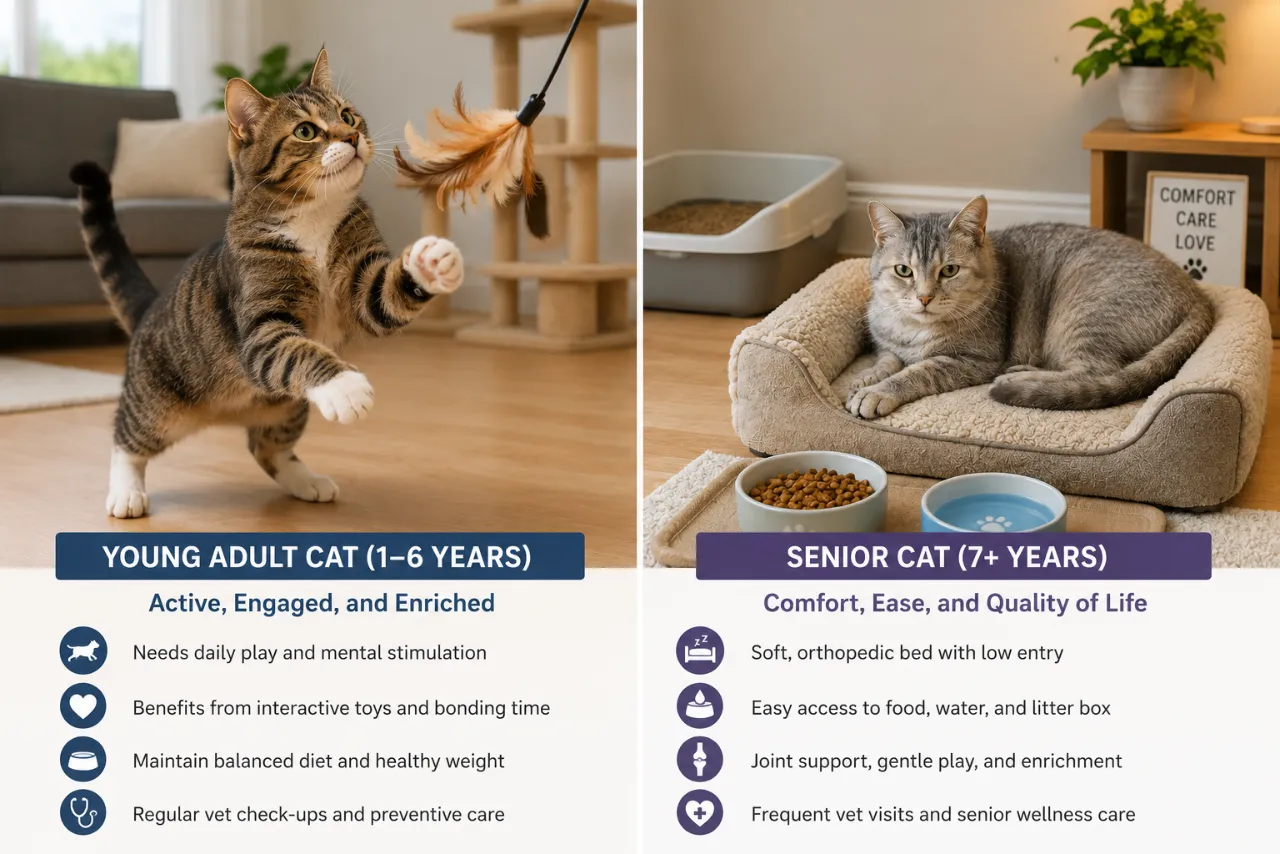
A healthy 2-year-old cat is usually active, alert, agile, and playful. This is a good time to maintain ideal body weight, build healthy feeding routines, and keep up with preventive veterinary care. Many long-term health problems begin with small habits during early adulthood, especially overfeeding and lack of exercise.
Adult Cat Years
From about 3 to 6 years old, many cats are in their prime adult stage. They are no longer kittens, but they are not yet senior cats. A 5-year-old cat is roughly equivalent to a 36-year-old human.
Adult cats may seem low-maintenance, but this is the stage when preventive care matters. Dental disease, obesity, urinary issues, skin problems, and early digestive changes may begin quietly. Regular checkups can help detect problems before they become serious.
Adult cats still need enrichment. Indoor cats especially benefit from climbing furniture, puzzle feeders, window perches, daily play, scratching surfaces, and safe hiding spaces.
Senior Cat Years
Cats are often considered senior around 11 years old, although some cats show age-related changes earlier or later. A 12-year-old cat is roughly like a 64-year-old human, while a 15-year-old cat is roughly like a 76-year-old human.
Senior cats may sleep more, play less, lose muscle, develop stiffness, or become more sensitive to stress. Some may become more affectionate, while others may prefer quiet spaces. Changes in appetite, drinking, litter box habits, weight, grooming, or movement should not be dismissed as “just old age.”
Many senior-cat problems can be managed better when caught early. Kidney disease, arthritis, dental disease, hyperthyroidism, diabetes, high blood pressure, and cognitive changes are more common in older cats.
Geriatric Cats and Very Old Cats
A cat aged 15 years or older is often considered geriatric. This does not mean the cat is near death. Many cats live happily into their late teens, and some reach 20 years or more. However, very old cats need closer observation and more supportive care.
Geriatric cats may need softer bedding, easier litter box access, ramps or steps, warmer resting areas, more frequent meals, pain management, dental care, and regular veterinary monitoring. Their needs can change quickly, so owners should pay attention to subtle differences in behavior.
A 20-year-old cat is roughly comparable to a person in their mid-90s. At that age, comfort, safety, hydration, nutrition, and quality of life become especially important.
Indoor Cats vs Outdoor Cats
Indoor cats often live longer than outdoor cats because they are protected from traffic, predators, fights, infectious disease, parasites, poisoning, and extreme weather. A well-cared-for indoor cat may commonly live into the teens, and many reach 18 to 20 years.
Outdoor cats may still live long lives, but their risks are higher. Free-roaming cats face injuries, disease exposure, territorial fights, vehicle accidents, and environmental hazards. This does not mean every outdoor cat ages faster biologically, but it does mean outdoor life often reduces average lifespan.
For cats that enjoy the outdoors, safer options include enclosed cat patios, supervised leash walks, secure gardens, or window perches that provide stimulation without the same level of danger.
Do Cat Breeds Age Differently?
Breed can influence lifespan and health risks, but individual care matters greatly. Some mixed-breed cats are very long-lived. Some purebred cats are also long-lived, while others may be prone to inherited conditions that affect the heart, kidneys, joints, or breathing.
For example, large or heavy-bodied breeds may need extra attention to joint health and weight control. Flat-faced breeds may have breathing or dental issues. Breeds with known inherited conditions should come from responsible breeders who perform health screening.
Still, no age chart can perfectly predict a cat’s future. A healthy lifestyle, good veterinary care, safe environment, and proper nutrition are often more important than breed alone.
Why Cats Age Fast at First
Cats are small mammals with rapid early development. In nature, reaching maturity quickly can be an advantage because young animals must learn to hunt, avoid danger, and reproduce. Domestic cats still carry this fast early growth pattern.
A kitten goes from helpless newborn to active juvenile in weeks, then to adolescent in months. That is why the first year of a cat’s life equals much more than one human year. The early years compress a huge amount of growth, learning, and physical development into a short time.
Is Cat Aging the Same as Human Aging?
No. Cat years are only an analogy. A 10-year-old cat may be compared to a 56-year-old human, but that does not mean its body is identical to a 56-year-old person’s body. Cats and humans have different biology, metabolism, diseases, movement patterns, and life histories.
The human-year comparison is useful because it helps owners understand that a 10-year-old cat is not “middle-aged young” anymore. It is entering an older life stage and may need more health monitoring. But the comparison should not be taken too literally.
Signs Your Cat Is Aging
Cats often hide signs of illness or pain. This is a survival behavior inherited from wild ancestors. Because of that, age-related problems may appear subtle at first.
Sleeping more than usual
Jumping less or hesitating before jumping
Weight loss or weight gain
Increased thirst or urination
Bad breath or difficulty eating
Matted fur or reduced grooming
Stiffness after resting
More vocalization, especially at night
Confusion, anxiety, or changes in routine
Litter box accidents
Any major change in behavior, appetite, water intake, litter box use, or movement should be discussed with a veterinarian.
How to Help Your Cat Live Longer
While no owner can control every factor, good care can improve both lifespan and quality of life. Cats often age better when their weight, teeth, kidneys, joints, and stress levels are managed early.
Keep your cat at a healthy body weight.
Feed a balanced diet appropriate for age and health status.
Provide clean water and monitor drinking habits.
Schedule regular veterinary checkups.
Maintain dental care and watch for bad breath or mouth pain.
Provide daily play and enrichment.
Keep indoor cats mentally stimulated with climbing, scratching, and hunting-style play.
Use parasite prevention as recommended by a veterinarian.
Make litter boxes easy to access, especially for older cats.
Reduce stress from sudden changes, loud environments, or conflict with other pets.
Cat Years vs Human Years for Veterinary Care
Thinking in human years can help owners understand why veterinary checkups matter. A cat may seem to age only one year between annual visits, but after age 2, that year is roughly like 4 human years. For a senior cat, a lot can change in that time.
Many veterinarians recommend more frequent checkups for senior cats because age-related diseases can develop quietly. Bloodwork, urine testing, blood pressure checks, dental exams, and weight tracking can reveal problems before the cat looks obviously sick.
For older cats, early detection can make a major difference in comfort and long-term care.
Common Mistakes About Cat Age
One common mistake is assuming a 7-year-old cat is old. A 7-year-old cat is roughly equivalent to a 44-year-old human, so it is more like a mature adult than a senior citizen. Many cats at this age are still active and healthy.
Another mistake is thinking a 12-year-old cat is “just slowing down” when it stops jumping or grooming. Pain, arthritis, dental disease, kidney problems, or thyroid disease may be involved. Older cats deserve medical attention, not just sympathy.
A third mistake is using the age chart as an exact prediction. A 14-year-old cat may act younger than a 9-year-old cat if it is healthier, leaner, and better cared for.
How to Estimate the Age of a Cat If You Do Not Know It
If you adopted a stray or rescue cat, exact age may be unknown. Veterinarians estimate age by examining teeth, eyes, muscle condition, coat quality, behavior, and general health. Kittens are easier to age because tooth eruption and growth stages are more predictable.
Adult cats are harder to age precisely. Dental wear, tartar, eye changes, and body condition can suggest a range, but not an exact birthday. A rescued adult cat may be estimated as “about 3 to 5 years old” or “senior,” rather than given a precise age.
If the age is uncertain, focus less on the exact number and more on health care appropriate to the cat’s condition.
Final Comparison
Cat years and human years do not match in a straight line. Cats grow up very quickly during the first two years, reaching the rough equivalent of a young adult human by age 2. After that, each cat year adds about 4 human years. This makes a 10-year-old cat roughly 56 in human years and a 15-year-old cat roughly 76.
The chart is useful, but your cat’s real age is more than a number. Body condition, dental health, movement, appetite, behavior, environment, and veterinary care all affect how old a cat feels and functions.
Related Cat Guides
How Long Do Cats Live?
Indoor Cat vs Outdoor Cat Lifespan
Senior Cat Care Guide
Kitten Age Chart
Cat Weight Chart by Age
Dog Years vs Human Years
FAQs About Cat Years vs Human Years
How old is a 1-year-old cat in human years?
A 1-year-old cat is roughly equivalent to a 15-year-old human. Cats mature very quickly during their first year, so the old “multiply by 7” rule does not work well.
How old is a 2-year-old cat in human years?
A 2-year-old cat is roughly equivalent to a 24-year-old human. By this age, most cats are fully mature adults.
How old is a 5-year-old cat in human years?
A 5-year-old cat is roughly equivalent to a 36-year-old human. This is usually a prime adult stage for a healthy cat.
How old is a 10-year-old cat in human years?
A 10-year-old cat is roughly equivalent to a 56-year-old human. Many cats are still active at this age, but health monitoring becomes more important.
How old is a 15-year-old cat in human years?
A 15-year-old cat is roughly equivalent to a 76-year-old human. This is considered a geriatric stage, and regular veterinary care is especially important.
Is 7 years old senior for a cat?
A 7-year-old cat is usually considered mature, not truly geriatric. It is roughly equivalent to a 44-year-old human. Some veterinary guidelines begin closer monitoring around this age, but many 7-year-old cats are still very active.
Do indoor cats live longer than outdoor cats?
Indoor cats often live longer because they are protected from traffic, predators, fights, disease exposure, parasites, and weather hazards. Outdoor cats may live long lives too, but their risks are usually higher.
What is the best formula for cat years to human years?
A common estimate is: the first cat year equals 15 human years, the second cat year brings the cat to 24 human years, and each year after that adds about 4 human years.