Is that long, snake-like animal underwater a sea snake or an eel? Both can have slender bodies and move with graceful, wave-like motions, so they are easy to confuse at first glance. But they belong to two very different groups of animals.
The quickest difference: A sea snake is an air-breathing reptile with a paddle-shaped tail and no fins. An eel is a fish that breathes through gills and usually has fins along part of its body or tail.
From a safe distance, look for a fin along the back, a visible gill opening behind the head, or a flattened paddle-like tail. These clues are generally more useful than color alone.
Sea Snake vs Eel: Quick Comparison
| Feature | Sea Snake | Eel |
|---|---|---|
| Animal group | Reptile | Fish |
| Breathing | Lungs; must surface for air | Gills; extracts oxygen from water |
| Tail | Flattened, paddle-like tail in marine sea snakes | Usually tapered or bordered by a fin |
| Fins | No fins | Most have one or more fins; some are reduced |
| Body covering | Reptile scales | Smooth skin; scales absent or very small in many species |
| Gill openings | None | Present behind the head, sometimes small |
| Venom | Many sea snakes have medically significant venom | Most eels are not venomous, but some can inflict serious bites |
These are general identification clues, not guarantees for every species. An animal observed briefly underwater may not reveal enough features for a confident identification.
1. Sea Snakes Are Reptiles; Eels Are Fish
The most fundamental difference is their evolutionary background.
True sea snakes are marine reptiles related to other snakes in the family Elapidae, which also includes cobras and several other venomous snake groups. They evolved adaptations that allow them to live and hunt in seawater.
Eels are elongated fish belonging to the order Anguilliformes. This includes moray eels, snake eels, garden eels and freshwater eels.
Both groups developed long, flexible bodies suited to moving through water, but they did not evolve from the same recent ancestor.
This resemblance is an example of convergent evolution: different animal lineages independently develop similar features when facing similar environmental challenges.
2. A Sea Snake Must Breathe Air; an Eel Has Gills
Sea snakes have lungs. They must periodically reach the surface to breathe, even though some can remain underwater for extended periods.
Some sea snakes can also absorb a portion of their oxygen through the skin. However, this does not replace their need to breathe air.
Eels are fish with gills that extract dissolved oxygen from water.
For example, moray eels often open and close their mouths while resting in reef crevices. This movement helps push water across their gills.
Identification tip: Watching an animal rise to the surface to take a breath may support a sea snake identification, but one brief observation is not enough to confirm its identity.
3. Look at the Tail: Paddle or Fin?
The shape of the tail is one of the most useful visible differences.
True sea snakes have a tail compressed from side to side, creating a paddle-like surface that helps propel them through water.
Sea kraits, which spend time both in the ocean and on land, also have paddle-shaped tails.
Eels do not have the same reptilian tail paddle. Many species have a fin extending along the back, around the tail and sometimes along the underside of the body.
The exact fin arrangement varies. Moray eels commonly have a continuous dorsal, caudal and anal fin, while some snake eels have much less conspicuous fins.
Important: Never attempt to pick up or move an unidentified animal to inspect its tail.
4. Real Photo: Yellow-Bellied Sea Snake
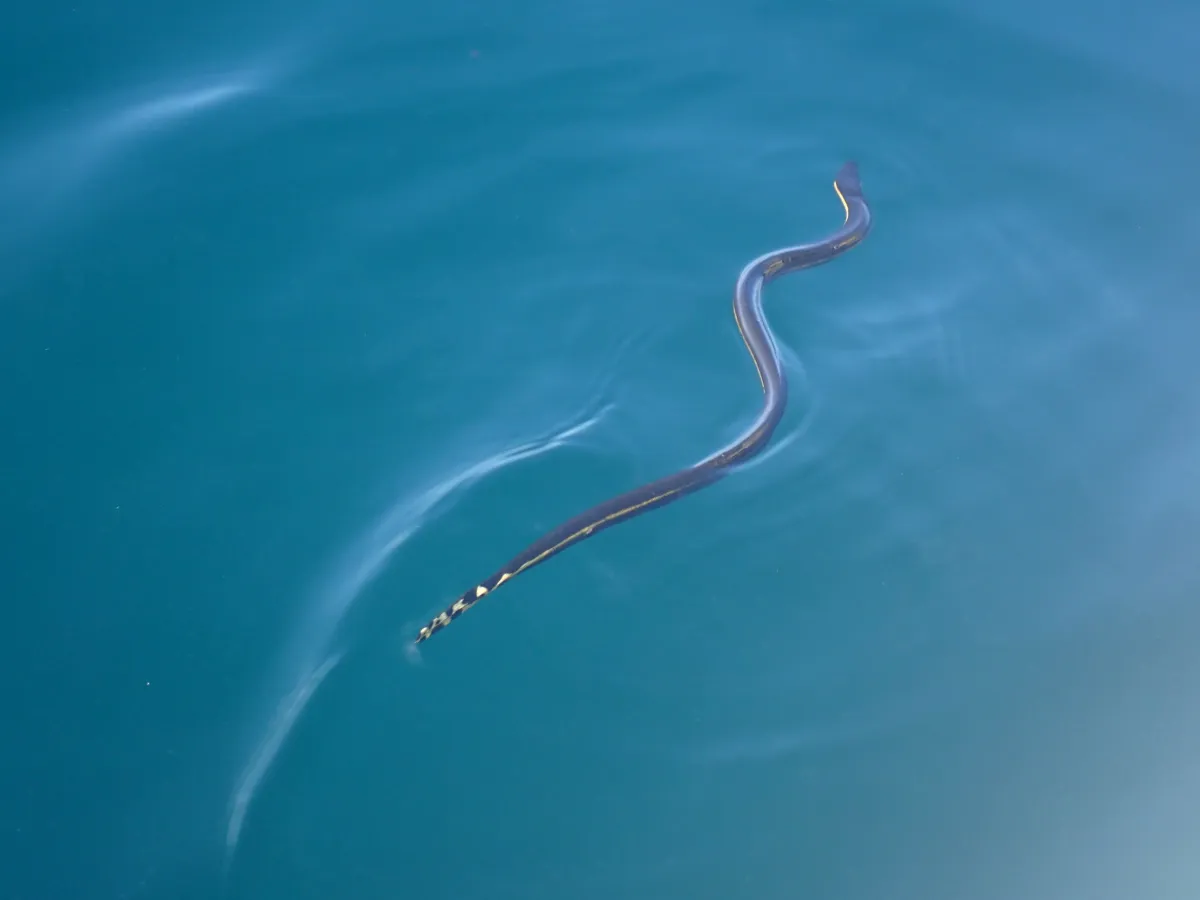
Yellow-bellied sea snake (Hydrophis platurus) photographed in the wild. Photo: keesgroenendijk / Wikimedia Commons, CC BY-SA 4.0. Original photograph.
The yellow-bellied sea snake is especially distinctive because of its dark upper body, yellow underside and paddle-shaped tail.
It spends its life in tropical ocean waters and is capable of remaining at sea without regularly coming ashore.
However, not all sea snakes are black and yellow. Many species have bands, spots or muted colors, making pattern alone an unreliable identification method.
5. Real Photo: Giant Moray Eel
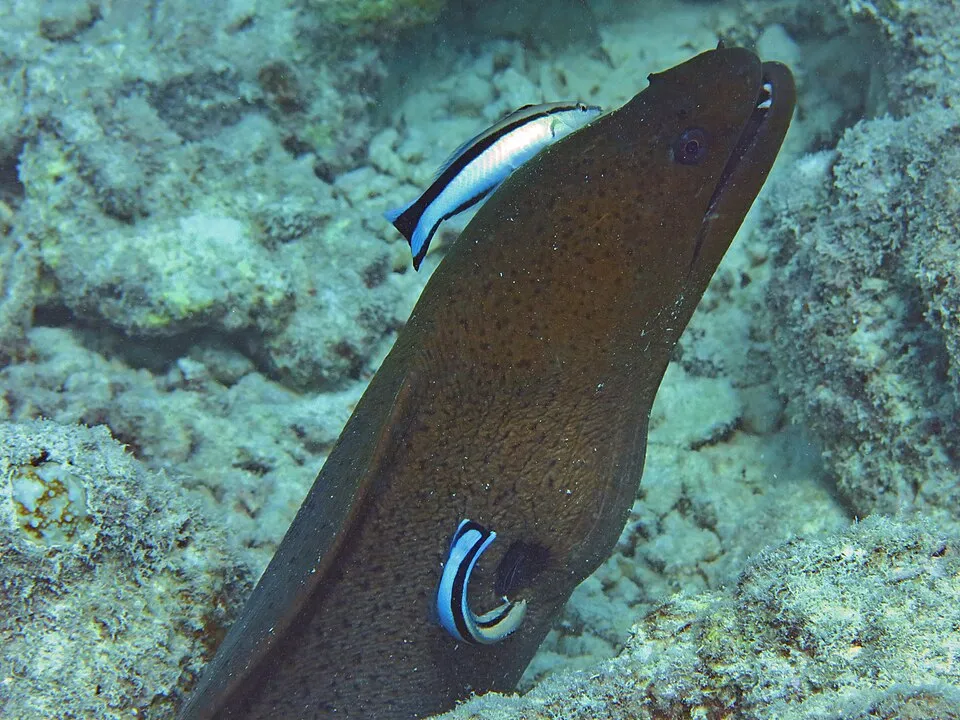
Giant moray eel (Gymnothorax javanicus) in the Maldives, accompanied by cleaner wrasse. Photo: Frédéric Ducarme / Wikimedia Commons, CC BY-SA 4.0. Original photograph.
Moray eels frequently spend time in rocky openings or reef crevices, sometimes leaving only the head visible.
Unlike sea snakes, they have gill openings and use gills for breathing. Their body shape and skin can look surprisingly snake-like when the fins are not visible.
Moray eels can bite if threatened, cornered or handled. Their appearance should never be treated as an invitation to approach.
6. Illustrated Comparison: External Features
Visual guide: Compare the sea snake's paddle-shaped tail and lack of fins with the moray eel's fin structure and gill opening.
AnimalsTop educational illustration. AI-generated visual explanation, not a photograph or a substitute for professional wildlife identification.
The illustration summarizes typical differences. Real animals can vary in appearance, body proportions and coloration, and some important structures may be hidden from view.
Can a Snake Eel Look Exactly Like a Sea Snake?
Yes, certain snake eels are particularly convincing look-alikes.
For example, the banded snake eel (Myrichthys colubrinus) has dark bands around a pale body. Its coloring can resemble the banding seen in some marine snakes and sea kraits.
Snake eels are still fish. They breathe through gills and possess fish anatomical structures rather than reptile scales and lungs.
The Cook Islands Natural Heritage Trust explains that snake eels can be distinguished by features including the dorsal fin, tail shape and nostril structures.
A quick glance at the pattern alone is therefore not enough. Look for a combination of features from a safe distance.
Are Sea Snakes More Dangerous Than Eels?
Many sea snakes possess potent venom. Although bites to people are uncommon in many settings, a serious envenomation can be life-threatening and requires urgent medical attention.
Do not assume a sea snake is harmless because it appears calm, small or reluctant to bite.
Moray eels are not generally considered venomous snakes' equivalents, but large morays can produce deep bite wounds. These wounds may be complicated by infection and require medical assessment.
The safest approach for both animals is simple:
Observe from a distance.
Never touch, grab or restrain an unidentified marine animal.
Do not attempt to move an animal for a better photograph.
Do not hand-feed moray eels.
Keep children and pets away from stranded sea snakes.
Seek urgent medical care if a sea snake bite is suspected.
If a marine snake is stranded on a beach, contact a local wildlife authority or trained rescue organization rather than attempting to return it to the water yourself.
Where Are You More Likely to See Each Animal?
True sea snakes are concentrated mainly in tropical and subtropical waters of the Indian and Pacific oceans.
Many are associated with coral reefs, coastal waters, seagrass habitats and shallow marine environments. The yellow-bellied sea snake is unusual because it can live far from shore in the open ocean.
Eels occur across a much wider variety of environments, depending on the species.
Moray eels commonly inhabit rocky and coral reef environments. Snake eels often burrow into sand or sediment. Other eel species occur in freshwater rivers, estuaries or deeper marine waters.
Geographic location can help narrow the possibilities, but it should never replace direct examination of visible features.
Can You Identify a Sea Snake From One Photo?
Sometimes a clear photograph provides enough information to identify the broad animal group, but not always.
A photograph showing a genuine paddle-like tail, reptilian scale structure and head may strongly support a sea snake identification.
However, an image showing only a long, banded body can be ambiguous. Snake eels and other fish may create a similar appearance.
For a more useful identification, record:
The country or coastal region.
Whether the animal was at sea, on a reef or on a beach.
The shape of the tail, if visible.
Whether a dorsal fin can be seen.
Any visible gill opening behind the head.
The approximate length, color pattern and swimming behavior.
Do not approach the animal for additional evidence.
You can also explore the AnimalsTop Wildlife Identification Guides for other examples of similar-looking animals and safe observation clues.
Frequently Asked Questions
Is a sea snake a type of eel?
No. A sea snake is a reptile, while an eel is a fish. Their similar body shapes evolved independently.
Do sea snakes have gills?
No. Sea snakes breathe air with lungs and must surface periodically. Some species also absorb oxygen through their skin.
Do eels have scales?
Some eels have tiny scales embedded in their skin, while others, including moray eels, generally lack scales. Smooth appearance alone is not a definitive identification feature.
Are all sea snakes venomous?
Many true sea snakes have venom-delivery systems, but venom development and function vary. Some specialized fish-egg-eating species have greatly reduced venom structures. Any unidentified sea snake should be treated as potentially dangerous.
Is a moray eel poisonous or venomous?
Moray eels are not generally venomous like sea snakes. However, bites can cause serious injuries, and some moray species can accumulate toxins in their tissues that make them unsafe to eat.
Can an eel have a paddle-shaped tail?
Eel tails vary between species, but they do not have the typical reptilian tail paddle of sea snakes. Some fins can be difficult to see underwater, so do not rely on a single characteristic.
What should I do if I see a sea snake while snorkeling?
Remain calm, keep a safe distance and allow the animal to move away. Do not try to touch or follow it. If you cannot identify the animal confidently, treat it as potentially dangerous.
The Bottom Line
Sea snake or eel? The most useful distinction is that a sea snake is an air-breathing reptile with no fins and a paddle-like tail, while an eel is a gill-breathing fish with fish-specific fin and body structures.
For safe identification, combine several visible clues rather than relying on stripes, color or the way the animal swims.
Both groups are fascinating examples of how evolution can produce similar shapes in very different animals.
Scientific Sources and Photo Credits
Natural History Museum — Sea Snakes, Sea Kraits and Their Aquatic Adaptations
Cook Islands Natural Heritage Trust — Are There Snakes in the Cook Islands?
Bristol Aquarium — Sea Snake vs Eel