Is it a jellyfish or a comb jelly? The easiest way to tell is to watch how it moves. Most familiar jellyfish swim by repeatedly contracting a bell-shaped body. Comb jellies move using eight rows of tiny beating hairs called cilia, which often appear as shimmering rainbow bands.
Although these animals can look almost identical in the water, they belong to different branches of the animal kingdom. Jellyfish are cnidarians, while comb jellies belong to the phylum Ctenophora.
This practical identification guide explains five useful visual clues, shows real photographs of both groups, and identifies several exceptions that can make recognition difficult.
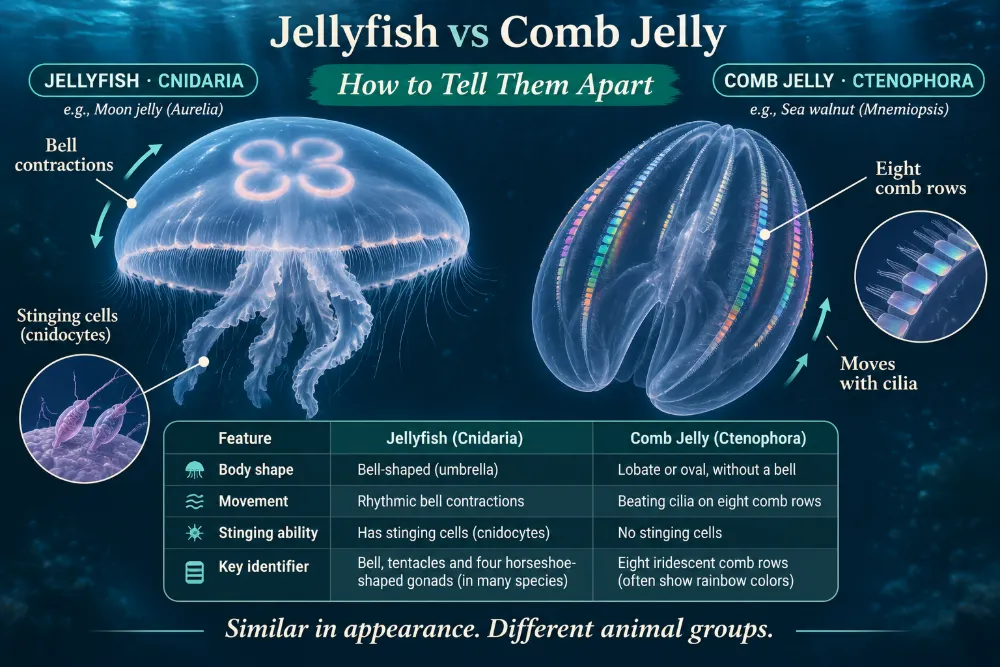
Jellyfish vs Comb Jelly: Quick Comparison
| Feature | Jellyfish | Comb Jelly |
|---|---|---|
| Animal group | Cnidaria | Ctenophora |
| Typical appearance | Bell-shaped or umbrella-like body | Often oval, rounded, lobed or ribbon-shaped |
| Main swimming method | Rhythmic bell contractions | Eight rows of beating cilia |
| Prey capture | Specialized stinging cells called cnidocytes | Often sticky cells called colloblasts; some use other strategies |
| Rainbow-colored lines | Not a defining feature | Frequently visible along comb rows |
| Human sting risk | Varies by species; some are dangerous | Typical comb jellies do not sting people |
| Typical examples | Moon jelly, sea nettle, box jelly | Sea walnut, sea gooseberry, lobed comb jelly |
Fast identification tip: Look for a pulsing bell first. If you see eight regularly spaced rows of moving, rainbow-like lights instead, you may be observing a comb jelly.
What Does a Jellyfish Look Like?
A familiar jellyfish usually has a soft, gelatinous bell. Depending on the species, it may also have tentacles around the bell margin and larger oral arms extending below the body.
Many jellyfish use repeated bell contractions to push water backward, allowing them to move through the ocean.
One familiar example is the moon jelly, represented by animals in the genus Aurelia.
Moon jellies often have a translucent, saucer-shaped bell. Four horseshoe-shaped reproductive structures can be visible through the bell in mature individuals.
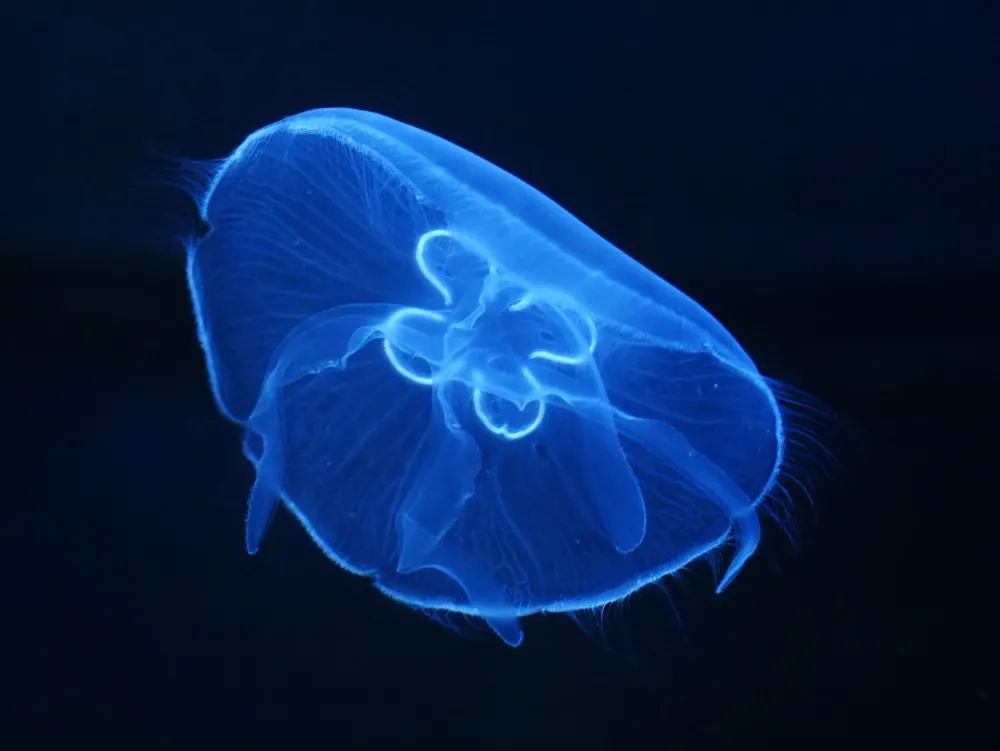
Moon jelly (Aurelia aurita). The aquarium lighting gives this specimen a blue appearance. Photo: Hans Hillewaert / Wikimedia Commons, CC BY-SA 4.0. Unmodified photograph.
The bell shape is a useful clue, but not every jellyfish looks like a flat umbrella. Box jellies, for example, have a more box-like bell.
Body shape should therefore be considered together with movement and other visible features.
What Does a Comb Jelly Look Like?
Comb jellies are gelatinous marine animals belonging to the phylum Ctenophora.
Many have transparent or nearly transparent bodies, and some look like floating eggs, walnuts, ribbons or delicate lobed structures.
Unlike a typical jellyfish, a comb jelly uses eight rows of fused cilia, called comb plates, for swimming.
These rapidly beating structures act like tiny paddles. When light strikes them, the comb rows can shimmer with changing rainbow colors.
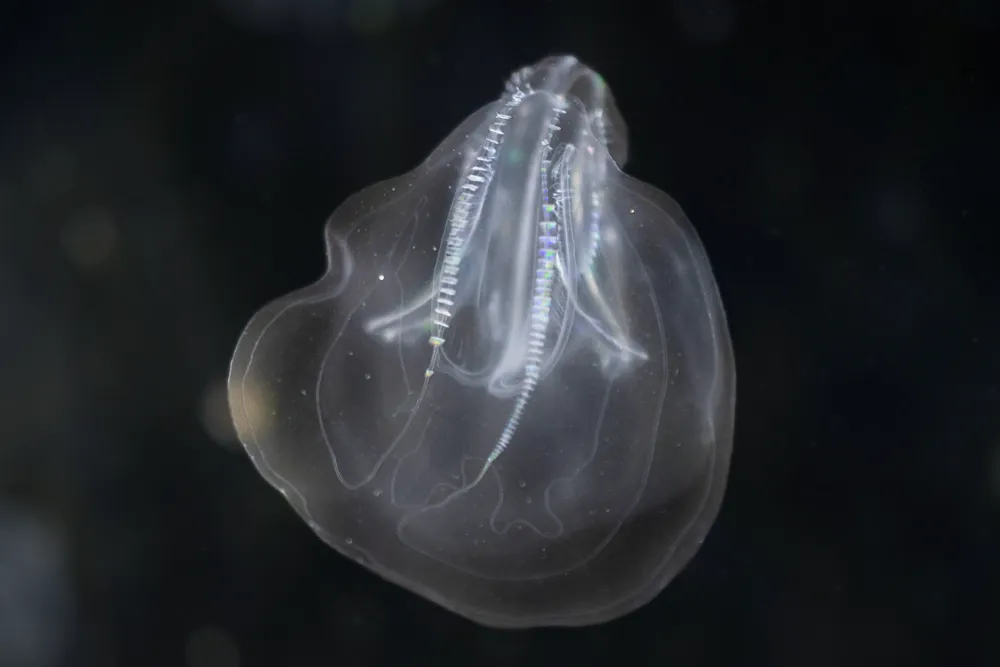
Sea walnut (Mnemiopsis leidyi), showing its translucent body and ciliary comb rows. Photo: Sepulturka / Wikimedia Commons, CC BY 4.0. Unmodified photograph.
Those comb rows are one of the strongest anatomical clues that the animal is a ctenophore rather than a jellyfish.
The Marine Biological Laboratory describes the sea walnut (Mnemiopsis leidyi) as a predatory comb jelly that captures small planktonic animals using specialized adhesive structures.
How to Tell a Jellyfish From a Comb Jelly: Five Visual Clues
Clue 1: Watch How the Animal Swims
Jellyfish: Look for repeated contractions of a bell-shaped body. The bell expands and contracts, creating visible swimming pulses.
Comb jelly: Look for smoother movement accompanied by rippling rows of tiny cilia. The ciliary motion may be difficult to resolve without good lighting or a close view.
If the animal is far away, the movement may be too subtle to identify confidently.
Clue 2: Look for Eight Rows of Comb Plates
The eight comb rows are the most important distinguishing structure of ctenophores.
They run along the surface of the animal's body and consist of many groups of fused cilia.
Under suitable lighting, these comb rows may resemble tiny strings of moving rainbow-colored beads.
Useful observation: If the colored bands appear to travel along the animal's body while its overall shape stays relatively stable, it is a strong clue that you are observing a comb jelly.
However, the bands may be invisible when the animal is poorly illuminated, viewed from the wrong angle, or photographed without sufficient detail.
Clue 3: Examine the Overall Body Shape
Many familiar jellyfish have a recognizable bell with trailing tentacles or oral arms.
Comb jellies are more variable. Some are rounded like tiny transparent berries, while others have two large lobes or elongated ribbon-shaped bodies.
Examples include:
Moon jelly: A flattened, translucent bell.
Sea walnut: A soft, lobed body with visible comb rows.
Sea gooseberry: A rounded body, often with two long fishing tentacles.
Beroe comb jelly: A sac-like body without prey-catching tentacles.
Shape is helpful but not definitive. Several unrelated gelatinous marine animals can resemble each other.
Clue 4: Do Not Rely on Tentacles Alone
A common mistake is to assume that every jellyfish has tentacles and every comb jelly does not.
Both assumptions are misleading.
Many comb jellies have a pair of tentacles that capture plankton with sticky cells. Some, including members of the genus Beroe, lack these tentacles and use their mouths to consume prey.
Jellyfish also vary greatly in the arrangement and appearance of their tentacles and oral arms.
Therefore, tentacle presence or absence should never be your only identification method.
Clue 5: Understand the Rainbow Effect
The colorful lines on many comb jellies look like miniature moving rainbows.
These colors are usually caused by light being diffracted or scattered by the beating cilia.
That effect is different from bioluminescence, which means light produced by a living organism through biochemical processes.
Some comb jelly species are bioluminescent, but a rainbow effect under a flashlight does not automatically mean that the animal is generating its own light.
For this reason, the best identification uses the visible comb-row structure, not color alone.
A Practical Identification Checklist
If you encounter a transparent, gelatinous animal in coastal water or in an aquarium, use this checklist.
| Observation | Likely Interpretation | Confidence |
|---|---|---|
| Clear, repeated bell contractions | Jellyfish is more likely | Useful clue |
| Eight parallel bands of moving cilia | Comb jelly is strongly indicated | Strong clue |
| Transparent rounded body | Could be either or another gelatinous animal | Weak clue |
| Long tentacles | Could occur in either group | Weak clue |
| Rainbow colors along the body | Comb jelly is more likely if colors follow comb rows | Useful clue |
| Animal photographed from only one angle | May not provide enough evidence | Uncertain |
Best practice: Observe several characteristics together. If the eight comb rows or bell contractions cannot be seen clearly, describe the animal as an unidentified gelatinous marine organism rather than making an unsupported species identification.
Why Are Jellyfish and Comb Jellies Different Animals?
Jellyfish and comb jellies share soft, water-rich bodies, but they are not members of the same animal phylum.
Familiar true jellyfish belong to the class Scyphozoa within Cnidaria. Other cnidarian groups include box jellies, many hydrozoan jellies, corals and sea anemones.
Comb jellies belong to Ctenophora, a distinct phylum characterized by its eight rows of locomotory comb plates.
The distinction is not just a naming issue. The groups differ in fundamental aspects of anatomy, feeding and development.
Do Comb Jellies Sting?
Typical comb jellies do not sting humans. Unlike cnidarian jellyfish, they generally lack their own stinging cnidocytes.
Many ctenophores catch prey using adhesive cells called colloblasts. Instead of injecting venom, these cells help the animal hold onto small prey.
There is an unusual biological exception: researchers have documented a comb jelly called Haeckelia rubra that can acquire and reuse stinging structures from cnidarian prey.
This does not make comb jellies equivalent to dangerous jellyfish, but it shows why absolute claims about every species should be avoided.
Do All Jellyfish Sting Humans?
Jellyfish possess specialized stinging structures used primarily for feeding and defense, but their effects on people vary enormously.
Some species produce little noticeable reaction, while others can cause painful or medically serious stings.
Box jellies include species associated with severe envenomation.
Beach safety: Never touch an unidentified gelatinous animal to test whether it stings. Follow local beach warnings and seek appropriate medical assistance after a concerning sting.
How Do Jellyfish and Comb Jellies Catch Food?
Jellyfish: Stinging Prey
Many jellyfish capture small fish, crustaceans and other planktonic organisms using tentacles equipped with stinging cells.
These cells contain specialized capsules called nematocysts that can discharge rapidly when triggered.
Captured prey is transported toward the mouth and digestive cavity.
Comb Jellies: Sticky Tentacles, Lobes or Large Mouths
Comb jellies use several different feeding strategies.
Sea gooseberries use adhesive tentacles to trap small animals.
Lobed comb jellies use enlarged lobes and currents created by cilia to collect planktonic food.
Other ctenophores, including Beroe, can swallow large gelatinous prey, sometimes consuming other comb jellies.
For a broader explanation of prey-catching structures, explore our guide to 20 animals with tentacles.
Do Jellyfish and Comb Jellies Have the Same Life Cycle?
Not usually.
Many familiar scyphozoan jellyfish have a life cycle that includes a small attached polyp stage and a free-swimming medusa stage.
In some species, the polyp produces young jellyfish through a process called strobilation.
Comb jellies generally develop into swimming forms that resemble small versions of adults, without the typical attached jellyfish polyp stage.
There are exceptions and variations within both groups, so these descriptions should be understood as common patterns rather than universal rules.
Are Comb Jellies the Same as Sea Nettles or Sea Walnuts?
No. These names can sound confusing, but they refer to different organisms.
Sea walnut: A common name associated with the comb jelly Mnemiopsis leidyi.
Sea nettle: A name used for certain cnidarian jellyfish, including species of Chrysaora.
Sea gooseberry: A common name for rounded comb jellies, including Pleurobrachia.
Moon jelly: A common name for familiar, bell-shaped cnidarian jellyfish in the genus Aurelia.
Common names are useful for everyday communication, but scientific names help avoid confusion when researching specific species.
Why Are Comb Jellies Important to Marine Ecosystems?
Comb jellies are predators of zooplankton, fish eggs, larvae and sometimes other gelatinous animals.
They are part of marine food webs and can influence plankton communities.
The sea walnut, Mnemiopsis leidyi, is especially notable because it has spread outside its native western Atlantic range and established populations in other marine regions.
Scientists study this species to understand how gelatinous predators interact with plankton, fisheries and changing ecosystems.
Source: Marine Biological Laboratory — Comb Jelly.
Frequently Asked Questions
What is the easiest way to tell a jellyfish from a comb jelly?
Watch for a pulsing bell versus eight rows of beating cilia. Bell contractions usually indicate a jellyfish, while visible comb rows strongly indicate a comb jelly.
Are comb jellies actually jellyfish?
No. Comb jellies belong to the phylum Ctenophora, while familiar jellyfish belong to the phylum Cnidaria. Their similar gelatinous appearance does not mean they are the same group of animals.
Can comb jellies hurt humans?
Typical comb jellies do not have the stinging system that makes certain cnidarian jellyfish dangerous to people. Nevertheless, unidentified marine animals should not be handled.
Why do comb jellies have rainbow colors?
The rainbow effect usually comes from light being diffracted by moving comb plates made of fused cilia. The effect should not be confused with bioluminescence.
Do all comb jellies have tentacles?
No. Many species have tentacles with adhesive cells, but some, including Beroe, lack prey-catching tentacles and use different feeding strategies.
Do jellyfish and comb jellies have brains?
Neither group has a centralized brain like that of a vertebrate. Both possess nervous systems suited to coordinating movement, feeding and responses to environmental stimuli.
Are all transparent animals in the ocean jellyfish?
No. Many unrelated marine animals have transparent or gelatinous bodies. These include comb jellies, salps, and some other planktonic organisms. Accurate identification requires more than transparency alone.
What should I do if I see a transparent jelly-like animal at the beach?
Avoid touching it. Observe from a safe distance, look for bell contractions or comb rows, and follow local beach guidance about jellyfish and other marine hazards.
Explore Related Marine Animal Guides
These related articles cover different aspects of marine invertebrates without repeating the identification guide:
20 Animals with Tentacles — Learn how different animal groups use tentacles to capture prey or detect their surroundings.
Mediterranean Jellyfish Identification Guide — Explore jellyfish and related gelatinous animals encountered in Mediterranean waters.
Cephalopods Explained — Discover why octopuses and squids belong to a completely different animal group.
Key Takeaways
Jellyfish and comb jellies belong to different animal phyla.
Familiar jellyfish swim by contracting their bells.
Comb jellies swim using eight rows of beating cilia.
Rainbow-colored comb rows are a strong visual identification clue.
Many comb jellies capture prey using sticky cells rather than stinging cells.
Tentacles, transparency and body shape alone are not reliable enough for every identification.
Final answer: If an animal has an obvious pulsing bell, it is probably a jellyfish. If it has eight shimmering rows of tiny paddles running along its body, it is probably a comb jelly. When those features cannot be seen, avoid guessing from appearance alone.
Scientific Sources and Photo Credits
Sources checked: October 28, 2026. This guide is intended for general identification and education. Individual animals may require expert identification when visible features are incomplete.