Quick answer
Neanderthals and Homo sapiens were close relatives in the human evolutionary tree. Neanderthals, often written as Homo neanderthalensis, lived mainly in Europe and western Asia before disappearing around 40,000 years ago. Homo sapiens, modern humans, evolved in Africa and later expanded into many parts of the world.
The biggest differences were body shape, skull structure, geographic range, and long-term survival. Neanderthals were generally more muscular and cold-adapted, with broad bodies, large noses, heavy brow ridges, and long, low skulls. Homo sapiens generally had taller, rounder skulls, smaller faces, more prominent chins, and lighter skeletons. However, both were intelligent humans with complex behavior.
Summary table
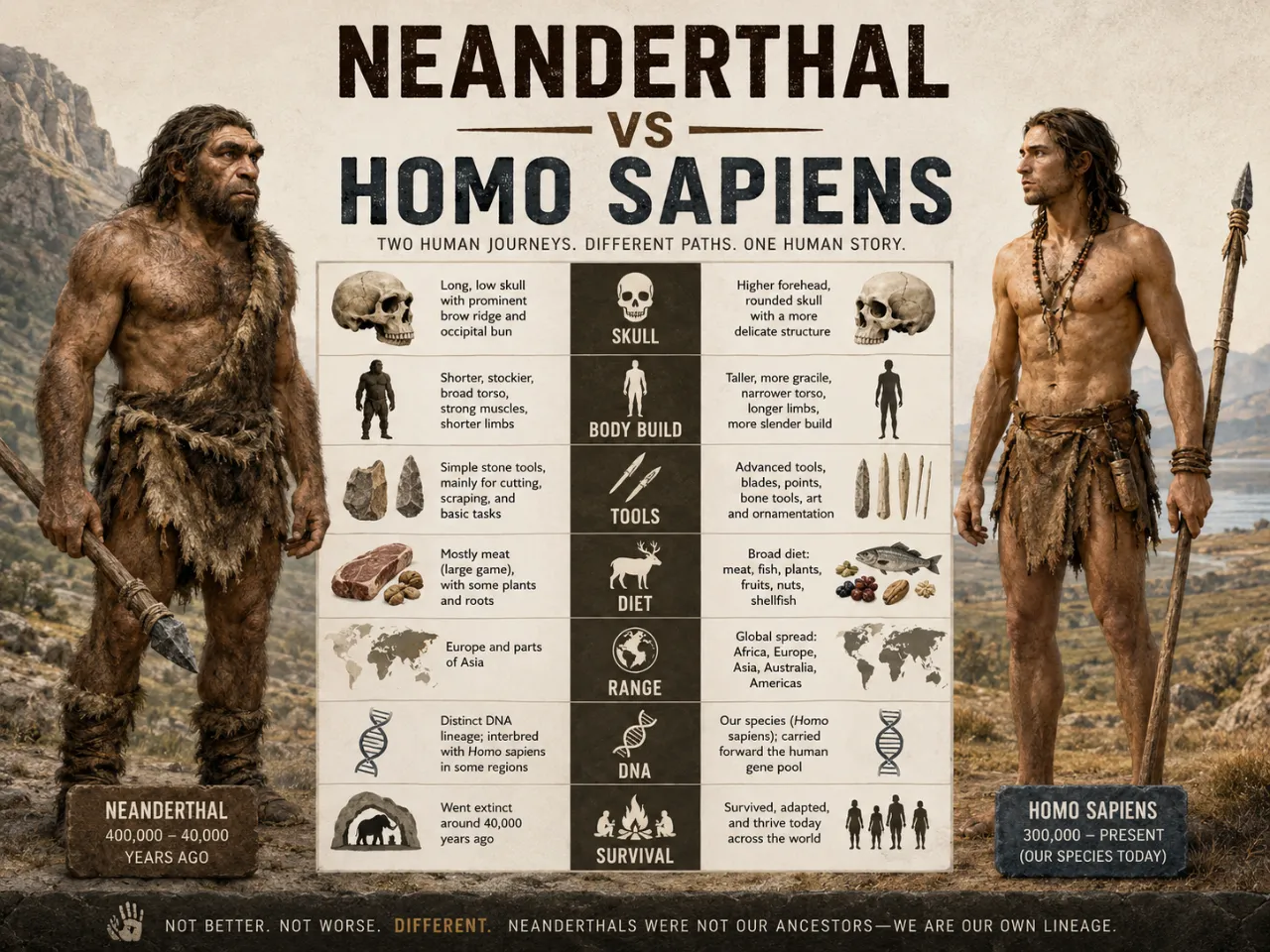
| Feature | Neanderthal | Homo sapiens |
|---|---|---|
| Scientific name | Homo neanderthalensis, though classification is sometimes debated | Homo sapiens |
| Time range | Generally lived from several hundred thousand years ago to around 40,000 years ago | Appeared roughly 300,000 years ago and still exists today |
| Main range | Europe and western to central Asia | Originated in Africa, later spread worldwide |
| Body build | Shorter, stockier, heavily muscled, cold-adapted | Generally taller, lighter-built, longer-limbed |
| Skull shape | Long, low skull with heavy brow ridges and large face | Rounder skull, smaller face, clear chin |
| Brain size | Similar to or sometimes larger than modern human average | Large brain with rounded skull shape |
| Tools | Skilled stone toolmakers, often linked with Mousterian tools | Highly varied tools, including stone, bone, antler, and later complex technologies |
| Diet | Often heavy reliance on large animals, with plant foods also likely important in many places | Very flexible diet including meat, fish, shellfish, plants, seeds, roots, and later agriculture |
| Interbreeding | Interbred with some Homo sapiens populations | Many people outside Africa carry a small amount of Neanderthal ancestry |
| Status today | Extinct as a distinct population | Living human species |
How Neanderthals and Homo sapiens are related
Neanderthals and Homo sapiens were not “ape versus human.” Both were humans in the genus Homo. They shared a common ancestor and developed along different evolutionary paths. Neanderthals evolved mainly in Eurasia, while Homo sapiens evolved in Africa before expanding outward.
Scientists often treat Neanderthals as a separate species, Homo neanderthalensis. Some discussions describe them as a subspecies of humans, sometimes written as Homo sapiens neanderthalensis. The species versus subspecies question is partly a matter of how researchers define species, especially because Neanderthals and Homo sapiens could interbreed.
The most practical way to understand them is this: Neanderthals were a close sister group to modern humans. They were not primitive brutes. They were intelligent, adaptable Ice Age humans with their own anatomy, traditions, and survival strategies.
Body size and physical build
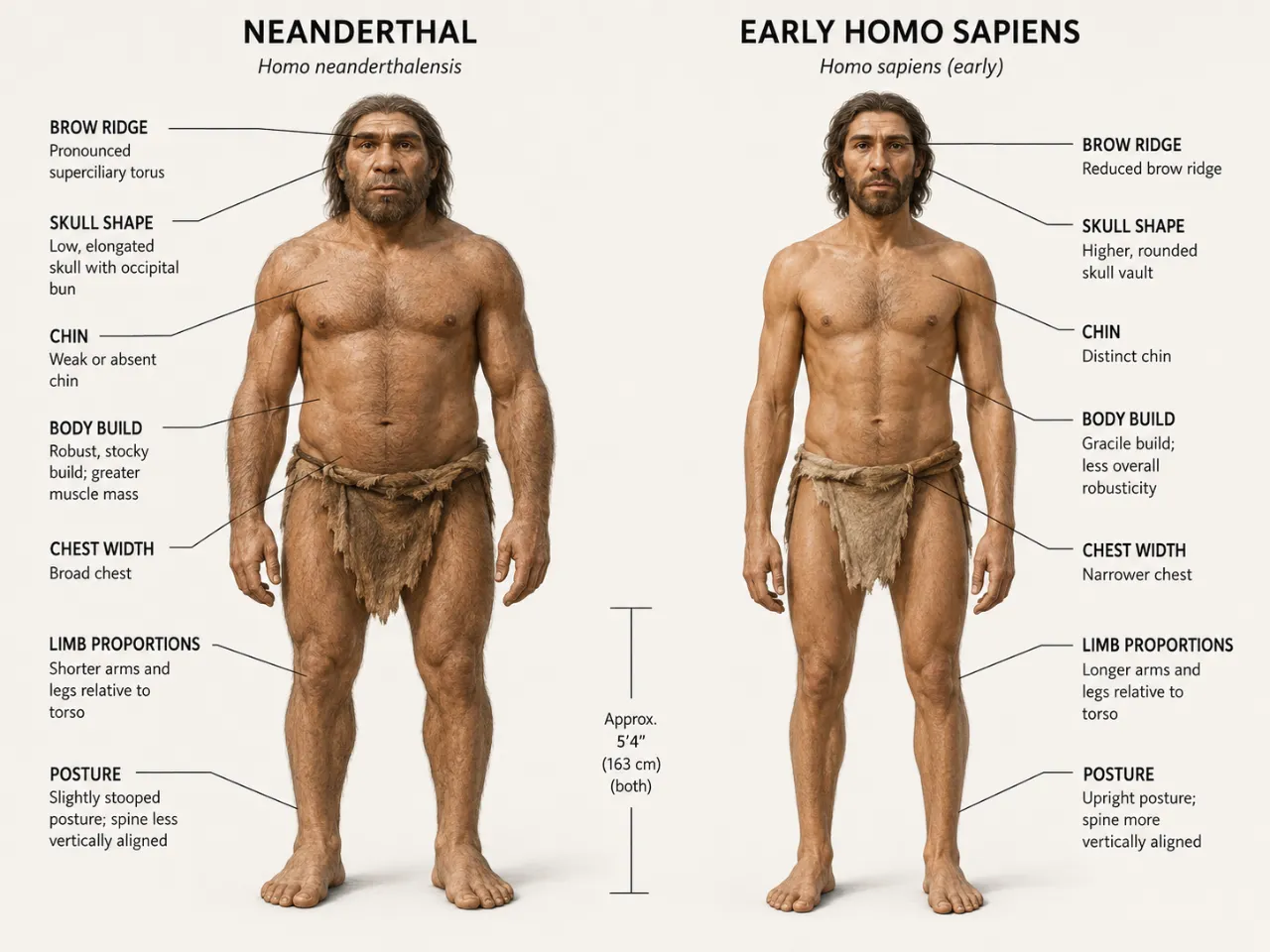
Neanderthals were generally shorter and more powerfully built than many modern humans. Their bodies were broad, muscular, and compact, with thick bones, strong shoulders, large joints, and a barrel-shaped chest. This body plan was likely useful in cold Ice Age environments because a compact body loses heat more slowly than a long, slender one.
Homo sapiens are generally more lightly built, with longer limbs and narrower bodies. This does not mean modern humans are weak, but our average skeletal structure is less robust than that of Neanderthals. Early Homo sapiens were also physically active hunter-gatherers, but their body proportions were generally different.
These physical differences reflect adaptation, not superiority. Neanderthals were well suited to cold, demanding landscapes. Homo sapiens were highly flexible and eventually adapted to deserts, forests, coasts, grasslands, mountains, and Arctic environments.
Skull and face differences
The skull is one of the clearest ways to distinguish Neanderthals from Homo sapiens. Neanderthals generally had long, low skulls, heavy brow ridges, large eye sockets, a projecting midface, and little or no chin. Their noses were large, which may have helped warm and humidify cold, dry air, although this explanation is still discussed.
Homo sapiens generally have taller, rounder skulls, smaller brow ridges, flatter faces, and a clear chin. The modern human skull is more globular, especially around the braincase. This rounded skull shape is one of the key anatomical traits of our species.
Neanderthal jaws and teeth were also robust. Their front teeth often show heavy wear, which may suggest they sometimes used their mouths as a kind of “third hand” while processing hides, plant fibers, or other materials. This interpretation is likely in many cases, but exact behavior can vary by site and individual.
Brain size and intelligence
Neanderthals had large brains. Their average brain size was similar to, and in some estimates slightly larger than, that of modern humans. However, brain size alone does not measure intelligence. Brain organization, development, social learning, language, culture, and environment all matter.
Homo sapiens also have large brains, but the modern human braincase has a different shape. Some researchers suggest that differences in brain organization may have influenced social behavior, planning, symbolic culture, or adaptability. These ideas are difficult to test directly because brains do not fossilize.
The safest conclusion is that Neanderthals were highly intelligent humans. They made tools, controlled fire, hunted dangerous animals, adapted to harsh climates, cared for injured individuals, and likely communicated in complex ways. Homo sapiens may have had advantages in larger social networks, symbolic communication, or cultural accumulation, but Neanderthals were not unintelligent.
Tools and technology
Neanderthals made sophisticated stone tools. They are often associated with Mousterian tool traditions, which included prepared-core techniques and carefully shaped flakes. These tools could be used for cutting meat, scraping hides, woodworking, processing plants, and making other tools.
Homo sapiens also made stone tools, but over time their technologies became extremely varied. Early modern humans used blades, points, scrapers, bone tools, antler tools, ornaments, needles, fishing gear, and later many other specialized technologies. This does not mean every Homo sapiens group was always more advanced than every Neanderthal group. Technology varied by time, region, available materials, and need.
One major difference may have been the speed and scale of innovation. Homo sapiens populations may have maintained wider exchange networks and more cumulative culture in some regions. Larger connected populations can preserve and improve skills more effectively over generations.
Diet and hunting behavior
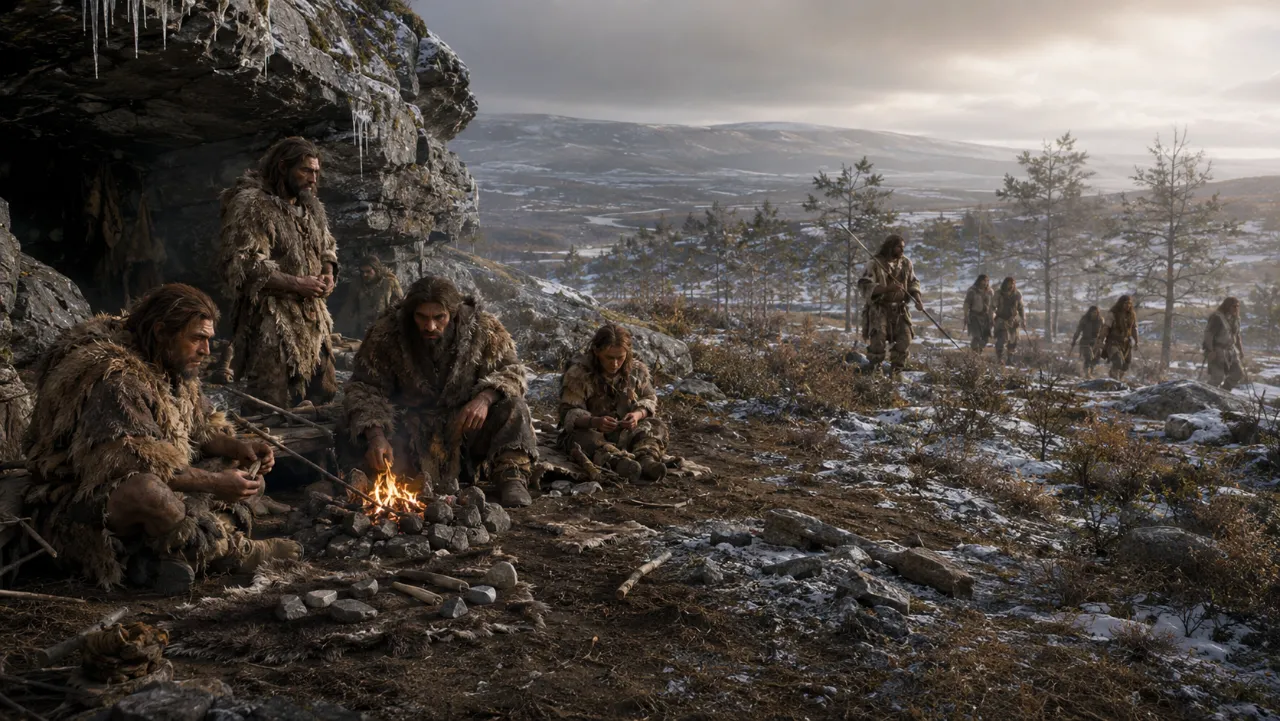
Neanderthals were skilled hunters. In many European and western Asian sites, evidence suggests they hunted large animals such as deer, horses, bison, wild cattle, and sometimes mammoths or rhinoceroses. Their strong bodies and close-range weapons may have helped them hunt in difficult Ice Age conditions.
However, Neanderthals were not purely meat-eaters in every habitat. Plant foods, nuts, seeds, roots, mushrooms, shellfish, birds, rabbits, and other resources were likely used in many places when available. Their diet probably varied by season and environment.
Homo sapiens also hunted large animals, but modern humans became especially known for dietary flexibility. Coastal groups used fish, shellfish, seabirds, and marine mammals. Inland groups used plants, small game, large game, insects, and later domesticated plants and animals. This broad flexibility may have helped Homo sapiens survive environmental change.
Social life and communication
Both Neanderthals and Homo sapiens likely lived in social groups with cooperation, learning, care, and communication. Neanderthal sites show evidence that injured or elderly individuals sometimes survived for long periods, suggesting that group members may have helped them. This points to social bonds and care.
Whether Neanderthals had language exactly like modern humans remains uncertain. Their anatomy and genetics suggest they likely had some capacity for complex vocal communication, but the details are debated. It is safer to say they probably communicated in rich ways using sounds, gestures, facial expressions, and learned social signals.
Homo sapiens developed highly complex symbolic language, storytelling, teaching, art, ritual behavior, and long-distance social networks. These abilities may have helped groups share information about food, danger, tools, landscapes, and alliances.
Art, symbolism, and culture
For a long time, Neanderthals were portrayed as lacking symbolic culture. That view is now considered too simple. Some evidence suggests Neanderthals may have used pigments, collected unusual objects, made personal ornaments in some places, and possibly created simple symbolic markings. The interpretation of some finds remains debated, but Neanderthal culture was likely richer than older stereotypes suggested.
Homo sapiens are strongly associated with symbolic culture, including cave art, carved figurines, beads, burials, musical instruments, body decoration, and complex ritual behavior in some regions. These forms of expression became especially visible in the archaeological record after modern humans expanded across Eurasia.
The difference may not be that Neanderthals had no culture and Homo sapiens had culture. A more careful view is that both had cultural behavior, but Homo sapiens may have developed larger, more connected, and more rapidly expanding symbolic traditions.
Did Neanderthals and Homo sapiens meet
Yes. Neanderthals and Homo sapiens overlapped in parts of Eurasia. Modern humans expanded from Africa into regions where Neanderthals already lived. During this period, the two groups likely encountered each other multiple times over thousands of years.
Genetic evidence shows that they interbred. Many people today with ancestry outside sub-Saharan Africa carry a small percentage of Neanderthal DNA, often estimated at around 1–2 percent, though this varies among individuals and populations. Some Neanderthal genetic variants may have influenced immunity, skin biology, metabolism, and other traits.
This interbreeding does not mean Neanderthals simply became modern humans. They disappeared as a distinct population, but some of their ancestry survived in Homo sapiens populations.
Why Neanderthals disappeared
Neanderthal disappearance was probably not caused by one simple event. Several factors may have contributed, including climate change, small population size, competition with Homo sapiens, disease, reduced genetic diversity, and environmental instability. The exact balance of these factors is still debated.
Neanderthals lived in smaller, more scattered populations than later Homo sapiens groups in many regions. Small populations are more vulnerable to random events, inbreeding, food shortages, and local extinction. If climate shifts reduced available habitat or prey, recovery may have been difficult.
Homo sapiens may have had advantages in long-distance networks, flexible diets, faster cultural innovation, or wider cooperation. But the disappearance of Neanderthals should not be imagined as a simple story of “smart humans replacing dumb Neanderthals.” The reality was likely more complex and gradual.
Do all scientists view Neanderthals the same way
No. Neanderthal research is an active field, and interpretations can change as new fossils, tools, ancient DNA, and archaeological sites are studied. Scientists generally agree that Neanderthals were close human relatives with large brains and complex behavior, but details about language, symbolism, social structure, and extinction remain debated.
Some researchers emphasize the similarities between Neanderthals and Homo sapiens. Others focus on differences in innovation, population networks, or ecological flexibility. Both approaches can be useful, as long as they avoid outdated stereotypes.
A careful comparison should recognize both facts: Neanderthals were highly capable humans, and Homo sapiens had certain traits that allowed our species to survive and expand globally.
Why these differences made each human group successful
Neanderthals were successful for a very long time. Their robust bodies, hunting skills, cold tolerance, fire use, and local knowledge helped them survive Ice Age environments across Europe and western Asia for hundreds of thousands of years.
Homo sapiens were successful in a different way. Our species became extremely adaptable, using symbolic communication, flexible technology, broad diets, social networks, and cultural learning to live in many environments. Over time, these advantages likely helped Homo sapiens expand into places where other human groups disappeared.
Both groups were products of evolution. Neanderthals were not failed humans; they were a long-lasting human lineage adapted to their world. Homo sapiens are the only surviving human species today, but our story includes genetic and cultural echoes of other ancient humans.
Final takeaway
Neanderthals and Homo sapiens were closely related humans, not a simple contrast between “primitive” and “modern.” Neanderthals were robust, cold-adapted Eurasian humans with large brains, skilled hunting, toolmaking ability, fire use, and social care. Homo sapiens were generally more lightly built, highly flexible, symbolically expressive, and eventually global in range.
The two groups met and interbred, which means Neanderthals are not completely separate from the story of modern humans. They disappeared as a distinct population, but part of their genetic legacy remains in many people today. Understanding Neanderthals helps us understand what makes our own species unique—and what we shared with other humans.
FAQs
Were Neanderthals a different species from Homo sapiens?
They are commonly classified as a separate species, Homo neanderthalensis, but some researchers discuss them as a close human subspecies. Because Neanderthals and Homo sapiens could interbreed, the boundary is more complex than a simple yes-or-no answer.
Were Neanderthals less intelligent than modern humans?
Not in the old stereotype of “cavemen” being unintelligent. Neanderthals had large brains, made tools, used fire, hunted large animals, and likely had complex social lives. Homo sapiens may have had advantages in symbolic culture, social networks, or innovation, but Neanderthals were clearly intelligent humans.
Do modern humans have Neanderthal DNA?
Many modern humans, especially people with ancestry outside sub-Saharan Africa, carry a small amount of Neanderthal DNA. This is because some Homo sapiens populations interbred with Neanderthals after leaving Africa and entering Eurasia.