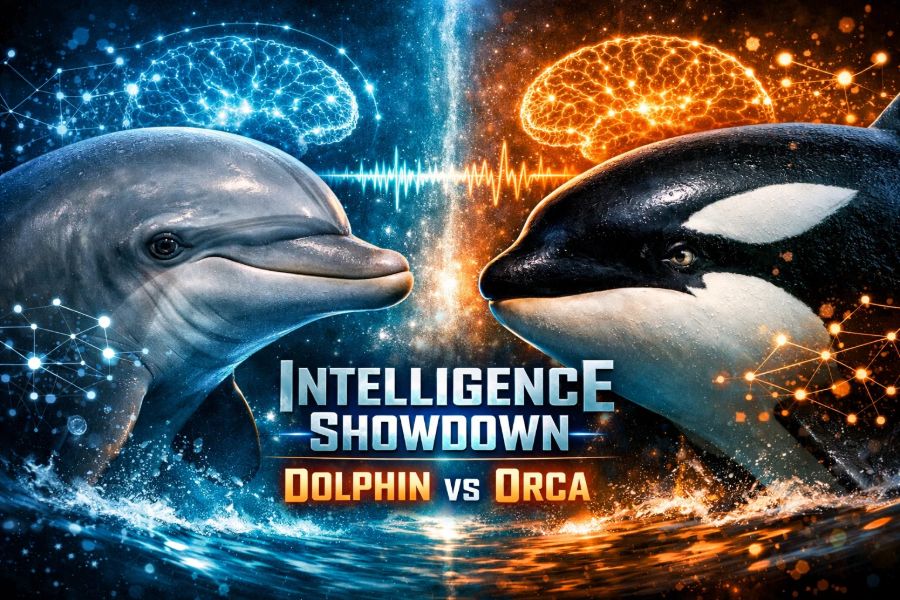
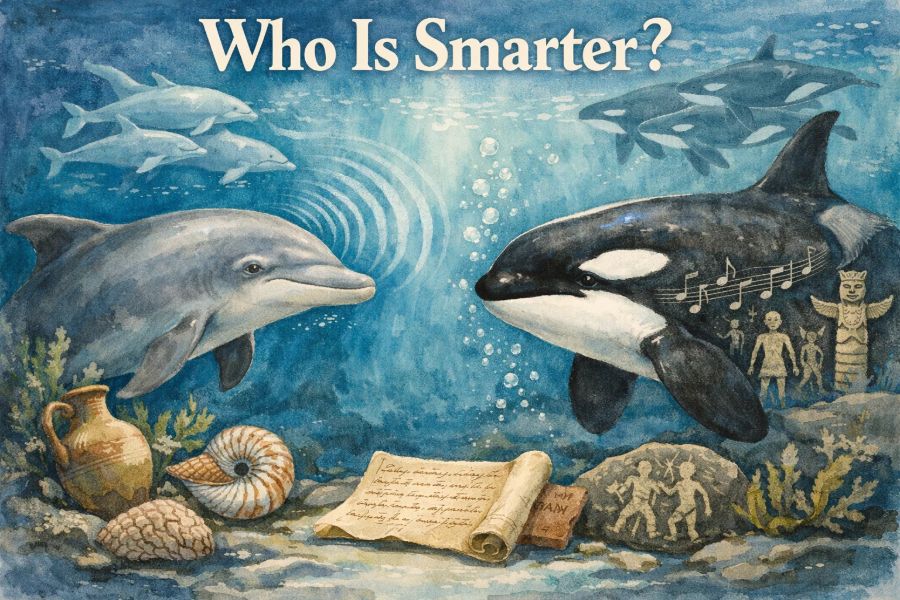
Are dolphins smarter than orcas? There is no scientifically proven single winner. If the comparison is between bottlenose dolphins and orcas, bottlenose dolphins have stronger evidence from controlled cognition experiments, including mirror self-recognition, learned vocal labels and long-term social memory. Orcas, however, show extraordinary cultural traditions, vocal dialects, coordinated hunting and socially inherited ecological specializations. The most accurate answer is that they excel in different kinds of intelligence.
There is also an important taxonomic twist: orcas are dolphins. The killer whale (Orcinus orca) is the largest member of the dolphin family, Delphinidae. So the useful comparison is really bottlenose dolphin vs orca intelligence, not “dolphin vs whale.”

Orcas are the largest members of the dolphin family, so this comparison is between two kinds of dolphins with different cognitive strengths.
Dolphin vs Orca Intelligence: The Short Answer
| Cognitive area | Bottlenose dolphin | Orca | Best-supported interpretation |
|---|---|---|---|
| Controlled cognition experiments | Extensively studied | Much less directly tested | Bottlenose dolphin has stronger evidence |
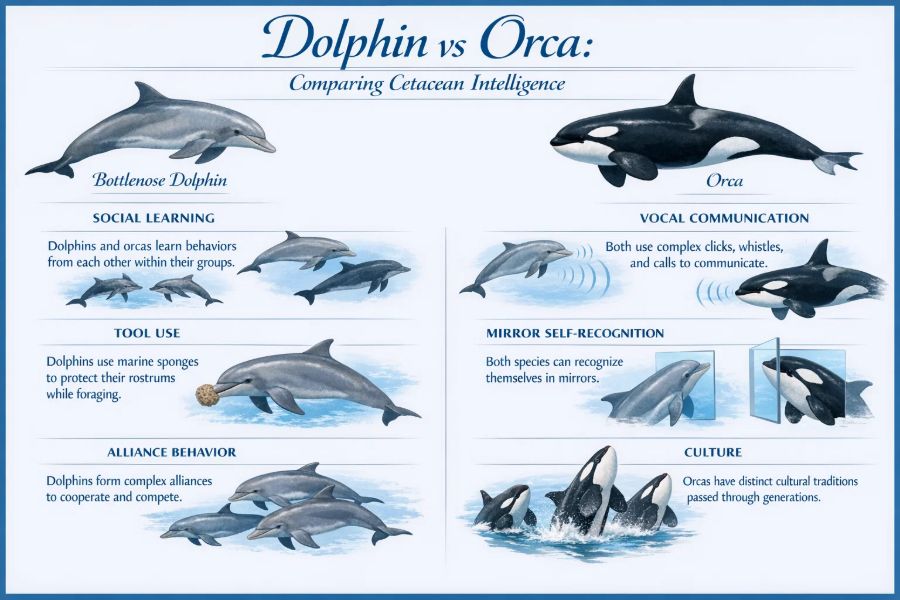
| Mirror self-recognition | Strong experimental evidence | Suggestive evidence, but thinner research base | Bottlenose dolphin |
| Vocal learning | Strong | Strong | Both |
| Individual vocal labels | Strong evidence from signature whistles | Group-specific dialects are well documented | Bottlenose dolphin for direct individual-label evidence |
| Social alliances | Complex multilevel alliances | Stable matrilines and population-specific social systems | Both, in different ways |
| Tool use | Documented sponge-tool tradition | Less classic material tool use | Bottlenose dolphin |
| Cultural traditions | Strong | Exceptionally well documented | Orca |
| Coordinated hunting traditions | Present in some populations | Highly specialized by population and ecotype | Orca |
| Overall verdict | Best-tested cetacean cognition | Exceptional social and cultural intelligence | No universal winner |
First: Orcas Are Dolphins
The name “killer whale” makes the relationship sound more confusing than it is. NOAA Fisheries classifies the orca in the family Delphinidae, the oceanic dolphin family, and identifies it as the largest member of that family.
So when people ask “dolphin vs orca,” they usually mean a familiar dolphin such as the common bottlenose dolphin (Tursiops truncatus) compared with the orca (Orcinus orca).
This distinction matters because “dolphin” covers many species. A scientifically useful intelligence comparison should identify which dolphin species is being discussed. Bottlenose dolphins are the logical comparison because they are among the most intensively studied cetaceans in cognition research.
Why “IQ” Is the Wrong Way to Compare Them
Scientists do not give dolphins and orcas a human-style IQ score. Animal intelligence is usually studied through separate abilities such as:
problem-solving
memory
vocal learning
imitation
self-recognition
social learning
cooperation
behavioral flexibility
cultural transmission
An animal can perform exceptionally well in one domain and still be poorly studied in another. That is especially important here because bottlenose dolphins have participated in far more controlled cognitive experiments than wild orcas.
Therefore, saying “orca IQ is higher” or “dolphin IQ is higher” goes beyond what the evidence can support.
Why Bottlenose Dolphins Have the Stronger Experimental Case
Bottlenose dolphins have been studied in laboratories, aquariums and long-term field projects for decades. That has produced a large body of evidence on memory, imitation, communication, concept learning and social cognition.
Their apparent advantage in an intelligence comparison is partly a research advantage: scientists simply have more controlled data for bottlenose dolphins than for orcas.
Mirror Self-Recognition
One of the best-known bottlenose dolphin cognition studies tested whether dolphins could use a mirror to inspect marked parts of their own bodies.
In a 2001 PNAS study, two bottlenose dolphins showed behavior consistent with using reflective surfaces to investigate visible marks placed on their bodies. The authors interpreted this as convincing evidence of mirror self-recognition.
Later research continued to investigate mirror-guided self-inspection in dolphins, including more controlled mark procedures. The broader interpretation of mirror tests is still debated across animal cognition, but bottlenose dolphins remain one of the strongest non-primate examples.
Orcas have also been studied in mirror contexts, and older work reported behavior suggestive of self-recognition. However, the evidence base is much smaller, so it would be misleading to say that orcas have been tested as thoroughly as bottlenose dolphins.
Dolphin Communication: Signature Whistles
Bottlenose dolphins produce individually distinctive learned calls known as signature whistles. These whistles function as identity signals and are sometimes described as the closest known nonhuman parallel to individual “name-like” vocal labels.
This does not mean dolphins use language exactly like humans. But it does demonstrate sophisticated vocal learning and individual recognition.
Dolphins can also remember the signature whistles of former social companions after very long separations. A 2013 study found recognition of familiar whistles after separations lasting many years, including more than two decades in some cases.
That gives bottlenose dolphins one of the strongest experimentally demonstrated examples of long-term social memory in a nonhuman animal.
Dolphin Social Intelligence: Multilevel Alliances
Wild bottlenose dolphins also show extraordinary social organization.
In Shark Bay, Western Australia, males form alliances with other males, and those alliances can cooperate with additional alliances. A 2022 PNAS study described this as the largest known multilevel alliance network outside humans.
Maintaining such relationships requires dolphins to recognize individuals, remember past interactions and adjust behavior depending on social context.
This is a major reason bottlenose dolphins are often discussed as one of the most socially intelligent nonhuman animals.
Dolphin Tool Use and Cultural Learning
Some Shark Bay bottlenose dolphins carry marine sponges on their rostra while searching for prey on the seafloor. The sponge appears to protect the snout while the dolphin probes rough substrate.
A classic genetic and behavioral study concluded that this “sponging” behavior is culturally transmitted, primarily from mothers to offspring rather than explained simply by genetic inheritance.
That makes bottlenose dolphins important not just for cognition research, but also for the study of animal culture.
Why Orcas May Have the Stronger Case for Culture
Orcas are less extensively tested in controlled cognitive experiments, but their natural societies provide some of the strongest evidence for animal culture in the ocean.
Different orca populations can have distinct:
vocal dialects
prey preferences
hunting techniques
group structure
movement patterns
social traditions
These differences can persist across generations even when populations live in overlapping regions.
Orca Vocal Dialects and Learning
Resident killer whale groups use distinctive call repertoires. Long-term acoustic studies have shown that calls can change gradually within social lineages, consistent with vocal learning and cultural transmission.
Other research has found that orcas can imitate novel sounds. In a controlled study published in 2018, a trained orca produced recognizable copies of unfamiliar orca calls and human-generated sounds.
This does not mean an orca “speaks human language.” It demonstrates flexible vocal imitation—an ability relevant to understanding how wild dialects may be socially learned.
Orca Hunting Traditions
Orca populations can specialize in very different prey. Some primarily eat fish, while others hunt marine mammals or sharks. These preferences are not simply individual choices; they are tied to long-lasting population traditions.
Hunting strategies can also require close coordination among pod members. Depending on the population, orcas may cooperate to herd fish, create waves, isolate marine mammals or target specific prey types.
This combination of social learning and coordinated hunting makes orcas exceptional examples of cultural specialization.
Can Culture Shape Orca Evolution?
One of the most striking findings in orca research is that socially inherited ecological traditions may have influenced genetic divergence.
A 2016 Nature Communications study found strong genetic structuring among killer whale ecotypes and argued that socially inherited ecological niches contributed to rapid divergence.
In simple terms, culturally transmitted ways of living—such as what prey a population specializes in—may help keep groups ecologically separated long enough for genetic differences to accumulate.
That is an unusually powerful example of culture potentially influencing evolution.
Who Has Better Memory: Dolphin or Orca?
Bottlenose dolphins currently have the stronger direct experimental evidence for long-term social memory.
The 2013 signature-whistle study demonstrated recognition of former associates after separations lasting years or decades. Orcas also live in stable, long-lived social systems where strong memory is clearly useful, but comparable controlled long-term memory experiments are much rarer.
So the careful answer is:
Bottlenose dolphins have better documented long-term memory, but this does not prove that their memory capacity is inherently greater than an orca’s.
Who Communicates Better?
Neither can be given a simple win.
Bottlenose dolphins have especially strong evidence for individually distinctive signature whistles. Orcas have particularly strong evidence for group-specific dialects and socially inherited call traditions.
| Communication feature | Bottlenose dolphin | Orca |
|---|---|---|
| Individual identity signals | Strong signature-whistle evidence | Less directly demonstrated in the same form |
| Group dialects | Population variation exists | Especially well documented |
| Vocal learning | Strong | Strong |
| Long-term social recognition | Strong experimental evidence | Likely important, but less experimentally tested |
Does the Orca’s Larger Brain Make It Smarter?
No. Orcas have very large brains, but raw brain mass is not a reliable intelligence score.
Comparative cognition depends on brain organization, sensory specialization, social ecology and demonstrated behavior—not just total brain weight.
A larger brain may support complex behavior, but scientists cannot rank two species simply by putting their brain masses side by side.
Are Orcas Smarter Because They Are Apex Predators?
Not automatically. Orcas are sophisticated predators, and many populations use highly coordinated hunting strategies. That demonstrates planning, social learning and behavioral flexibility.
But being an apex predator is not itself an intelligence test. Bottlenose dolphins also cooperate, innovate and solve complex social problems even though their prey and ecological roles differ.
Predatory complexity is one piece of the intelligence puzzle, not a universal score.
Who Is More Intelligent: Orca or Dolphin?
The answer depends on what kind of intelligence you mean.
If you mean controlled experimental cognition: bottlenose dolphins currently have the stronger evidence. They have been tested extensively for self-recognition, memory, imitation, symbolic learning and communication.
If you mean socially inherited culture: orcas may have the stronger case. Their dialects, matrilines, prey traditions and ecotypes reveal extraordinary cultural specialization.
If you mean overall intelligence: science does not support a single winner.
That is why “bottlenose dolphins are the better-tested minds, while orcas are exceptional cultural minds” is more accurate than claiming one species simply has a higher IQ.
Are Dolphins Smarter Than Orcas?
There is no evidence that dolphins as a group are universally smarter than orcas. Remember that orcas are themselves dolphins.
If the comparison is specifically bottlenose dolphin vs orca, bottlenose dolphins have more controlled experimental evidence, but that reflects both their cognitive abilities and the fact that they have been studied much more intensively.
Are Orcas Smarter Than Dolphins?
Orcas show extraordinary intelligence, especially in social learning, culture and cooperative hunting, but scientists have not demonstrated that they are universally smarter than bottlenose dolphins.
The two species have different ecological and social demands, and the available research measures different aspects of cognition.
Explore More About Orcas
One of the most searched orca anatomy questions is surprisingly simple: where are their real eyes? The white patches are not the eyes. See Where Are Orca Eyes? The White Patch Is Not the Eye.
Frequently Asked Questions
Are dolphins smarter than orcas?
Not in any scientifically proven overall sense. Bottlenose dolphins have stronger evidence from controlled cognition experiments, while orcas show exceptional cultural and social intelligence.
Are orcas smarter than dolphins?
Orcas may exceed bottlenose dolphins in some forms of cultural specialization, but there is no validated overall intelligence ranking that places orcas above dolphins.
Who is more intelligent, an orca or a dolphin?
It depends on the cognitive domain. Bottlenose dolphins are better tested for self-recognition, memory and experimental cognition. Orcas have particularly strong evidence for cultural traditions, dialects and specialized cooperative hunting.
Is an orca a dolphin?
Yes. The orca or killer whale (Orcinus orca) is the largest member of the oceanic dolphin family, Delphinidae.
Do dolphins have a higher IQ than orcas?
There is no scientifically accepted dolphin or orca IQ score comparable with a human IQ test, so this comparison cannot be expressed as one reliable number.
Can dolphins recognize themselves in a mirror?
Bottlenose dolphins have shown mirror-guided inspection of visible body marks in controlled studies, which researchers have interpreted as evidence of mirror self-recognition.
Can orcas imitate sounds?
Yes. Controlled research has shown that an orca can imitate unfamiliar conspecific calls and human-generated sounds, supporting flexible vocal learning.
Which has better memory, an orca or a bottlenose dolphin?
Bottlenose dolphins currently have stronger direct experimental evidence for extremely long social memory. That does not prove orcas have poorer memory; they simply have far less comparable experimental data.
Why are orcas considered intelligent?
Orcas show coordinated hunting, vocal dialects, strong social bonds, social learning and population-specific cultural traditions that can persist across generations.
Why are bottlenose dolphins considered intelligent?
Bottlenose dolphins show complex communication, long-term memory, multilevel alliances, tool use, imitation and mirror-guided self-inspection.
Scientific and Official Sources
Reiss & Marino — Mirror Self-Recognition in the Bottlenose Dolphin
Connor et al. — Strategic Multilevel Alliances in Bottlenose Dolphins
Krützen et al. — Cultural Transmission of Tool Use in Bottlenose Dolphins
Foote et al. — Genome-Culture Coevolution in Killer Whale Ecotypes
Deecke et al. — Killer Whale Dialect Change and Cultural Transmission
Final Answer
There is no scientifically established winner in dolphin vs orca intelligence. Bottlenose dolphins currently have the stronger record in controlled cognition research, including self-recognition, signature whistles, long-term social memory and multilevel alliances. Orcas stand out for population-level culture, dialects, cooperative hunting traditions and socially inherited ecological specialization. The evidence supports two exceptionally intelligent cetaceans with different strengths—not a simple IQ ranking.