Some dog breeds look so unusual that people seeing one for the first time may wonder whether the animal has been groomed, crossed with another breed or even digitally altered.
Hairless skin, rope-like coats, enormous wrinkles, egg-shaped heads and lamb-like silhouettes are all genuine features found in established dog breeds.
Calling a dog “weird-looking” is subjective, so this is not a ranking from weirdest to least weird. Instead, these 10 breeds were selected because each has one or more physical features that make it immediately different from the average dog.
10 Weird-Looking Dog Breeds at a Glance
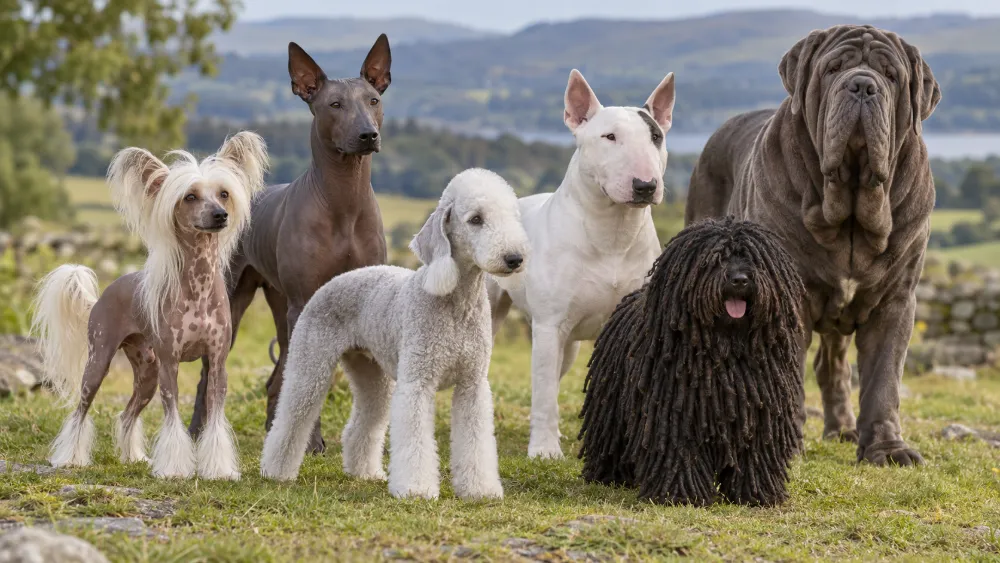
| Breed | Most Unusual Feature |
|---|---|
| Chinese Crested | Hairless body with crest, socks and feathered tail |
| Xoloitzcuintli | Ancient hairless form with smooth exposed skin |
| Bedlington Terrier | Lamb-like coat and unusual head shape |
| Bull Terrier | Long egg-shaped head and triangular eyes |
| Puli | Dense corded coat |
| Komondor | Massive body covered in long white cords |
| Bergamasco Sheepdog | Flat felted flocks of hair |
| Neapolitan Mastiff | Extreme loose skin and facial folds |
| Brussels Griffon | Short muzzle, large eyes and dramatic beard |
| Afghan Hound | Extremely long silky coat and elegant narrow head |
1. Chinese Crested
The hairless Chinese Crested is one of the easiest dogs in the world to recognize.
Most of its body has exposed skin, while long silky hair remains on:
the head, forming the crest;
the lower legs and feet;
and the end of the tail.
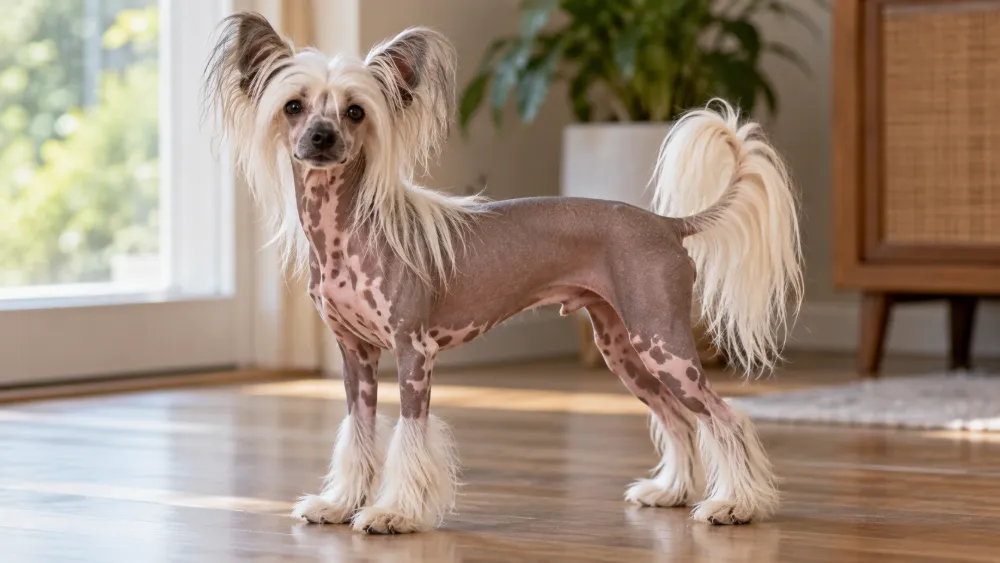
Its skin can also be spotted or patterned, adding to the unusual appearance.
There is an important twist: not every Chinese Crested is hairless.
The breed also has a fully coated form known as the Powderpuff, which has a soft silky coat covering the body.
The two varieties can look so different that someone unfamiliar with the breed might assume they are separate dogs.
2. Xoloitzcuintli
The Xoloitzcuintli—often shortened to Xolo—is another famous hairless breed.
It is an ancient Mexican dog with a history stretching back thousands of years.
The AKC recognizes three size varieties:
toy;
miniature;
and standard.
Like the Chinese Crested, Xolos occur in both hairless and coated varieties.
The hairless dog normally has smooth skin and may retain small amounts of coarse hair on the head, feet and tail.
Its clean silhouette, large upright ears and lack of a conventional coat give it a striking appearance that is very different from most familiar pet dogs.
3. Bedlington Terrier
The Bedlington Terrier is often compared with a small lamb.
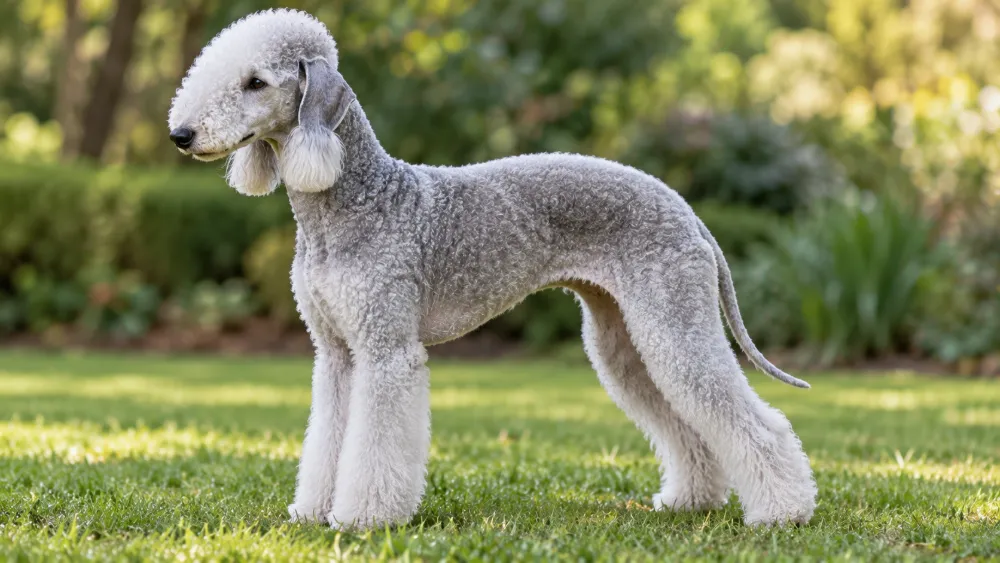
The resemblance comes from several features working together:
a soft curly coat;
a narrow head covered with a distinctive topknot;
long tapered ears;
and an arched body outline.
Traditional grooming emphasizes this unusual silhouette even more.
Despite the delicate appearance, the Bedlington is a true terrier rather than a decorative lapdog.
AKC lists adult weight at only about 17 to 23 pounds, making it one of the smaller breeds in this list.
4. Bull Terrier
The Bull Terrier has one of the most distinctive heads in the dog world.
The AKC breed description calls its hallmark a long, egg-shaped head.
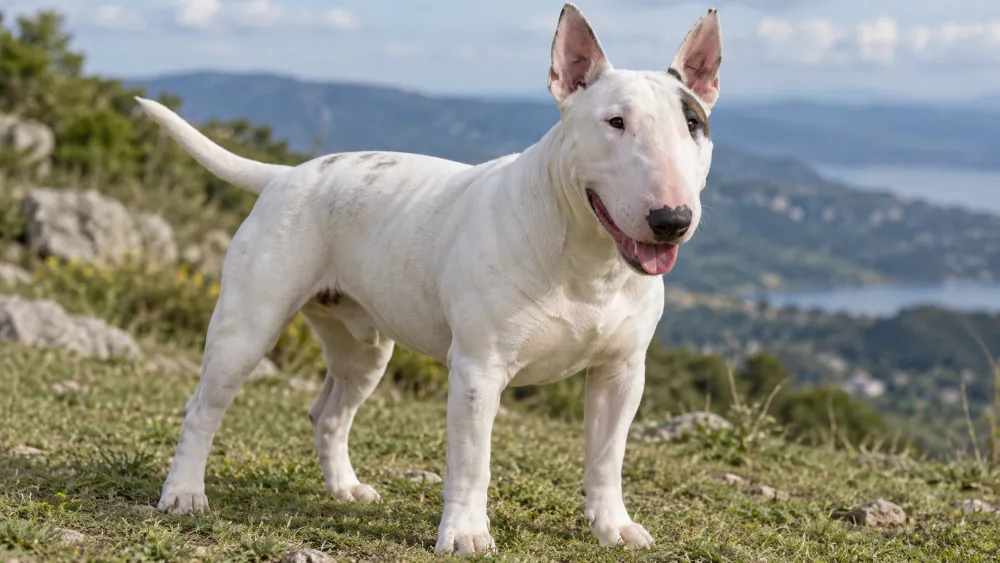
Seen from the side, the top of the skull curves continuously downward toward the nose rather than having the pronounced stop seen in many breeds.
Add:
small triangular eyes;
upright pointed ears;
and a heavily muscled body;
and the result is unmistakable.
The head shape is a breed characteristic, not the result of an injury or unusual camera angle.
5. Puli
A mature Puli can look like a small dog covered in hundreds of ropes.
The breed is a Hungarian herding dog famous for its naturally corded coat.
As the coat develops, the undercoat and outer hair interact to form long cords.
Those cords can cover much of the dog's:
face;
body;
legs;
and tail.
This creates a moving curtain of hair when the agile little herding dog runs.
Pulik are much smaller than Komondors, although the two Hungarian breeds are frequently confused because of their coat structure.
6. Komondor
If the Puli resembles a small mop, the Komondor resembles a giant one.
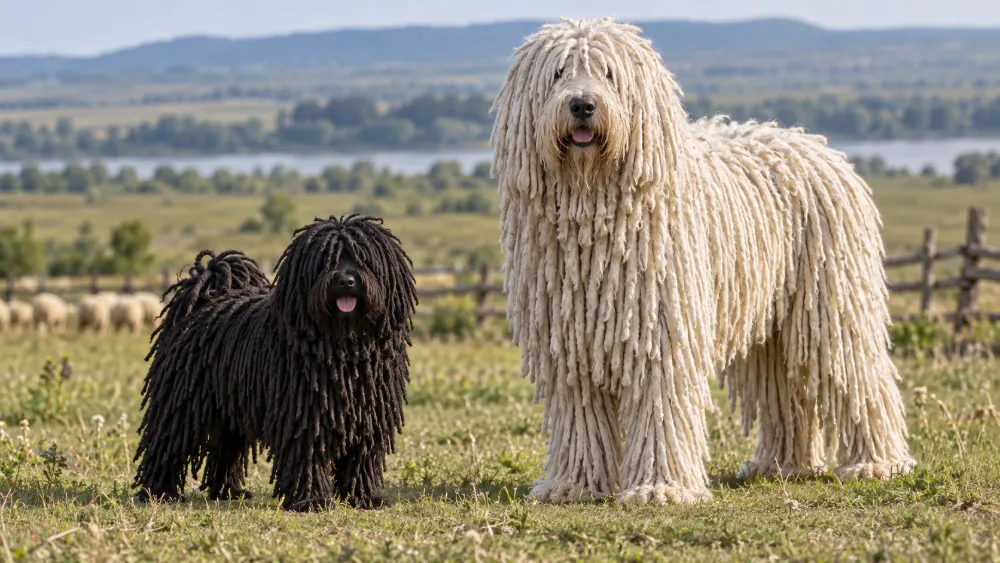
The Komondor is a large Hungarian livestock guardian covered in long white cords.
But describing it as simply a “large Puli” is incorrect.
The breeds historically performed different jobs:
the smaller, highly agile Puli worked as a herding dog;
the much larger Komondor guarded livestock.
AKC notes that although the two breeds share corded coats and Hungarian working history, they are distinct breeds with very different size and function.
7. Bergamasco Sheepdog
At first glance, the Bergamasco may look like another corded dog.
Look more closely and the coat is fundamentally different.
A mature Bergamasco develops broad structures called flocks rather than the narrow cords of a Puli or Komondor.
These flocks are large, irregular mats of felted hair that can become broad and flat.
The coat contains three different types of hair that work together to create the characteristic texture.
That gives the Bergamasco a rustic, layered appearance unlike almost any other breed.
8. Neapolitan Mastiff
The Neapolitan Mastiff looks unusual for almost the opposite reason from a hairless breed: it appears to have far more skin than it needs.
The breed is massive and heavy-boned, with:
loose skin;
deep facial wrinkles;
heavy folds;
pendulous lips;
and a large dewlap beneath the neck.
AKC specifically identifies extensive wrinkles and hanging folds as defining characteristics of the breed.
The enormous head and heavily folded skin give the Mastino a prehistoric appearance, but these features are part of the established breed type.
9. Brussels Griffon
The Brussels Griffon is tiny, but its face is hard to forget.
Its most distinctive features include:
a very short muzzle;
large dark eyes;
a prominent beard and mustache in rough-coated dogs;
and an expressive face.
The result has inspired comparisons with tiny old men and fictional creatures.
Behind the unusual expression is a true toy breed weighing only around 8 to 10 pounds.
Brussels Griffons occur in both rough-coated and smooth-coated forms, creating noticeably different appearances within the same breed.
10. Afghan Hound
The Afghan Hound is unusual in a completely different way.
Rather than looking rugged, wrinkled or hairless, it has an almost exaggerated elegance.
Its appearance combines:
a long narrow head;
very long silky hair;
a distinctive topknot;
long feathered ears;
a high hip structure;
and a tail ending in a characteristic ring or curve.
The flowing coat originally helped protect this ancient sighthound in harsh mountainous environments.
When fully groomed, an Afghan Hound can look dramatically different from almost every short-coated working dog.
Why Do Some Dog Breeds Look So Strange?
Unusual appearance usually comes from one of three sources.
1. Working function
Many unusual characteristics originally developed in dogs bred for specific environments or jobs.
Livestock guardians needed weather-resistant coats. Sighthounds developed body shapes optimized for speed. Hair and skin characteristics became fixed within isolated populations.
2. Genetics
Some dramatic differences come from specific inherited traits.
Hairlessness in breeds such as the Chinese Crested and Xoloitzcuintli is genetically controlled.
Coat texture, length, curl and growth patterns are also strongly influenced by inherited variants.
3. Selective breeding
Once a breed was established, breeders selected dogs that best matched the desired appearance and function.
Over many generations, distinctive features such as the Bull Terrier's head profile or the Neapolitan Mastiff's loose skin became increasingly recognizable breed traits.
Are Hairless Dogs Completely Hairless?
Not always.
The hairless Chinese Crested retains characteristic hair on the head, feet and tail.
Hairless Xolos may also have limited hair on the head, feet and tail.
Both breeds also have fully coated varieties.
Hairless skin also requires care. Without a normal coat, dogs can need protection from strong sunlight, cold weather and skin irritation.
Are Corded Dog Coats Natural?
Yes, but they still require human maintenance.
Puli and Komondor coats naturally tend to form cords as different layers of hair interact.
Owners must separate and maintain those cords to prevent uncontrolled matting and keep the skin and coat clean.
The Bergamasco is different: its coat forms broader felted flocks instead of classic narrow cords.
Are Weird-Looking Dogs Unhealthy?
An unusual appearance by itself does not mean a dog is unhealthy.
However, every breed has its own health considerations.
For example:
hairless breeds require extra skin care;
giant breeds can face orthopedic concerns;
heavy facial folds may require regular inspection and cleaning;
and unusual coat types require specialized grooming.
Anyone choosing a dog should research health testing, temperament, exercise needs and grooming requirements rather than selecting a breed only because of its unusual appearance.
Which Dog Breed Looks Most Like a Lamb?
The Bedlington Terrier is the breed most famously compared with a lamb.
Its curly coat, narrow head, topknot and traditional grooming style create the resemblance.
Which Dog Breed Looks Like a Mop?
The Puli and Komondor are the classic “mop dogs” because of their corded coats.
The Puli is much smaller and historically worked as a herder, while the giant white Komondor is a livestock guardian.
Which Dog Has an Egg-Shaped Head?
The Bull Terrier is famous for its long egg-shaped head and small triangular eyes.
Those features are among the clearest ways to distinguish it from other terriers.
FAQ
What are some weird-looking dog breeds?
Chinese Cresteds, Xoloitzcuintlis, Bedlington Terriers, Bull Terriers, Pulis, Komondors, Bergamascos and Neapolitan Mastiffs are among the breeds with especially unusual physical features.
What is the weird-looking hairless dog?
Two likely answers are the Chinese Crested and Xoloitzcuintli. Both have well-known hairless varieties, although both breeds can also produce coated dogs.
What dog looks like a sheep?
The Bedlington Terrier is frequently compared with a lamb because of its curly coat, narrow head and traditional grooming style.
What dog looks like a mop?
Pulis and Komondors develop natural corded coats that create the famous mop-like appearance.
What dog has the strangest head?
That is subjective, but the Bull Terrier is particularly distinctive because its breed hallmark is a long, egg-shaped head with small triangular eyes.
What dog has the most wrinkles?
The Neapolitan Mastiff is famous for extensive loose skin and heavy folds around its enormous head and body. Chinese Shar-Pei are also well known for wrinkles.
Are weird-looking dog breeds rare?
Some are relatively uncommon, but unusual appearance does not automatically mean a breed is rare. Popularity varies greatly by country and year.
Are hairless dogs hypoallergenic?
No dog can be guaranteed allergen-free. Hairless dogs may shed less hair, but people can still react to proteins in skin flakes, saliva and other secretions.
Final Thoughts
“Weird-looking” is ultimately a matter of perspective.
The same feature one person finds strange may be exactly what another person loves about a breed.
More importantly, most of these unusual appearances have real genetic or historical explanations.
The Chinese Crested and Xoloitzcuintli inherited hairless traits. Pulis and Komondors developed extraordinary corded coats. The Bergamasco forms broad flocks of hair. The Bull Terrier is defined by its egg-shaped head, while the Neapolitan Mastiff is famous for dramatic loose skin and wrinkles.
These breeds show just how much physical diversity humans and thousands of years of canine history have produced within a single species: the domestic dog.