Are dog strollers good for dogs? Yes, they can be. A dog stroller can help an older dog, a small dog with limited stamina, or a dog with mobility problems enjoy the outdoors without having to walk farther than is comfortable. But a stroller is not necessary for every dog, and it should not routinely replace healthy exercise.
The most important question is not whether dog strollers look fashionable. It is whether a stroller makes life better for your particular dog.
A dog that struggles to walk may benefit from being able to accompany its family outdoors. A healthy, energetic dog, on the other hand, still needs opportunities to walk, sniff, explore and move naturally.
Quick answer: Dog strollers are useful mobility aids when they meet an individual dog's needs. They are not a substitute for appropriate exercise, veterinary care or mental enrichment.
Why Do People Use Dog Strollers?
Dog strollers allow owners to transport their pets while keeping them contained in a wheeled carrier.
Some owners use them for convenience, but others rely on them because their dogs cannot comfortably complete long walks.
Common situations include:
Senior dogs with reduced mobility or stamina.
Small dogs that become tired on longer outings.
Dogs recovering from certain injuries or surgeries, when their veterinarian permits stroller use.
Dogs with chronic mobility problems that limit walking distance.
Dogs that can enjoy a short walk but need help completing a longer family outing.
Veterinarians interviewed by the American Kennel Club explain that a stroller can allow some dogs to continue experiencing the outdoors without excessive physical strain.
However, a stroller should enhance a dog's quality of life rather than simply make transportation more convenient for its owner.
1. Dog Strollers Can Help Senior Dogs Enjoy the Outdoors
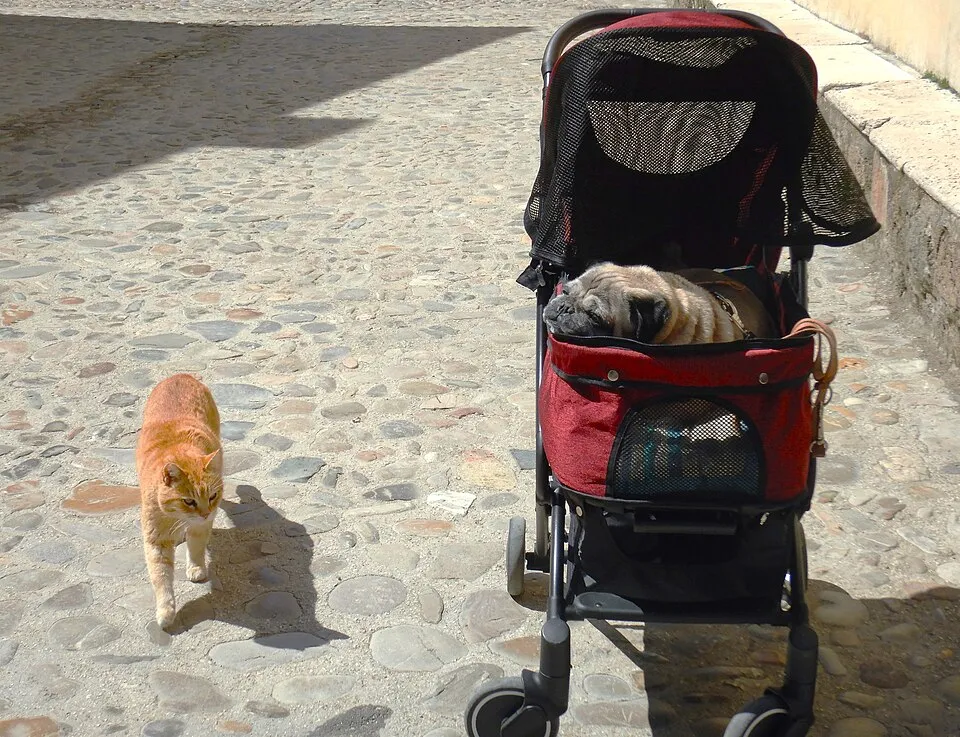
An elderly pug using a stroller because it could no longer walk, according to the photographer. Photo: Albarubescens / Wikimedia Commons, CC BY-SA 4.0. Original photograph.
Older dogs often experience changes in their physical abilities.
Some may develop arthritis, weakness, reduced stamina or other medical conditions that make long walks uncomfortable.
Nevertheless, many senior dogs continue to enjoy familiar outdoor experiences, including watching their surroundings and investigating interesting smells.
A stroller can help some of these dogs remain included in family activities.
For example, an older dog might comfortably walk a short distance before becoming tired. Its owner could then use a stroller for the remainder of the outing.
This approach may preserve opportunities for gentle activity while reducing excessive strain.
Important: A dog that suddenly becomes unwilling to walk should receive veterinary attention. Reduced mobility should not automatically be dismissed as normal aging.
2. Are Dog Strollers Good for Dogs With Arthritis?
They can be helpful, but a stroller does not treat arthritis.
Canine osteoarthritis is a chronic joint condition that can cause pain, stiffness and changes in movement.
Dogs with arthritis may walk more slowly, avoid stairs, struggle to rise after resting or become less willing to participate in familiar activities.
Veterinary care may involve weight management, pain control, rehabilitation, environmental modifications and an individualized exercise plan.
A stroller can be one part of that plan when walking longer distances would cause discomfort.
However, excessive inactivity can contribute to loss of muscle strength and physical conditioning.
Appropriate, controlled movement remains important for many dogs with arthritis.
The American Animal Hospital Association recommends addressing mobility limitations through a combination of veterinary assessment, pain management, rehabilitation and practical environmental support.
Ask your veterinarian how much walking is appropriate before using a stroller as a regular mobility aid.
3. Should Healthy Dogs Ride in Strollers?
There is no general rule that a healthy dog must never ride in a stroller.
A calm, healthy dog may be comfortable riding in one occasionally, particularly during an outing that would otherwise be too long for its normal activity level.
However, a healthy dog should still have suitable opportunities for physical activity and exploration.
Dogs use walking for much more than transportation.
They investigate scents, interact with their surroundings, practise movement and experience mental stimulation.
When a dog spends an entire outing sitting in a stroller, some of these opportunities are reduced.
For this reason, a stroller is best treated as an optional transport aid rather than the default replacement for walking.
Dog Stroller vs. Walking: What's Better?
| Situation | Walking | Stroller |
|---|---|---|
| Healthy, active adult dog | Usually essential for regular exercise and exploration | Optional for specific circumstances |
| Senior dog with reduced stamina | Short, comfortable walks may remain valuable | Useful for longer outings |
| Dog with arthritis | Veterinarian-guided low-impact activity may help | Can reduce excessive strain |
| Dog recovering from surgery | Depends on veterinary restrictions | Only when approved and suitable for recovery |
| Young puppy | Age-appropriate movement and positive exploration | Can provide transport in some situations |
| Dog frightened by crowds | Quiet, controlled environments may be preferable | Not automatically a solution to anxiety |
The best approach depends on the dog's health, temperament, age, physical ability and the environment.
A stroller and a walk do not have to be competing choices. For some dogs, combining both offers the best experience.
4. Do Dog Strollers Prevent Dogs From Getting Enough Exercise?
They can if owners use them to replace most of a dog's normal movement without a suitable reason.
Regular, appropriate activity helps support muscle condition, weight management, joint function and mental stimulation.
Veterinary organizations such as PDSA recommend continuing suitable exercise as dogs age, with adjustments based on their abilities.
A dog that can safely walk should not automatically be prevented from walking simply because a stroller is available.
Consider a senior dog that enjoys a familiar park but cannot manage the entire route.
Instead of choosing between a long walk and staying home, the owner may allow the dog to walk a comfortable distance, rest in the stroller, and explore again when appropriate.
This can be a useful compromise, provided the activity matches the dog's medical needs.
5. How Can You Tell if Your Dog Enjoys the Stroller?
Not every dog likes riding in a stroller.
Some appear comfortable almost immediately, while others dislike being confined, lifted or moved through noisy environments.
Watch your dog's behavior rather than assuming that being quiet means being happy.
Possible Signs of Comfort
Voluntarily entering or approaching the stroller.
Maintaining a relaxed body posture.
Looking around calmly without repeated attempts to escape.
Settling comfortably when the stroller is stationary.
Accepting treats or engaging normally, if appropriate.
Possible Signs of Stress
Repeated whining, barking or attempts to climb out.
Trembling or a tense body posture.
Repeated avoidance when approaching the stroller.
Panting that is unexplained by heat or exertion.
Freezing or becoming unusually still.
Repeated lip licking or yawning in a stressful context.
No single behavior establishes the dog's emotional state. Body language must be interpreted in context.
If your dog becomes distressed, stop the ride in a safe location and allow it to settle.
Do not force a frightened dog to remain in the stroller simply to finish an outing.
6. How to Introduce a Dog to a Stroller
A gradual introduction is usually more comfortable than putting a dog into a stroller and immediately beginning a long walk.
Step 1: Let Your Dog Investigate
Place the stationary stroller in a familiar, quiet environment with its brakes engaged.
Allow your dog to approach, sniff and investigate voluntarily.
Offer a suitable reward for calm exploration without forcing contact.
Step 2: Practise Entering Safely
For a small dog, the owner may be able to lift the animal carefully while supporting its body, provided handling is comfortable and medically appropriate.
A larger dog may require a different access arrangement.
Do not encourage a dog with joint problems to jump into or out of a raised stroller.
Step 3: Make the Interior Comfortable
Use a stable, non-slip resting surface with enough room for the dog to sit or lie in a natural posture.
Check that the dog can breathe freely and is not pressed against hard components.
Step 4: Start With Short, Slow Movement
Move the stroller gently over a smooth surface.
Watch for discomfort or fear. Stop and return to an earlier stage if your dog becomes distressed.
Step 5: Build Up Gradually
Increase the duration only when your dog remains comfortable.
Practise in quiet locations before considering busy streets or crowded public areas.
Some dogs may never become comfortable in a stroller, and that is acceptable.
7. What Makes a Dog Stroller Safe?
Safety is more important than appearance.
A stroller should be appropriate for the animal's actual size and weight, with enough space for comfortable positioning.
| Feature | What to Check |
|---|---|
| Weight capacity | The manufacturer's limit must safely accommodate the dog and anything carried inside. |
| Internal space | Enough room to sit, turn or lie comfortably as appropriate. |
| Ventilation | Air openings remain unobstructed, including when the canopy is closed. |
| Brakes | The stroller can remain securely stationary when needed. |
| Stability | Wheels and frame are suitable for the intended surface. |
| Restraint | A compatible, properly fitted harness and designed restraint can help reduce escape risk. |
| Flooring | Stable, slip-resistant support without unsafe gaps. |
| Access | The dog can enter and exit without inappropriate jumping or painful handling. |
Follow the stroller manufacturer's instructions regarding assembly, restraints, loading and safe operation.
Never attach a short interior tether to a dog's neck collar if sudden movement could create pressure on the neck. Use only a compatible restraint arrangement recommended for the product and appropriate to the dog's body and medical needs.
Do not leave a dog unattended in a stroller.
8. Can Dog Strollers Become Too Hot?
Yes. Heat is an important safety concern, particularly in warm weather and direct sunlight.
Even when the outside temperature feels comfortable, a poorly ventilated enclosed stroller can become uncomfortable or dangerously warm.
A canopy may provide shade, but it does not automatically guarantee adequate airflow.
Dogs regulate body temperature partly through panting. Some dogs are especially vulnerable to heat-related illness, including those with breathing difficulties, obesity, advanced age or certain medical conditions.
To reduce risk:
Avoid outings during extreme heat.
Keep ventilation openings clear.
Use shade where possible.
Offer access to drinking water as appropriate.
Never cover the stroller with a blanket that blocks airflow.
Do not leave a dog unattended inside a parked stroller.
Stop immediately if the dog shows signs of overheating.
Signs such as severe or persistent panting, weakness, collapse, confusion or difficulty breathing require urgent veterinary attention.
A stroller is not a substitute for appropriate temperature management.
9. Are Dog Strollers Useful for Small Dogs?
Small dogs may find it difficult to keep up with a much longer walk planned around larger dogs or human exercise goals.
A stroller can make some outings more manageable, especially when the dog would otherwise need to be carried.
However, small dogs still need appropriate opportunities to walk, sniff and explore.
Size alone is not a reason to keep a healthy dog in a stroller all the time.
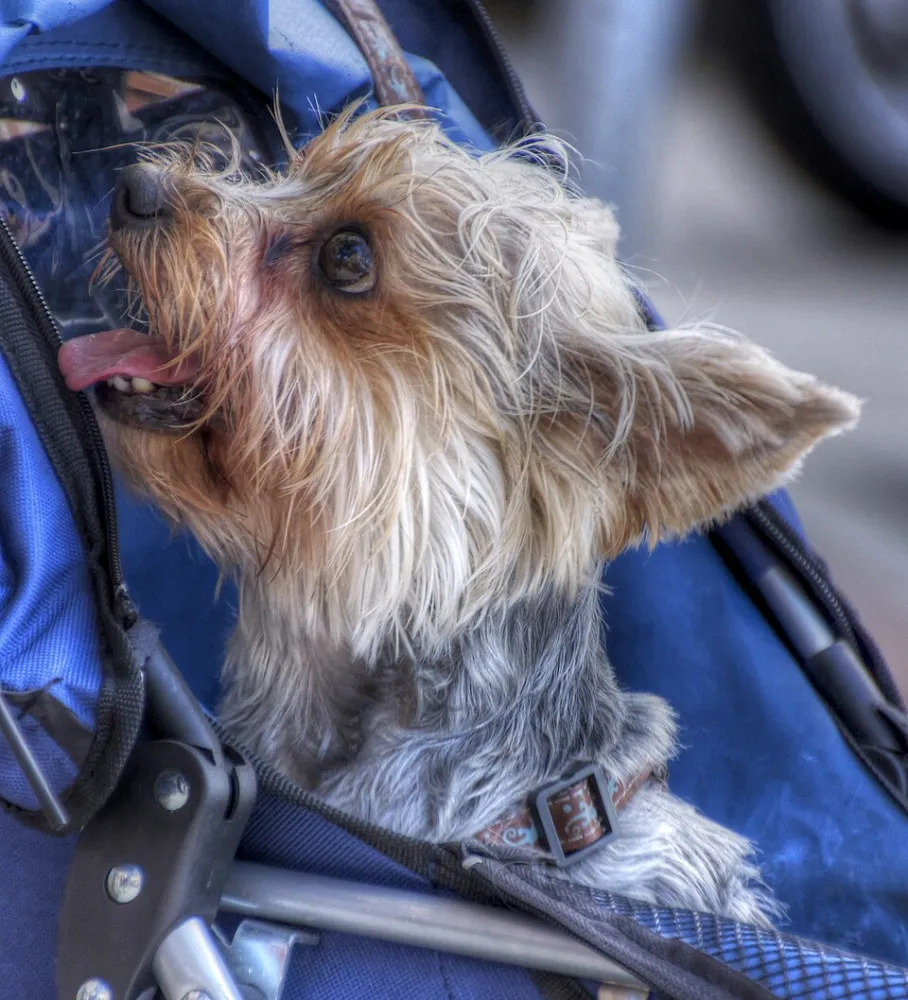
A small dog riding in a stroller. Photo: psyberartist / Wikimedia Commons, CC BY 2.0. Original photograph.
When choosing a stroller for a small dog, pay particular attention to internal space, ventilation, the security of the carrier opening and stability on uneven ground.
10. Can Puppies Ride in Dog Strollers?
A stroller may help transport a young puppy in certain situations, but it should not replace appropriate early socialization and safe physical activity.
Puppies benefit from positive experiences with different environments, people, sounds and surfaces.
However, they also need protection from unsafe exposure, excessive handling and overwhelming situations.
For puppies that have not completed their vaccination series, discuss appropriate outdoor exposure and disease risks with a veterinarian.
A stroller does not make every environment risk-free. Puppies can still encounter other animals, contaminated surfaces or stressful situations.
If you are preparing to bring home a puppy, see our First-Year Puppy Costs Guide for veterinary, training and equipment considerations.
11. When Is a Dog Stroller a Bad Idea?
A stroller may be unsuitable when it causes more distress or risk than benefit.
Examples include:
A dog that becomes highly anxious when confined.
A stroller that is too small or structurally unsuitable for the dog.
A dog with medical needs that make the intended riding position unsafe.
Hot conditions where safe temperature control cannot be maintained.
Situations where a healthy dog's necessary movement is being unnecessarily restricted.
Rough terrain that exceeds the stroller's safe operating limits.
A dog recovering from surgery, spinal injury or another medical condition may require very specific movement restrictions.
Do not assume that a stroller is automatically safe during medical recovery. Follow the treating veterinarian's instructions.
12. Dog Stroller or Dog Wheelchair: Which Is Better?
A stroller and a canine wheelchair serve different purposes.
A stroller transports the dog while its body is supported inside a carrier.
A canine wheelchair, sometimes called a mobility cart, is designed to support a dog while allowing some degree of self-directed movement.
The most appropriate option depends on the underlying medical condition, mobility goals and veterinary assessment.
| Mobility Aid | Main Purpose | Important Consideration |
|---|---|---|
| Dog stroller | Provides supported transport during outings | Does not actively exercise the legs |
| Support harness | Helps an owner assist a dog with standing or walking | Must fit appropriately and suit the dog's condition |
| Canine wheelchair | Supports mobility while the dog moves | Requires careful fitting, training and veterinary guidance |
| Shorter walks | Allows controlled physical activity | Should match the dog's comfort and endurance |
No single mobility aid is appropriate for every dog.
A veterinarian or qualified canine rehabilitation professional can help determine which option supports comfort and long-term function.
13. What if Your Senior Dog Suddenly Stops Walking?
Do not assume the problem can be solved simply by buying a stroller.
A sudden change in mobility can have many causes, including pain, injury, neurological problems or other illness.
Warning signs may include:
New or worsening limping.
Difficulty standing.
Refusal to bear weight on a limb.
Dragging the back legs.
Marked weakness or collapse.
Vocalizing when moving or being touched.
Sudden reluctance to walk or climb stairs.
Seek prompt veterinary advice if these signs occur. Sudden inability to stand, severe pain, collapse or breathing difficulty warrants urgent assessment.
A stroller may eventually become part of a care plan, but the underlying cause should be identified first.
Frequently Asked Questions
Are dog strollers good for older dogs?
They can be helpful for senior dogs with reduced stamina or mobility. A stroller may allow the dog to enjoy outdoor experiences without excessive walking, but appropriate activity and veterinary care remain important.
Do dogs like being pushed in strollers?
Some do, while others do not. Look for voluntary participation, relaxed body language and comfort during movement. Do not force a dog that repeatedly shows fear or tries to escape.
Are dog strollers bad for healthy dogs?
Not inherently. Occasional stroller use is not automatically harmful, but it should not unnecessarily replace the regular movement, sniffing and exploration a healthy dog needs.
Can a dog stroller help with arthritis?
A stroller can reduce the need for prolonged walking, but it does not treat arthritis. Dogs with arthritis may still benefit from controlled exercise, pain management and rehabilitation under veterinary guidance.
Do small dogs need strollers?
Not necessarily. Healthy small dogs can enjoy regular walks suited to their abilities. Strollers may be useful for longer outings or when mobility is limited.
Can puppies use dog strollers?
Yes, in some circumstances. However, a stroller should not replace age-appropriate movement and positive socialization. Health precautions and the puppy's comfort must be considered.
Are dog strollers safe in hot weather?
Only when the environment remains suitable for the dog. Direct sunlight, poor airflow and excessive heat can make stroller use unsafe. Never leave a dog unattended in an enclosed stroller.
Should I use a stroller instead of walking my dog?
Usually not as a complete replacement if your dog can safely walk. Many dogs benefit from a combination of appropriate walking, sniffing and stroller-assisted transport when needed.
Can large dogs use strollers?
Some larger dogs can use specially designed mobility strollers, but the equipment must have adequate weight capacity, stability, internal space and safe access. Veterinary guidance is particularly important for dogs with significant mobility problems.
How do I know if my dog needs a stroller?
Consider your dog's stamina, comfort, medical history and reaction to outdoor activity. If mobility has changed or pain is suspected, ask a veterinarian to assess the underlying cause before deciding on a mobility aid.
The Bottom Line
Dog strollers can improve quality of life when they help a dog participate comfortably in activities that would otherwise be difficult.
They may be particularly useful for some senior dogs, small dogs with limited stamina and dogs with medically assessed mobility problems.
But a stroller should not replace healthy movement without a good reason.
The best choice is the one that respects your dog's individual needs, allows appropriate activity and keeps every outing safe, comfortable and enjoyable.
Veterinary and Animal Welfare Sources
American Kennel Club — Are Dog Strollers Good for Dogs? Benefits and Safety
PDSA — Exercising Your Senior Dog
American Animal Hospital Association — Senior Care and Pain Management
Banfield Pet Hospital — Exercise and Activities for Senior Dogs and Cats