Cats knead because the behavior begins naturally during kittenhood, when nursing kittens rhythmically press their front paws against their mother's body to help stimulate milk flow. Many cats continue kneading as adults, especially on soft blankets, beds, or people they feel comfortable around. This movement, often called "making biscuits," may be associated with relaxation, familiar textures, preparation for rest, or scent marking. However, scientists have not established one definitive reason why every adult cat kneads. In most cases it is normal behavior, although sudden changes or excessive kneading can sometimes occur alongside stress or discomfort.
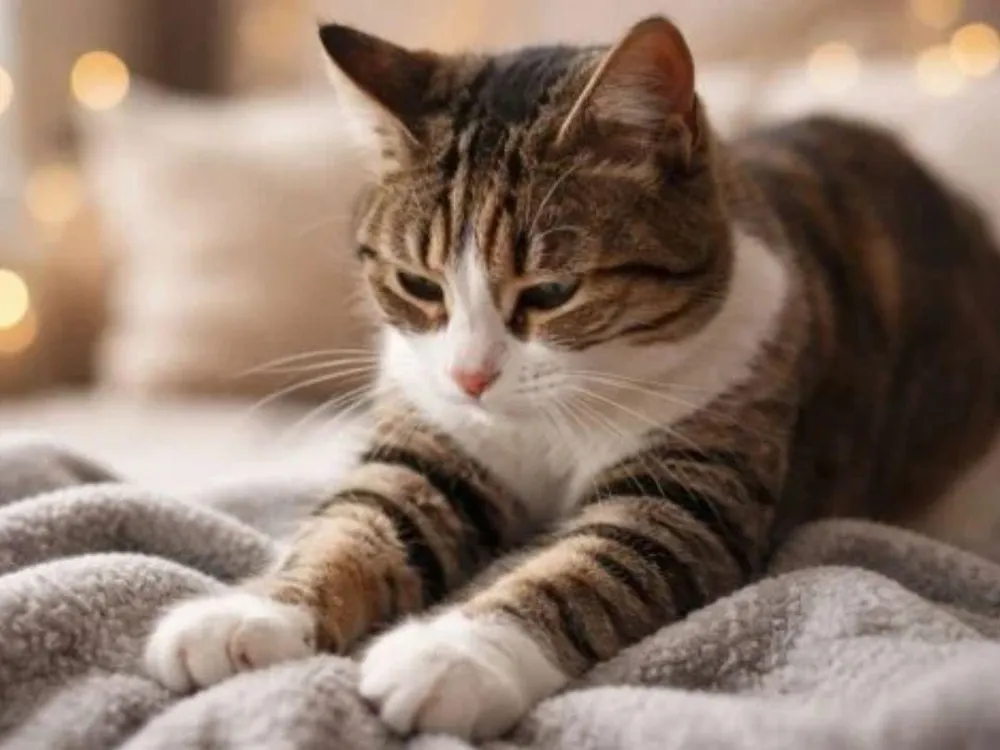
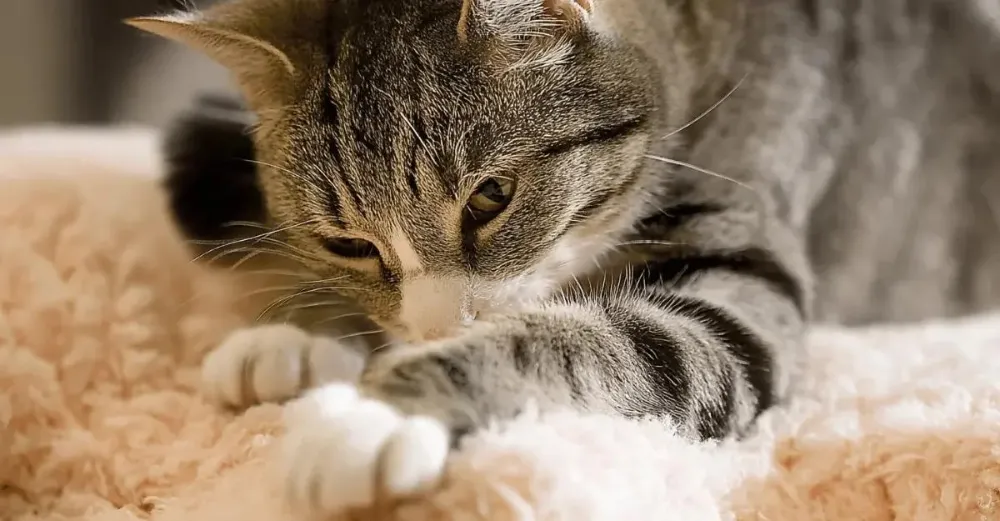
Kneading is a natural feline behavior in which a cat alternately presses its front paws against a surface.
Why Do Cats Knead?
Kneading is a familiar behavior in which a cat alternately pushes its front paws against a surface.
The movement resembles a person working bread dough, which explains the popular expression "making biscuits."
Although it is especially noticeable in domestic cats, its origins lie in normal kitten development.
Very young kittens knead while nursing from their mothers.
This rhythmic movement helps stimulate milk flow.
Some cats continue using the same motor pattern long after they stop drinking their mother's milk.
Adult cats commonly knead when they are comfortable or preparing to settle down.
However, researchers have not proved that every instance of adult kneading serves exactly the same function.
The behavior may reflect several influences, including early-life associations, sensory stimulation, and individual differences.
What Does It Mean When a Cat Makes Biscuits?
The expression "making biscuits" means kneading.
A cat usually performs the action by pressing one forepaw into a soft surface, withdrawing it, and then pressing the other forepaw.
This alternating pattern may continue for several seconds or minutes.
Some cats extend their claws during the movement.
Others keep their claws mostly retracted.
Many cats purr, close their eyes, or gradually lie down while kneading.
These accompanying behaviors can suggest that the animal is relaxed.
However, kneading should always be interpreted alongside the cat's other body-language signals.
A cat that appears tense, hides, or shows signs of illness may knead for different reasons than a relaxed cat on a favorite blanket.
Why Do Kittens Knead Their Mothers?
Newborn kittens depend on their mother's milk for nourishment.
While nursing, they make alternating pushing movements with their front paws against the area around the mammary glands.
This action helps stimulate milk release.
The behavior appears very early in life and does not require a kitten to be taught by a human.
Veterinary sources, including VCA Animal Hospitals and the Cornell University College of Veterinary Medicine, describe this nursing connection as the most widely accepted explanation for the origin of kneading.
Nursing also involves warmth, physical contact, and familiar sensations.
These experiences may contribute to the association between kneading and comfort later in life.
Why Do Adult Cats Still Knead?
Adult cats no longer need to stimulate milk production from their mothers, but some continue kneading throughout life.
Researchers have proposed several possible explanations.
The movement may retain associations with the warmth and security of nursing.
It may also be triggered by soft textures that resemble those encountered during early development.
Some cats appear to use kneading while preparing to rest.
Scent communication and stretching have also been suggested as possible additional functions.
However, Cats Protection, a major feline welfare organization, emphasizes that the exact reason adult cats retain the behavior remains uncertain.
These explanations should be understood as hypotheses rather than a complete, experimentally proven list of causes.
Does Kneading Mean a Cat Is Happy?
Kneading often occurs when a cat appears content and relaxed.
A cat may knead a warm blanket, purr softly, and settle down to sleep.
This combination of behaviors is consistent with comfort.
However, the action alone cannot prove that a cat feels happy.
Cats may also use familiar behaviors to soothe themselves when they are anxious or uncomfortable.
A cat's posture, ears, tail, facial expression, vocalizations, and overall activity provide additional context.
For example, kneading accompanied by relaxed muscles and normal appetite is generally less concerning than a sudden increase in kneading combined with hiding and changes in eating behavior.
Why Does My Cat Knead Me?
A cat may knead its owner because the person's lap or body provides a warm, soft, familiar surface.
The cat may also associate close physical contact with security.
When a cat kneads during relaxed social contact, the behavior can be a positive sign of familiarity and comfort.
However, scientists cannot infer a cat's precise emotional state from kneading alone.
The cat may simply be responding to the texture beneath its paws.
If the cat curls up and sleeps afterward, the kneading may also be part of settling into a comfortable resting position.
Does Cat Kneading Mean Love?
People often interpret kneading as a sign of affection.
That interpretation may be reasonable when a cat voluntarily approaches a familiar person, relaxes, kneads, and seeks physical contact.
However, kneading is not an exclusive signal of affection.
Cats also knead blankets, cushions, and beds that do not provide social companionship.
Therefore, it is more accurate to say that kneading can occur during affectionate or comfortable interactions than to claim that every kneading movement means love.
Other behaviors, such as voluntary proximity, relaxed body posture, and friendly social interactions, help provide a fuller picture.
Why Do Cats Knead Blankets?
Soft blankets are common surfaces for kneading because they provide textures that allow a cat's paws to press and release repeatedly.
Some researchers and animal behavior specialists suggest that these textures may activate a familiar motor pattern associated with kittenhood.
A blanket may also be part of the cat's preferred sleeping area.
Some cats knead for a short period and then lie down on the same blanket.
Others continue for much longer.
However, there is no definitive evidence showing that every cat chooses a blanket for the same reason.
Texture, warmth, habit, and individual preference may all contribute.
Why Do Cats Knead Before Lying Down?
Some cats knead just before settling into a resting position.
One hypothesis is that the movement helps prepare a comfortable sleeping surface.
Veterinary resources sometimes connect this behavior with the movements of wild felids adjusting vegetation or other natural bedding materials.
However, this explanation has not been established as the principal cause of adult kneading in domestic cats.
Cats Protection notes that the popular ancestral grass-flattening explanation has relatively limited supporting evidence.
It remains possible that kneading and settling down are linked by a familiar behavioral routine.
The strongest directly observable conclusion is that some cats knead before resting.
Why Do Cats Knead and Purr at the Same Time?
Kneading and purring commonly appear together during relaxed interactions.
Both behaviors can occur when a cat feels comfortable.
However, purring is not always a straightforward sign of happiness.
Cats may also purr when seeking comfort or experiencing distress.
Similarly, kneading can sometimes occur in self-soothing contexts.
Therefore, the combination of kneading and purring should be evaluated with the cat's other behavior.
Relaxed eyes, normal breathing, a comfortable posture, and willingness to rest usually support a positive interpretation.
Signs of pain or illness warrant greater attention.
Why Do Cats Knead With Their Claws Out?
Kneading involves repeated movements of the paws and toes.
As the paws flex and extend, the claws may become visible.
For many cats, this is simply part of the normal movement.
It does not necessarily mean the animal intends to scratch or hurt anyone.
However, sharp claws can be uncomfortable when a cat kneads directly on human skin.
Placing a thick blanket between the cat and your lap is a simple way to reduce discomfort without punishing the animal.
Regular, appropriate claw trimming may also help when performed safely.
Why Does Cat Kneading Sometimes Hurt?
Cat claws are sharp and can press through thin clothing or bedding.
During kneading, repeated pressure can make the claw tips contact skin.
This is especially noticeable when the cat is excited or applying considerable pressure.
However, the cat is usually performing a normal movement rather than deliberately attacking.
A thicker blanket or a nearby soft resting surface can protect the person while allowing the behavior to continue.
Do not forcibly pull at embedded claws, because sudden movement could scratch the skin or upset the cat.
Do Cats Have Scent Glands in Their Paws?
Cats possess scent-producing structures associated with their paws.
These contribute to chemical communication.
Some veterinary behavior resources suggest that kneading may help deposit scent on surfaces.
This has led to the theory that kneading may contribute to marking familiar areas.
However, the exact role of scent deposition in every kneading event is not fully established.
It should not be assumed that a cat kneading a person is necessarily claiming ownership of that person.
Chemical communication is an important part of feline behavior, but the interpretation of a particular action depends on context.
Are Cats Marking Their Territory When They Knead?
Territorial scent marking is one proposed function of kneading.
Because cats have scent-producing glands associated with the paws, repeated paw contact may deposit chemical information on an object.
However, kneading does not always occur in territorial situations.
It is common during relaxed interactions and before sleep.
Researchers have not demonstrated that territorial communication is the primary explanation for every adult cat's kneading.
Therefore, scent marking is best presented as one possible function rather than a universal rule.
Why Do Cats Knead Soft Surfaces Instead of Hard Ones?
Soft materials compress under the cat's paws.
That tactile feedback may resemble sensations associated with nursing or resting on other soft surfaces.
Blankets, cushions, bedding, and laps are therefore frequently used for kneading.
However, cats vary in their preferred surfaces.
Some knead clothing, carpets, or other materials.
Others rarely knead at all.
The relationship between texture and kneading has not been completely explained through controlled experiments across large cat populations.
Individual preference and experience likely matter.
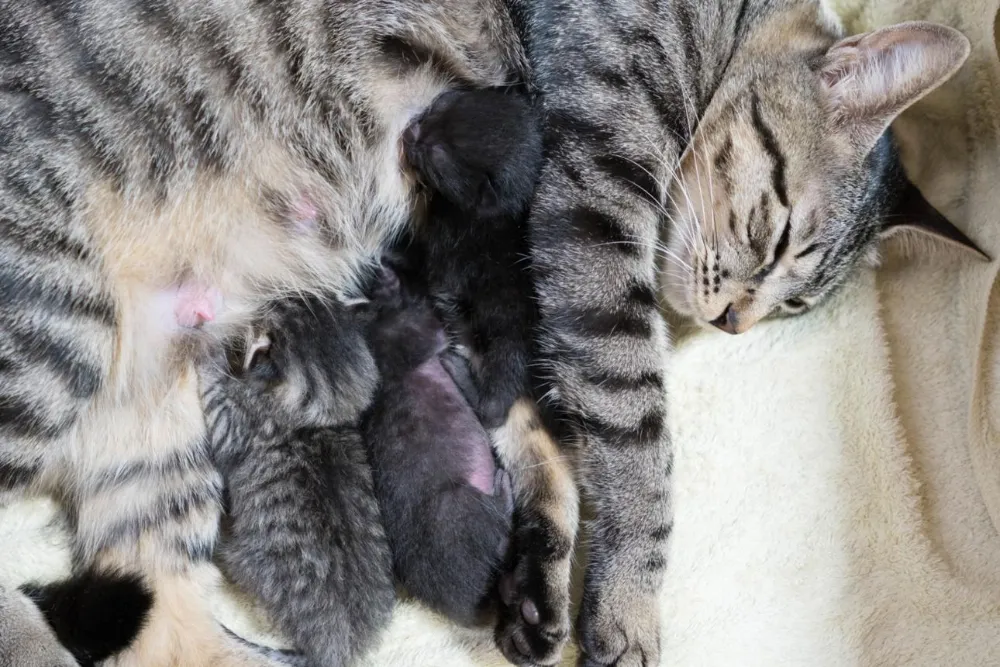
Kneading begins in kittenhood and is associated with nursing, making the early-life origin of the behavior especially well supported.
Is Kneading an Instinctive Behavior?
Kneading begins naturally in nursing kittens and is generally regarded as an instinctive motor behavior.
It does not require formal training.
However, the persistence of kneading into adulthood varies among individuals.
Some cats knead frequently, while others do so rarely.
This suggests that adult kneading may be influenced by additional factors beyond the basic inherited movement pattern.
Early experiences, preferred surfaces, environmental conditions, and individual behavioral differences may all contribute.
Scientists have not established a single model explaining all of this variation.
Do All Cats Knead?
No. Kneading is common, but not every adult cat performs it visibly or frequently.
Some cats knead every day.
Others do it only occasionally.
Some may have stopped performing the behavior after kittenhood.
This variation is not necessarily a sign of poor health, unhappiness, or a weak relationship with an owner.
Cats communicate comfort and social attachment through many behaviors.
The absence of kneading alone does not indicate that anything is wrong.
Why Doesn't My Cat Knead?
There are several possible explanations.
Your cat may simply have a different individual behavioral pattern.
It may prefer other ways of settling down or interacting with people.
It may also knead when you are not watching.
If a cat has never kneaded as an adult and otherwise behaves normally, there is usually no reason to treat the absence of kneading as a problem.
However, if an animal suddenly stops performing familiar movements and also shows stiffness, pain, or reduced mobility, a veterinarian can help evaluate the change.
Can Male and Female Cats Both Knead?
Yes. Kneading occurs in male and female cats.
It originates during nursing, which is a normal developmental stage for kittens of either sex.
Adult cats of both sexes may retain the behavior.
However, the frequency and circumstances vary among individuals.
It is not scientifically justified to assign a universal kneading pattern to one sex.
Do Cats Knead More as They Get Older?
There is no universal age-related pattern that applies to every cat.
Some adults continue kneading throughout their lives.
Others reduce the behavior after kittenhood.
Individual health, comfort, environment, and behavioral preferences can influence the frequency.
A sudden change in an older cat deserves more attention than a long-established habit.
For example, increased kneading combined with abnormal movement, reduced appetite, or other changes may justify a veterinary assessment.
Do Cats Knead Because They Were Weaned Too Early?
This is a common claim, but kneading alone does not establish that a cat was separated from its mother too early.
Kneading begins naturally in all nursing kittens.
Many cats that experienced ordinary maternal care continue the behavior as adults.
Some cats also knead while suckling fabric, a behavior that may raise additional questions about early experience and comfort.
However, researchers cannot reliably reconstruct a cat's weaning history from kneading alone.
Early-life experience may influence behavior, but it is not the only possible explanation.
Why Does My Cat Knead and Suckle on a Blanket?
Some cats combine kneading with sucking or mouthing soft fabric.
The combination resembles aspects of nursing behavior.
It may occur when a cat is relaxed or seeking familiar sensory comfort.
However, fabric suckling should be distinguished from chewing and swallowing nonfood materials.
If a cat actually ingests fabric, threads, or other objects, the behavior may create a gastrointestinal hazard.
Repeated ingestion of nonfood items should be discussed with a veterinarian.
Kneading a blanket without swallowing material is a different situation.
Why Does My Cat Knead My Hair or Clothes?
Hair and clothing can provide textures that a cat finds comfortable or stimulating.
A cat lying close to a familiar person may knead a sweater, blanket, or other nearby material.
The action may be related to its general preference for soft surfaces.
However, it is not possible to conclude from this behavior alone that the cat believes the material is its mother's fur.
Such explanations are commonly repeated but remain speculative.
The safest interpretation depends on what the cat is doing before and after the movement.
Why Does My Cat Knead My Stomach or Chest?
A person's stomach or chest may provide a warm and compressible surface.
If the cat is already resting comfortably on the person, kneading may be part of its normal settling routine.
Some cats purr or close their eyes during these interactions.
However, the behavior does not have one universal emotional meaning.
If the pressure is uncomfortable, you can place a folded blanket beneath the cat's paws.
This allows the interaction to continue without encouraging painful claw contact.
Why Does My Cat Knead Before Sleeping?
Kneading may occur as part of a routine that precedes rest.
The cat may press its paws into a favorite blanket, circle briefly, and lie down.
One explanation is that the action helps settle bedding material.
Another is that familiar textures and movements promote relaxation.
Both remain plausible, although researchers have not identified one experimentally proven function for all cats.
The association between kneading and settling down is nevertheless easy to observe in many domestic cats.
Is Cat Kneading the Same as Scratching?
No. Kneading and scratching are different behaviors.
Kneading involves alternating pressure from the forepaws, often on soft surfaces.
Scratching usually involves the claws contacting and dragging along a surface.
Scratching can help maintain claws, stretch muscles, and leave visual or chemical signals.
Kneading may involve visible claws, but the movement pattern and behavioral context are different.
A cat using its claws during kneading is not necessarily attempting to scratch the surface.
Cat Kneading vs. Scratching
| Feature | Kneading | Scratching |
|---|---|---|
| Typical movement | Alternating pressing with front paws | Claw contact followed by pulling or dragging |
| Common surface | Blankets, cushions, laps | Posts, mats, trees, furniture |
| Kittenhood connection | Directly associated with nursing | Separate normal feline behavior |
| Common context | Relaxation or settling down | Claw maintenance, stretching, signaling |
| Can involve claws | Yes | Yes |
Is It Normal for a Cat to Knead Every Day?
Daily kneading can be normal for an individual cat.
The important question is whether the behavior fits the animal's established pattern and overall well-being.
A cat that regularly kneads a favorite blanket before sleeping may simply have a strong habit.
However, changes deserve attention.
If kneading suddenly becomes much more frequent or appears alongside hiding, irritability, appetite changes, or altered mobility, the behavior should be considered in context.
The kneading itself may not be the underlying problem.
It may be one of several signs that the animal's condition has changed.
Can Cats Knead When They Are Stressed?
Yes. Although kneading is commonly associated with comfort, some cats may use familiar behaviors while attempting to soothe themselves.
Veterinary behavior sources note that cats can purr and knead during periods of discomfort.
However, kneading alone cannot diagnose anxiety or a medical condition.
Changes in behavior, hiding, reduced appetite, unusual vocalization, or signs of pain provide more meaningful warning signs.
If a cat shows persistent behavioral changes, a veterinarian can help assess potential causes.
Can Kneading Be a Sign of Pain?
Kneading is not generally considered a specific sign of pain.
Nevertheless, a cat experiencing discomfort may repeat familiar behaviors as a way of seeking comfort.
For that reason, a sudden change in kneading should not automatically be dismissed.
VCA Animal Hospitals advises considering other changes in the animal's behavior, such as hiding or appetite loss.
Veterinary assessment is appropriate if kneading occurs alongside signs of illness or appears markedly different from the cat's usual behavior.
When Should You Be Concerned About Cat Kneading?
Most kneading does not require intervention.
However, consider seeking veterinary advice if you notice:
A sudden and persistent increase in kneading
Unusual hiding or withdrawal
Changes in eating or drinking
Apparent pain, stiffness, or difficulty moving
Frequent fabric chewing or swallowing
Repetitive behavior that interferes with normal activities
Other new behavioral changes occurring at the same time
These signs do not prove kneading is causing a problem.
They indicate that the cat's broader health and behavior deserve evaluation.
Should You Stop Your Cat From Kneading?
Usually, there is no need to stop normal kneading.
The behavior is common and may be part of how the cat settles down or interacts comfortably with its surroundings.
Punishing a cat for kneading can create unnecessary stress.
If the claws hurt or the cat damages an unsuitable surface, a gentler approach is to provide an alternative.
A thick blanket, soft bed, or designated resting spot may allow the cat to knead without causing discomfort.
The goal is to manage the environment rather than suppress an otherwise normal behavior.
How Do You Stop Cat Kneading From Hurting?
If your cat kneads directly on your lap, place a thick folded blanket between its paws and your skin.
You can also offer a nearby soft cushion or cat bed.
Regular claw trimming may reduce sharp points, provided the process is performed safely.
Do not cut into the quick of the nail.
Never use declawing as a solution to normal kneading behavior.
If the cat becomes frustrated when moved, encourage it toward an alternative resting place rather than physically forcing it.
A consistent, calm response can help preserve comfortable interactions.
Should You Pet a Cat While It Kneads?
Some cats enjoy gentle petting while kneading.
Others prefer to continue without additional touching.
Watch the cat's body language.
If it remains relaxed and leans toward your hand, gentle interaction may be welcome.
If it moves away, stiffens, turns its ears back, or shows irritation, stop touching it.
The cat's response is more informative than any universal rule about petting during kneading.
Why Do Some Cats Knead Other Cats?
Some cats knead while resting against another familiar cat.
This may occur during close social contact or in a warm, comfortable resting position.
However, the exact function has not been established for every interaction.
Kneading should not be treated as automatic proof of a maternal relationship.
The cats' overall social behavior, including grooming, proximity, and tolerance of contact, provides additional information about their relationship.
Do Big Cats Knead?
Kneading-like movements can occur in other felids, but the exact patterns and contexts vary among species.
Young felids nurse from their mothers, providing a developmental connection with domestic cats.
However, observations of kneading-like behavior in a wild or captive felid should not automatically be interpreted as having the same adult function as domestic cat kneading.
Different species live in different environments and show different behavioral patterns.
Research directly comparing adult kneading across felid species remains limited.
Why Is Cat Kneading Called Making Biscuits?
The nickname comes from the movement of a cat's paws.
As the cat alternately presses and lifts its paws, the motion resembles a person kneading dough.
The expression is informal rather than scientific.
In animal behavior discussions, kneading is the standard term.
Other casual expressions include making bread and playing the piano.
Regardless of the nickname, the underlying behavior is the same rhythmic paw movement.
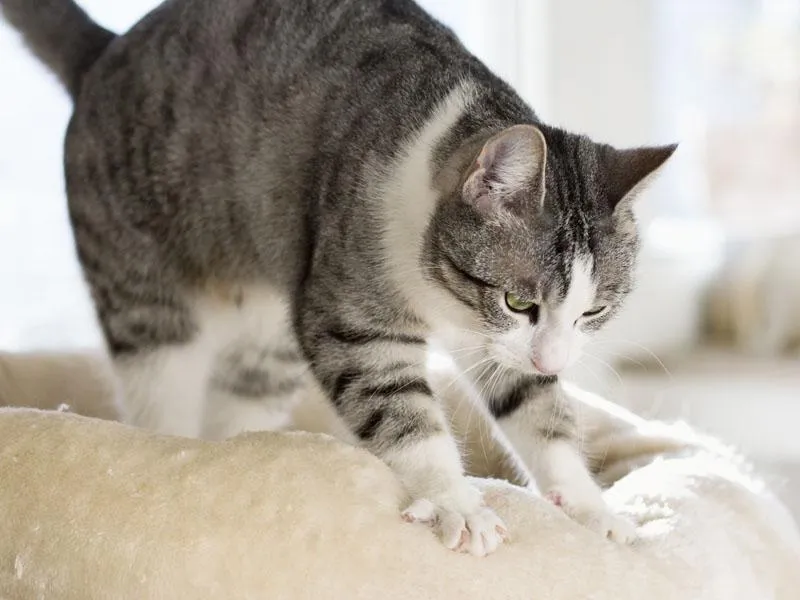
A soft resting surface allows cats to express normal kneading behavior without uncomfortable claw pressure on people.
Frequently Asked Questions
Why do cats knead?
Kneading begins during nursing, when kittens press their paws against their mother's body to stimulate milk flow. Many cats continue the behavior as adults, often while relaxed.
Why do cats make biscuits?
Making biscuits is a nickname for kneading, the alternating paw-pressing movement cats perform on soft surfaces.
Why does my cat knead me?
Your cat may find your lap warm and comfortable or associate the interaction with familiar, relaxing sensations.
Does kneading mean my cat loves me?
It can occur during affectionate interactions, but kneading alone does not establish a cat's precise emotional state.
Why do cats knead blankets?
Soft textures may trigger familiar kneading movements and provide comfortable resting surfaces.
Why do cats purr and knead?
Both behaviors can accompany relaxation, although they may also occur when a cat seeks comfort during stress.
Why do cats knead with their claws?
Claws may extend naturally as the paws and toes flex during kneading. The cat is usually not intentionally scratching.
Do all cats knead?
No. Some adult cats knead frequently, while others rarely or never display the behavior.
Is cat kneading a sign of stress?
Not necessarily. It is usually normal, but sudden excessive kneading together with other behavioral changes may warrant investigation.
Should I stop my cat from kneading?
Normal kneading usually does not need to be stopped. Provide a soft blanket or other suitable surface if it causes discomfort.
Why does my cat knead before sleeping?
Kneading may be part of a familiar settling routine or an attempt to adjust a comfortable resting surface.
Do cats knead to mark territory?
Scent marking is one proposed function because cats have scent-producing structures associated with their paws, but it is not proven to explain every instance.
Do cats knead because they were weaned early?
Kneading alone cannot establish early weaning. Many normally raised adult cats also knead.
When is excessive kneading concerning?
Consult a veterinarian when new or unusually frequent kneading occurs with signs such as appetite changes, hiding, pain, or abnormal repetitive behavior.
The Bottom Line
Cat kneading begins as a natural kitten behavior associated with nursing.
Many domestic cats continue kneading into adulthood, often on soft surfaces and during relaxed interactions.
Researchers have proposed several explanations, including early-life comfort associations, resting routines, tactile stimulation, and possible scent marking.
However, no single explanation has been conclusively established for all adult cats.
Kneading is usually normal and harmless.
When it causes discomfort, a thick blanket or suitable resting surface can help.
Changes in kneading matter most when they occur alongside broader signs of stress, illness, or pain.
Sources & Further Reading
Cornell University College of Veterinary Medicine — Why Do They Knead With Their Paws?. Veterinary behavioral explanation emphasizing kitten nursing.
Cats Protection — Why Do Cats Knead?. Discusses the nursing origin and uncertainty surrounding adult kneading.
VCA Animal Hospitals — Why Do Cats Knead?. Veterinary overview of normal kneading and when to investigate behavioral changes.
PetMD — Why Do Cats Knead? (Updated 2026). Veterinarian-reviewed information on kneading, purring, comfort, and management.
Live Science — Why Do Cats Knead? Interviews with animal behavior and feline welfare specialists about kneading in adulthood.