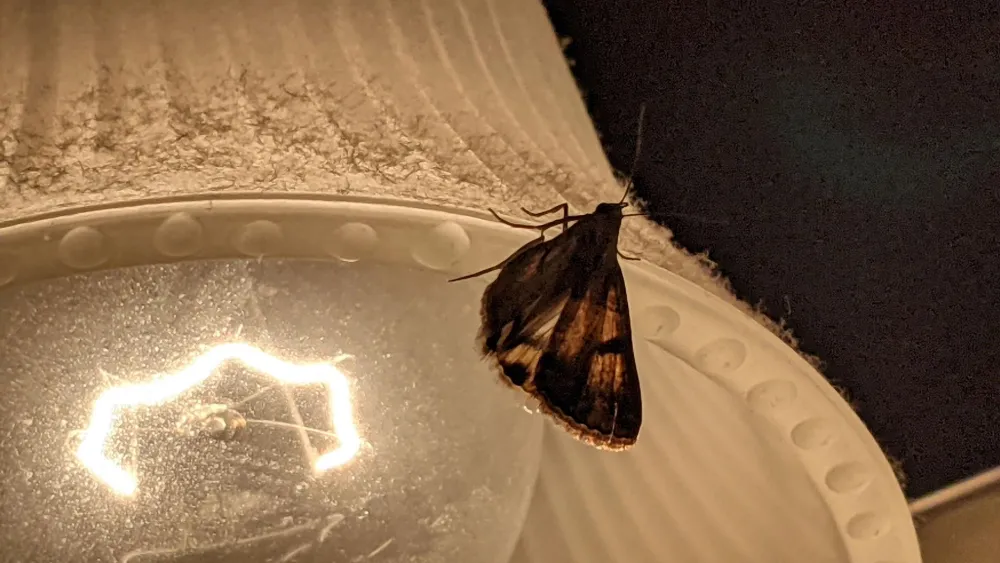
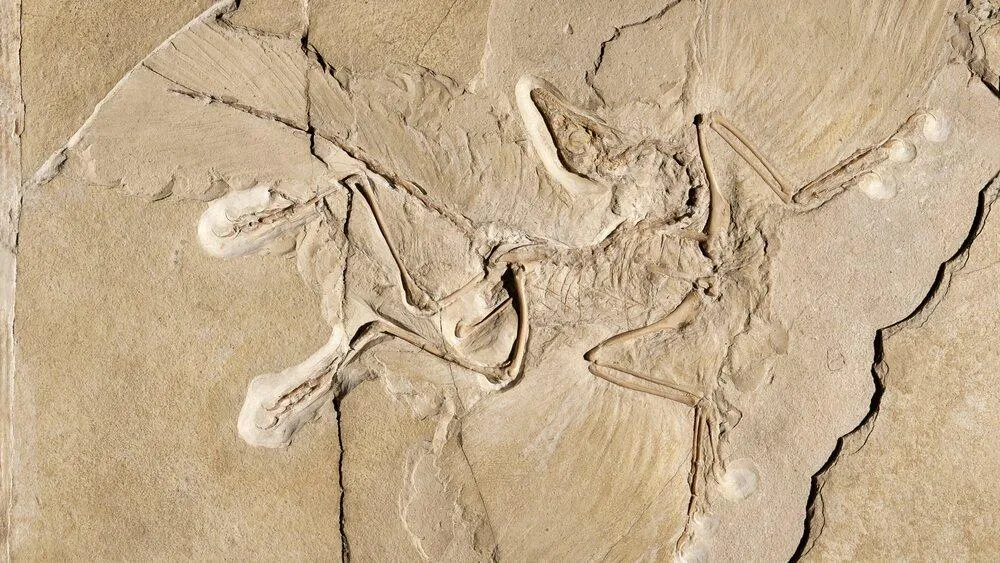
Moths often gather around artificial lights because nearby light sources can interfere with the flight-orientation system used by many flying insects. Research published in 2024 found that insects near lamps frequently turn their backs toward the brightest light instead of steering directly toward it. This behavior normally helps insects remain upright beneath the naturally bright sky. Near a lamp, however, it can cause them to bank, circle, stall, or flip upside down. The discovery offers a strong explanation for why moths appear trapped around lights, although not every moth species responds in the same way.
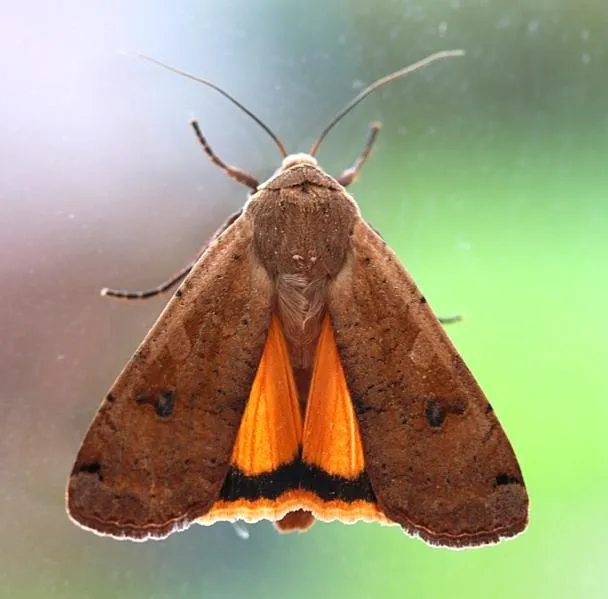
Moths are often seen near artificial lights at night, but their flight behavior is more complicated than simple attraction.
Why Do Moths Fly Toward Light?
Moths and many other flying insects are commonly observed circling streetlights, porch lamps, and other artificial light sources.
For generations, people have wondered why these insects appear unable to leave a bright light.
Traditional explanations suggested that moths confuse lamps with the moon, seek light as an escape route, or respond to the heat produced by the bulb.
However, these theories did not fully explain the unusual flight patterns observed around artificial lights.
In January 2024, researchers published a detailed investigation in Nature Communications.
They used high-speed cameras and three-dimensional flight tracking to examine how insects move near different light sources.
The researchers found that insects often did not steer straight toward the light.
Instead, they turned the upper surface of their bodies toward it.
This disrupted normal flight orientation and could cause continuous circling or sudden loss of flight control.
The finding provides a powerful explanation for the behavior commonly described as moths being attracted to lamps.
What Did Scientists Discover in 2024?
The 2024 study was led by researchers including Samuel T. Fabian and Yash Sondhi.
It investigated how flying insects behaved around artificial lights.
The research combined field recordings with laboratory experiments.
High-speed stereoscopic video allowed scientists to reconstruct insect flight paths in three dimensions.
Laboratory motion-capture systems recorded how different insects oriented their bodies in response to nearby lights.
The researchers also developed computer models to test possible explanations.
Their central finding was that many insects orient their dorsal surface, or back, toward the light.
Near a natural sky, this response can help an insect remain upright.
Near an artificial point source, the same response can become misleading.
The resulting body tilts can redirect flight and keep the insect near the source.
The researchers concluded that this disrupted orientation response is the most plausible explanation for much of the abnormal flight behavior they observed around nearby artificial lights.
What Is the Dorsal Light Response?
The dorsal light response is a behavior in which a flying insect tends to orient the upper side of its body toward the brightest part of its visual surroundings.
The term dorsal refers to the back or upper surface of the body.
Under natural conditions, the sky is usually the brightest broad region of the visual environment.
Turning the back toward the sky can therefore help an insect maintain an appropriate upright posture.
This is useful because flying animals must continually monitor their orientation.
If an insect rolls too far to one side, the direction of the forces produced by its wings changes.
That change can alter its flight path.
Normally, orienting toward the brightest overhead region is a useful part of maintaining stable flight.
However, artificial lighting can create an unusual situation in which the brightest visible source is no longer above the animal.
Why Does Artificial Light Confuse Flying Insects?
A bright lamp can appear beside, below, or directly in front of an insect.
If the insect responds by turning its back toward the lamp, it may tilt away from its normal upright orientation.
Because wing forces act relative to the insect's body, this tilt can change its direction of movement.
Instead of flying smoothly away, the insect may turn around the lamp.
In some situations, it may climb steeply, lose speed, or even invert its body.
The 2024 research demonstrated that these changes in orientation could explain several unusual flight trajectories.
Importantly, this is not the same as the insect deliberately deciding to reach the light.
The apparent attraction may partly result from disruption of the insect's normal flight-control behavior.
Why Do Moths Circle Lights?
Circling is one of the most recognizable behaviors observed around artificial lights.
A moth may repeatedly move around a lamp without reaching or leaving it.
In the 2024 study, researchers identified orbiting as one of three common abnormal flight patterns.
During orbiting, the insect maintained a tilted body orientation directed toward the light source.
This body tilt caused the insect to keep turning.
The resulting flight path often formed a circle or curved orbit around the source.
Researchers found that orbiting was especially evident under relatively calm wind conditions.
Stronger gusts could interrupt the behavior and disperse insects.
This suggests that both the insect's orientation response and surrounding flight conditions influence how long it remains near a lamp.
Why Do Moths Fly Upside Down Near Lights?
Some insects fly over artificial lights and suddenly flip upside down or lose control.
The 2024 researchers called this behavior inversion.
When an insect passes above a bright lamp, the light is now beneath it.
If the insect continues trying to orient its back toward that source, it may roll or pitch into an inverted position.
This can result in a steep downward dive.
Some insects then recover their normal orientation and climb again, only to repeat the same maneuver near the light.
Such behavior supports the idea that nearby artificial lights interfere with the insect's sense of which direction is up.
It is not necessary to assume that the insect wants to collide with the lamp.
What Does Stalling Mean in Moth Flight?
Stalling is another flight pattern documented in the 2024 research.
In this behavior, an insect may climb steeply while moving away from the lamp.
As it climbs, its forward speed decreases.
Eventually, the insect may temporarily stop making forward progress.
Its flight can then become unstable.
This differs from a moth orbiting the lamp in a relatively continuous circle.
The distinction matters because the observed behaviors can arise from different consequences of the same disrupted orientation response.
The study classified three major patterns: orbiting, stalling, and inversion.
These patterns were much less common during ordinary flight in the dark.
Three Common Flight Behaviors Around Artificial Lights
| Behavior | What Happens | Possible Mechanism |
|---|---|---|
| Orbiting | The insect flies repeatedly around the lamp | Continuous body tilting produces turning |
| Stalling | The insect climbs steeply and loses forward speed | Disturbed body orientation redirects flight |
| Inversion | The insect rolls or pitches upside down, sometimes diving | The insect orients its back toward a light beneath it |
These behaviors were documented across multiple insect groups. Their frequency and severity vary with species and experimental conditions.
Do Moths Mistake Lamps for the Moon?
The idea that moths confuse artificial lamps with the moon is one of the most familiar explanations for their behavior.
According to this hypothesis, an insect might use a distant celestial object as a navigational reference.
If it maintained a fixed angle to a nearby lamp instead, its path could curve around the source.
However, the 2024 study found that the observed close-range flight paths were more consistent with a disrupted dorsal light response.
The insects frequently oriented their backs toward the lamp rather than following the pattern expected from simple celestial navigation.
This does not mean that insects never use the moon or other celestial information for navigation.
It means that moon-compass confusion is not the best-supported universal explanation for the abnormal flights studied around nearby lamps.
Do Moths Use the Moon to Navigate?
Some insects use celestial information as part of navigation.
The moon, stars, and polarized patterns of skylight can provide environmental orientation cues for different animal groups.
However, the navigational systems of moths vary by species.
Some migratory moths have sophisticated orientation abilities.
Other moths may rely on different combinations of visual, magnetic, chemical, or learned environmental cues.
The fact that a moth circles a streetlight does not prove that it normally navigates by keeping a fixed angle to the moon.
Scientists must distinguish the mechanisms of long-distance navigation from those governing immediate flight orientation near a bright object.
Are Moths Attracted to the Heat of Light Bulbs?
Heat was historically proposed as an explanation for insects approaching lamps.
Traditional incandescent bulbs produce considerable heat, making the hypothesis intuitively appealing.
However, moths also gather around light sources that produce relatively little heat.
The 2024 study demonstrated abnormal flight behavior around several artificial light sources, including LED lighting.
This supports a mechanism involving visual orientation rather than heat alone.
However, temperature can still influence insect activity and behavior in some circumstances.
The important conclusion is that heat is not required to explain the characteristic circling and disorientation observed near lights.
Are Moths Blinded by Bright Lights?
Bright artificial light can affect the sensory systems of nocturnal insects.
However, the 2024 researchers found that the repeated orbiting, stalling, and inversion patterns were more consistent with disturbed flight orientation than simple temporary blindness.
Insects frequently maintained a specific orientation toward the light even when that behavior caused unstable flight.
If blindness alone explained the behavior, these predictable light-directed body orientations would be harder to account for.
This does not mean that intense light can never affect insect vision.
Rather, reduced visual sensitivity or glare is not the most complete explanation for the particular movement patterns documented in the study.
Do All Moths Fly Toward Lights?
No. Moth species differ considerably in their responses to artificial lighting.
Some are frequently found at lamps and light traps.
Others show relatively weak responses.
The 2024 researchers observed that some insects were less affected by particular experimental lighting arrangements.
For example, certain hawkmoths maintained more normal flight under conditions that strongly disturbed other tested insects.
Factors such as species, physiological state, wavelength, and environmental conditions may influence responses.
It is therefore inaccurate to describe all moths as irresistibly drawn to every light source.
Are Some Moths More Attracted to Light Than Others?
Yes. Researchers have measured substantial variation among moth families and species.
A 2013 study comparing different kinds of lamps found that shorter-wavelength lighting attracted more moths overall than longer-wavelength lighting under the study conditions.
However, the strength of the difference varied among moth groups.
Noctuid moths showed especially strong responses to shorter wavelengths.
Geometrid moths showed different patterns.
These findings demonstrate that responses to light depend partly on species-specific visual and behavioral characteristics.
The word attraction is commonly used in these studies to describe observed movement or collection near light sources.
It should not necessarily be interpreted as proof that the moth consciously seeks the lamp as a destination.
What Colors of Light Attract Moths Most?
Many nocturnal moths respond strongly to ultraviolet and blue wavelengths.
A study published in Insect Conservation and Diversity in 2021 tested thousands of moths from multiple families under different lighting conditions.
It found that ultraviolet light was particularly effective at drawing moths into the experimental collection areas.
Blue light also produced strong responses.
Longer wavelengths generally attracted fewer moths under the tested conditions.
However, the response depended on the species, light intensity, and available alternatives.
Therefore, ultraviolet and blue-rich lights are often more disruptive to moth communities than many longer-wavelength sources, but no wavelength should be described as completely harmless to every insect.
Why Does Ultraviolet Light Attract Moths?
Many insects can detect wavelengths that are invisible to humans.
Ultraviolet sensitivity is common in numerous moth species.
This sensory ability allows insects to detect information in their natural environments.
However, artificial ultraviolet sources can create unusually bright visual stimuli.
Studies of moth responses consistently find strong effects from short-wavelength illumination.
The 2021 experimental research on ultraviolet and blue radiation confirmed that moths were more frequently collected near these wavelengths than near several longer-wavelength alternatives.
However, the mechanism underlying wavelength preference is not identical to the mechanism explaining why a nearby lamp disrupts flight orientation.
The two research questions are related but distinct.
Does Blue Light Attract Moths?
Blue-rich artificial lighting can attract or disrupt many moths.
In experimental comparisons, blue wavelengths have often produced stronger responses than red or some warmer-spectrum alternatives.
However, not all lamps described as white emit the same spectrum.
Some LEDs contain substantial blue components, while others emit relatively little short-wavelength light.
Brightness and light direction also matter.
A very bright warm lamp may still affect insects.
For this reason, choosing lighting with less blue content is only one part of reducing light pollution.
Do Red Lights Attract Moths?
Red light generally attracts fewer moths than ultraviolet or blue light in several experimental comparisons.
However, this does not mean red light has no ecological effect.
Different moth species have different visual sensitivities.
Light intensity, environmental context, and competing sources also influence behavior.
It is therefore more accurate to say that longer-wavelength lighting can reduce attraction for many moth species than to claim that red lights never attract insects.
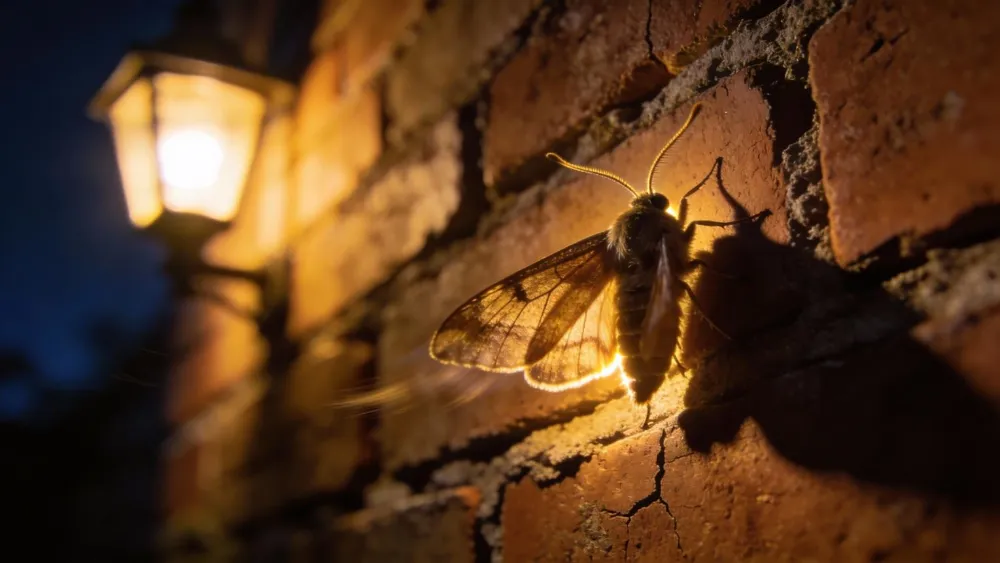
Artificial lighting can disrupt normal moth movement, especially when bright point sources are surrounded by darkness.
Why Do Moths Gather Around Porch Lights?
Porch lights create bright local sources against relatively dark surroundings.
For insects flying close enough to respond strongly to the light, this arrangement can disturb their normal flight orientation.
Instead of maintaining stable movement through the environment, they may begin circling or repeatedly changing direction.
Some eventually settle on nearby walls or other surfaces.
However, not every moth found near a porch light necessarily arrived through the same behavioral mechanism.
Individual responses can also be influenced by wavelength, brightness, activity patterns, and local conditions.
The 2024 study primarily explains the unusual flight behavior of insects once they are near the artificial source.
Why Do Moths Keep Flying Into Windows?
Bright windows and illuminated buildings can create unusual visual conditions for flying insects.
Artificial light may affect orientation and movement.
Transparent or reflective surfaces can also create hazards, although the mechanisms involved may differ.
A moth flying near a bright window may experience a combination of lighting, visual contrast, and physical obstacles.
It is not scientifically justified to attribute every collision with glass to exactly the same mechanism as circling a free-standing lamp.
Both situations involve human-created changes to an insect's visual environment, but the details require separate investigation.
Do Moths Fly Into Flames on Purpose?
No evidence shows that moths deliberately seek injury from flames.
The phrase like a moth to a flame is a metaphor based on their visible behavior near lights.
Flames produce light, heat, and other environmental cues.
Insects approaching them may experience disrupted orientation or other responses.
However, the 2024 research focused on artificial lighting and flight-control mechanisms, not on proving the exact cause of every interaction between insects and open flames.
The important biological point is that moths do not need to intend to enter a dangerous source in order to end up near it.
Can Moths Escape Artificial Lights?
Yes. Moths are not always permanently trapped around lights.
Their ability to leave depends on the circumstances.
Changing wind conditions, turning off the light, or flying beyond the immediate region of disruption may allow insects to resume normal movement.
The 2024 research documented that wind could interrupt some orbiting flights.
Other insects showed only weak responses to the tested lights.
Therefore, light entrapment is an important observed behavior, but not an unavoidable outcome for every insect near a lamp.
Does Artificial Light Harm Moths?
Artificial light at night can affect moth behavior and ecological interactions.
Potential consequences include disrupted flight, altered activity patterns, increased exposure to predators, and reduced opportunities to forage or reproduce normally.
However, the severity depends on species, habitat, light characteristics, and exposure.
A scientific review published in Ecology and Evolution in 2018 examined the broader effects of artificial night lighting on nocturnal insects.
It emphasized that artificial illumination can influence movement, reproduction, feeding, and interactions with other organisms.
Not every local light source causes the same outcome, but widespread changes in nighttime lighting create an important ecological concern.
Do Streetlights Reduce Moth Activity?
Streetlights can alter how moths use their surroundings.
A 2016 study published in Global Change Biology compared moth communities at illuminated and unilluminated locations.
Researchers found that moth abundance near ground level was lower at lit sites.
Species richness was also reduced.
At the height of the streetlights, moth flight activity was higher.
These results indicate that artificial lighting can redistribute moth activity within a habitat.
The study also investigated the consequences for pollen transport.
However, its measured effects should not be treated as universal percentages for every streetlight or location.
Are Moths Important Pollinators?
Yes. Many moths contribute to pollination.
Some visit flowers at night to obtain nectar.
Pollen can attach to their bodies and be transported between flowers.
However, not every moth species is an important pollinator.
Some adult moths do not feed, while others have different feeding habits.
Pollination importance also varies among ecosystems and plant species.
Nevertheless, nocturnal moths can provide valuable interactions that are easily overlooked because they occur when most people are asleep.
Can Artificial Light Affect Nighttime Pollination?
Artificial lighting can change how moths move between flowers.
If moths spend more time near lamps or avoid naturally dark areas, their normal pollination activity may be disrupted.
The 2016 streetlighting study found evidence of reduced nocturnal pollen transport at illuminated sites.
Approximately 23 percent of the sampled moths carried pollen from at least 28 plant species.
The researchers also observed changes in moth abundance and distribution around streetlights.
These findings suggest that artificial lighting may affect plant reproduction indirectly through changes in insect behavior.
However, the long-term consequences vary and require further ecological investigation.
Do Moths Help the Environment?
Moths are part of many terrestrial food webs.
Adults and larvae provide food for birds, bats, spiders, and other predators.
Some moths contribute to pollination.
Their caterpillars also interact with plants in a wide variety of ways.
Because moth species differ in their ecology, no single role describes all of them.
However, changes in moth populations can affect predators, plants, and other organisms.
This is one reason light pollution has attracted attention from conservation researchers.
How Can Outdoor Lighting Be Made Safer for Moths?
Reducing unnecessary artificial light is one of the most direct ways to limit potential disturbance.
Useful measures include:
Turning off lights when they are not needed
Using fixtures that direct light downward rather than outward
Reducing unnecessary brightness
Limiting the duration of outdoor lighting
Choosing lower-blue, lower-ultraviolet lighting where appropriate
Keeping natural habitats dark whenever possible
These measures are consistent with research showing that shorter wavelengths often attract more moths.
However, lighting should also meet legitimate human safety needs.
The goal is to reduce unnecessary light exposure rather than assume one bulb color is harmless under every condition.
Would Turning Off Porch Lights Help Moths?
Turning off unnecessary porch lights can reduce exposure to an artificial light source.
This may help avoid the near-light flight disruption documented in scientific studies.
It also reduces nighttime illumination that can affect local insects and other wildlife.
However, the ecological effect of any one action depends on the surrounding environment and other sources of light.
For households that need outdoor lighting, timers, motion sensors, and well-directed fixtures can reduce unnecessary illumination.
These practical measures address the presence, duration, and spread of artificial light.
Do LED Lights Attract Moths?
Some LED lights attract or disrupt moths.
LED is a lighting technology rather than one fixed color or spectrum.
Different LED products emit different wavelengths and intensities.
Some produce substantial blue light, while others are designed to emit warmer spectra.
Research comparing insect responses to different wavelengths indicates that ultraviolet and blue-rich sources are often more attractive to many moths.
However, the effect of a particular lamp also depends on brightness, placement, and the species present.
It is therefore incorrect to claim that LED lights either always attract moths or never attract them.
Are Moths Attracted to Phone Screens?
A phone screen is an artificial light source, so it may provide a visual stimulus to nearby insects.
However, whether a moth responds depends on the screen's brightness, spectrum, size, distance, and the insect's behavior.
There is not enough evidence to apply the full conclusions of the 2024 lamp experiments directly to every phone screen.
The mechanisms of near-light orientation may still be relevant, but the actual response needs to be measured.
People should therefore avoid assuming that every moth near a phone is showing the same behavior as one circling a streetlight.
Why Are Some Moths Active During the Day?
Although many moths are nocturnal, not all moth species fly primarily at night.
Some are active during daylight hours.
These moths may visit flowers, search for mates, or perform other behaviors in bright environments.
Visual systems and activity patterns differ across moth lineages.
This diversity helps explain why light responses are not identical among all moths.
The 2024 investigation also included flying insects that are normally active during the day, providing evidence that the dorsal light response is not restricted to strictly nocturnal species.
What Is the Difference Between Moths and Butterflies Around Light?
Both moths and butterflies belong to the order Lepidoptera.
However, their behavior and visual ecology differ among species.
Many familiar butterflies are active during the day, while numerous moth species are nocturnal.
Artificial lights may affect some members of both groups.
The dorsal light response is not limited exclusively to moths.
Nevertheless, moths are especially familiar around nighttime lighting because many species fly after dark.
It would be inaccurate to describe every butterfly and moth as having identical responses to all artificial light sources.
Does Light Pollution Explain All Moth Population Declines?
No. Moth populations can be affected by multiple environmental pressures.
Habitat changes, land management, climate conditions, pesticides, and artificial lighting may all influence different species.
Research on artificial light demonstrates plausible and measurable effects on moth behavior and ecological interactions.
However, these effects do not prove that light pollution is the only cause of moth declines everywhere.
The relative importance of each pressure varies geographically and among moth groups.
Conservation efforts therefore require attention to multiple environmental factors.
What Does the 2024 Research Mean for Insect Conservation?
The 2024 study provides a mechanistic explanation for why artificial lights can disturb nearby flying insects.
Rather than assuming insects simply prefer bright objects, it demonstrates how artificial light can interfere with a normally useful orientation response.
This helps explain why a local point source can cause insects to circle or lose control.
When combined with research on wavelength sensitivity and ecological consequences, the findings strengthen the case for reducing unnecessary nighttime illumination.
However, the study did not establish the complete consequences of light pollution for every insect population.
Those broader outcomes require ecological studies across different habitats and species.
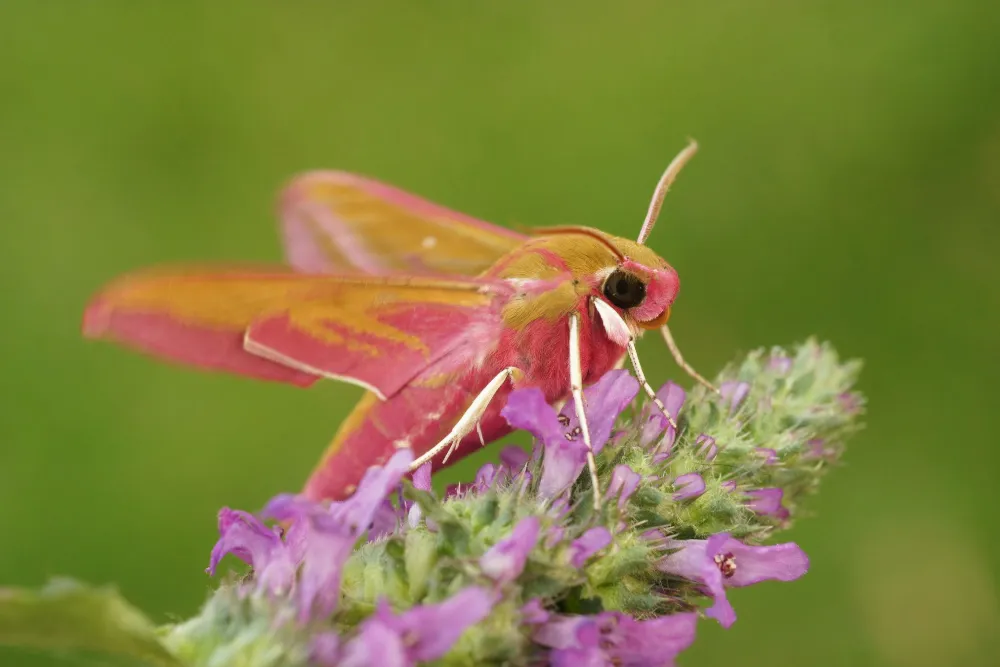
Moths also use nighttime darkness for normal activities, including feeding and pollination.
Frequently Asked Questions
Why do moths fly toward light?
Research suggests that nearby artificial lights can disrupt a moth's flight orientation by causing it to turn its back toward the source.
Why do moths circle lamps?
Continuous body tilting toward a light can redirect flight and produce repeated orbiting movements.
Do moths think lamps are the moon?
The moon-confusion hypothesis is a historical explanation, but 2024 research found stronger support for disrupted flight orientation around nearby lamps.
Are moths attracted to light or confused by it?
Both words appear in everyday descriptions, but the best-supported close-range explanation involves disturbed orientation rather than simple direct steering toward a lamp.
Why do moths fly upside down near lights?
If a light is below an insect, turning its back toward the source can cause it to roll or pitch into an inverted position.
Do all moths fly toward lights?
No. Responses vary among moth species and depend on lighting conditions and other factors.
What color light attracts moths most?
Many moths respond strongly to ultraviolet and blue wavelengths, although sensitivity varies by species.
Are moths attracted to LED lights?
Some are. The response depends on the LED's spectrum, brightness, placement, and the insect species.
Do red lights attract moths?
Longer-wavelength lights generally attract fewer moths than ultraviolet or blue lights in several studies, but red lighting is not universally harmless.
Do moths fly into lights because of heat?
Heat alone does not explain the behavior. Researchers have documented light-related flight disruption around relatively cool artificial sources.
Can moths escape from streetlights?
Yes. Moths are not permanently trapped in every case, and changes in conditions can allow normal movement to resume.
Are moths important pollinators?
Many moths visit flowers and transport pollen, making them important nocturnal pollinators in some ecosystems.
Does turning off outdoor lights help moths?
Reducing unnecessary nighttime lighting can reduce exposure to artificial sources that disturb moth behavior.
Is the moth-to-flame behavior intentional?
There is no evidence that moths deliberately seek injury. Their movement can result from responses to environmental cues.
The Bottom Line
Moths often gather around artificial lights because the lights can disrupt systems used to maintain stable flight.
A 2024 study demonstrated that many insects turn their backs toward nearby light sources, causing orbiting, stalling, and inversion.
This provides a stronger explanation for many close-range flight patterns than the simple claim that moths mistake lamps for the moon.
However, different moth species respond differently, and the mechanisms responsible for approaching lights from farther away are not completely resolved.
Artificial lighting can also interfere with normal nighttime activity and pollination.
Reducing unnecessary light, limiting short-wavelength emissions, and keeping natural habitats dark where possible can help protect nocturnal insects.
Sources & Further Reading
Fabian et al. (2024) — Why Flying Insects Gather at Artificial Light. Nature Communications. Primary experimental research on dorsal light response, orbiting, stalling, and inversion.
Imperial College London (2024) — Flying Insects Become Disorientated and Trapped by Artificial Light. Explanation of the experimental methods and major findings.
Brehm et al. (2021) — Moths Are Strongly Attracted to Ultraviolet and Blue Radiation. Experimental evidence concerning wavelength differences.
Somers-Yeates et al. (2013) — Shedding Light on Moths: Shorter Wavelengths Attract Noctuids More Than Geometrids. Compares responses of different moth families to artificial lighting.
Macgregor et al. (2016) — The Dark Side of Street Lighting: Impacts on Moths and Evidence for the Disruption of Nocturnal Pollen Transport. Field evidence of altered moth activity and pollen movement.
Owens and Lewis (2018) — The Impact of Artificial Light at Night on Nocturnal Insects: A Review and Synthesis. Reviews ecological impacts and potential mechanisms.