Yes, whales sleep, but they do not sleep exactly like humans. Whales are air-breathing mammals, so they must continue reaching the surface to breathe while resting. Research on dolphins and other cetaceans has revealed an unusual pattern called unihemispheric slow-wave sleep, in which one side of the brain shows sleep-related activity while the other remains comparatively active. This allows important functions and environmental awareness to continue. However, whale species differ in how they rest. Sperm whales, for example, have been observed hanging almost vertically beneath the surface during prolonged periods of quiet drifting.
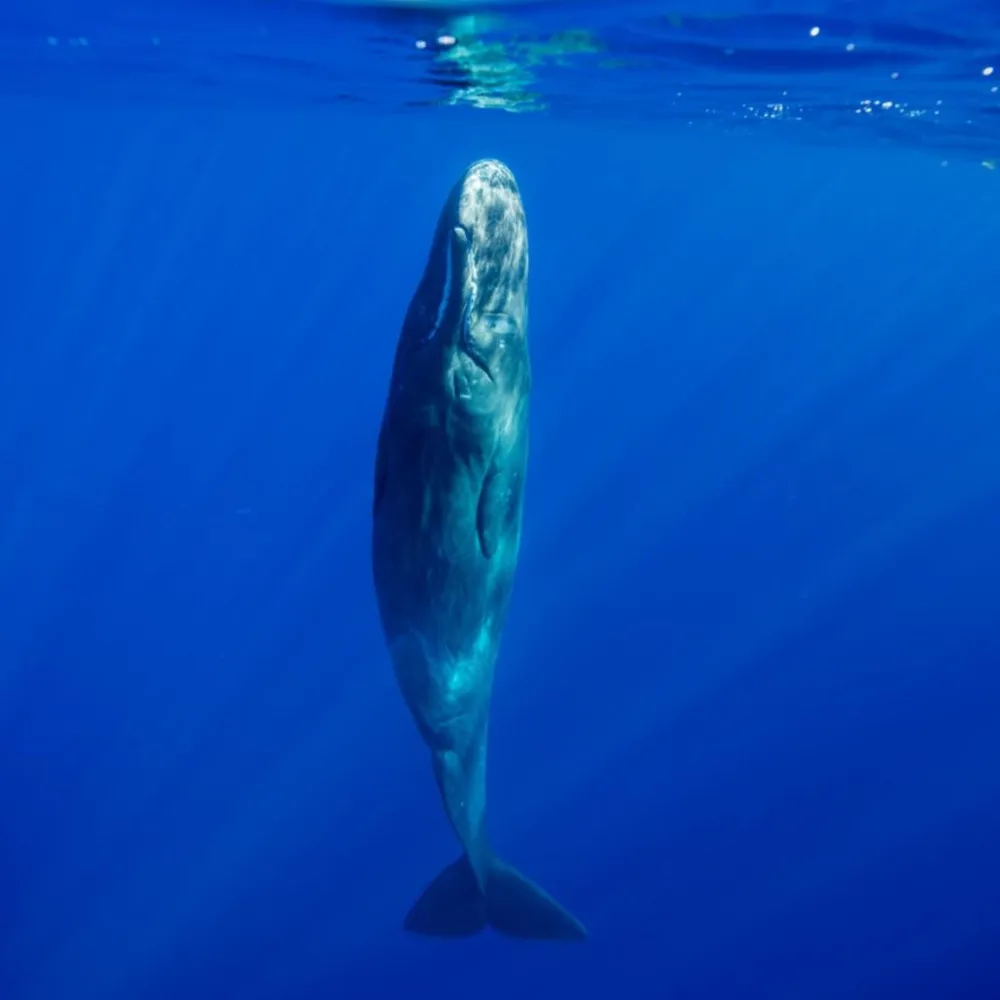
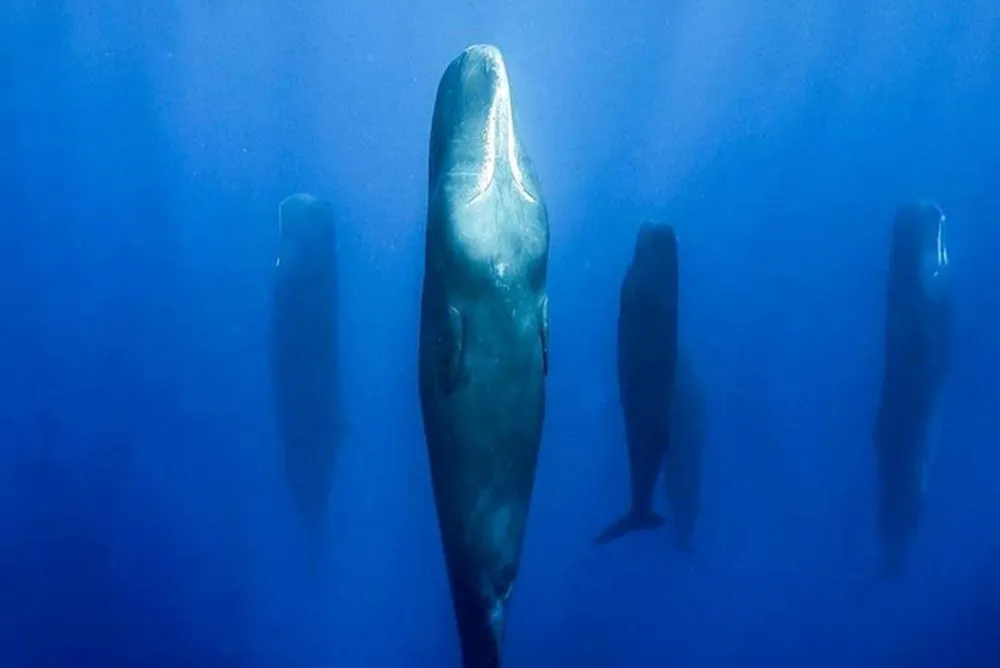
Sperm whales can adopt unusual vertical drifting postures during resting periods beneath the ocean surface.
Do Whales Sleep?
Yes. Whales and dolphins sleep, although their sleep differs in important ways from the sleep of most terrestrial mammals.
Whales must breathe atmospheric air through their blowholes.
They cannot extract sufficient oxygen directly from water using gills because they do not have gills.
This creates a challenge: a whale needs restorative rest but must continue to surface for breathing.
Research has shown that cetaceans can maintain breathing and other essential functions during sleep-related states.
One of their most remarkable adaptations is unihemispheric slow-wave sleep.
Scientists have documented this pattern through recordings of electrical activity in the brains of dolphins and belugas.
However, directly measuring sleep in large free-ranging whales is much more difficult.
Researchers therefore combine physiological findings from studied species with behavioral observations of wild whales.
How Do Whales Sleep Without Drowning?
Whales are mammals that breathe air.
They use their blowholes to exchange air with the atmosphere.
During sleep or rest, they must maintain sufficient control over breathing and body position to avoid prolonged, dangerous submersion.
In studied cetaceans, sleep-related brain activity can occur while the animals continue to breathe and sometimes swim.
However, it is misleading to say that whales must always wake fully before every breath.
Scientific investigations of dolphins indicate that breathing can occur during unihemispheric slow-wave sleep.
The precise patterns differ among species and situations.
The major adaptation is not simply staying awake all the time, but coordinating sleep-related activity with continued survival in the aquatic environment.
What Is Unihemispheric Sleep?
Unihemispheric sleep is a sleep state in which one cerebral hemisphere shows slow-wave activity while the other hemisphere remains in a more wake-like state.
The word unihemispheric literally refers to one hemisphere.
In ordinary human non-rapid-eye-movement sleep, slow-wave activity can occur across both sides of the brain.
In dolphins and other cetaceans that have been examined physiologically, the electrical patterns can be strongly asymmetric.
One side displays slow waves, while the other shows lower-voltage activity resembling wakefulness.
Later, the pattern may switch sides.
This allows sleep-related processes to occur without the animal entering a prolonged state of complete behavioral unresponsiveness.
However, unihemispheric sleep is not the same as having one physically separate brain asleep and another completely independent brain awake.
The hemispheres remain parts of one nervous system.
Do Whales Sleep With Half Their Brain Awake?
The expression half the brain asleep is a useful simplification of unihemispheric slow-wave sleep.
Electrical recordings support the presence of slow-wave activity in one cerebral hemisphere while the other remains more active.
However, describing one hemisphere as fully awake and the other as completely shut down can create a misleading impression.
Sleep and wakefulness involve multiple brain systems and physiological processes.
The cetacean pattern is more complex than a simple on-off switch.
Researchers continue to investigate how this unusual state supports movement, breathing, sensory processing, and temperature regulation.
Do Dolphins Sleep With One Eye Open?
Yes. Dolphins can sleep with one eye open and the other closed.
This behavior is associated with unihemispheric slow-wave sleep.
A study examining bottlenose dolphins and belugas found that eye closure commonly corresponded with slow-wave activity in the opposite cerebral hemisphere.
The eye associated with the more wake-like hemisphere was more likely to remain open.
However, the relationship is not absolutely perfect.
Researchers observed that eye states did not predict brain activity accurately in every case.
Therefore, seeing a dolphin with one eye closed is suggestive of unihemispheric sleep but does not conclusively establish its precise brain state.
Why Do Dolphins Sleep With One Eye Open?
Keeping one eye open may help a dolphin monitor its surroundings while resting.
Potential benefits include detecting nearby animals, maintaining contact with companions, and avoiding obstacles.
However, these functions are hypotheses supported by behavioral and physiological evidence rather than proof that every instance of one-eye closure serves one exact purpose.
Cetaceans live in environments where continued awareness can have important survival benefits.
Researchers have proposed that unihemispheric sleep may support vigilance, swimming, breathing, and temperature regulation.
A major scientific review concluded that maintaining body temperature may also have played an important evolutionary role.
Do Whales Breathe Automatically While Sleeping?
Whale breathing is unusual because cetaceans can exercise substantial behavioral control over respiration.
However, the popular statement that whales must consciously decide on every breath is too absolute.
Research on dolphins indicates that respiration can be supported by physiological control mechanisms and can continue during unihemispheric sleep.
There is no evidence that all whales must become completely awake before each breath.
The balance between voluntary and automatic respiratory control is more complex than the simplified explanation often repeated in popular media.
Whales remain dependent on access to atmospheric oxygen, regardless of how their breathing is regulated.
Can Whales Sleep Underwater?
Yes. Whales can rest underwater, although their exact posture and depth vary by species.
Some cetaceans rest near the surface, where breathing requires relatively little movement.
Others may remain submerged for part of a resting bout.
Sperm whales have been observed drifting in nearly vertical positions below the surface.
However, remaining underwater indefinitely is not possible for an air-breathing whale.
The animal must eventually reach the atmosphere to replenish oxygen.
Therefore, sleeping underwater does not mean breathing underwater.
Do Whales Float While Sleeping?
Some whales float or drift during resting periods.
However, resting behavior differs among species.
Some cetaceans remain relatively motionless.
Others swim slowly while displaying sleep-related brain activity.
Whale buoyancy also depends on body condition, lung volume, depth, and other physical factors.
It is therefore inaccurate to assume that every whale simply floats motionless at the surface whenever it sleeps.
Scientific observations show a diversity of resting postures and movement patterns.
Why Do Sperm Whales Sleep Vertically?
Sperm whales have been observed floating almost vertically beneath the surface.
This posture is one of the most remarkable examples of cetacean resting behavior.
A 2008 study published in Current Biology used animal-borne recording tags to investigate sperm whale movement.
The researchers discovered repeated passive drift-dives in shallow water with stereotyped vertical body positions.
They interpreted these behaviors as likely related to rest or sleep.
However, the study did not record the whales' brain activity directly.
It therefore provided strong behavioral evidence of resting rather than definitive electroencephalographic proof of sleep during every vertical drift.
What Are Sperm Whale Drift-Dives?
Drift-dives are periods in which sperm whales move relatively little and drift passively in the water.
During some of these episodes, the body adopts a near-vertical posture.
The 2008 researchers recorded these events using suction-cup tags attached temporarily to wild sperm whales.
Across their recordings, drift-dives represented approximately 7.1 percent of the total recording time.
However, this figure should not automatically be interpreted as the total daily sleep time of every sperm whale.
The recordings measured a particular behavior during limited observation periods.
Scientists still need further evidence to determine how different brain sleep states correspond to these natural resting postures.
Do Sperm Whales Sleep in Groups?
Sperm whales can be observed resting in groups.
Photographs and research observations have shown several individuals hanging in the water in similar vertical positions.
However, not every resting event involves a group.
The social structure of sperm whales varies with sex, age, and location.
Adult females and young animals commonly form social units, while mature males may spend substantial time apart from such groups.
Whether group resting directly improves vigilance or social coordination remains a topic for research.
It is therefore better to describe the behavior without assuming that every whale is consciously guarding the others.
Do Sperm Whales Sleep Upside Down?
Sperm whales are more accurately described as resting in vertical or near-vertical postures rather than always sleeping upside down.
Depending on the individual and its position, the body may point toward the surface.
Popular images sometimes exaggerate the idea that the whales hang head-down or tail-up in one fixed arrangement.
The documented behavior involves passive drifting and a stereotyped vertical orientation.
The precise posture may vary among episodes.
Therefore, describing every vertically resting sperm whale as upside down is not scientifically reliable.
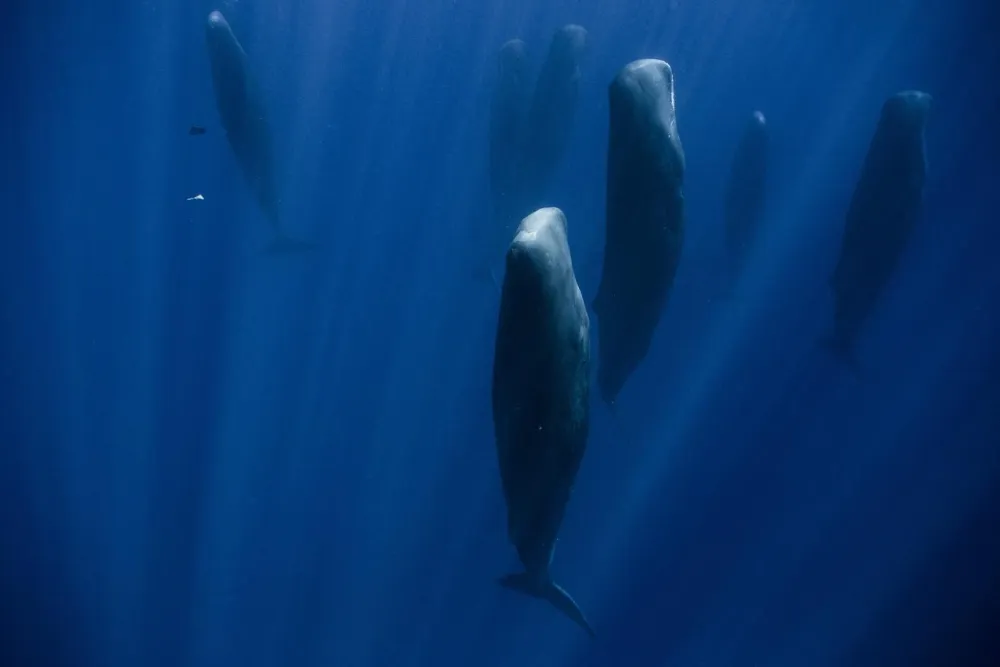
Group resting in a vertical posture has been observed in sperm whales, but researchers cannot measure brain sleep directly from photographs.
Do Humpback Whales Sleep?
Humpback whales need rest, but scientists know less about their precise sleep physiology than about that of bottlenose dolphins.
Researchers have observed resting humpbacks at or near the surface.
They may move slowly or remain relatively motionless for periods of time.
However, interpreting every quiet surface behavior as sleep is difficult without direct physiological measurements.
The broader cetacean research literature suggests that specialized sleep mechanisms are widespread within the group.
Nevertheless, detailed sleep patterns should not automatically be transferred from dolphins to humpback whales without qualification.
Do Blue Whales Sleep?
Blue whales are mammals and require periods of rest.
However, direct measurements of brain sleep activity in free-ranging blue whales are extremely limited.
Their enormous body size and life in the open ocean make such studies challenging.
Researchers can observe movement, breathing, and surface behavior, but these observations do not fully reveal the underlying sleep state.
Therefore, specific claims that blue whales sleep for an exact number of hours every day are not well established.
The safest conclusion is that blue whales rest, while the details of their sleep physiology remain incompletely studied.
Do Orcas Sleep?
Yes. Orcas, also called killer whales, are members of the dolphin family and display resting behavior.
Like other studied cetaceans, they are thought to use specialized sleep mechanisms compatible with breathing at the surface.
Orcas may rest while moving slowly or remaining relatively quiet.
However, much of the direct electrophysiological research on unihemispheric sleep comes from other species.
Therefore, specific measurements from bottlenose dolphins should not automatically be applied to all orcas.
Whales and dolphins share evolutionary adaptations, but species differences remain important.
Do Beluga Whales Sleep?
Yes. Beluga whales have been directly studied in research on cetacean sleep.
Electroencephalographic recordings have shown asymmetrical slow-wave activity.
Researchers have also examined how the state of the eyes relates to activity in the two cerebral hemispheres.
A study of belugas and bottlenose dolphins found that one-eye closure commonly accompanied sleep-related activity in the opposite hemisphere.
However, eye state was not a perfect substitute for brain recordings.
These findings support the role of unihemispheric sleep in toothed whales.
Do All Whale Species Sleep the Same Way?
No. Resting behavior varies across cetaceans.
Some species are capable of slow movement during sleep-related states.
Others can remain nearly motionless at the surface or below it.
The strength of evidence also differs among species.
Researchers have directly measured sleep-related brain activity in certain dolphins and belugas.
For many large whales, much of the available information comes from behavior, movement recordings, and observations.
It is therefore important to distinguish well-established physiological findings from plausible interpretations of resting behavior.
Whale Sleep vs. Dolphin Sleep
| Feature | Dolphins and Studied Toothed Whales | Large Whales Such as Sperm Whales |
|---|---|---|
| Sleep directly measured by EEG | Yes, in selected species | Limited or unavailable in wild individuals |
| Unihemispheric slow-wave sleep | Well documented in studied species | Likely relevant, but species-specific measurements are limited |
| Movement during rest | Can continue swimming | Some may drift nearly motionless |
| Eye state | Asymmetrical eye closure documented | Less well characterized in wild conditions |
| Breathing | Must surface for air | Must surface for air |
The table compares the strength of scientific evidence as well as observed behavior. It should not be interpreted as proof that all large whale species use an entirely different type of sleep.
How Long Do Whales Sleep?
There is no universal number of sleeping hours that applies to every whale species.
In well-studied bottlenose dolphins, the electrical activity of each hemisphere can show several hours of slow-wave sleep across a day.
However, adding the sleeping time of both hemispheres does not produce a directly comparable human sleep duration.
Studies of wild sperm whales have measured time spent in a particular resting posture.
That is not identical to measuring total brain sleep.
For many large whales, reliable daily sleep-duration estimates remain unavailable.
Therefore, websites claiming that all whales sleep for exactly one or two hours a day oversimplify the research.
Do Whales Sleep at Night?
Whales can rest at different times of the day.
The timing depends on species, feeding behavior, social activity, and environmental conditions.
The 2008 sperm whale study found that recorded drift-dives occurred at different rates throughout the day.
However, these findings do not establish one fixed nighttime sleep schedule for all sperm whales.
Other cetaceans may show different patterns.
Whales do not necessarily follow the same consolidated nighttime sleep schedule familiar from humans.
Can Whales Sleep While Swimming?
Yes. Some cetaceans can swim while displaying unihemispheric slow-wave sleep.
Studies of dolphins have shown that coordinated movement can continue during sleep-related brain activity.
This is remarkable because terrestrial mammals usually reduce movement during sleep.
However, swimming during sleep does not mean every part of the nervous system is operating exactly as it does during normal wakefulness.
The relationship between sleep-related brain activity and movement is complex.
Some whales rest with little movement instead of swimming continuously.
Do Whales Stop Moving When They Sleep?
Sometimes, but not always.
Some species display quiet floating or drifting behavior.
Others may continue moving slowly.
Sleep-related brain activity in cetaceans can coexist with certain coordinated movements.
Therefore, immobility is not a universal requirement for whale sleep.
Likewise, a moving whale is not necessarily completely awake.
Researchers need physiological measurements or carefully interpreted behavioral evidence to distinguish different states.
Do Whales Dream?
Scientists do not currently know whether whales experience dreams in the same way humans describe them.
Dreaming is a subjective experience that cannot be directly measured in a nonverbal animal.
Researchers can study brain activity associated with sleep stages.
However, cetacean sleep is unusual because the rapid-eye-movement sleep patterns commonly recorded in terrestrial mammals are rare or have not been clearly documented in studied whales and dolphins.
This does not prove that whales cannot have any form of dream-like experience.
It means the evidence is insufficient for confident statements about their subjective dreaming.
Do Whales Have REM Sleep?
REM stands for rapid-eye-movement sleep.
In humans and many other terrestrial mammals, REM is an important stage of sleep with recognizable physiological characteristics.
However, research reviews report that distinct conventional REM sleep has not been clearly documented in cetaceans.
Some authors describe REM-like activity as absent or extremely limited in the available recordings.
Scientists continue to study the evolutionary and physiological significance of this difference.
The absence of conventional REM in recordings should not be interpreted as proof that cetacean brains perform no restorative functions during sleep.
Why Is Whale Sleep Different From Human Sleep?
Whales evolved in an aquatic environment while retaining the need to breathe air.
They also face constant heat exchange with surrounding water.
These conditions create different demands from those faced by sleeping terrestrial mammals.
Unihemispheric sleep may help whales maintain movement, breathing, environmental awareness, and body temperature.
However, scientists debate which evolutionary pressures were most important in producing this unusual pattern.
A major 2008 review proposed that preventing excessive heat loss in water may have played an especially important evolutionary role.
Other research emphasizes vigilance and respiration.
The relative contribution of these factors remains an area of investigation.
Do Baby Whales Sleep?
Whale calves rest, but their behavior differs from that of mature animals.
Very young cetaceans spend much of their time close to their mothers.
The need to remain near a swimming mother creates important demands on movement and coordination.
Researchers have investigated sleep and rest behavior in young dolphins and orcas.
However, sleep development varies among species.
The available evidence does not support assigning one universal sleeping pattern to every newborn whale.
Young animals may display different activity and rest patterns from adults.
How Do Whale Calves Breathe While Resting?
Whale calves must breathe atmospheric air, just as adult whales do.
They often remain close to their mothers, particularly during early development.
Some calves use the water flow created by their mothers to help maintain movement.
However, the precise relationship between swimming, resting, and breathing varies among cetacean species.
The calf must still reach the surface to breathe.
Sleeping or resting does not give a whale calf the ability to absorb oxygen through water like a fish.
Can Whales Drown While Sleeping?
Whales can drown if they are unable to breathe atmospheric air.
However, their normal resting behavior is adapted to maintaining access to the surface.
In studied cetaceans, sleep-related brain activity can occur without a complete loss of respiratory function.
Therefore, ordinary whale sleep should not be described as an inherently dangerous state in which the animal is constantly about to drown.
Danger can arise from entanglement, illness, injury, or other circumstances that interfere with normal movement and breathing.
Those risks are different from normal sleep physiology.
Can Whales Breathe Through Their Skin?
No. Whales do not obtain the oxygen required for normal survival through their skin.
They breathe air using lungs.
Air enters and leaves through the blowhole or blowholes on top of the head.
To replenish their oxygen supply, whales must reach the atmosphere.
Even species capable of long dives eventually need to surface.
Sleep adaptations allow whales to coordinate rest with this breathing requirement, not to eliminate it.
Why Don't Whales Have Gills?
Whales are mammals descended from terrestrial ancestors.
They evolved numerous adaptations for aquatic life, including streamlined bodies and modified limbs.
However, they retained lungs as their respiratory organs.
Fish gills are specialized structures that extract dissolved oxygen from water.
Whales did not evolve that type of respiratory system.
Instead, they developed adaptations for holding their breath and exchanging air efficiently when they surface.
The need for atmospheric breathing is a central feature of whale biology.
Can Whales Sleep in Deep Water?
Whales can rest in offshore environments, but resting depth differs among species and behaviors.
Some may remain close to the surface.
Sperm whales have been documented performing relatively shallow vertical drift-dives.
However, the fact that a whale is capable of diving deeply during feeding does not mean it normally sleeps at its maximum diving depth.
Sleep and foraging are different activities.
Researchers cannot infer sleep depth simply from the deepest dive a species is known to make.
Do Whales Sleep Together?
Some cetaceans rest near other individuals.
Sperm whales have been observed in groups during vertical drifting behavior.
Other whale species may remain close to companions during periods of reduced activity.
However, social resting patterns vary among species.
Some whales are more solitary than others.
Researchers have proposed that remaining near companions may help with social coordination or vigilance.
However, not every group resting observation demonstrates a particular cooperative function.
How Do Scientists Study Whale Sleep?
Studying whale sleep is challenging because many cetaceans live in open ocean environments.
Researchers use several approaches.
Electroencephalography, or EEG, measures electrical activity in the brain.
It has provided direct evidence of unihemispheric slow-wave sleep in species such as bottlenose dolphins and belugas.
Other methods include underwater observation, video recordings, movement sensors, breathing measurements, and temporary animal-borne tags.
For large wild whales, movement and posture data can provide evidence of resting behavior.
However, these methods do not always establish exactly which brain sleep stage is occurring.
Researchers therefore distinguish direct physiological measurements from behavioral interpretation.
What Did the 2008 Sperm Whale Study Show?
The 2008 study in Current Biology investigated resting behavior in wild sperm whales.
Researchers used suction-cup tags to record movement patterns.
They documented passive shallow drift-dives associated with nearly vertical body positions.
These behaviors were recorded in different ocean regions.
The researchers calculated that drift-dives accounted for approximately 7.1 percent of the recording time.
However, the result was not a direct measurement of the whales' total daily sleep.
The study established a distinctive, repeatable resting posture and provided evidence relevant to the broader investigation of whale sleep.
How Does Whale Sleep Compare With Other Marine Mammals?
Whales are not the only marine mammals with unusual sleep adaptations.
Seals and sea lions can display specialized sleep patterns influenced by whether they are on land or in water.
Some fur seals show forms of unihemispheric sleep during aquatic rest.
However, their sleep physiology differs from that of cetaceans.
Sea otters may sleep while floating at the surface, often using their fur and body position to maintain buoyancy.
The different sleep patterns reflect distinct evolutionary histories and environmental demands.
Therefore, marine mammal sleep should not be treated as one uniform biological strategy.
Whales vs. Humans: Sleep Comparison
| Feature | Studied Cetaceans | Humans |
|---|---|---|
| Respiration | Must maintain access to atmospheric air in water | Breathe air on land |
| Slow-wave sleep | Often strongly asymmetric between hemispheres | Can involve both hemispheres |
| Movement during sleep | Some species continue coordinated swimming | Usually limited during ordinary sleep |
| Eye position | One eye may remain open | Usually both closed |
| Conventional REM sleep | Rare or not clearly documented in studied species | Well established |
| Daily sleep duration | Varies; poorly characterized in many species | Usually measured as consolidated sleep periods |
This comparison emphasizes documented patterns rather than suggesting that all whale species have been studied equally well.
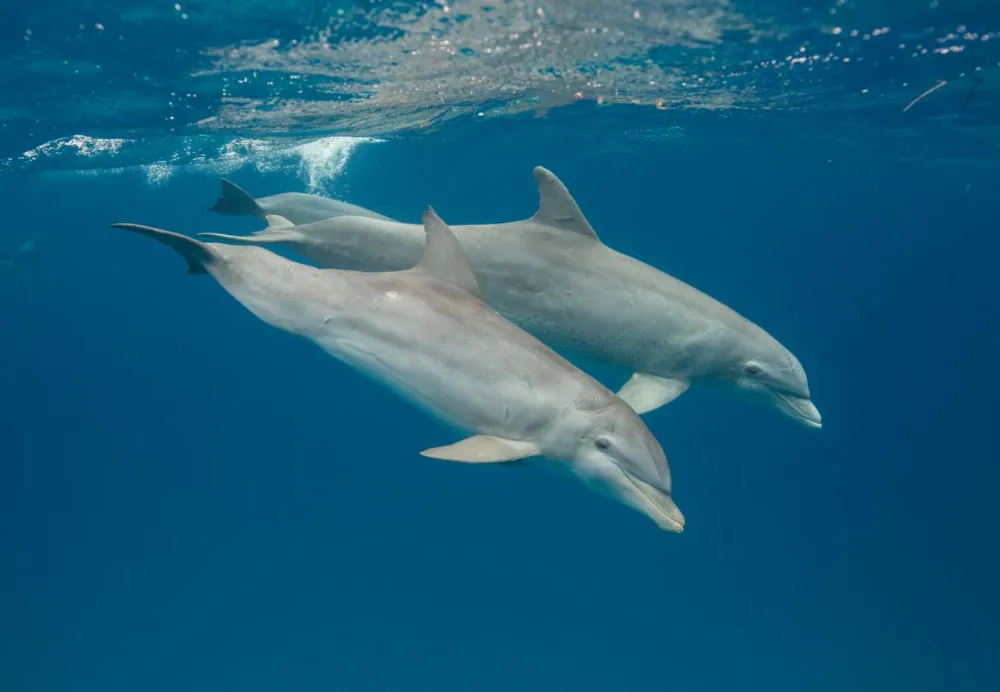
Bottlenose dolphins can display sleep-related activity while maintaining slow, coordinated movement near the surface.
Frequently Asked Questions
Do whales sleep?
Yes. Whales sleep and rest, although their patterns differ from ordinary human sleep.
How do whales sleep without drowning?
Whales have specialized sleep and respiratory control mechanisms that allow them to maintain access to air while resting.
Do whales sleep with half their brain?
Unihemispheric slow-wave sleep has been directly documented in studied cetaceans, including dolphins and belugas.
Can whales sleep underwater?
Yes. Some whales rest underwater, but they must eventually surface to breathe air.
Do whales sleep with one eye open?
Some cetaceans can. Dolphins and belugas have been observed showing asymmetrical eye states associated with unihemispheric sleep.
Why do sperm whales sleep vertically?
Wild sperm whales have been observed passively drifting in near-vertical postures, a behavior interpreted as likely associated with rest or sleep.
How long do whales sleep?
The duration varies among species, and reliable daily sleep measurements are unavailable for many large whales.
Do whales sleep at night?
Whales can rest at different times. There is no universal nighttime sleep schedule for all species.
Can whales swim while sleeping?
Yes. Some cetaceans can continue coordinated swimming during unihemispheric slow-wave sleep.
Do blue whales sleep?
Blue whales require rest, but their precise sleep physiology and daily duration are not well documented.
Do humpback whales sleep?
Humpbacks display resting behavior, although direct measurements of their brain sleep states remain limited.
Do orcas sleep?
Yes. Orcas display resting behavior and belong to the cetacean lineage with specialized sleep adaptations.
Do dolphins sleep?
Yes. Bottlenose dolphins are among the best-studied animals showing unihemispheric slow-wave sleep.
Can whales dream?
Scientists do not know whether whales experience dreams in the human sense. Conventional REM sleep has not been clearly documented in studied cetaceans.
Do whales have to wake up to breathe?
Not necessarily. Studies of dolphins indicate that breathing can continue during unihemispheric sleep.
The Bottom Line
Whales sleep, but their sleep is adapted to life in water.
Studies of dolphins and belugas demonstrate a pattern called unihemispheric slow-wave sleep, in which sleep-related activity is concentrated in one cerebral hemisphere at a time.
This allows important functions to continue during rest.
Some whales can also maintain movement, while sperm whales have been observed drifting vertically below the surface.
However, scientists know much more about the sleep physiology of certain dolphins than about the precise brain sleep states of large wild whales.
The strongest conclusion is that cetaceans possess unusual and varied strategies for combining restorative rest with the need to breathe atmospheric air.
Sources & Further Reading
NOAA Fisheries — Dolphins and Whales on the High Seas. Official explanation of whale and dolphin sleep and unihemispheric rest.
Lyamin et al. (2008) — Cetacean Sleep: An Unusual Form of Mammalian Sleep. Comprehensive scientific review of cetacean brain activity, eye state, respiration, and sleep evolution.
Miller et al. (2008) — Stereotypical Resting Behavior of the Sperm Whale. Current Biology. Research documenting vertical passive drift-dives in sperm whales.
Lyamin et al. (2004) — Relationship Between Sleep and Eye State in Cetaceans and Pinnipeds. Experimental evidence linking brain sleep states and eye closure.
Unihemispheric Sleep and Asymmetrical Sleep: Behavioral, Neurophysiological, and Functional Perspectives (2016). Research review on one-hemisphere sleep across animals.
Lyamin and Mukhametov (2013) — Sleep in Cetaceans. Review of breathing, swimming, eye state, and thermoregulation during cetacean sleep.