Honeybees dance to communicate the location and value of important resources, especially food sources such as nectar and pollen. A foraging worker that discovers a useful source may return to the hive and perform a waggle dance, moving forward while shaking her abdomen and then looping back. The direction of the waggle run indicates the direction of the resource relative to the sun, while its duration conveys approximate distance. Other workers can follow the dance and use the information to help find the resource. However, the signals are not perfectly accurate, and recent research shows that young honeybees improve important aspects of their dancing through social experience.
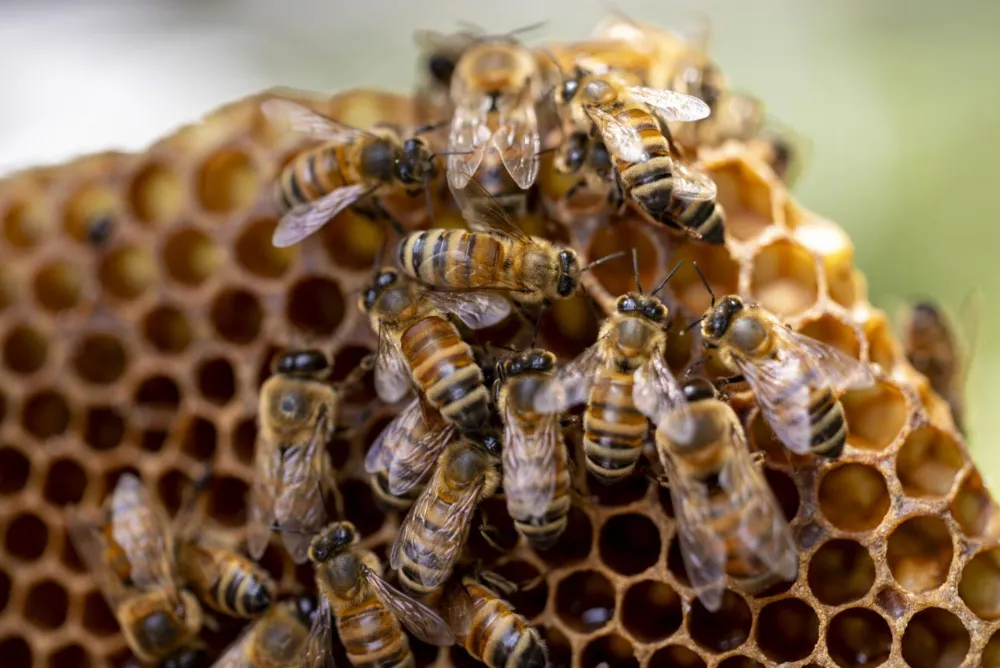
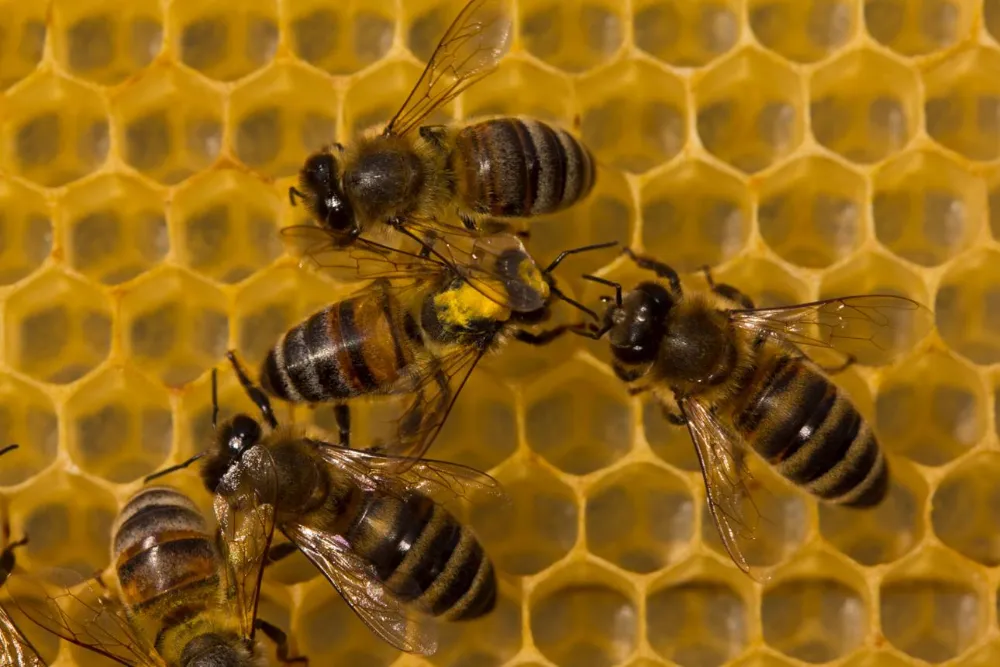
Worker honeybees communicate valuable information through movements performed on the surface of the honeycomb.
Why Do Bees Dance?
Honeybees live in social colonies in which thousands of individuals may depend on shared resources.
Workers need to locate nectar, pollen, water, and suitable nesting sites.
Finding these resources can require substantial time and energy.
When an individual discovers a valuable food source, sharing information can help other colony members locate it more efficiently.
The waggle dance is one way honeybees communicate that information.
Instead of randomly searching the surrounding landscape, recruited workers can use the dancer's signals as guidance.
However, a dance is not a perfect set of geographic coordinates.
Followers still use their own sensory systems, previous experience, and environmental cues.
The dance is therefore best understood as part of a broader foraging communication system.
What Is the Honeybee Waggle Dance?
The waggle dance is a specialized form of movement used by certain honeybee species to communicate the approximate location of resources.
It is especially well studied in the western honeybee, Apis mellifera.
During a typical waggle dance, the forager moves forward along a relatively straight path while rapidly oscillating her abdomen.
This part of the movement is called the waggle run.
After completing it, the bee turns and returns toward the starting position.
She then performs another waggle run and may return along the opposite side.
Repeated circuits often produce a pattern resembling a figure eight.
The direction and duration of the waggle runs contain important spatial information.
How Does the Waggle Dance Work?
The honeybee waggle dance has two major components:
Direction: The orientation of the waggle run communicates the direction of the resource relative to an external reference, usually the sun.
Distance: The duration of the waggle run provides information about how far the resource is from the hive.
The dancer may repeat the pattern many times.
Nearby workers follow or closely attend to the movements and associated mechanical signals.
These followers can then leave the hive to search for the indicated resource.
Research has shown that the directional and distance information are encoded together in the straight waggle portion of the dance.
However, decoding the signal is not equivalent to receiving an exact human-style map.
The indicated direction and distance have natural variation.
How Do Bees Use the Sun to Communicate Direction?
Honeybees can use the sun and patterns of polarized skylight as navigational references.
When a forager returns to a hive containing vertical honeycomb, she can transform the outdoor direction of a resource into an angle on the comb.
The upward direction on the comb represents the direction toward the sun.
If the food source lies in the same direction as the sun, the dancer may perform her waggle run upward.
If the food source lies at an angle relative to the sun, the waggle run is tilted correspondingly.
For example, a waggle run directed 45 degrees to the right of vertical indicates a resource approximately 45 degrees to the right of the sun's direction.
This coding system was famously investigated by Karl von Frisch.
Later experiments confirmed and refined researchers' understanding of how bees translate celestial information into movements inside a hive.
What Does an Upward Waggle Dance Mean?
On a vertical comb, an upward-directed waggle run generally indicates that the resource lies in the direction of the sun.
It does not necessarily mean the food is uphill or physically above the hive.
The comb is vertical, but the food source may be located horizontally across the surrounding landscape.
The bee uses gravity as the reference for translating an outdoor compass direction into a movement on the comb.
A downward-oriented waggle run generally represents a direction away from the sun.
However, the interpretation changes when bees dance on horizontal surfaces where direct visual references may be available.
The context of the dance matters.
How Do Bees Communicate Distance?
The distance signal is associated with the duration of the waggle run.
Longer waggle phases generally indicate more distant resources.
Shorter phases tend to represent closer resources.
However, the precise relationship varies among honeybee species and populations.
A 2021 study published in eLife investigated whether waggle duration increases linearly with distance.
The researchers found evidence supporting a more complex, nonlinear relationship.
Therefore, simple formulas such as one second always means exactly one kilometer should not be treated as universal rules.
Distance encoding also depends on how bees experience the landscape during flight.
Do Honeybees Measure Distance With Their Eyes?
Honeybees use visual motion information as an important part of estimating travel distance.
This process is often called optic flow.
As a bee flies, objects in its visual field appear to move across the retina.
The amount of image motion can provide information about travel through the environment.
Research has demonstrated that the visual structure of the landscape influences the distance communicated in waggle dances.
For example, flying through visually rich surroundings can produce different optic-flow information from flying through environments with fewer nearby visual features.
This is one reason the waggle dance cannot always be converted into a precise physical distance using a universal number.
The bee communicates information based partly on its sensory experience of the journey.
Does the Waggle Dance Form a Figure Eight?
Yes. A typical waggle dance often resembles a figure-eight pattern.
However, the shape emerges from a sequence of repeated movements rather than a rigid geometric figure.
The bee performs a forward waggle run.
She then turns back toward the starting point.
After another waggle run, she may return along the opposite side.
Repeated circuits produce the familiar alternating loops.
Different performances can vary in precision, turning shape, and number of circuits.
Researchers studying dance movements often focus on the waggle phase because that portion carries the primary direction and distance information.
Why Do Bees Shake Their Abdomens?
During the waggle phase, a dancer rapidly oscillates her body while moving forward.
These movements are associated with mechanical and airflow signals that can be detected by nearby bees.
Research has shown that wagging and wing vibrations create air movements close to the dancer.
Followers position themselves near the bee and can detect parts of the signal using their antennae.
These mechanical signals are particularly important in the dark interior of the hive.
However, the communication system involves more than a single body movement or sound.
Direction, timing, contact, sensory experience, and behavioral context all contribute.
Can Bees Understand the Dance in a Dark Hive?
Yes. Honeybee dance communication can occur on vertical combs inside dark nest cavities.
The dancer's movements produce mechanical information that followers can detect.
The bees do not need to view the complete pattern from above in the same way a human watches an educational video.
Close-range interactions allow followers to attend to the dancer's orientation and movement.
Researchers have investigated the role of antennal sensing, airflow, vibration, and other signals.
A 2023 review of the waggle dance emphasized the importance of specialized sensory-processing systems in the honeybee brain.
This makes the dance an important model for studying communication through multiple sensory channels.
How Do Other Bees Follow a Waggle Dance?
A worker interested in the dance approaches the performing bee and tracks her movement on the comb.
Followers often remain close to the dancer, particularly around the waggle phase.
They can detect directional and temporal information from the performance.
However, dance-following behavior is variable.
Some bees attend only briefly, while others follow multiple circuits.
Research has also shown that the encoded information contains errors and variation.
Therefore, followers are not guaranteed to fly directly to the target on their first attempt.
They may need additional sensory cues and search behavior to locate the resource.
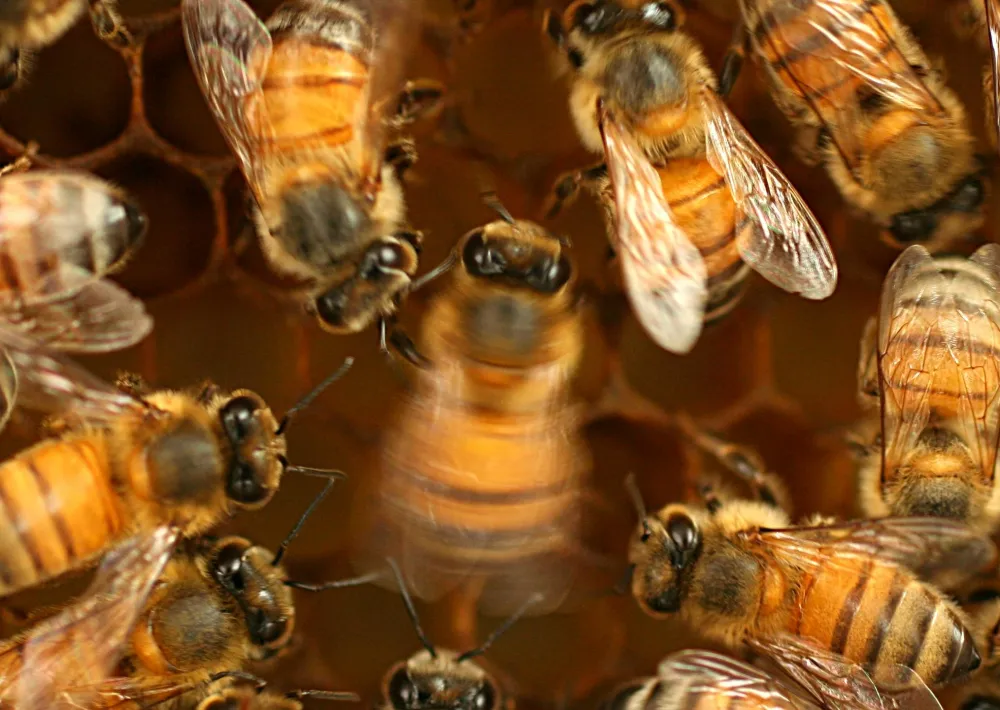
Follower bees gather close to a dancing forager and use multiple sensory cues to obtain information about a resource.
Do Bees Dance Only to Tell Others About Flowers?
No. Food locations are among the most familiar subjects of waggle dance communication, but they are not the only resources involved.
Honeybees may recruit others to valuable nectar and pollen sources.
Colonies can also use dance communication when searching for suitable new nest sites during swarming.
Scout bees inspect possible cavities and communicate information that can influence the colony's choice.
The underlying ability to communicate spatial information can therefore support more than ordinary food collection.
However, the context of nest-site recruitment differs from the context of daily foraging.
The evaluation of resource quality also differs according to the colony's needs.
Do Bees Dance to Tell Other Bees About Water?
Honeybee colonies need water for several purposes, including nest temperature regulation.
Successful water collectors can recruit other workers, and dance behavior can contribute to that recruitment.
However, the colony's need for water changes with environmental conditions and internal demand.
For example, a colony experiencing high temperatures may require more water than one under cooler conditions.
The signals associated with water collection therefore occur within a broader system of colony regulation.
Bees do not necessarily perform identical dances for every resource under every circumstance.
Do Bees Dance More for Better Food?
The profitability of a food source influences recruitment behavior.
A valuable source may contain abundant nectar, high sugar concentrations, or other desirable resources.
A forager's assessment can influence how vigorously and persistently she dances.
Higher-value resources may receive stronger recruitment signals.
However, dance intensity is not a perfectly standardized numerical rating.
The dancer's experience, colony conditions, and available alternatives can also influence behavior.
The 2023 study of social learning in honeybees described how information about direction, distance, and relative resource value is integrated into the dance system.
What Is the Difference Between a Round Dance and a Waggle Dance?
Honeybee communication includes movements traditionally described as round dances and waggle dances.
The round dance often occurs in association with nearby resources.
The waggle dance provides directional and distance information that becomes particularly useful for locating more distant resources.
However, these should not necessarily be interpreted as two completely unrelated behaviors.
Honeybee dance patterns can change as resource distance changes.
The transition between rounder and more elongated patterns may be gradual.
Different species and experimental contexts may also show different relationships.
Round Dance vs. Waggle Dance
| Feature | Round Dance | Waggle Dance |
|---|---|---|
| Typical resource location | Relatively nearby | Often farther away |
| Visible pattern | Circling or turning movements | Waggle runs with return loops |
| Direction information | Less explicit in the traditional pattern | Encoded by waggle-run orientation |
| Distance information | Limited or less developed | Encoded by waggle-run duration |
| Primary function | Recruitment to useful resources | Recruitment with spatial information |
These are simplified descriptions. Real honeybee behavior can occur along a continuum rather than fitting perfectly into two categories.
Do All Bees Perform the Waggle Dance?
No. The classic waggle dance is particularly associated with honeybees in the genus Apis.
Not every bee species uses the same communication system.
Bumblebees, solitary bees, and stingless bees have different social structures and recruitment behaviors.
Some communicate using chemical cues or other forms of activity.
Some do not recruit nestmates to food locations in the way honeybees do.
It is therefore inaccurate to say that every bee species communicates with a figure-eight waggle dance.
The behavior should be identified specifically with honeybee communication unless evidence supports a broader claim.
Can Young Honeybees Dance Correctly Without Learning?
Young honeybees can perform waggle dance movements without having previously followed an experienced dancer.
However, research published in Science in 2023 showed that early social experience affects the precision of the performance.
Researchers studied honeybees that were not able to follow dances before performing their own first dances.
These bees showed greater directional errors and more disordered dance patterns.
They also encoded distance less accurately.
The results suggest that the basic tendency to dance has an inherited component, but correct performance is influenced by social learning.
This finding changed the older simplified view that the dance is entirely automatic and unaffected by experience.
What Did the 2023 Honeybee Dance Study Discover?
The study was led by researchers including Shihao Dong, Tao Lin, James Nieh, and Ken Tan.
It compared honeybees with different opportunities to observe experienced dancers before their first performances.
Bees lacking those opportunities produced more disordered dances and greater angular divergence.
Their communicated distances were also inaccurate.
Some problems with dance direction improved as the bees gained experience.
However, the distance-encoding errors persisted in the studied bees.
The authors concluded that social learning contributes to the development of accurate waggle dance communication.
The work was published in Science in March 2023.
It provides strong experimental evidence that complex insect communication can be shaped by social experience.
Does That Mean Bees Have Culture?
Social learning is one important ingredient in discussions of animal culture.
The 2023 honeybee study demonstrated that experience with other dancers can influence later communication performance.
However, the word culture can carry different scientific meanings.
Some definitions require socially transmitted behavioral differences that persist within groups or populations.
The waggle dance findings support a role for socially acquired information, but they do not prove that honeybee communication is equivalent to human language or human culture.
The most precise conclusion is that social learning helps shape the accuracy of a complex communication behavior.
Are Honeybee Waggle Dances Always Accurate?
No. Waggle dances contain natural variation.
Direction and duration may differ from one waggle run to another.
A 2013 review examined angular variation within and between honeybee dances.
It discussed several possible reasons for this variability, including sensory limitations and environmental conditions.
Some earlier interpretations suggested that variation might deliberately spread recruited bees across an area.
However, other research indicates that at least part of the variation may result from performance and sensory constraints.
Therefore, dance errors should not automatically be described as either deliberate strategy or simple failure.
Researchers continue to investigate their causes and ecological consequences.
Why Do Bee Dances Sometimes Point in Different Directions?
Different waggle runs within the same dance can vary in angle.
This is sometimes called angular scatter.
The dancer must convert outdoor navigation information into a movement performed on a comb.
That process involves sensory and motor systems that are not perfectly precise.
Research has found that dances performed using visual references can be more precise than dances relying on gravity-based references.
This suggests that the sensory reference available to the bee can influence dance accuracy.
However, the amount of variation also depends on species, individual experience, and other conditions.
Can Bees Use the Dance When the Sun Moves?
Yes. Honeybees can compensate for the changing position of the sun.
The sun moves across the sky during the day, so the angle between the sun and a fixed food source changes.
Honeybees possess timing and navigational mechanisms that help account for these changes.
As a result, dance orientation can remain informative even though the solar reference is not fixed throughout the day.
However, the precision of sun-compass navigation depends on the available sensory information and the bee's internal timing systems.
This ability illustrates the integration of visual navigation, biological timing, and social signaling.
Can Bees Dance on Horizontal Surfaces?
Yes. Although the familiar textbook example involves dancing on vertical comb, honeybees can perform related movements under other spatial conditions.
When a bee dances on a horizontal surface with a visible reference to the sky, the directional relationship can be expressed differently.
The dancer may orient directly toward the intended resource direction rather than translating the information into an angle relative to gravity.
Researchers have studied these differences to understand the sensory reference systems underlying dance communication.
The common vertical-comb explanation is accurate for the classic hive setting but should not be applied without qualification to every possible dance surface.
Do Bees Communicate With Smell as Well as Dance?
Yes. Honeybees use several kinds of information while foraging and communicating.
Odors associated with flowers can help workers recognize attractive resources.
Bees can also use memory, learned landmarks, and visual information during navigation.
The waggle dance provides approximate spatial guidance, while other cues help bees identify or confirm a resource.
For example, a follower may gain information about the odor of a food source through interactions inside the hive.
After flying toward the communicated location, the worker may use floral scent and visual landmarks to find the actual flowers.
This is why the dance should not be imagined as replacing all other communication and navigation systems.
What Happens After a Bee Follows a Waggle Dance?
A recruited worker may leave the hive and travel in approximately the indicated direction.
She uses the distance information to guide how far she should search.
However, the communicated location has uncertainty.
The bee may need to investigate nearby flowers or other possible resources.
Odors, landmarks, visual features, and prior experience can help complete the search.
If she finds a profitable resource, she may collect nectar or pollen and return to the hive.
Under suitable conditions, she may then perform her own recruitment dance.
Communication and direct experience therefore interact in the foraging process.
Why Is the Waggle Dance Important for Honeybee Colonies?
A honeybee colony depends on its workers collecting enough resources to support brood development, maintenance, and survival.
Food sources can vary across space and time.
The waggle dance helps successful foragers communicate useful spatial information to nestmates.
This can reduce unnecessary searching in some circumstances.
However, the benefit of dance communication depends on the environment.
The availability and distribution of flowers, competition, and other ecological conditions influence the value of recruitment.
Researchers have investigated how communication systems help colonies adjust their foraging activity to changing resource conditions.
How Did Scientists Discover the Meaning of the Waggle Dance?
Karl von Frisch played a central role in deciphering honeybee dance communication.
Through experiments, he investigated how bees recruited nestmates to food sources.
He recognized that the orientation and duration of the dance carried spatial information.
Later researchers refined the understanding of solar references, optic flow, mechanical signals, and follower behavior.
Von Frisch received a share of the 1973 Nobel Prize in Physiology or Medicine for discoveries concerning the organization and elicitation of individual and social behavior patterns.
His work remains foundational to the scientific study of animal communication.
Is the Waggle Dance a Language?
The honeybee waggle dance is often described as a symbolic communication system because it conveys information about a resource that is not physically present inside the hive.
It can communicate approximate direction and distance.
However, describing it as a language requires care.
Human language has extensive grammatical, semantic, and generative properties that have not been demonstrated in honeybee dances.
The dance has a limited but biologically important set of encoded variables.
It is therefore best described as a sophisticated system of spatial referential communication rather than assuming it is equivalent to human speech.
Do Honeybees Dance for Fun?
There is no strong evidence that the waggle dance is primarily performed for entertainment.
Its well-established function is communication about resources.
That does not mean researchers can infer the complete subjective experience of an individual bee during a dance.
However, the behavioral context, recruitment responses, and experimental evidence demonstrate a practical communicative role.
The word dance describes the appearance of the movement, not necessarily the motivation humans associate with recreational dancing.
Can Bees Dance Without Finding Food?
Not every waggle dance concerns a newly discovered patch of flowers.
Scouting for a potential new nest site can also produce dance communication.
However, the specific context differs from ordinary foraging.
In both cases, a bee may communicate information about an external resource or location.
There is no reason to assume that bees perform the full spatial dance randomly without any associated behavioral context.
Scientific interpretation requires observing the dancer's activities and what happens afterward.
How Do Researchers Measure Waggle Dances?
Scientists record dances using cameras and analyze the orientation and duration of waggle runs.
They may also use automated image-processing techniques.
A 2017 study published in PLOS ONE described systems for automatically detecting and decoding honeybee waggle dances.
These methods measure the movement of the dancer and estimate the communicated direction and distance.
Researchers can then compare the dance with known food-source locations.
Such techniques are useful for studying how bees interact with the surrounding landscape.
However, automated decoding still contains measurement uncertainty, and the underlying bee signals are themselves variable.
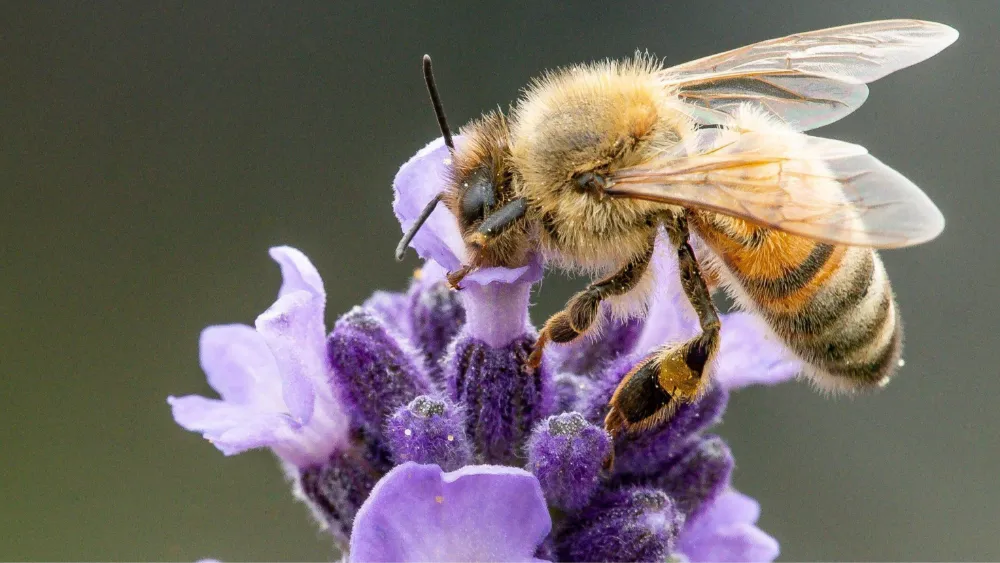
The waggle dance helps recruit nestmates to profitable food sources, while the recruited bees use their own senses to find the flowers.
Frequently Asked Questions
Why do bees dance?
Honeybees dance to communicate information about valuable resources, especially the direction and distance of food sources.
What is the waggle dance?
It is a honeybee communication behavior involving straight waggle runs and return loops that often form a figure-eight pattern.
How does a honeybee communicate direction?
On vertical comb, the angle of the waggle run relative to upward indicates the direction of the resource relative to the sun.
How do bees communicate distance?
The duration of the waggle run generally increases with resource distance, although the relationship varies among honeybee populations.
Do all bees perform a waggle dance?
No. The classic waggle dance occurs in honeybees, while many other bee species use different communication systems.
What does a figure-eight bee dance mean?
The repeated loops and central waggle run form part of a signal communicating the approximate location of a resource.
What is a round dance?
A round dance is a honeybee recruitment movement commonly associated with nearby resources. It differs from the classic directional waggle dance.
Can bees dance in the dark?
Yes. Honeybees can use close-range mechanical and sensory signals to communicate on combs inside dark nest cavities.
Do bees learn how to dance?
Social experience improves dance accuracy. A 2023 study found that bees lacking early opportunities to follow experienced dancers made more errors.
Are bee dances always accurate?
No. Waggle dances contain natural variation in angle and duration, so they communicate approximate rather than perfectly exact information.
Can bees dance to communicate water sources?
Yes. Honeybees can recruit workers to useful water sources as well as nectar and pollen resources.
Do bees dance to find new homes?
Scout honeybees can use dance communication during the search for suitable nest cavities when a colony swarms.
Who discovered the honeybee waggle dance?
Karl von Frisch was central to deciphering the spatial information conveyed by honeybee dances.
Is the waggle dance a language?
It is a sophisticated spatial communication system, but it does not possess all the demonstrated properties of human language.
The Bottom Line
Honeybees dance because communication helps their colonies locate and exploit valuable resources.
The waggle dance encodes approximate direction and distance through the angle and duration of a vibrating forward movement.
Followers use this information along with odor, vision, memory, and other cues.
Recent research also demonstrates that social experience helps young honeybees perform accurate dances.
The waggle dance is therefore not simply an instinctive figure-eight movement. It is a complex communication system shaped by inherited behavior, sensory information, and learning.
Sources & Further Reading
Dances as Windows into Insect Perception. Explains the relationship between the waggle-run angle, gravity, and the sun's direction.
Honey Bees Communicate Distance via Non-Linear Waggle Duration Functions (2021). Examines the relationship between waggle duration, travel distance, and population differences.
Dong et al. (2023) — Social Signal Learning of the Waggle Dance in Honey Bees. Experimental evidence that social learning affects dance accuracy.
Schürch and Couvillon (2013) — Too Much Noise on the Dance Floor. Discusses variation in the direction and duration of honeybee dances.
Automatic Detection and Decoding of Honey Bee Waggle Dances (2017). Describes methods for measuring and interpreting dance signals.
In Search of Behavioral and Brain Processes Involved in Honey Bee Dance Communication (2023). Reviews neural and sensory mechanisms involved in the communication system.