Fireflies glow because they produce light through a chemical reaction called bioluminescence. Inside specialized cells in their light-producing organs, a molecule called luciferin reacts with oxygen in a process involving the enzyme luciferase and cellular energy supplied by ATP. Many adult fireflies use flashes to communicate with potential mates, while glowing larvae may signal that they are chemically defended against predators. Different firefly species produce different colors and flashing patterns. However, not all adult fireflies flash, and scientists are still investigating the exact mechanisms that control how their lights switch on and off.
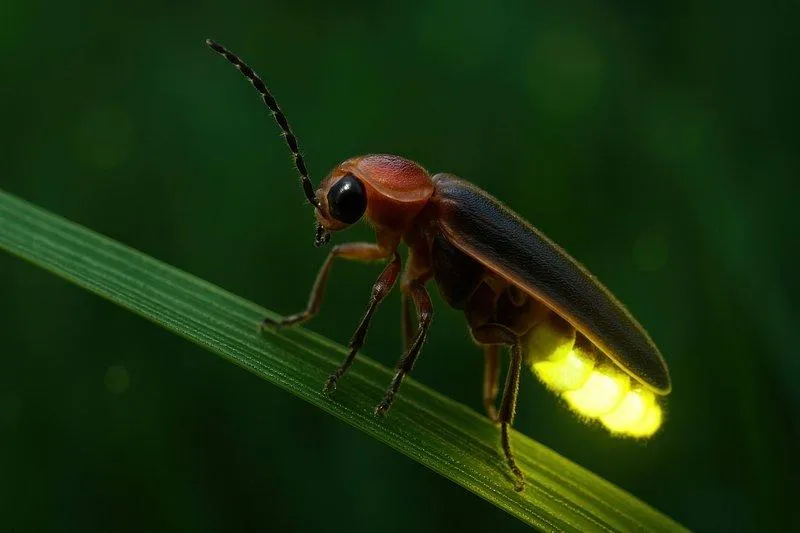
A firefly produces its own light through bioluminescence rather than reflecting sunlight or generating a flame.
Why Do Fireflies Glow?
Fireflies use light for communication and, in some life stages, defense.
Many familiar adult fireflies flash to attract potential mates or respond to the signals of other members of their species.
These flashes provide a way for individuals to communicate in the darkness of evening or nighttime habitats.
However, mating is not the only reason fireflies produce light.
Larvae of many species glow even though they are not yet capable of reproduction.
Their light is commonly understood as a warning signal associated with chemical defenses that can make them unpleasant or unsuitable prey.
Some adults also produce light in contexts other than courtship.
Therefore, the meaning of a glow depends on the animal's species, age, and behavior.
How Do Fireflies Make Light?
Firefly light comes from a biochemical process called bioluminescence.
The light-producing system contains a chemical substrate called luciferin and an enzyme called luciferase.
ATP, a molecule used by cells to transfer energy, helps activate luciferin.
Oxygen is also required for the reaction.
Through a series of chemical steps, activated luciferin undergoes oxidation.
The reaction forms an excited product that releases energy as visible light.
This process occurs in specialized cells called photocytes.
The biochemical reaction has been studied extensively because it offers an important natural example of converting chemical energy into visible light.
What Is Bioluminescence?
Bioluminescence is the production of visible light by living organisms through biochemical reactions.
It differs from ordinary reflection because the organism generates light rather than merely bouncing external light toward an observer.
Bioluminescence also differs from fluorescence.
Fluorescence usually requires incoming light to excite molecules that then emit light at different wavelengths.
Bioluminescence can occur in darkness because the energy comes from a chemical reaction within the organism or from associated microorganisms.
Fireflies are among the best-known terrestrial examples.
Bioluminescence also occurs in various marine animals, fungi, and other living organisms.
However, different organisms may rely on different molecules and biochemical mechanisms.
What Chemicals Make Fireflies Glow?
The main components of the familiar firefly light reaction are:
Luciferin: The light-producing chemical substrate.
Luciferase: The enzyme that catalyzes the relevant reactions.
ATP: A cellular energy-transfer molecule used during luciferin activation.
Oxygen: Required for the oxidation reaction that generates light.
Magnesium ions also participate in the ATP-dependent activation process.
The reactions produce light as an excited chemical product returns to a lower-energy state.
Researchers have identified several intermediate steps in this process.
The detailed biochemical mechanism is more complex than a single collision between four ingredients.
What Is Luciferin?
Luciferin is the chemical substrate that participates directly in the light-emitting reaction.
Firefly luciferin is activated through an ATP-dependent process catalyzed by luciferase.
The activated molecule then reacts with oxygen.
During the reaction, a product called oxyluciferin is formed.
Light is released as an excited intermediate or product relaxes to a lower-energy state.
Luciferin is not a tiny glowing lamp by itself.
Its ability to produce light depends on the biochemical reaction occurring under suitable conditions.
Different bioluminescent organisms can use chemically different luciferins.
What Is Luciferase?
Luciferase is the enzyme that catalyzes the reactions producing firefly light.
Enzymes are biological catalysts that accelerate specific chemical processes.
Firefly luciferase helps activate luciferin using ATP and then supports its oxidation.
The reaction can produce visible light very efficiently.
Because luciferase activity can be measured through light emission, scientists also use it as a tool in molecular biology.
Researchers may introduce genes encoding luciferase into experimental systems so that light signals reveal aspects of gene expression or other biological activity.
However, these laboratory applications are different from the biological purpose of flashing in a living firefly.
Does Firefly Light Need Oxygen?
Yes. Oxygen is required for the firefly light-producing reaction.
The availability of oxygen is also relevant to theories explaining how flashing is controlled.
Researchers have proposed that fireflies regulate the delivery or availability of oxygen in their light-producing cells.
One hypothesis involves changes in the amount of oxygen used by mitochondria, allowing more oxygen to participate in the bioluminescent reaction.
However, the precise mechanism responsible for every rapid flash has not been completely resolved.
Studies using different experimental approaches have produced evidence supporting some aspects of oxygen regulation while questioning the universality of particular models.
How Do Fireflies Turn Their Lights On and Off?
Fireflies can control their light output, sometimes producing very brief flashes.
This requires a mechanism that coordinates biochemical reactions with physiological signals.
Experiments have implicated oxygen availability and neural regulation.
Scientists have also investigated a signaling molecule called nitric oxide.
A study published in Science in 2001 demonstrated that nitric oxide could influence firefly light production under experimental conditions.
Later research examined how oxygen transport within the lantern organ might support rapid flashing.
However, a 2014 gene-expression study did not support all predictions of a simple nitric-oxide-controlled flashing model.
Therefore, the most accurate summary is that scientists understand the core chemistry of firefly light much better than they understand every detail of the biological on-off switch.
What Is Nitric Oxide's Role in Firefly Flashing?
Nitric oxide is a small signaling molecule that has several biological functions.
In one proposed firefly flash-control system, nitric oxide inhibits oxygen consumption by mitochondria.
This could allow more oxygen to reach the light-producing reaction.
A 2001 study found that nitric oxide could stimulate firefly bioluminescence and that chemicals removing nitric oxide could interfere with some experimentally induced flashes.
However, researchers later tested whether nitric oxide synthase gene expression consistently matched flashing behavior across different fireflies.
That study did not support all the expectations of the proposed model.
Other work has continued investigating oxygen supply and cellular regulation.
The evidence therefore supports nitric oxide as a potentially important participant without establishing a single universal switch mechanism for every firefly species.
Where Does a Firefly's Light Come From?
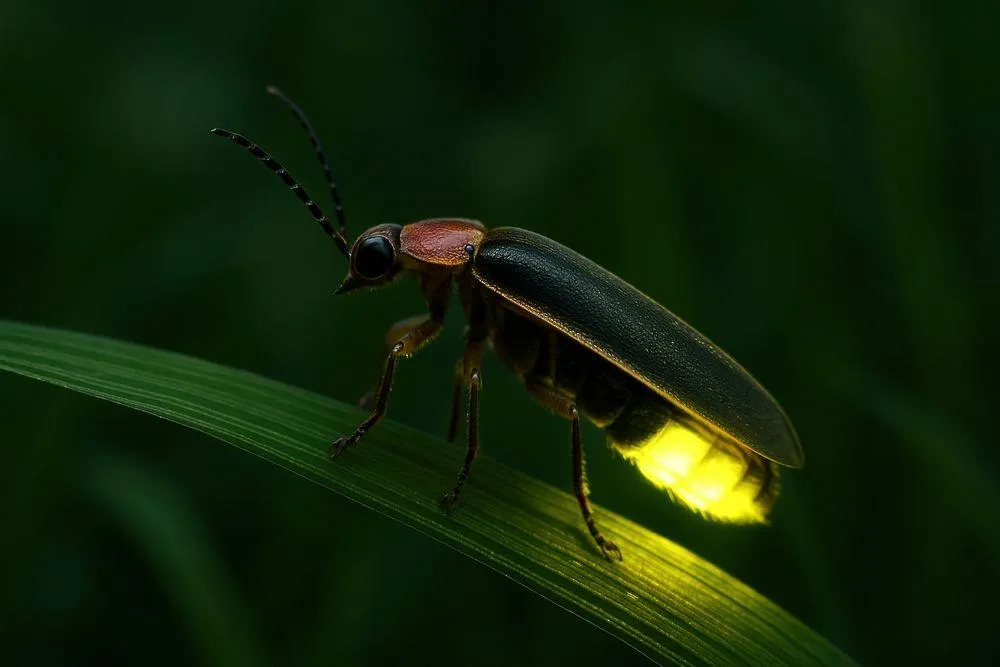
In many familiar adult flashing fireflies, light is produced in specialized organs near the end of the abdomen.
These organs are commonly called lanterns.
The lantern contains photocytes, the cells responsible for producing light.
Additional tissue structures help organize oxygen delivery and the movement of light through the organ.
The appearance and placement of light-producing areas vary among species and life stages.
For example, adult males and females may differ in the number or extent of visible light segments.
Larvae often have different light-producing structures from adults.
Therefore, not every glowing firefly has an identical lantern shape.
What Color Do Fireflies Glow?
Firefly light often appears yellow, yellow-green, or greenish.
Some species produce warmer orange or reddish light.
The color depends on the properties of the light-producing system and the species.
Different luciferase proteins and the chemical environment of the reaction can influence emitted wavelengths.
However, a photographed firefly may appear more blue, green, or yellow than it does to the human eye because camera settings affect color recording.
Accurate scientific illustrations should avoid assuming that every firefly glows bright neon green.
Why Is Firefly Light Called Cold Light?
Firefly bioluminescence is often described as cold light because it produces visible light without the extreme temperatures associated with flames or incandescent filaments.
The chemical reaction converts energy into light with relatively little waste heat compared with many conventional light sources.
However, cold light does not mean the reaction has no thermal effects whatsoever.
The firefly is a living organism with ongoing metabolism.
The important distinction is that bioluminescence does not require heating an object until it glows.
Unlike a burning material, the abdomen does not need to become dangerously hot to produce visible light.
Do Fireflies Produce Light Without Electricity?
Yes. Firefly light results from chemical reactions within living cells rather than from an electrical circuit powering a bulb.
Electrical signals in the nervous system may participate in controlling the behavior.
However, the immediate light-producing process is biochemical.
This is why fireflies are an important natural example of chemical energy conversion.
Modern biotechnology also uses luciferase reactions to create measurable light signals in scientific experiments.
Why Do Fireflies Blink Instead of Glowing Constantly?
Many adult firefly species produce intermittent flashes because timing can be part of their communication system.
A flash signal can convey information through its duration, number of pulses, and intervals.
Different species may display different patterns.
Potential mates can respond to signals associated with their own species.
However, not every firefly flashes.
Some produce prolonged glows, while others communicate mainly through chemical signals.
Flashing is therefore one of several evolutionary solutions to communication among fireflies.
How Do Fireflies Use Light to Find Mates?
Many flashing fireflies use bioluminescent signals during courtship.
In several well-studied North American species, flying males emit flashes while searching for females.
Females resting on vegetation may respond with flashes of their own.
The timing of the response can help the male locate the female.
However, these behaviors vary among species.
Not all females fly, and not every species uses the same pattern of male and female signaling.
The broader function is reproductive communication.
Do Male and Female Fireflies Both Glow?
In many firefly species, both sexes can produce light.
However, males and females may differ in how, when, and where they signal.
In some species, males fly and flash while females remain on vegetation.
Other species have females that are flightless or resemble larvae in body shape.
Some adult fireflies rely less on flashing and more on chemical communication.
Therefore, it is incorrect to say that only male fireflies glow or that every female produces the same type of response flash.
Do Female Fireflies Answer Male Flashes?
Yes, in several well-studied flashing species.
A flying male emits a species-associated signal.
A receptive female can answer after a characteristic delay.
The male may use the timing and direction of her response to approach her.
However, the exact pattern differs among species.
Researchers study these differences to understand mate recognition and reproductive isolation.
A delay that is meaningful for one species should not automatically be applied to another.
Do Different Firefly Species Have Different Flash Patterns?
Yes. Firefly species can differ in flash duration, number of pulses, timing, and movement.
These patterns can help individuals locate appropriate mates.
In some species, geographical populations also differ in flashing intervals.
A study of Japanese fireflies reported differences in flash timing between populations of Luciola cruciata.
However, species identification based only on a casual observation of a single flash may be unreliable.
Accurate identification can require geographic context, repeated observations, and morphological characteristics.
Firefly Glowing vs. Flashing
| Feature | Continuous or Extended Glow | Discrete Flashes |
|---|---|---|
| Light pattern | Relatively sustained illumination | Distinct light pulses separated by darkness |
| Common context | Some larvae and adults | Many courting adults |
| Potential functions | Defense or other species-specific communication | Mate recognition and signaling |
| Species variation | Substantial | Substantial |
| Biochemical basis | Luciferin-luciferase bioluminescence | Luciferin-luciferase bioluminescence |
The distinction describes patterns of light emission rather than two entirely different kinds of firefly chemistry.
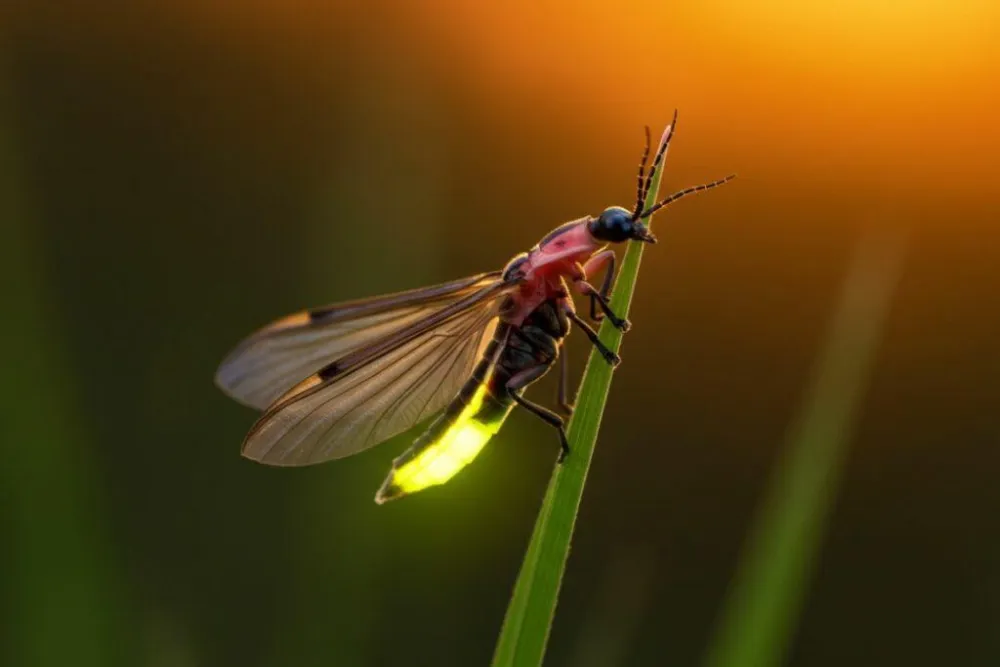
The light-producing lantern is located in the abdominal region of many adult flashing fireflies.
Why Do Firefly Larvae Glow?
Many firefly larvae produce light before they are old enough to reproduce.
That indicates their glow cannot function exclusively as a mating signal.
Researchers have connected larval bioluminescence with warning signals directed toward potential predators.
Some fireflies contain defensive chemicals that make them distasteful or harmful to certain predators.
A visible glow can serve as a warning of that defense.
However, chemical defenses and the effectiveness of warning signals vary among species.
The light of a larva should not be assigned exactly the same function as the courtship flashes of a particular adult species.
What Is a Glowworm?
The term glowworm can refer to different light-producing organisms.
In many contexts, it refers to firefly larvae or flightless glowing females of certain beetle species.
However, the name is also used for unrelated bioluminescent insects.
For example, some cave glowworms are fungus gnat larvae rather than fireflies.
Therefore, a glowing worm-like animal is not necessarily a member of the firefly family Lampyridae.
Scientific identification requires attention to geography, appearance, and classification.
Are Fireflies Really Flies?
No. Fireflies are beetles, not true flies.
They belong to the insect order Coleoptera and the family Lampyridae.
True flies belong to the order Diptera.
Despite the word fly in their common name, fireflies possess the general anatomical characteristics of beetles.
Many adult fireflies have hardened forewings called elytra covering their flight wings.
However, some species or sexes are flightless.
The common name lightning bug refers to the same general group.
Are Lightning Bugs and Fireflies the Same?
Yes. Firefly and lightning bug are common names used for members of the family Lampyridae.
Regional language preferences may differ.
Both names refer to bioluminescent beetles, although not every species produces conspicuous flashes as an adult.
The names should not be interpreted as referring to two separate insect families.
Why Do Fireflies Flash Together?
Some firefly species produce synchronized displays in which many individuals flash at roughly the same time.
This creates the dramatic appearance of a landscape blinking in unison.
The behavior has been investigated through mathematical models and experiments involving visual interactions among individuals.
Synchronization does not mean that the insects are connected by an invisible electrical network.
Their timing can respond to the light signals of nearby individuals.
However, the mechanisms and patterns vary among species.
It would be inaccurate to assume that every firefly colony synchronizes its flashes.
What Are Synchronous Fireflies?
Synchronous fireflies are species or populations in which adults can coordinate their flashing patterns.
One well-known example is Photinus carolinus, which produces spectacular displays in parts of the eastern United States.
Such displays attract scientific interest because they involve collective behavior emerging from interactions among individuals.
However, many other firefly species flash independently.
Scientists have investigated synchronization using controlled light signals and behavioral observation.
These studies help explain how local interactions can produce organized group-level patterns.
Are Fireflies Dangerous to Predators?
Some fireflies contain defensive compounds that deter predators.
These chemical defenses can make the insects unpalatable or harmful to certain animals.
Bioluminescence may help warn predators that the insect is chemically defended.
However, the strength and nature of the defenses vary.
The fact that a firefly glows does not imply that it poses a serious threat to humans during ordinary outdoor observation.
Wild insects should nevertheless be left undisturbed rather than eaten or offered to pets.
Do Fireflies Use Light to Warn Predators?
Warning coloration or warning light is called aposematism.
Some firefly researchers interpret larval glowing as an aposematic signal.
The insect's light may help predators recognize an unprofitable prey item.
However, the effectiveness of a warning signal depends on the predator's sensory abilities and prior experience.
Scientists distinguish the presence of a glow from direct proof that every predator responds to it in the same way.
Firefly bioluminescence likely has an evolutionary history involving both defense and reproduction.
What Are Photuris Fireflies?
Photuris is a genus of North American fireflies.
Some species are famous because females can imitate the response signals of other firefly species.
This can lure heterospecific males close enough to capture.
The behavior is sometimes described as aggressive mimicry.
It demonstrates that not every flash exchange is a successful courtship interaction.
Light signals can be exploited by predators as well as used by potential mates.
However, not every female in every Photuris species behaves identically.
Why Do Some Fireflies Stop Glowing?
Light output varies among species, life stages, and behavioral circumstances.
A firefly may stop flashing when a signaling sequence ends or when environmental conditions change.
Some adults do not use conspicuous flashing as their main reproductive signal.
Others may be less active during unfavorable weather or outside their normal display period.
Therefore, not seeing a glow does not necessarily mean the insect is dead or unhealthy.
Do Fireflies Glow All Night?
Not necessarily.
Many species display during particular periods after sunset.
Others may be active later at night.
Temperature, moisture, season, and local conditions can influence activity.
Different species may occupy different signaling periods even within the same general region.
For this reason, the best time to observe fireflies cannot be generalized to one universal hour.
Why Are Fireflies Common in Summer?
In many temperate regions, adult firefly activity becomes conspicuous during warm months.
The timing reflects the insects' life cycles, local temperatures, moisture, and habitat conditions.
However, not every species appears during exactly the same summer period.
Some fireflies are associated with different seasonal conditions or climates.
Firefly larvae may spend much longer developing than the brief period during which people commonly notice glowing adults.
What Do Firefly Larvae Eat?
Many firefly larvae are predators of other small invertebrates.
Depending on the species, prey can include snails, slugs, worms, and other soft-bodied animals.
Larvae often live in or near moist soil, leaf litter, or similar habitats.
Because they spend much of their lives in these environments, disturbances to ground-level habitat can affect their survival.
Adult diets vary considerably among species.
Some feed on nectar or other resources, while others may eat little or nothing during the adult stage.
Do Fireflies Live in Water?
Some firefly larvae inhabit aquatic or semi-aquatic environments.
Other species develop in moist terrestrial habitats.
The family Lampyridae therefore contains substantial ecological diversity.
Many adults fly over vegetation or near waterways during their display periods.
However, a firefly seen over a pond should not automatically be classified as having an aquatic larval stage.
Life-history patterns vary among species.
Why Are Fireflies Disappearing?
Researchers are concerned about declines in some firefly populations.
Important potential threats include habitat loss, artificial lighting, pesticide exposure, and environmental changes.
However, firefly population trends are not equally well documented everywhere.
A 2024 study using more than 24,000 citizen-science surveys investigated relationships between firefly observations and environmental factors across North America.
Such research helps identify patterns associated with abundance, although observational correlations do not establish a single cause for every local decline.
Some firefly species may be more vulnerable than others because of specialized habitat requirements.
How Does Light Pollution Affect Fireflies?
Many adult fireflies depend on visible light signals to locate potential mates.
Artificial lights can interfere with the contrast and visibility of those signals.
Bright outdoor illumination may make it more difficult for some individuals to detect courtship flashes.
Effects vary with light intensity, spectrum, direction, and species.
Researchers have identified artificial light at night as an important conservation concern for nocturnal wildlife.
However, one should not conclude that every light source affects every firefly species equally.
Reducing unnecessary illumination during firefly activity periods is a practical way to lessen potential disturbance.
Do Streetlights Prevent Fireflies From Mating?
Artificial light can interfere with mating communication in some fireflies.
However, the degree of disruption depends on experimental and environmental conditions.
A brightly illuminated area may reduce the visibility of courtship signals or alter signaling behavior.
That does not mean a single streetlight automatically prevents every nearby firefly from reproducing.
Scientists investigate effects at different levels, including individual behavior, reproductive success, and long-term population change.
These outcomes should not be treated as interchangeable.
How Can People Help Fireflies?
Several habitat-management choices may benefit fireflies and other nocturnal wildlife:
Reduce unnecessary outdoor lighting during the evening.
Use shielded fixtures that direct light only where needed.
Protect moist habitats, native vegetation, and leaf litter.
Avoid unnecessary insecticide applications.
Reduce disturbance of soil and vegetation used by larvae.
Observe fireflies without collecting large numbers or damaging habitat.
The specific needs of local firefly species may differ.
Where firefly populations are present, conserving the environments required for their entire life cycle is more useful than focusing only on glowing adults.
How Is Firefly Light Different From Glow-in-the-Dark Paint?
Firefly bioluminescence results from ongoing chemical reactions inside living cells.
Many glow-in-the-dark materials, by contrast, absorb energy from an external light source and release some of that energy over time.
This physical process is called phosphorescence.
Glow-in-the-dark paint does not need an enzyme and luciferin to work.
Fireflies do not simply charge their abdomens under the sun like a luminous toy.
Firefly Light vs. Other Types of Glow
| Light Type | Energy Source | Example |
|---|---|---|
| Bioluminescence | Biochemical reaction | Firefly lantern |
| Fluorescence | Absorbed incoming light | Fluorescent materials under suitable illumination |
| Phosphorescence | Previously absorbed energy released over time | Glow-in-the-dark paint |
| Incandescence | High temperature | Heated light-bulb filament |
These processes can produce superficially similar visible effects but have different physical or chemical foundations.
Do Scientists Use Firefly Light in Laboratories?
Yes. Firefly luciferase has become an important tool in biological research.
Scientists can measure light output from luciferase reactions to study cellular processes.
Luciferase reporter systems are widely used in molecular biology.
Light intensity can provide information about experimental changes under controlled conditions.
Researchers also use related approaches to investigate gene expression and other biochemical events.
However, a laboratory luciferase assay is not identical to a firefly's complex natural flashing behavior.
Why Is Firefly Bioluminescence Important to Science?
Fireflies connect several areas of biology.
Their light-producing chemistry provides a model for understanding enzyme catalysis.
Their mating displays offer opportunities to study communication and behavior.
Synchronous flashing provides a natural example of collective biological timing.
Research on their light organs also addresses how living tissues regulate oxygen and biochemical reactions.
Finally, fireflies are important conservation subjects because their communication can be disrupted by artificial light at night.
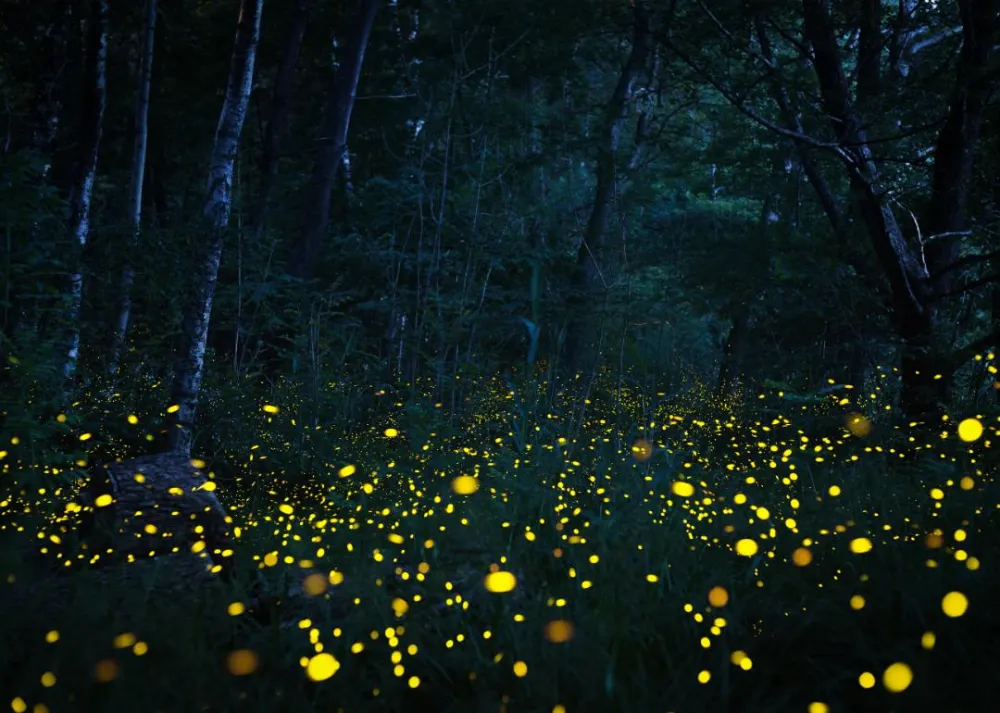
Dark, vegetated habitats provide places for fireflies to develop, communicate, and reproduce.
Frequently Asked Questions
Why do fireflies glow?
Fireflies produce light through bioluminescence. Many adults use flashing for mating communication, while larval glowing can function as a warning signal.
How do fireflies make light?
A biochemical reaction involving luciferin, luciferase, ATP, and oxygen produces visible light in specialized cells.
Are lightning bugs and fireflies the same?
Yes. Both names commonly refer to beetles in the family Lampyridae.
Are fireflies actually flies?
No. Fireflies are beetles belonging to the order Coleoptera.
Why do fireflies blink?
In many species, timed flashes help individuals communicate with potential mates.
Do female fireflies glow?
Many females produce light, although signaling patterns differ among species and some females are flightless.
What chemical makes fireflies glow?
Luciferin is the light-producing substrate, and luciferase catalyzes the reaction using ATP and oxygen.
Do fireflies need sunlight to glow?
No. Their light is generated chemically and does not require stored sunlight.
Does firefly light produce heat?
The process produces comparatively little waste heat and does not require the extreme temperature of a flame.
Why do some fireflies flash together?
Some species coordinate their timing through responses to nearby individuals' flashes, producing synchronized displays.
Do baby fireflies glow?
Many firefly larvae can glow, often in a context associated with predator deterrence.
Are glowworms fireflies?
Some glowworms are firefly larvae or flightless firefly females, but the name can also refer to unrelated glowing insects.
Why are fireflies disappearing?
Habitat changes, artificial light, pesticides, and environmental pressures may contribute to declines in some species, although population information remains incomplete.
Can artificial light stop fireflies from mating?
Artificial illumination can disrupt courtship signals in some species, but effects depend on species and lighting conditions.
Can all fireflies flash?
No. Some species produce steady glows, have reduced adult bioluminescence, or rely more heavily on chemical communication.
The Bottom Line
Fireflies glow because living cells in their light-producing organs carry out a specialized bioluminescent chemical reaction.
Luciferin, luciferase, ATP, and oxygen work together to produce visible light.
Many adult fireflies use flashes to recognize and locate mates, while glowing larvae may warn predators of chemical defenses.
Different fireflies have different colors, flashing patterns, and life histories.
Although scientists understand the basic light-producing chemistry, they continue to study the physiological mechanisms that control flashing.
Protecting dark natural habitats is important because artificial light can interfere with the very signals that make fireflies so remarkable.
Sources & Further Reading
Inouye — Firefly Luciferase: An Adenylate-Forming Enzyme for Multicatalytic Functions. Review of luciferin, luciferase, ATP, oxygen, and the underlying biochemistry.
Trimmer et al. (2001) — Nitric Oxide and the Control of Firefly Flashing. Science. Experimental evidence concerning nitric oxide and flash regulation.
Expression of the nos Gene and Firefly Flashing: A Test of the Nitric-Oxide-Mediated Flash Control Model. Evaluates limitations of the proposed nitric oxide mechanism.
Firefly Light Flashing: Oxygen Supply Mechanism (2014). Physical Review Letters. Research on oxygen delivery and photocyte function.
McNeil et al. (2024) — Illuminating Patterns of Firefly Abundance Using Citizen Science Data and Machine Learning Models. Research on environmental variables and observed firefly abundance.
IUCN — Light Pollution. Explains threats posed by artificial light to nocturnal ecosystems.
Firefly Conservation & Research — How You Can Help Prevent Fireflies from Disappearing. Habitat and lighting recommendations for conservation.