Chameleons change color to communicate with other chameleons, respond to environmental conditions, and sometimes improve camouflage. Their most dramatic color displays often occur during courtship or competition between males. Research on panther chameleons has shown that they can change the spacing of tiny guanine crystals in specialized skin cells, altering the wavelengths of light reflected from their skin. Temperature, light, stress, and species-specific biology also influence their appearance. However, chameleons cannot turn into any color or perfectly copy every background they encounter.
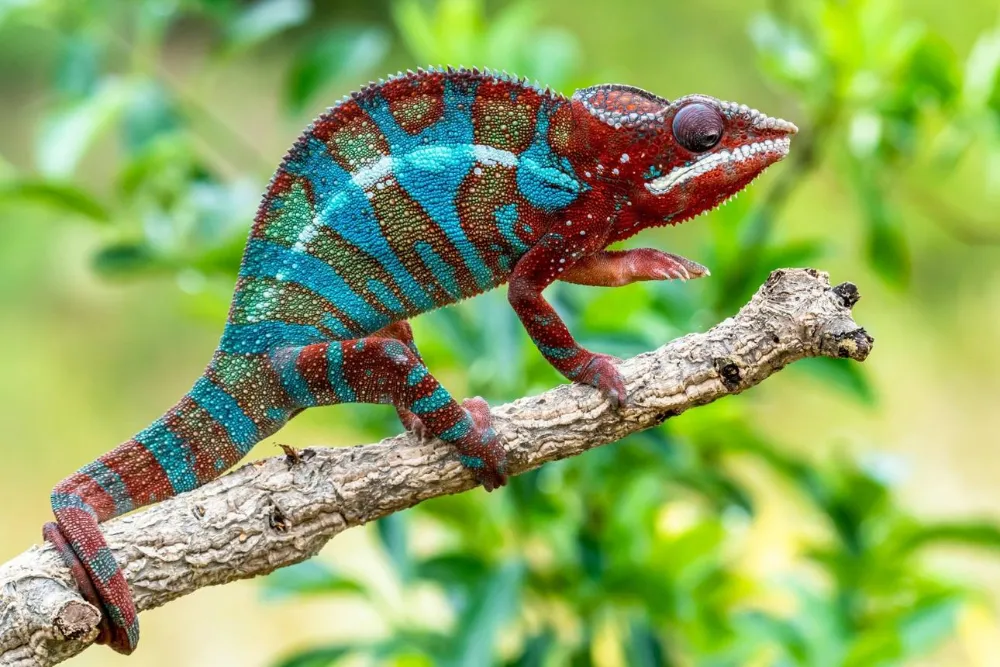
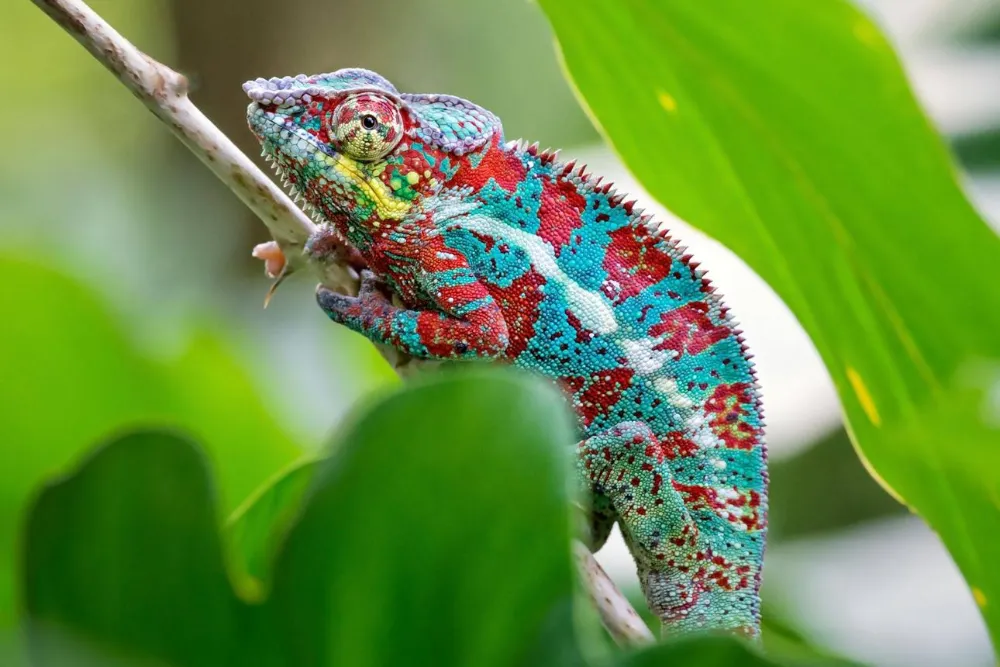
Panther chameleons are known for vivid color displays, especially during social interactions.
Why Do Chameleons Change Color?
Chameleons are a specialized group of lizards famous for their independently movable eyes, grasping feet, long projectile tongues, and remarkable skin coloration.
However, their ability to change color is often misunderstood.
Many people imagine a chameleon instantly becoming identical to whatever object it touches.
Real color changes are more limited and have important biological functions.
Scientists have identified several major contexts:
Social communication: Colors and patterns can signal information during interactions with other chameleons.
Courtship: Males may display conspicuous colors when approaching potential mates.
Competition: Rival males can communicate through changes in brightness, pattern, and color.
Environmental responses: Temperature, light, and other conditions can influence coloration.
Camouflage: Some colors and patterns help chameleons remain inconspicuous in natural habitats.
The relative importance of these functions varies among species.
Researchers therefore avoid assuming that one explanation applies equally to all chameleons.
Do Chameleons Change Color to Camouflage?
Camouflage is part of chameleon biology, but it is not the only explanation for their color-changing ability.
Many chameleons naturally possess green, brown, or other patterns that help them blend with vegetation and branches.
Some species can adjust the brightness and shade of their coloration.
However, dramatic shifts from green to vivid yellow, orange, or red may be particularly important during social communication.
A 2008 study published in PLOS Biology examined color change among southern African dwarf chameleons.
It found that species capable of especially conspicuous changes tended to use those colors during courtship and male competition.
The researchers found stronger evidence for selection favoring social signaling than for the idea that increasingly dramatic color changes evolved mainly to match more backgrounds.
This does not mean camouflage never matters.
It means that camouflage alone cannot explain the diversity and intensity of chameleon displays.
Can Chameleons Match Any Background?
No. Chameleons cannot reproduce every color and pattern they encounter.
Each species has a particular range of color appearances determined by its skin structure, pigments, physiology, and genetics.
A chameleon placed on a red-and-white patterned surface will not automatically produce an identical pattern.
The San Diego Zoo emphasizes that chameleons do not simply look at their surroundings and decide to copy them.
Instead, color changes occur in response to biological and environmental signals.
Some species are capable of dramatic shifts.
Others display more limited changes among greens, browns, grays, and related shades.
Popular demonstrations showing perfect background matching should therefore be treated skeptically.
How Do Chameleons Change Color?
Chameleon skin contains multiple layers of specialized cells.
Some contain pigments, while others produce structural colors through interactions with light.
In panther chameleons, a particularly important type of cell is called an iridophore.
These cells contain tiny crystals made from guanine.
The crystals are organized in arrangements that selectively reflect particular wavelengths of light.
By changing the spacing between the crystals, the skin can alter which wavelengths are strongly reflected.
The reflected light then interacts with pigments and other skin layers to produce the colors visible to an observer.
This mechanism was demonstrated in a landmark 2015 study published in Nature Communications.
However, structural reflection is not the only process involved in every chameleon color change.
Pigment cells and the organization of the surrounding skin also contribute.
What Are Iridophores?
Iridophores are specialized cells that produce structural coloration by reflecting light.
They occur in several groups of animals, including fishes, amphibians, and reptiles.
In chameleons, iridophores can contain nanoscale guanine crystals.
The arrangement and dimensions of these crystals influence how incoming light is reflected.
For the panther chameleon, researchers identified two distinct layers of iridophores.
The upper layer is involved in rapid visible color changes.
The deeper layer reflects a broad range of wavelengths, including substantial near-infrared radiation.
These layers perform different optical functions.
It is therefore misleading to describe all iridophores as simply being colored pigment bags.
What Are Guanine Nanocrystals?
Guanine is a naturally occurring molecule found in living organisms.
In chameleon iridophores, it forms extremely small crystalline structures.
These crystals can be organized into a repeating lattice.
The spacing between neighboring crystals influences how the arrangement interacts with incoming light.
Because light behaves as a wave, a repeating structure can selectively reinforce the reflection of particular wavelengths.
Researchers describe these optical arrangements as photonic crystals.
The 2015 research showed that changes in crystal spacing could produce shifts in reflected color.
The crystals are far too small to be distinguished individually with the unaided human eye.
Their collective optical effects, however, can be highly visible.
How Can Crystal Spacing Change a Chameleon's Color?
Different wavelengths of visible light are perceived as different colors.
Blue light has a shorter wavelength than red light.
In a repeating crystal structure, the spacing between reflective elements affects which wavelengths are reinforced.
When the crystal lattice changes, the strongest reflected wavelengths can shift.
In the studied male panther chameleons, changing the arrangement of guanine crystals helped produce transitions between greenish and more yellow-orange appearances.
The final color also depended on pigments present in other skin cells.
This is important because skin color is produced by several interacting layers rather than by the crystals alone.
The 2015 researchers tested their interpretation using microscopy, optical measurements, modeling, and experiments on skin samples.
What Did the 2015 Chameleon Study Discover?
In March 2015, scientists at the University of Geneva published a major study titled Photonic Crystals Cause Active Colour Change in Chameleons.
The research focused particularly on the panther chameleon, Furcifer pardalis.
Researchers examined skin tissues using advanced microscopy and measured changes in the reflected light.
They found that superficial iridophore cells contained a structured lattice of guanine crystals.
The crystal spacing differed between relaxed and excited color states.
Changes in this spacing altered which colors were reflected.
The researchers also identified a deeper layer with larger crystals that reflected a broad range of light, including near-infrared wavelengths.
The study established that active structural color change is central to the dramatic displays of the examined panther chameleons.
It did not demonstrate that every chameleon species has an identical color-changing mechanism or range.
Do Chameleons Use Pigments to Change Color?
Yes. Pigments contribute to chameleon coloration, even though structural reflection is crucial in some of the most dramatic changes.
Different skin cells contain materials that absorb particular wavelengths of light.
Dark pigment cells can influence how much light is absorbed.
Other pigments contribute yellow or red components to the final appearance.
The visible color emerges from the interaction between pigment absorption, structural reflection, and illumination.
Some changes in brightness may involve different processes from the rapid shifts in hue seen in excited male panther chameleons.
Therefore, neither pigments alone nor nanocrystals alone fully explain all chameleon coloration.
What Is the Difference Between Pigment Color and Structural Color?
| Feature | Pigment Color | Structural Color |
|---|---|---|
| Main mechanism | Selective absorption of light | Light interaction with microscopic structures |
| Biological components | Pigment-containing skin cells | Reflective structures such as guanine crystals |
| Contribution to chameleons | Dark, yellow, red and other color components | Reflected wavelengths and rapid hue shifts in studied species |
| Change mechanism | Can involve pigment redistribution or other cellular changes | Can involve changes in nanoscale crystal arrangement |
Real skin often combines both mechanisms, making the visible result more complex than either category alone.
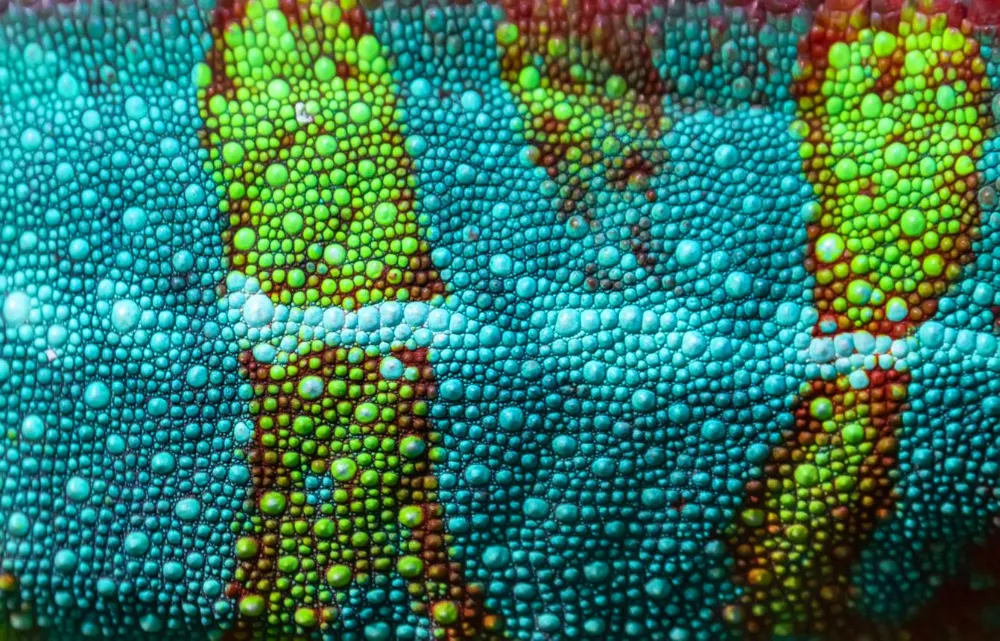
Visible chameleon coloration results from interactions between structural reflection and pigments within the skin.
Why Do Chameleons Change Color When They Are Angry?
Chameleons can change color during defensive or competitive social interactions.
In some species, males display conspicuous bright colors when confronting rivals.
These colors may communicate information about motivation, aggression, or competitive ability.
A 2013 study of veiled chameleons examined how rapid color changes related to contests between males.
The researchers found that brighter stripe colors were associated with approaching an opponent.
Brighter head coloration was associated with winning contests.
The speed of head color change also predicted aspects of contest outcome.
However, the results were specific to the studied species and experimental circumstances.
They do not establish a universal color dictionary for all chameleons.
Why Do Male Chameleons Turn Bright Colors?
Bright coloration can function as a social signal.
Male chameleons may use vivid displays during encounters with rivals or potential mates.
These displays can make individuals more noticeable.
That may seem contradictory for animals commonly associated with camouflage.
However, a conspicuous signal can be useful when communication with another chameleon matters more than remaining hidden.
The signal can also be temporary.
An animal may display intense colors during an interaction and return to a less conspicuous appearance afterward.
The 2008 comparative study of dwarf chameleons found evidence that selection for social communication helped shape the evolution of striking color-changing abilities.
Do Female Chameleons Change Color?
Yes. Female chameleons can also change their coloration.
However, males and females may differ in their available colors, patterns, and behavioral displays.
Females in some species display distinctive colors during reproductive interactions.
They may also change color in response to stress or other environmental conditions.
The specific meaning of a pattern depends on the species and context.
It is incorrect to assume that only male chameleons can change color.
Nevertheless, some of the most spectacular displays occur in adult males of species such as the panther chameleon.
Do Chameleons Change Color to Attract Mates?
Yes. Color displays can play a role in courtship and mate choice.
A 2020 study published in the Journal of Experimental Biology investigated female mate choice in panther chameleons.
Researchers examined changes in the coloration of courting males, including wavelengths visible to humans and ultraviolet light.
The results indicated that female preferences were associated with particular aspects of male color change.
However, females did not simply select the male that appeared brightest in every body region.
Different measurements of saturation, brightness, and hue were associated with different responses.
This shows why color communication is more sophisticated than assigning one universal meaning to each shade.
Do Chameleons Change Color When They Are Scared?
Fear and stress can influence chameleon appearance.
Some individuals become darker, display stronger contrast, or show other species-specific patterns when disturbed.
However, a particular shade does not provide a reliable emotional diagnosis on its own.
Lighting, temperature, reproductive state, and ordinary individual variation also affect coloration.
The San Diego Zoo notes that color changes can occur in response to mood, environmental light, temperature, and humidity.
The safest interpretation comes from observing the animal's posture and surroundings together with its color.
What Does It Mean When a Chameleon Turns Black?
Darker coloration can have different causes.
In some species, darkening may occur during stress, defensive behavior, or exposure to cooler conditions.
Darker skin can alter the absorption of incoming solar radiation.
However, it is not scientifically accurate to state that every black chameleon is angry, sick, or cold.
The meaning depends on species, normal color variation, and environmental context.
Persistent changes in appearance, especially alongside abnormal behavior, should not be interpreted solely through a simplified color chart.
Why Do Chameleons Turn Green?
Green coloration is common among many chameleon species that live in vegetation.
It can help an individual remain inconspicuous among leaves and branches.
In some chameleons, green arises through interactions between structural blue reflection and yellow pigments.
The 2015 panther chameleon research demonstrated how changes in crystal spacing can shift the reflected component and therefore alter the resulting skin color.
However, the exact contribution of pigments and structures varies among species and body regions.
A chameleon does not need to actively imitate a particular leaf to possess effective green camouflage.
Why Do Chameleons Turn Yellow or Orange?
Bright yellow or orange displays often occur during heightened social activity in certain chameleon species.
In the studied male panther chameleons, shifts in structural reflection helped produce dramatic transitions from green toward yellow-orange appearances.
These changes were observed during excited states associated with social interactions.
However, yellow or orange does not always indicate aggression or mating.
Some individuals naturally possess these colors as part of their ordinary regional or species-specific patterns.
Meaning depends on what the animal is doing and how its appearance changes over time.
Why Do Chameleons Change Color With Temperature?
Temperature can influence the coloration of some chameleons.
Dark surfaces generally absorb more visible solar radiation than pale surfaces under comparable conditions.
Changes in coloration can therefore affect how much radiant energy reaches the animal's body.
However, the connection between skin color and body temperature depends on many factors.
These include sunlight intensity, infrared reflection, wind, surface properties, and behavioral thermoregulation.
The 2015 study also identified a deeper layer of iridophores that strongly reflected near-infrared radiation.
The researchers suggested that this structural feature may contribute to passive thermal protection.
However, direct physiological outcomes should not be inferred from optical reflectance measurements alone.
Do Chameleons Turn Darker When They Are Cold?
Some chameleons may display darker coloration under cooler conditions.
This can change the amount of solar energy absorbed.
However, not every species follows an identical dark-when-cold pattern.
Environmental temperature is only one influence among several.
Color changes associated with social interactions can also occur at the same time.
Researchers therefore need to examine temperature, light, behavior, and species identity to interpret a dark color state reliably.
How Fast Can Chameleons Change Color?
Some chameleons can produce noticeable color changes within seconds or minutes.
The timing depends on the species, type of change, and behavioral context.
Rapid shifts have been documented during male-male contests and other social interactions.
However, spectacular changes are not always instantaneous.
The 2013 study of veiled chameleons measured how the speed of color change related to contest behavior and outcomes.
Different body regions could change at different rates.
This suggests that color change is a dynamic physiological process rather than a single whole-body switch.
Can Chameleons Change Color While Sleeping?
A chameleon's coloration may differ between resting, active, and sleeping states.
However, the precise pattern depends on the species and environmental conditions.
Sleep-related changes should not be interpreted as deliberate background matching.
Many physiological processes continue without conscious control.
Light levels, temperature, and changes in normal activity may all influence the appearance of an animal at rest.
There is no universal nighttime color that applies to every chameleon species.
Do Baby Chameleons Change Color?
Young chameleons can display color variation, but their abilities often differ from those of mature adults.
In some species, adult males develop especially elaborate patterns as they reach sexual maturity.
Juveniles may show a more limited range.
Individual development, sex, species, and health can affect appearance.
The ability to produce certain adult social displays should not be assumed to be fully developed in every newly hatched chameleon.
Can All Chameleon Species Change Color?
Chameleons vary greatly in the range and intensity of their color changes.
Some are capable of vivid shifts involving blue, green, yellow, orange, and red.
Others mainly vary in brightness or between relatively subdued shades.
The panther chameleon is a particularly colorful example, but it does not represent every species in the family Chamaeleonidae.
Smaller and less brightly colored chameleons may rely more on subtle pattern or brightness changes.
Therefore, the correct statement is that color-changing capacity varies among chameleon species rather than being equally dramatic in all of them.
Which Chameleon Changes Color the Most?
The panther chameleon is among the best-known species for dramatic visible color changes.
Adult males can display combinations of blue, green, red, yellow, and orange.
However, ranking all chameleons by the amount of color change is difficult.
Scientists can measure hue, brightness, saturation, contrast, speed, and the number of visually distinguishable states.
These are different properties.
A species that changes quickly is not necessarily the one with the widest range of colors.
For this reason, there is no simple universal ranking of the most color-changing chameleon without specifying the measurement used.
Do Chameleons Have Special Color Vision?
Chameleons use vision during hunting and social interactions.
Their eyes can move relatively independently, providing wide visual coverage of the surroundings.
They can also coordinate both eyes when focusing on a target.
Color vision is important for interpreting the appearance of other chameleons.
Studies of social color signals have used models of chameleon visual perception rather than relying only on what human observers see.
This matters because the visual appearance of a signal to a chameleon may differ from its appearance to a person.
Can Chameleons See Ultraviolet Color?
Research on chameleon communication has examined ultraviolet components of skin reflectance.
Ultraviolet wavelengths lie outside the normal human visible range.
The 2020 panther chameleon mate-choice study investigated both human-visible and ultraviolet color changes in male displays.
It found relationships between certain ultraviolet signal properties and female preferences.
This demonstrates that an interpretation based only on human-visible colors may miss relevant information.
However, detailed visual sensitivity should not be assumed identical across all chameleon species.
Do Chameleons Change Color to Hide From Predators?
Some chameleon coloration contributes to camouflage.
Patterns and colors that resemble natural vegetation can make animals less conspicuous.
However, dramatic color changes are not necessarily selected primarily for predator avoidance.
The 2008 study of dwarf chameleons found that the most conspicuous displays were strongly associated with social communication rather than camouflage.
This does not mean predator avoidance is unimportant.
It means the evolutionary importance of color change must be evaluated within each species and behavioral system.
How Is Chameleon Color Change Different From Octopus Camouflage?
Chameleons and octopuses can both change their appearance, but their skin systems differ.
Octopuses possess complex chromatophore organs controlled by muscles and the nervous system.
These can rapidly expand or contract visible pigment areas.
Octopuses also have structures that contribute to reflectance and changes in skin texture.
In the studied panther chameleons, rapid hue changes are strongly associated with the adjustment of guanine crystal lattices in iridophore cells.
Although both animals produce visually impressive results, they do not rely on precisely the same mechanisms.
Chameleons vs. Other Color-Changing Animals
| Animal | Important Color Mechanism | Common Biological Context |
|---|---|---|
| Panther chameleon | Tunable guanine nanocrystals and pigments | Social signaling, environmental responses |
| Octopus | Neuromuscular chromatophores and reflective structures | Camouflage, communication |
| Cuttlefish | Chromatophores and reflective skin structures | Camouflage, signaling |
| Some fish | Pigment cells and structural reflectors | Communication, camouflage, physiological adjustment |
| Some amphibians | Changes in pigment distribution and other skin properties | Camouflage, environment, physiology |
These are broad examples; mechanisms and functions vary considerably among species.
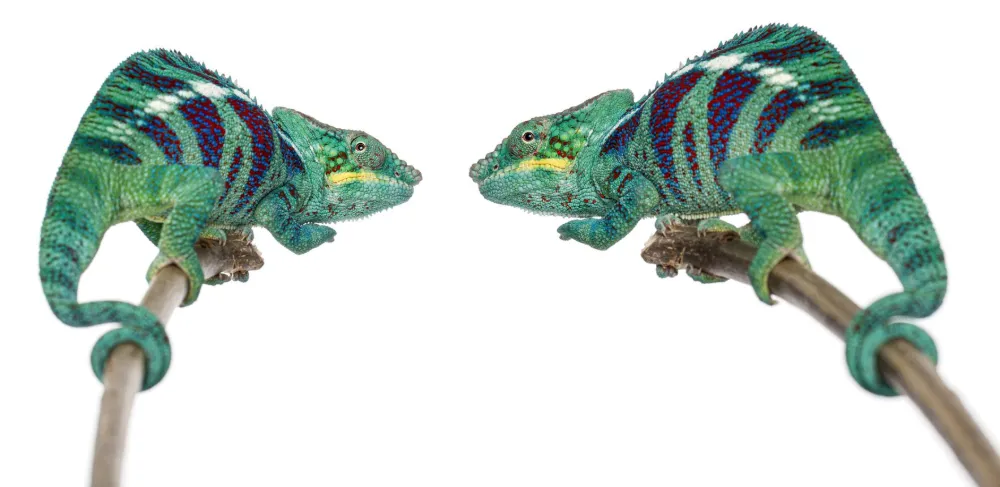
Color changes in adult male chameleons can communicate important information during territorial interactions.
How Do Scientists Study Chameleon Color Change?
Researchers combine behavioral observation with measurements of skin reflectance and anatomy.
High-resolution photography can document changes during social interactions.
Spectrometry measures the wavelengths of light reflected from different body regions.
Microscopy reveals the structure of specialized skin cells.
Optical modeling helps researchers test how microscopic arrangements can produce visible colors.
In the 2015 panther chameleon study, scientists used these methods together.
They also manipulated skin samples to investigate how changing crystal spacing affected optical properties.
Such experiments provide stronger evidence than simply observing that an animal turns a different color.
Why Is Chameleon Color Change Important to Evolutionary Biology?
Chameleon color change provides an example of how physical structures and behavior evolve together.
A skin adaptation can affect how an animal appears to predators or other members of its species.
Social interactions can then influence which visual signals are advantageous.
The 2008 comparative research found evidence that conspicuous social displays helped drive the evolution of color change among studied dwarf chameleons.
Other research has shown that optical properties of the skin can be modified through nanoscale structural changes.
Together, these findings connect evolution, animal communication, physiology, and the physics of light.
Frequently Asked Questions
Why do chameleons change color?
Chameleons change color mainly for communication and in response to environmental and physiological conditions. Camouflage is also important in some contexts.
Do chameleons change color to camouflage?
Sometimes, but dramatic color changes often play an important role in social communication rather than simple background matching.
How do chameleons change color?
In species such as the panther chameleon, specialized skin cells can change the spacing of guanine nanocrystals, altering reflected light. Pigments also contribute.
Can chameleons turn any color?
No. Each species has a biologically limited range of colors and patterns.
Why do chameleons turn black?
Darkening can occur in different physiological and behavioral contexts, including stress or environmental responses. It has no single universal meaning.
Why do chameleons turn bright colors?
Bright displays often occur during courtship or competition, especially among adult males of colorful species.
Do female chameleons change color?
Yes. Females can change color, although their patterns and available color range may differ from those of males.
Do chameleons change color to attract mates?
Yes. Studies of panther chameleons have found that particular male color-change characteristics influence female mate choice.
How fast do chameleons change color?
Some changes become visible within seconds or minutes, depending on species, body region, and context.
Do chameleons turn darker when cold?
Some may darken under cooler conditions, but temperature responses vary among species and are influenced by other factors.
What are iridophores?
Iridophores are specialized cells containing reflective structures. In panther chameleons, tunable guanine crystal arrays are important for rapid visible color shifts.
Can baby chameleons change color?
Young chameleons may show color variation, although their range and intensity can change as they mature.
Do chameleons change color while sleeping?
Their appearance may differ during rest or sleep, but there is no single sleeping color shared by all chameleons.
Are chameleons the only animals that change color?
No. Octopuses, cuttlefish, some fishes, amphibians, and other animals also change coloration through different mechanisms.
The Bottom Line
Chameleons do not change color simply to imitate whatever surface surrounds them.
Their coloration serves several purposes, including communication, courtship, competition, camouflage, and environmental responses.
Research on panther chameleons has shown that tiny guanine crystals within specialized skin cells can change their spacing, altering the wavelengths of light reflected by the skin.
Other pigments and skin structures contribute to the final appearance.
These changes are biologically limited and vary among species.
Understanding chameleon color change therefore requires both animal behavior and the physics of light.
Sources & Further Reading
Teyssier et al. (2015) — Photonic Crystals Cause Active Colour Change in Chameleons. Nature Communications. Primary evidence for guanine nanocrystal lattice changes in panther chameleon skin.
University of Geneva — The Chameleon Reorganizes Its Nanocrystals to Change Colors. University explanation of the 2015 study and its optical mechanisms.
Stuart-Fox and Moussalli (2008) — Selection for Social Signalling Drives the Evolution of Chameleon Colour Change. PLOS Biology. Comparative evidence emphasizing social signaling in dwarf chameleons.
Chameleons Communicate with Complex Colour Changes During Contests: Different Body Regions Convey Different Information (2013). Study linking display coloration and speed with male competition.
The Colour of Success: Does Female Mate Choice Rely on Male Colour Change in the Chameleon Furcifer pardalis? (2020). Research on female responses to male visible and ultraviolet color displays.
San Diego Zoo — Chameleon. Reference on species diversity, color limits, communication, and anatomy.
Smithsonian's National Zoo — Meller's Chameleon. Example of coloration, camouflage, and communication in another chameleon species.