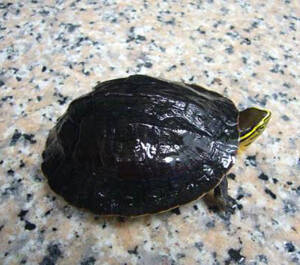
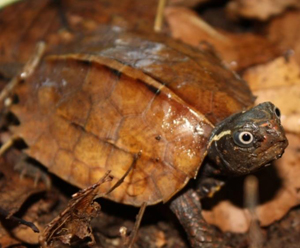
Krefft’s Turtle (Emydura krefftii), sometimes called Krefft’s River Turtle or Krefft’s Short-necked Turtle, is a medium-sized freshwater side-necked turtle in the family Chelidae and the genus Emydura. It is native to rivers, streams and impoundments in north-eastern Australia, where it is a familiar inhabitant of creeks, floodplain wetlands and farm dams. Like other side-necked turtles, it cannot retract its head straight back into the shell; instead, it bends the neck sideways beneath the front edge of the shell when threatened.
Taxonomy and naming
Krefft’s Turtle belongs to Class Reptilia, Order Testudines, Family Chelidae and Genus Emydura. Species in Emydura are short- to medium-necked freshwater turtles found across Australia and New Guinea. The scientific and common names honour Gerard Krefft, a 19th-century German-Australian naturalist who made significant contributions to the study of Australian reptiles and fishes. Some authors have treated Krefft’s Turtle as a regional form or subspecies of the Murray River Turtle (Emydura macquarii), but in practice it is widely referred to by the common name “Krefft’s Turtle” in its own right.
Physical characteristics
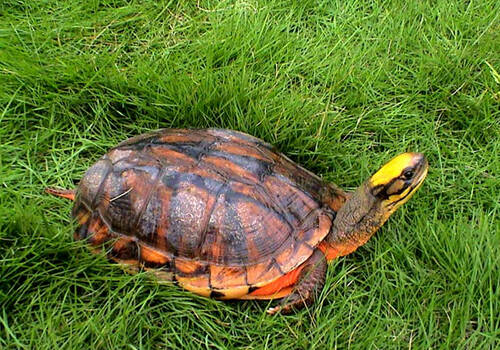
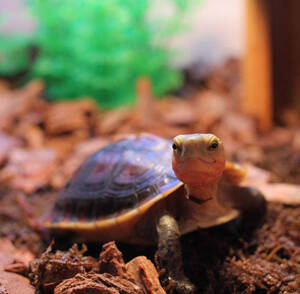
Krefft’s Turtle is a medium-sized turtle with an oval carapace that appears smooth and rounded when viewed from above. The shell is usually olive-brown, grey-brown or dark brown, sometimes slightly raised along the centre. The plastron is pale yellow or cream and may bear darker blotches or irregular markings. The head is broad and somewhat flattened, with a blunt snout; pale stripes or patches are often visible on the sides of the face, and some individuals show orange or reddish markings on the neck and chin. The neck is of moderate length but shorter than that of typical long-necked turtles. The limbs are strong, with well-developed webs between the toes to aid swimming and manoeuvring in water.
Distribution and habitat
Krefft’s Turtle is native to north-eastern Queensland and neighbouring regions of Australia, where it inhabits coastal river systems, tributaries, floodplain channels, wetlands and artificial water bodies such as farm dams and reservoirs. It favours slow to moderately flowing waters with muddy or sandy bottoms, submerged logs, snags and abundant aquatic vegetation. Turtles can be seen swimming in the water column, resting on the bottom or basking on logs and banks exposed to sunlight. Seasonal changes in rainfall and river levels influence the availability of feeding and nesting sites across floodplains and backwaters.
Behaviour and lifestyle
This species is predominantly aquatic, spending most of its time in the water. Individuals often bask on logs, rocks or the banks during sunny periods, then slip back into the water when disturbed. When threatened, Krefft’s Turtles dive quickly and seek shelter under logs, in root tangles or within undercut banks. As a side-necked turtle, it folds the head sideways beneath the front edge of the shell rather than pulling it straight back. The species is generally shy and non-aggressive toward humans, though it may deliver a defensive bite if handled or restrained.
Diet
Krefft’s Turtle is omnivorous, with a diet that includes aquatic invertebrates (such as insect larvae, aquatic beetles, snails and crustaceans), small fish, tadpoles and carrion, as well as plant material such as aquatic vegetation, algae and fallen fruits or seeds. It forages both in the water column and along the bottom, using sight and smell to detect prey. By feeding on a mixture of animal and plant matter and occasionally scavenging carcasses, it helps recycle nutrients and contributes to the ecological functioning of freshwater systems.
Reproduction and life cycle
Krefft’s Turtle is oviparous. Breeding and nesting are influenced by regional climate and water-level patterns, typically occurring during warmer parts of the year. Females leave the water to search for suitable nesting sites in sandy or soft soils along riverbanks, floodplains or near wetlands. Using their hind limbs, they dig flask-shaped nest chambers and lay clutches of around a dozen or more eggs, depending on body size and condition. After covering the nest with soil, the female returns to the water, leaving the eggs to incubate under natural temperature and moisture conditions. After several weeks to a few months, depending on local climate, hatchlings emerge and make their way to water. Juveniles suffer high mortality from predators, desiccation and habitat disturbance, and only a small proportion survive to adulthood. Growth is moderate, with several years required to reach sexual maturity; adults may live for many decades in the wild.
Relationship with humans
In parts of Australia, Krefft’s Turtle is a familiar component of local freshwater fauna and is often encountered by anglers and landholders. It may occasionally take bait or become entangled in fishing gear, but it is not considered a major nuisance species. Because of their appealing appearance and generally calm behaviour, these turtles have attracted interest in the aquarium and pet trade, yet in Australia native reptiles are usually protected and may only be kept under licence. Internationally, translocation and trade in native turtles raise concerns about invasive species and disease spread, making Krefft’s Turtle more appropriate for display in licensed zoos and public aquaria rather than private collections.
Conservation status and threats
Overall, Krefft’s Turtle is generally regarded as a species of Least Concern or relatively low conservation concern at a broad scale, although detailed assessments vary between regions. Local populations may nevertheless be affected by river regulation, dam construction and water extraction, which alter flow regimes and reduce access to floodplain habitats; by water pollution from agriculture and urban runoff; by entanglement in fishing gear; and by nest predation from introduced predators such as foxes, dogs and cats. Effective conservation measures include maintaining natural river and floodplain structure where possible, improving water quality, protecting key nesting areas from heavy machinery and trampling, and raising public awareness about the ecological value and legal protection of native freshwater turtles.
References
Cann, J. 1998. Australian Freshwater Turtles. Beaumont Publishing. Singapore.
Cogger, H. G. 2000. Reptiles and Amphibians of Australia. Reed New Holland, Sydney
Ehmann, H. 1992. Encyclopaedia of Australian Animals: Reptiles. Angus & Robertson. Pymble.
Greer, A. E. 2006. Encyclopedia of Australian Reptiles : Chelidae. Australian Museum