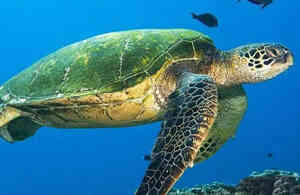
The Green Turtle (Chelonia mydas) is one of the largest and most widespread sea turtles on Earth. Belonging to the family Cheloniidae and the genus Chelonia, it inhabits tropical and subtropical coastal waters, coral reefs and seagrass meadows in the Atlantic, Indian and Pacific Oceans. Despite its name, the shell is not always bright green; instead, the species is named for the greenish colour of its body fat. As a mainly herbivorous sea turtle in adulthood, the Green Turtle plays a key ecological role in maintaining healthy seagrass beds and nearshore marine ecosystems.
Taxonomy and naming
The Green Turtle is classified within Class Reptilia, Order Testudines, Family Cheloniidae and Genus Chelonia. The generic name “Chelonia” refers broadly to turtles, while the specific name mydas is associated with aquatic environments. The common English names Green Turtle or Green Sea Turtle derive from the greenish hue of the turtle’s body fat rather than the colour of the shell itself. As one of the best-known marine turtles, this species is often used as a flagship for ocean conservation and endangered species campaigns.
Physical characteristics
Green Turtles have large, oval-shaped carapaces that are relatively smooth compared with some other sea turtles. The shell is usually olive, brown or brownish-green, marked with marbled or blotched patterns, while the plastron (underside) is pale yellow or cream. The head is relatively small for the body size, and the beak is strong but not sharply hooked, reflecting a diet dominated by seagrasses and algae rather than hard-shelled prey. The forelimbs are powerful, paddle-like flippers designed for efficient swimming over long distances, and the hind limbs are shorter and used mainly for steering and for digging nests on beaches. Like other sea turtles, Green Turtles cannot retract their head and limbs into the shell.
Distribution and habitat
Green Turtles occur in warm coastal waters around the world, including much of the tropical and subtropical Atlantic, Indian and Pacific Oceans. Adults are strongly associated with shallow coastal habitats such as seagrass meadows, coral reefs, lagoons and sheltered bays, where food is abundant. Nesting usually takes place on remote sandy beaches and islands with relatively undisturbed shorelines. Young hatchlings begin life at sea, spending their early years drifting in open-ocean currents and floating zones. As they grow, juveniles gradually recruit to coastal feeding grounds, often many hundreds or thousands of kilometres away from their natal beaches.
Behaviour and lifestyle
Green Turtles spend almost their entire lives in the ocean, surfacing periodically to breathe. They are strong swimmers and undertake long-distance migrations between feeding grounds and nesting beaches. Adults are mostly herbivorous and spend much of the day grazing on seagrasses and algae in shallow water. Dive durations typically range from a few minutes during active foraging to much longer periods while resting on the seabed or under reef ledges. The species shows remarkable navigational abilities and natal homing: mature females often return to the same region, and sometimes the same beach, where they hatched in order to nest.
Diet
The diet of Green Turtles changes with age. Hatchlings and small juveniles are more omnivorous, feeding on a mix of small invertebrates such as crustaceans, jellyfish and other soft-bodied animals as well as plant material. As they mature, Green Turtles become predominantly herbivorous, cropping seagrasses and feeding on a variety of marine algae. This grazing behaviour helps maintain healthy, productive seagrass beds by stimulating new growth and preventing excessive build-up of older leaves, with important consequences for biodiversity, nutrient cycling and carbon storage in coastal ecosystems.
Reproduction and life cycle
Green Turtles are oviparous, with reproduction strongly linked to seasonal and regional environmental cycles. During the breeding season, adults migrate from foraging grounds to nesting areas, often travelling hundreds or thousands of kilometres. Females come ashore at night on sandy beaches, usually above the high-tide line, where they use their hind flippers to dig a flask-shaped nest chamber. Each clutch contains several dozen round, white eggs, and a female may lay multiple clutches in a single season, separated by intervals of several weeks. After laying, the female covers the nest with sand and returns to the sea, leaving the eggs to incubate for roughly 6–8 weeks depending on temperature. When ready to hatch, the young turtles dig their way to the surface and, typically under cover of darkness, scramble down the beach to the ocean. Mortality at this stage is extremely high, as hatchlings are vulnerable to birds, crabs, fish and other predators. Only a small fraction survive to adulthood, with sexual maturity reached after 20–30 years.
Relationship with humans
Humans have exploited Green Turtles for centuries for their meat, eggs, skin and oil. Historically, large numbers were harvested for food and for making turtle soup and other products. Today, many countries protect Green Turtles by banning or strictly regulating hunting and trade, recognising their ecological importance and threatened status. At the same time, Green Turtles have become major attractions for snorkelling, diving and wildlife tourism, bringing economic benefits to coastal communities. However, human activities also threaten the species through coastal development on nesting beaches, disturbance from artificial lighting, entanglement in fishing gear, boat strikes and ingestion of marine debris such as plastic bags mistaken for jellyfish.
Conservation status and threats
Globally, the Green Turtle is listed as Endangered on the IUCN Red List, though the status of individual regional populations can range from improving to severely depleted. Key threats include illegal and unsustainable harvest of turtles and eggs, loss and degradation of nesting beaches due to coastal development and erosion, light pollution that disorients nesting females and hatchlings, accidental capture in fishing gear (bycatch), drowning in entangling nets, boat collisions and the ingestion of plastic and other marine debris. Climate change adds further pressures by altering sea temperature, sea levels and storm patterns and by affecting the sand temperatures that influence hatchling sex ratios. Effective conservation requires protecting key nesting beaches and feeding grounds, implementing turtle-friendly fishing gear and practices, reducing marine pollution, managing coastal lighting, strengthening international agreements and engaging local communities in long-term conservation and monitoring.