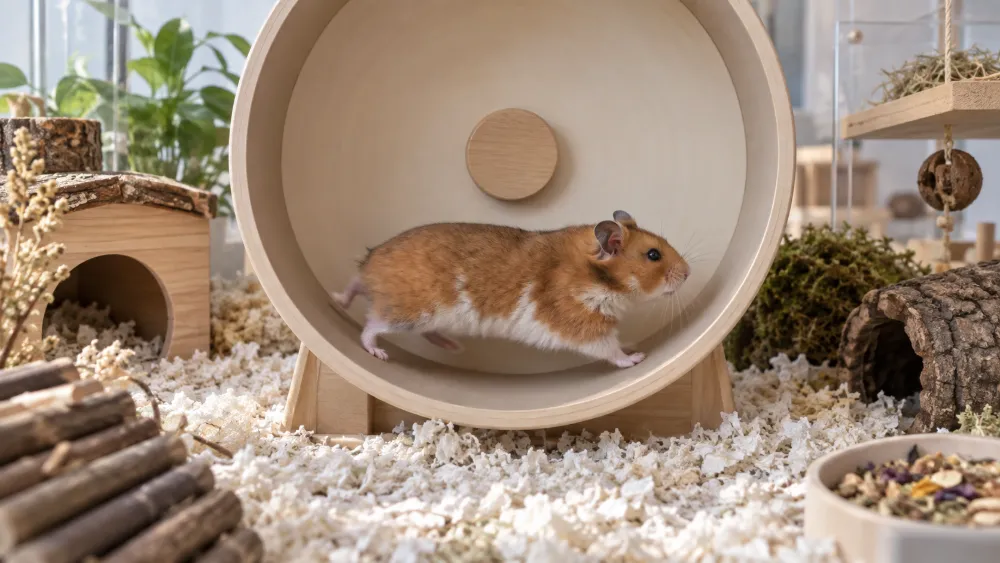
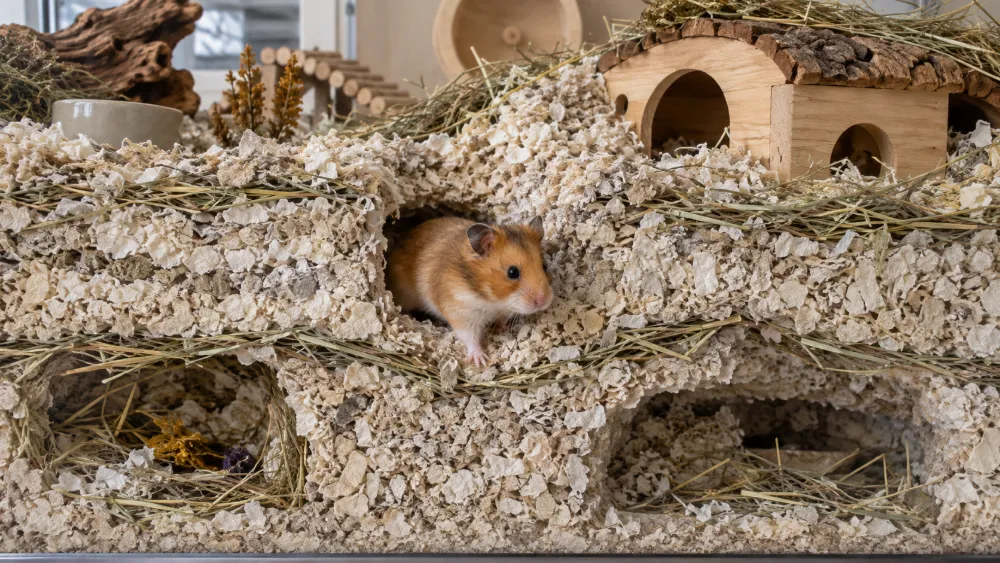
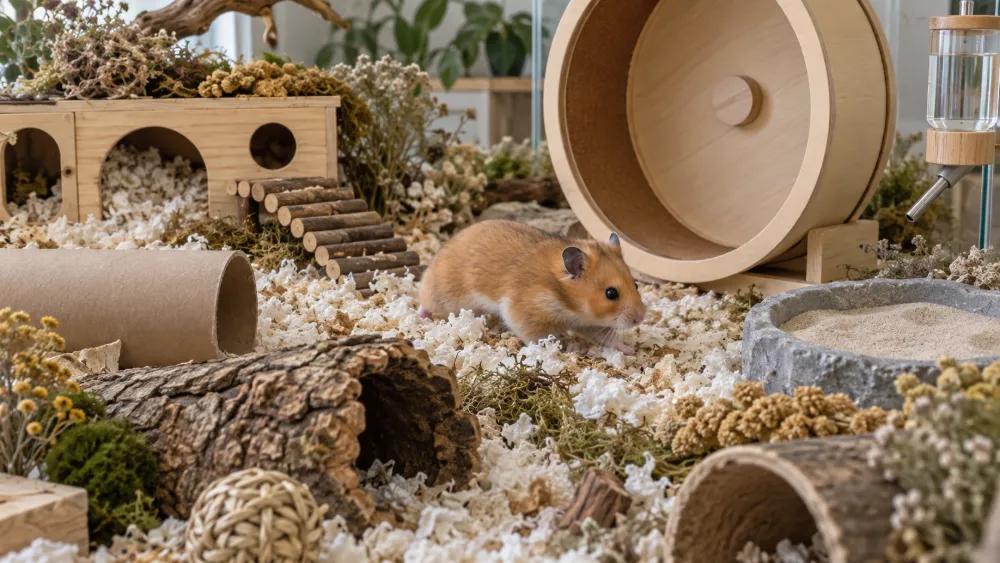
A good hamster cage should provide about 100 × 50 cm of horizontal floor space or more, with enough height for deep bedding, a correctly sized upright wheel, hides and enrichment. Current welfare guidance from organizations such as Blue Cross, PDSA and Woodgreen treats 100 × 50 cm as an important minimum benchmark rather than an ideal maximum. Syrian hamsters generally need around 50 cm of enclosure height, while some dwarf hamster setups can work at about 40 cm high if there is still room for deep bedding and safe equipment.
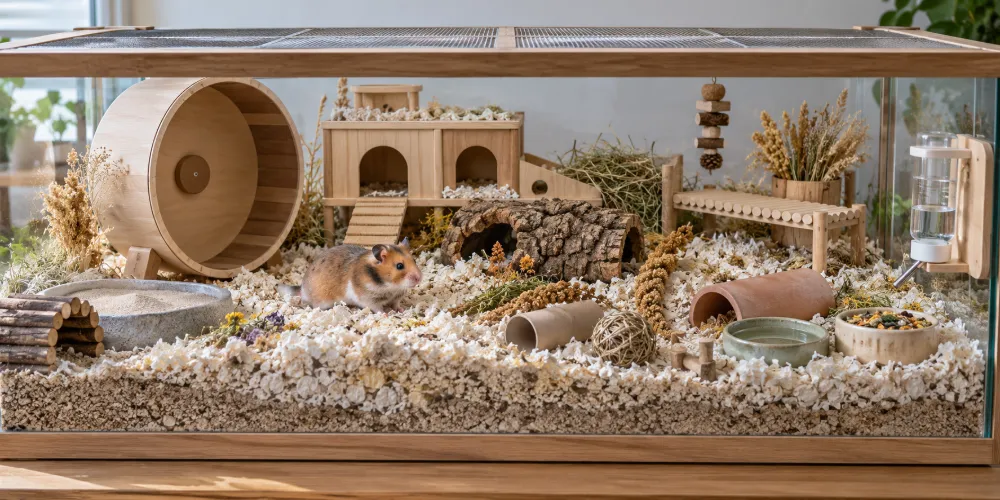
A hamster enclosure needs horizontal space for roaming plus enough depth for bedding, burrowing, a large wheel and several enrichment areas.
Hamster Cage Size at a Glance
| Hamster Type | Useful Minimum Benchmark | Height | Bar Spacing |
|---|---|---|---|
| Syrian hamster | About 100 × 50 cm floor area | About 50 cm or more | About 1 cm maximum |
| Chinese hamster | About 100 × 50 cm floor area | About 50 cm | Approximately 1 cm or less |
| Campbell's dwarf hamster | About 100 × 50 cm floor area | About 40 cm or more | Approximately 7 mm is safer |
| Winter white hamster | About 100 × 50 cm floor area | About 40 cm or more | Approximately 7 mm is safer |
| Roborovski hamster | About 100 × 50 cm floor area | About 40 cm or more | Approximately 7 mm is safer |
These numbers should be treated as a starting point.
Bigger is generally better when the extra space is arranged properly with bedding, hides, digging areas and enrichment rather than left as a large empty box.
Is 100 × 50 cm Really Necessary for a Hamster?
Hamsters have traditionally been sold with surprisingly small cages because their bodies are small.
Body size, however, is a poor way to estimate how much living space a hamster needs.
Hamsters are active animals that naturally:
travel while searching for food;
construct underground burrows;
maintain food stores;
use separate areas for sleeping and toileting;
run for extended periods;
explore changing scents and objects.
A tiny cage may physically contain a hamster while giving it very little opportunity to perform these behaviors.
Blue Cross currently recommends housing no smaller than approximately 100 × 50 cm of floor space and about 50 cm tall.
PDSA also refers to 100 × 50 cm as a minimum benchmark and emphasizes that larger single-level enclosures are preferable to small tall cages.
Woodgreen recommends the same 100 × 50 cm footprint for the common pet hamster species.
Floor Space Matters More Than Extra Levels
A hamster cage with several small shelves is not automatically better than a large single-level enclosure.
The most useful dimension is usually unbroken horizontal floor space.
A larger base allows room for:
deep bedding;
a full-sized wheel;
a large hide;
a sand bath;
tunnels;
foraging zones;
multiple textures;
open exploration.
Hamsters also have relatively poor eyesight and are not naturally adapted to living in tall, exposed multi-level cages.
Platforms can still be useful for supporting heavy items, but height should not be used as a substitute for adequate floor area.
How Big Should a Syrian Hamster Cage Be?
A Syrian hamster enclosure should provide at least about 100 × 50 cm of floor space, with approximately 50 cm of height or more.
Syrian hamsters are the largest common pet hamster, so their equipment also takes up substantial space.
A proper Syrian setup needs enough room for:
deep bedding;
a wheel around 27–32 cm;
a multi-chamber hide;
a sand bath;
tunnels;
foraging material;
water;
additional enrichment.
Once all of those objects are placed inside a small cage, very little usable space remains.
Do Female Syrian Hamsters Need More Space?
Some female Syrian hamsters are exceptionally active.
Woodgreen specifically notes that females may need a larger enclosure to remain comfortably occupied.
If a hamster repeatedly:
climbs cage bars;
paces;
tries constantly to escape;
chews enclosure edges;
appears restless despite enrichment;
review the entire setup rather than assuming the behavior is simply part of the hamster's personality.
More space, deeper bedding and better enrichment may help.
How Big Should a Dwarf Hamster Cage Be?
Dwarf hamsters are much smaller than Syrians, but they still benefit from generous floor space.
Woodgreen recommends approximately 100 × 50 cm for dwarf and Roborovski hamsters, with at least about 40 cm of height.
A dwarf hamster enclosure still needs space for:
deep burrowing substrate;
a species-appropriate wheel;
hides;
sand;
foraging;
tunnels;
water.
Do not assume a dwarf hamster needs only half the cage because it weighs much less than a Syrian.
Roborovski Hamster Cage Size
Roborovski hamsters are extremely small but very fast and active.
A generous horizontal enclosure is particularly useful because it provides room for running, foraging and a substantial sand area.
Approximately 100 × 50 cm remains a useful minimum benchmark.
Because Roborovskis are so small, security becomes especially important.
Check:
bar spacing;
mesh openings;
lid gaps;
cable holes;
door gaps.
A gap that looks impossibly small to a person may still become an escape route.
What Bar Spacing Is Safe for Hamsters?
Bar spacing depends on the hamster species and body size.
Woodgreen currently recommends approximately:
| Hamster | Bar Spacing |
|---|---|
| Syrian | About 1 cm maximum |
| Chinese | About 1 cm maximum |
| Dwarf hamsters | About 7 mm is safer |
| Roborovski | About 7 mm is safer |
Blue Cross similarly advises keeping mesh or bar gaps below about 1 cm.
If you are unsure whether a very small hamster can fit through the bars, a securely ventilated tank-style enclosure can remove much of the escape risk.
Tank vs Barred Cage: Which Is Better?
Both can work when designed correctly.
| Feature | Tank-Style Enclosure | Barred Cage |
|---|---|---|
| Deep bedding | Excellent | Depends on base depth |
| Escape prevention | Very good with secure lid | Depends on bar spacing |
| Ventilation | Requires large mesh top | Usually excellent |
| Bedding scatter | Well contained | Can fall through bars |
| Access | Usually from above | Door access varies |
| Burrowing depth | Easy to provide | Can be difficult in shallow bases |
Blue Cross specifically notes that tank or aquarium-style housing can work well because it accommodates deep bedding and prevents escapes through bars.
A tank must still have a secure mesh lid providing good ventilation.
Is an Aquarium Safe for a Hamster?
Yes, a suitably sized aquarium or tank can make an excellent hamster enclosure when ventilation is adequate.
Use:
a large footprint;
a secure mesh lid;
substantial ventilation across the top;
deep bedding;
safe heavy-item supports.
A solid glass lid should not seal the enclosure.
The habitat needs continuous air exchange.
Are Plastic Hamster Cages Good?
Plastic itself does not automatically make an enclosure good or bad.
The real questions are:
Is it large enough?
Can it hold deep bedding?
Does it have adequate ventilation?
Can it fit the correct wheel?
Is it escape-proof?
Can accessories be arranged safely?
Many traditional plastic hamster cages fail because their floor area is very small and most of their apparent size comes from narrow tubes and towers.
Are Tube Cages Good for Hamsters?
Complex external tube systems are generally a poor replacement for usable cage space.
Blue Cross advises avoiding elaborate tube systems because:
ventilation can be limited;
tubes may be too narrow for Syrian hamsters;
dwarf hamsters can struggle with steep climbs;
cleaning can be difficult.
A short, wide tunnel used as enrichment is different from making narrow plastic tubes the main living environment.
Can You Use a Bin Cage for a Hamster?
A large modified storage container can potentially function as an enclosure if it genuinely meets the same welfare requirements as any other hamster home.
That means it needs:
adequate floor area;
extensive secure ventilation;
enough height for deep bedding and a wheel;
a secure lid;
no sharp cut edges;
no accessible plastic edges that can easily be chewed into an escape hole.
The fact that a container is inexpensive does not make a small or poorly ventilated setup acceptable.
How Deep Should Hamster Bedding Be?
Cage dimensions are only useful if the enclosure can also support deep bedding.
Blue Cross recommends at least around 20 cm of digging substrate.
PDSA recommends no less than approximately 25 cm.
Woodgreen recommends at least around 15 cm across much of the enclosure plus a deeper zone of roughly 25–30 cm.
A practical modern setup therefore aims for a substantial section containing approximately 20–30 cm or more of stable bedding.
See the dedicated guide: Best Hamster Bedding: Safe Materials, Depth & What to Avoid.
Why Deep Bedding Needs Cage Height
Suppose you provide 25 cm of bedding but buy a cage only slightly taller than that.
There may no longer be enough vertical clearance for:
the wheel;
platforms;
hides;
water equipment;
safe ventilation.
This is why enclosure height should be considered together with bedding depth and wheel diameter.
A large Syrian wheel alone may be around 30 cm in diameter.
Where Should the Hamster Wheel Go?
A heavy wheel should not sit loosely on top of deep burrowing substrate.
As the hamster digs, bedding can shift and the wheel may:
tilt;
sink;
stop rotating;
collapse part of a burrow.
Place the wheel on a stable platform or solid support that transfers its weight safely.
For species-specific dimensions, see Hamster Wheel Size: Syrian, Dwarf, Roborovski & Chinese Hamsters.
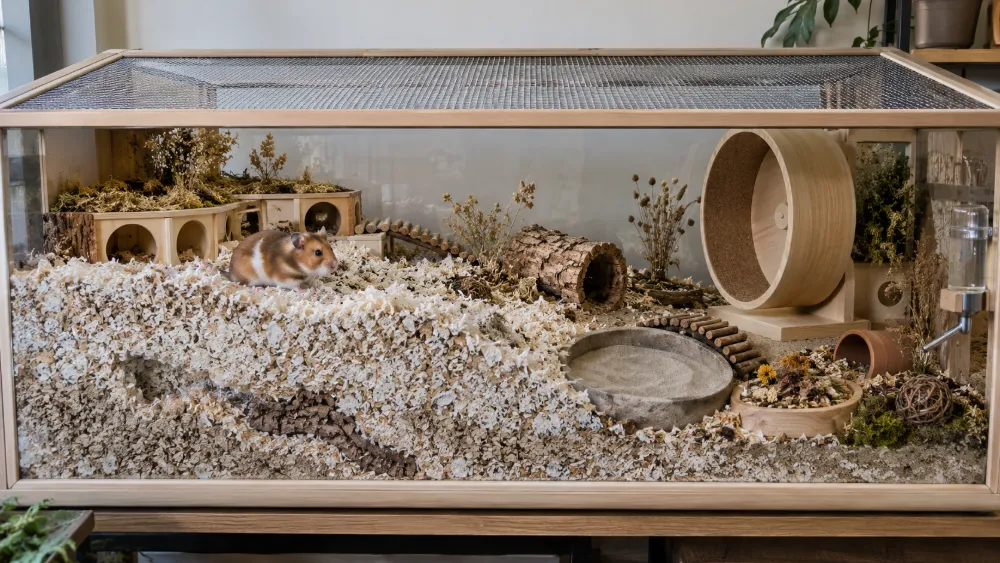
Heavy objects such as wheels, sand baths and large hides should be positioned securely so that burrowing underneath them does not create a collapse hazard.
What Should Be Inside a Hamster Cage?
A good enclosure normally contains:
deep bedding;
a correctly sized wheel;
a multi-chamber hide;
additional hiding places;
a sand bath;
tunnels;
chew-safe material;
foraging enrichment;
food;
fresh water.
Not every object must be expensive.
Cardboard boxes and tubes can provide useful tunnels, hides and chewable enrichment when they are clean and safe.
Do Hamsters Need a Multi-Chamber Hide?
A multi-chamber hide can imitate some features of an underground burrow system.
Hamsters may use separate chambers for:
sleeping;
food storage;
nesting;
toileting.
It is not the only acceptable hide, but it can be a useful addition to a large enclosure.
Ideally it should be stable and positioned so that it cannot collapse into tunnels.
Does a Hamster Need a Sand Bath?
A sand bath provides another digging and grooming area.
Choose suitable hamster sand rather than fine dusty powder.
Dust can irritate the respiratory tract.
The container should be stable enough that burrowing underneath it does not make it tip over.
Do Hamsters Need Climbing Toys?
Hamsters can climb, but their enclosure should not be designed like a tall climbing cage.
They have relatively poor depth perception and can be injured by falls.
Low-level climbing opportunities can still provide enrichment.
Use:
low cork logs;
bridges;
low platforms;
branches positioned close to bedding.
A fall should land on deep soft substrate rather than a hard floor.
Should a Hamster Cage Have a Wire Floor?
No.
The floor should be solid.
RSPCA advises against wire mesh floors because they can contribute to foot problems and prevent the enclosure from holding the deep substrate hamsters need for digging.
Wire or mesh is much more appropriate for secure ventilation than for the walking surface.
Where Should You Put a Hamster Cage?
Place the enclosure indoors in a stable, quiet location.
Avoid:
direct sunlight;
windows with strong temperature changes;
draughts;
radiators;
heating vents;
constant loud television or music;
areas where cats or dogs can harass the hamster.
Woodgreen also notes that a bedroom can be inconvenient because hamsters are especially active during the night.
Should a Hamster Cage Be on the Floor?
A stable raised surface is often more practical.
It can:
reduce draught exposure;
make maintenance easier;
help protect the enclosure from other pets;
reduce vibration from foot traffic.
The stand must support the full weight of the enclosure, bedding, sand and accessories.
Large glass tanks can become surprisingly heavy.
Does a Hamster Cage Need a Lid?
Yes, most setups need a secure lid.
Hamsters are capable climbers and persistent escape artists.
A good lid should:
lock or fit securely;
provide generous ventilation;
have safe mesh spacing;
prevent cats or other pets from entering.
Do not assume high glass walls alone make an enclosure escape-proof.
How Should a Hamster Cage Be Ventilated?
A barred enclosure naturally provides substantial airflow.
Tank-style enclosures generally rely on a large mesh top.
Ventilation should not be reduced to a handful of tiny holes in an otherwise sealed container.
At the same time, avoid placing the cage directly in a cold draught.
Good ventilation and draught exposure are not the same thing.
Can Two Hamsters Share a 100 × 50 cm Cage?
Syrian hamsters should not share an enclosure.
Chinese hamsters are also generally housed alone.
Dwarf hamster social housing is more complicated, and welfare organizations note that even apparently compatible dwarf hamsters can later fight.
Do not interpret a large cage as permission to house two Syrian hamsters together.
A single hamster can use the full enclosure.
Is Bigger Always Better?
More usable space is generally beneficial, but the design still matters.
An enormous empty enclosure is not automatically better than a somewhat smaller but highly enriched one.
The ideal combination is:
generous floor area + deep bedding + appropriate equipment + enrichment.
If you upgrade cage size, also provide enough hides and cover so the hamster does not feel exposed in a huge open space.
Signs a Hamster Cage May Be Too Small or Poorly Set Up
No single behavior proves that cage size is the cause, but persistent repetitive behavior deserves attention.
Possible warning signs include:
repeated bar climbing;
constant bar chewing;
persistent attempts to escape;
repetitive pacing;
difficulty fitting equipment without overcrowding;
inability to provide deep bedding;
a wheel that is too small because a proper one will not fit.
If the cage cannot physically accommodate the hamster's basic equipment, it is a strong indication that the enclosure needs upgrading.
Common Hamster Cage Mistakes
| Mistake | Better Approach |
|---|---|
| Choosing a cage because the hamster is small | Choose based on behavioral needs |
| Counting shelves as floor area | Prioritize a large continuous base |
| Using only a thin layer of bedding | Create a deep burrowing zone |
| Keeping the wheel supplied with a starter cage | Measure and install a species-appropriate wheel |
| Using a wire floor | Use a solid floor covered with bedding |
| Relying on narrow plastic tube systems | Use open floor space and wider tunnels |
| Placing heavy objects on loose bedding | Support them on platforms |
| Putting the cage in direct sunlight | Use a stable indoor location |
How to Set Up a Hamster Cage Step by Step
Choose the enclosure. Aim for about 100 × 50 cm or larger.
Check security. Inspect bar spacing, doors, lid and cable holes.
Create the bedding zone. Build a substantial area of deep, stable substrate.
Support heavy objects. Add platforms for the wheel, sand bath or large hides.
Add the wheel. Make sure it is large enough for straight-backed running.
Add hides. Include a main nest area plus additional cover.
Add sand. Use a stable container with suitable sand.
Add tunnels and enrichment. Cork, cardboard and safe branches can provide variety.
Add food and water. Make both easy to inspect.
Scatter some food. Encourage natural foraging.
Check the setup from hamster height. Look for fall hazards, traps and unstable objects.
How Often Should the Cage Be Cleaned?
A larger enclosure with deep bedding should not normally be completely stripped and sterilized every few days.
Instead:
remove spoiled fresh food regularly;
spot clean wet or heavily soiled bedding every few days;
clean toilet areas as needed;
deep clean only when hygiene requires it.
RSPCA states that for many hamster enclosures, a deeper clean approximately once or twice per month can be sufficient, depending on cage size and toilet habits. :contentReference[oaicite:2]{index=2}
Preserving some clean old bedding helps retain familiar scent.
See How Often Should You Clean a Hamster Cage? for the full cleaning routine.
What Bedding Should Go in the Cage?
Good bedding should be low-dust, absorbent and capable of holding burrows.
Common options include:
paper bedding;
hemp;
appropriate aspen;
soft hay mixed with bedding to add structure.
Avoid fluffy cotton-style nesting material because long fibers can create entanglement and ingestion risks.
For material comparisons, see Best Hamster Bedding: Safe Materials, Depth & What to Avoid.
What Size Wheel Fits the Cage?
The cage must be tall and spacious enough for the hamster's wheel.
Typical guidance includes approximately:
Syrian: 27–32 cm;
Chinese: 25–27 cm;
Campbell's dwarf: 22–25 cm;
winter white: 22–25 cm;
Roborovski: 20–22 cm.
The correct wheel is the one that allows the hamster to run with a relatively straight back and natural head position.
Read Hamster Wheel Size: Syrian, Dwarf, Roborovski & Chinese Hamsters.
What Should You Feed a Hamster in the Cage?
The main diet should be a nutritionally complete hamster food, with suitable fresh extras in small portions.
Our feeding cluster covers the subject separately:
Scatter feeding part of the normal ration around the enclosure can also create useful foraging enrichment.
Hamster Cage Setup Checklist
About 100 × 50 cm or greater horizontal footprint
Enough height for deep bedding and wheel
Secure lid or doors
Correct bar or mesh spacing
Solid floor
Deep burrowing bedding
Stable wheel platform
Correctly sized upright wheel
Multi-chamber or large main hide
Additional hides
Sand bath
Tunnels
Chew-safe enrichment
Fresh water
Balanced hamster food
No dangerous high fall areas
Frequently Asked Questions
What is the minimum cage size for a hamster?
Current welfare guidance commonly uses approximately 100 × 50 cm of floor area as a minimum benchmark. Blue Cross recommends housing no smaller than about 100 × 50 × 50 cm, while Woodgreen recommends a 100 × 50 cm footprint for common pet hamster species.
Is a 100 × 50 cm cage big enough for a Syrian hamster?
It is a useful minimum starting point, but larger can be beneficial. Particularly active Syrian hamsters, including some females, may use additional space well.
What size cage does a dwarf hamster need?
Woodgreen recommends approximately 100 × 50 cm of floor area for dwarf and Roborovski hamsters, with at least around 40 cm of enclosure height.
Do dwarf hamsters need smaller cages than Syrians?
They need smaller equipment in some areas, such as wheels and bar spacing, but they are still active animals and benefit from generous horizontal floor space.
How deep should hamster bedding be?
Major welfare organizations recommend substantial digging depth. Around 20–30 cm in a large burrowing section is a useful target, with PDSA recommending at least about 25 cm.
Are glass tanks good hamster cages?
Yes, if they are large enough and have a secure, highly ventilated mesh lid. Tanks are particularly useful for holding deep bedding.
Are wire cages bad for hamsters?
Not automatically. A large barred cage with a solid floor, correct bar spacing and a deep enough base can work well. Wire mesh flooring should be avoided.
What bar spacing is safe for Syrian hamsters?
Approximately 1 cm or less is commonly recommended. Always check the actual hamster and enclosure because young or unusually small individuals may fit through surprising gaps.
What bar spacing is safe for dwarf hamsters?
Woodgreen recommends about 7 mm for dwarf and Roborovski hamsters.
Are multi-level cages good for hamsters?
Extra low platforms can be useful, but tall levels do not replace horizontal floor space. Hamsters have poor eyesight and should not be exposed to high fall risks.
Can hamsters live in plastic tube cages?
Elaborate tube systems are generally not recommended as the main habitat. They can have poor ventilation, steep climbs and tubes that are too narrow for larger hamsters.
Does a hamster cage need a lid?
Yes. Hamsters are skilled escape artists, so tanks and open-topped habitats need secure ventilated lids.
Where should I put my hamster cage?
Keep it indoors in a quiet, stable location away from direct sunlight, draughts, radiators, constant loud noise and access by cats or dogs.
Complete Hamster Care Cluster
Hamster Care Guide for Beginners: Cage, Bedding, Food & Handling
Hamster Cage Size & Setup: How Big Should a Hamster Cage Be?
Hamster Wheel Size: Syrian, Dwarf, Roborovski & Chinese Hamsters
Animal-Welfare Sources
Blue Cross — Hamster Care
PDSA — Hamsters as Pets
RSPCA — Creating a Good Home for Hamsters
Woodgreen Pets Charity — Caring for Hamsters
Woodgreen Pets Charity — Hamster Habitat Guide