Are catios good for cats? Yes, a well-designed catio can give an indoor cat safe access to fresh air, outdoor sights, interesting smells and opportunities to explore. It can also reduce some of the dangers associated with letting cats roam freely.
However, a catio is only beneficial when it is secure, comfortable and suited to the individual cat. An enclosure with poor ventilation, inadequate shade, unsafe materials or no place to hide can create new problems rather than solve existing ones.
Some cats enjoy spending hours observing the garden from a sheltered outdoor platform. Others may be nervous about unfamiliar sounds or reluctant to leave their indoor territory.
Quick answer: Catios can improve environmental enrichment and provide controlled outdoor access, but they do not replace a suitable indoor home, everyday play, veterinary care or a cat's need for choice and control.
What Is a Catio?
A catio is an enclosed outdoor space designed specifically for cats. The word combines "cat" and "patio."
Most catios use a sturdy frame, protective mesh and a secure roof or ceiling to create an outdoor area that prevents cats from wandering away.
Some connect directly to a house through a window or cat flap. Others are larger structures built onto a porch, patio or garden.
The purpose is to let cats experience the outdoors while reducing risks from vehicles, roaming animals and other hazards.
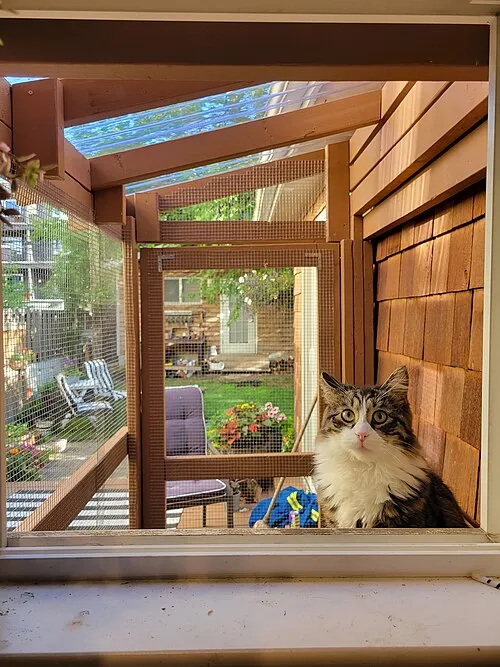
A domestic cat inside a home-connected catio. Photo: Grungaloo / Wikimedia Commons, CC BY-SA 4.0. Original photograph, shown for illustration.
Are Catios Good for Indoor Cats?
They can be particularly useful for indoor cats that enjoy outdoor stimulation but cannot safely roam.
A cat may spend much of its day watching birds through a window, listening to outdoor sounds or investigating scents carried through a screen.
A catio can offer additional opportunities for these normal behaviors.
SPCA New Zealand, RSPCA Australia and Humane World for Animals recognize secure outdoor enclosures as one option for providing enriched, controlled outdoor experiences.
However, the enclosure should give the cat access to an appropriate environment rather than simply add another confined space.
Benefits may include:
New sensory experiences: Outdoor smells, moving leaves, insects, sunlight and environmental sounds.
More places to explore: Platforms, shelves, branches and sheltered spaces.
Opportunities for movement: Climbing, walking and investigating different areas.
Greater choice: A connected enclosure may let the cat decide when to go outside and when to return indoors.
Controlled outdoor access: Reduced exposure to several common dangers associated with free roaming.
These benefits depend on the quality of the enclosure and the individual cat's response.
Do Catios Make Cats Happier?
A catio may improve a cat's welfare when it offers useful experiences that the animal enjoys voluntarily.
However, scientists cannot simply assume that every cat becomes happier because it spends time in an outdoor enclosure.
Good feline welfare depends on having access to important resources, opportunities to express normal behavior, and control over interactions with the environment.
The Feline Veterinary Medical Association emphasizes five principles of a healthy feline environment:
Provide safe places where the cat can retreat.
Provide multiple, separated essential resources.
Offer opportunities for play and predatory behavior.
Support positive and predictable human-cat interactions.
Respect the cat's senses, including its sensitivity to smells.
A well-designed catio can support some of these principles, particularly exploration, climbing and observation.
But an empty outdoor cage without shelter, hiding spots or enrichment may do very little to meet the cat's needs.
Are Catios Safer Than Letting Cats Roam Outside?
Properly constructed catios can reduce many of the risks that free-roaming cats encounter.
These include traffic accidents, fights with other animals, becoming lost and certain forms of contact with wildlife.
However, no outdoor enclosure is completely risk-free.
For example, a cat may still be exposed to fleas, mosquitoes, extreme temperatures, frightening noises or other environmental hazards.
| Outdoor Risk | Free-Roaming Cat | Cat in a Secure Catio |
|---|---|---|
| Road traffic | May encounter roads and vehicles | Direct road access is prevented |
| Becoming lost | Can travel beyond the home | Escape risk is reduced when the structure is secure |
| Fights with unfamiliar cats | May come into direct contact with other cats | Direct contact can be limited by suitable barriers |
| Predator encounters | May encounter roaming animals | Can be reduced, depending on enclosure construction |
| Parasites and insects | Exposure possible | Exposure still possible |
| Weather extremes | Potential exposure | Still requires shade, shelter and supervision |
| Wildlife hunting | May capture birds and small mammals | Hunting opportunities are reduced when wildlife cannot enter |
Safety depends on suitable materials, secure connections and regular inspection.
Are Catios Better for Birds and Wildlife?
Catios can benefit wildlife by preventing cats from roaming freely and hunting birds, reptiles and small mammals.
Domestic cats are capable predators, and feeding a cat well does not necessarily remove its motivation to hunt.
The American Bird Conservancy supports secure cat containment, including catios, as one way to reduce direct predation on wild birds.
Catios can therefore offer a practical compromise between allowing cats outdoor experiences and protecting local wildlife.
However, the enclosure itself needs to be wildlife-safe.
Large mesh openings may allow small animals to enter. An outdoor enclosure can also become a hazard if loose cords, exposed hardware or other unsafe materials are left inside.
A properly enclosed catio should prevent cats from reaching wildlife through its walls, roof or floor.
For other ways to manage animal encounters in gardens, read our guide to keeping animals and insects out of your garden without harming them.
What Are the Different Types of Catios?
Catios vary in size, construction and how cats enter them.
The right design depends on the home, available outdoor space, local weather and the cat's individual needs.
| Catio Type | Main Features | Things to Consider |
|---|---|---|
| Window catio | Small enclosure attached to a window | Secure mounting, safe access and sufficient room |
| Balcony catio | Enclosed balcony or part of a balcony | Full escape protection, building rules and fall prevention |
| Porch catio | Converted screened porch or attached outdoor structure | Weatherproofing, secure doors and suitable furnishings |
| Walk-in catio | Larger enclosure with space for people and cats | Structural stability, safe entry and sufficient enrichment |
| Freestanding cat enclosure | Separate structure in a garden | Safe transfer, supervision and the cat's ability to retreat |
An enclosure connected to the home often provides an important advantage: the cat can move between the indoor environment and the outdoor space when it wishes, provided the access point is safe and available.
Cats Protection notes that freestanding enclosures can be stressful for some cats if they are placed inside without the choice to leave.
That does not mean every freestanding enclosure is unsuitable. It means owners should pay particular attention to choice, supervision and the individual cat's comfort.
What Does a Well-Designed Catio Look Like?
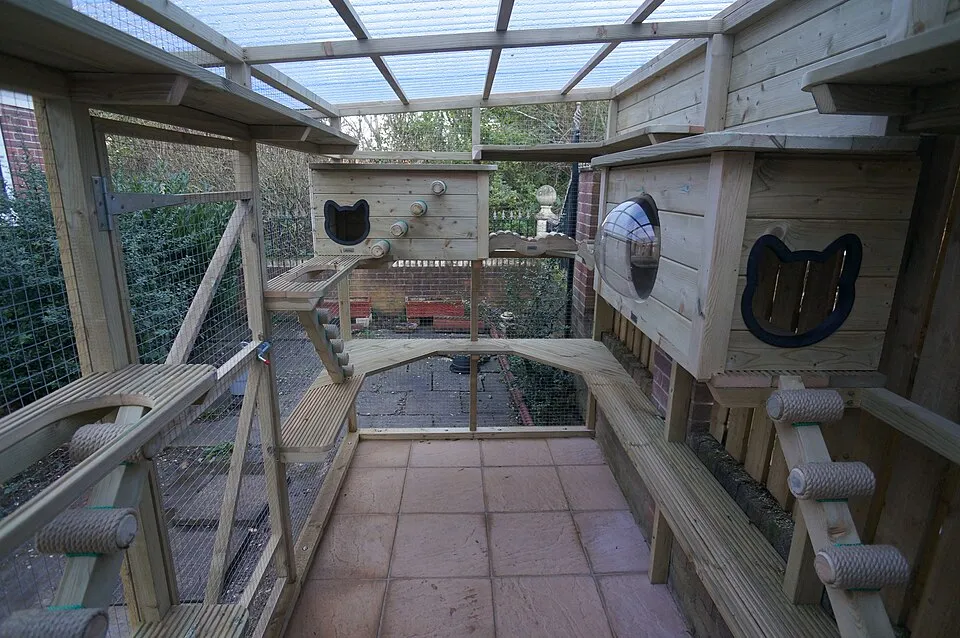
Freestanding catio with a multilevel play area, shelves, climbing features and enclosed resting spaces. Photo: CatioKing / Wikimedia Commons, CC BY-SA 4.0. The photograph illustrates enclosure design and does not independently verify structural safety.
This enclosure includes several useful design ideas: elevated platforms, climbing routes, enclosed resting spaces and different heights.
Vertical space is important because cats often enjoy climbing and observing their environment from raised positions.
However, adding shelves is not enough on its own. Platforms should be securely attached, appropriate for the cat's size and abilities, and arranged to prevent dangerous falls.
An older cat with arthritis may need lower shelves, stable ramps and easier access rather than high jumping routes.
Eight Important Safety Features Every Catio Should Have
1. Secure Walls and a Roof
Use durable materials suitable for outdoor conditions and for the size and strength of the cats using the enclosure.
Inspect the mesh, frame and roof for loose connections, gaps, rust or damaged sections.
Do not assume that ordinary insect screening is automatically strong enough to contain a determined cat.
2. A Safe Entrance
Doors, windows and access tunnels should close securely.
Make sure a cat cannot escape while someone is entering or leaving.
Where practical, a double-door entry can provide additional protection against accidental escapes.
3. Shade and Weather Protection
Cats need a way to escape direct sunlight, rain and strong wind.
A roof can help provide shelter, but a transparent roof may also allow intense sunlight to enter.
Always assess how the enclosure feels during the warmest part of the day.
4. Good Ventilation
Air needs to circulate through the enclosure.
Enclosed spaces with transparent walls or roofing may heat up quickly under direct sunlight.
Do not treat shade or ventilation as optional decorative features.
5. Stable Climbing Structures
Platforms, shelves and ramps should be securely mounted.
Avoid unstable furniture, slippery surfaces and sharp edges.
The arrangement should suit the cat's mobility and confidence.
6. Hiding and Resting Areas
Cats should have somewhere to retreat if they become frightened by people, dogs or unfamiliar noises.
Provide comfortable resting spaces rather than forcing the cat to remain visible at all times.
7. Access to Essential Resources
A cat staying in the enclosure for an extended period needs appropriate access to water and other essential resources.
If the cat cannot freely return indoors, its needs for toileting, food, rest and shelter must be addressed in the enclosure.
8. Regular Maintenance
Check locks, mesh, structural connections and furnishings regularly.
Remove waste and unsafe debris. Clean water containers and inspect the area for insects, damaged plants or other hazards.
A catio is not a structure that should be installed and then forgotten.
How Big Should a Catio Be?
There is no single size that suits every cat.
A suitable enclosure should allow the cat to move comfortably and provide different functional areas, including places to rest and opportunities to explore.
The amount of usable space matters more than floor area alone.
A taller enclosure with safe shelves and climbing routes may offer more opportunities for movement than a similarly sized empty box.
However, height should not come at the expense of safe access or resting space.
Consider these factors:
The number of cats using the enclosure.
The age and mobility of each cat.
Whether the cat can return indoors freely.
The availability of separate resting and hiding areas.
How long the cats are expected to spend in the space.
Whether enough routes exist for cats to avoid one another.
For multi-cat households, simply adding more animals to the same small enclosure can create conflict.
Are Catios Good for Senior Cats?
They can be, particularly for older cats that enjoy watching outdoor activity but have difficulty roaming safely.
However, senior cats may have arthritis, reduced balance, changes in vision or other health conditions.
An enclosure designed around high platforms and large jumps may not be appropriate.
Consider lower resting areas, stable ramps, non-slip surfaces and easy access to the house.
If a cat suddenly becomes reluctant to climb or move, arrange a veterinary assessment rather than assuming the animal is simply getting older.
Can Cats Stay in a Catio All Day?
That depends on the cat, the enclosure and the available indoor access.
A secure catio connected to the home may allow a cat to come and go throughout the day.
However, spending time in a catio should remain a positive choice rather than a requirement.
A cat should not be left in an outdoor enclosure without adequate protection from changing weather, access to necessary resources or appropriate supervision.
Even a large catio is not a substitute for a complete, suitable living environment.
If a cat appears distressed, overheated, frightened or unwilling to remain outside, provide a safe way to return indoors.
Can Catios Get Too Hot in Summer?
Yes. Outdoor enclosures can become dangerously hot, especially when they have poor airflow, transparent roofing or prolonged exposure to direct sunlight.
Cats can experience heat-related illness.
Warning signs may include unusual panting, excessive drooling, weakness, confusion or collapse.
Move a cat showing signs of overheating to a cooler environment and seek urgent veterinary advice.
Do not rely on a small shaded corner if the enclosure itself is exposed to severe heat.
Provide effective ventilation, appropriate shade and fresh water, and avoid catio use when conditions cannot be kept safe.
What About Winter, Rain and Cold Weather?
Cold weather, strong wind, wet surfaces and snow can also create problems.
An outdoor enclosure should have suitable shelter, but this does not mean every cat can safely remain outside in cold conditions.
Age, health, coat characteristics and individual tolerance influence how well a cat copes with lower temperatures.
Some cats may enjoy brief outdoor experiences in cool weather, while others need to remain inside.
Learn more in our Winter Pet Safety Guide for Dogs and Cats.
How Do You Introduce an Indoor Cat to a Catio?
Do not assume a cat will immediately enjoy an unfamiliar outdoor enclosure.
Introduce the space gradually.
Step 1: Allow Investigation
Let the cat approach the entrance at its own pace.
Do not push or carry an unwilling cat into the enclosure simply because it has been built.
Step 2: Begin With Quiet Sessions
Choose a calm period without loud equipment, nearby dogs or other disturbances.
Allow the cat to investigate and return indoors when it wishes, if the design permits.
Step 3: Make the Space Familiar
Provide comfortable resting surfaces, hiding places and familiar objects.
Keep strong fragrances and other unnecessary sensory disturbances out of the enclosure.
Step 4: Use Positive Reinforcement
Reward voluntary exploration with something the cat enjoys, such as a treat, play or calm attention.
Avoid forcing contact or trapping the cat in an unfamiliar environment.
Step 5: Watch the Cat's Response
Some cats adjust quickly; others need more time.
Move gradually and end the session if the cat is frightened or distressed.
The goal is to create an additional enjoyable choice, not to make every cat use the enclosure.
How Can You Tell if Your Cat Likes Its Catio?
A comfortable cat may enter voluntarily, explore calmly, observe the surroundings and settle in a relaxed position.
Other signs can include ordinary grooming, gentle play or choosing to rest on a familiar platform.
Possible signs of distress include:
Repeated attempts to escape.
Hiding with a tense body posture.
Flattened ears and other defensive signals.
Persistent growling or hissing.
Refusing to approach the enclosure after frightening experiences.
Freezing or remaining motionless in an unusually tense posture.
No single behavior proves whether a cat is happy or unhappy. Context and the individual cat's normal behavior matter.
If the cat repeatedly appears uncomfortable, change the setup or consult a veterinarian or qualified feline behavior professional.
Are Catios Good for Multiple Cats?
They can be, but shared space must be managed carefully.
Not all cats in the same household are socially compatible.
Some cats may compete for high resting spots, access tunnels or favorite observation areas.
A catio that has only one narrow route between platforms may allow one cat to block another.
To reduce conflict, consider:
More than one resting place.
Multiple routes between different levels.
Separate hiding areas.
Space for cats to move away from each other.
Access to separate resources where appropriate.
Observation for bullying, guarding or avoidance behavior.
A multi-cat enclosure should offer choice rather than force cats into close contact.
Do Catios Replace Indoor Play and Exercise?
No. A catio should complement enrichment inside the home.
Indoor cats still need opportunities to chase, stalk, climb, scratch, explore and interact with people in ways they enjoy.
Interactive toys, food puzzles, scratching posts and comfortable elevated resting places can remain important even when a cat has outdoor access.
Some cats may spend much of their catio time watching the garden rather than exercising.
Owners should continue offering suitable daily play and movement opportunities.
Catio vs. Cat Fence vs. Harness: Which Is Better?
There are several approaches to controlled outdoor access.
The best option depends on the individual animal, the property and the owner's ability to manage the equipment safely.
| Option | Potential Advantage | Important Limitation |
|---|---|---|
| Catio | Defined outdoor space with controlled boundaries | Requires suitable construction, space and maintenance |
| Cat-proof fencing | Can provide access to a larger part of a garden | May be unsuitable for some properties or determined climbers |
| Harness and leash | Allows supervised exploration outside the home | Not every cat tolerates a harness or unfamiliar environments |
| Indoor enrichment | Can support normal behaviors without outdoor exposure | Requires thoughtful environmental design and ongoing engagement |
No single method is ideal for every cat.
For example, Cats Protection cautions that a previously free-roaming cat may experience frustration if its outdoor access is suddenly restricted.
By contrast, a cat that has always lived indoors may find a secure catio a welcome addition to its usual environment.
Changes in outdoor access should be managed gradually, with attention to the cat's behavior and welfare.
Can You Build a Catio on a Balcony?
Potentially, but balconies require particular care because a structural failure or escape could result in a dangerous fall.
Any balcony enclosure must prevent access to open edges and gaps.
Do not rely on decorative screens, ordinary insect netting or loose temporary barriers without verifying their suitability.
Check building rules, landlord restrictions and local requirements before installation.
Where structural modifications, elevated construction or uncertainty about load-bearing components are involved, seek appropriate professional advice.
The enclosure should also remain safe during wind, rain and temperature changes.
Are Catios Expensive?
The cost depends on the design, materials, local labor prices, available space and whether the structure is professionally installed.
A small window enclosure may require substantially fewer materials than a large walk-in catio.
However, the cheapest option is not necessarily the safest.
A poorly secured structure could create escape or injury risks that outweigh any savings.
When planning a budget, account for secure construction, furnishings, maintenance and any applicable property permissions.
For broader cat ownership expenses, see our Cat Ownership Cost Guide.
Frequently Asked Questions
Are catios good for cats?
Yes, well-designed catios can provide controlled outdoor access, sensory stimulation and opportunities for climbing and exploration. They should be secure, comfortable and suited to the individual cat.
What is the purpose of a catio?
A catio is an enclosed outdoor area that lets cats experience the outdoors while helping reduce risks associated with free roaming.
Are catios safe for indoor cats?
They can be safe when properly constructed and maintained. However, owners still need to manage temperature, ventilation, structural security and potential environmental hazards.
Can cats escape from a catio?
Yes, if the structure has gaps, damaged mesh, loose connections or insecure doors. Regular inspection and suitable construction are essential.
Do catios protect birds?
A secure catio can prevent a domestic cat from roaming and directly hunting wild birds. The enclosure must also be designed to keep wildlife from entering or being reached through openings.
Will a cat be bored in a catio?
Some cats may become bored in a featureless enclosure. Shelves, resting spots, hiding places and opportunities to observe the surroundings can help create a more engaging environment.
Can a cat sleep in a catio?
Some cats choose to nap in sheltered outdoor enclosures. They still need safe temperatures, comfortable resting areas and protection from weather. Overnight confinement should not be assumed safe for every cat or enclosure.
Are catios good for older cats?
They can be, especially when they provide easy access and comfortable outdoor experiences. Senior cats may need ramps, low platforms and adaptations for limited mobility.
Can cats use a catio in winter?
Possibly for suitable periods in mild conditions, but cold, wind, rain and snow may make outdoor access inappropriate. Cats must have adequate shelter and a safe way to return indoors.
Can several cats share one catio?
Yes, when the enclosure provides sufficient usable space, multiple resting areas and escape routes from social conflict. Some cats may prefer separate access or different schedules.
Does a catio replace a litter box?
No. Cats still need suitable, accessible toileting facilities. If a cat spends extended periods in a separate enclosure, its toileting needs must be addressed there as well.
Do cats need a catio to be happy?
No. A catio is one possible form of enrichment. Cats can have good welfare in a suitably enriched indoor environment that meets their physical, social and behavioral needs.
The Bottom Line
A well-designed catio can be a valuable addition to a cat's environment, but it is not automatically beneficial just because it is outdoors.
The most important features are safety, environmental enrichment and the cat's ability to make choices.
For many indoor cats, a secure outdoor enclosure offers opportunities to observe, climb, smell and explore without some of the dangers of free roaming.
At the same time, catios can help protect local birds and other wildlife.
The best catio is not necessarily the largest or most expensive. It is the one that safely supports your individual cat's needs while remaining practical to inspect and maintain.
Animal Welfare Sources and Further Reading
Cats Protection — Are Catios Good for Cats?
SPCA New Zealand — Keeping Your Cat Safe and Happy at Home
RSPCA Australia — Is It Okay to Keep My Cat at Home All the Time?
Humane World for Animals — Catios: Safe Outdoor Enclosures
American Bird Conservancy — Solutions for Indoor Cats
Feline Veterinary Medical Association — Setting Up the Environment for Success
Photo Credits
Catio with Cat — Grungaloo, CC BY-SA 4.0. Original photograph, no editorial modifications.
Freestanding Catio with Multilevel Play Area — CatioKing, CC BY-SA 4.0. Original photograph, no editorial modifications.