A broken leg, a late-night emergency, a sudden surgery… For pet owners in the US and Europe, the question is almost never “Will I love my pet enough to help?” – it’s “Can I afford the bill?”.
Even a single emergency vet visit can cost as much as a short vacation, a new laptop, or a month of rent. That’s why a dedicated pet emergency fund is one of the most powerful tools you can create to protect both your finances and your dog or cat.
In this guide, we’ll walk through:
What a pet emergency fund is (and what it’s not)
How much you should realistically aim to save
Step-by-step strategies to build your fund on a normal income
Where to keep the money so it’s safe and accessible
How a fund works together with pet insurance
Rules for using and refilling your fund after an emergency
1. What Exactly Is a Pet Emergency Fund?
A pet emergency fund is a separate pot of money that exists for one purpose only:
To pay for unexpected veterinary care that your dog or cat may urgently need.
1.1 How it’s different from normal savings
It’s not for rent, groceries, holidays or gadgets.
It’s not for routine vet care like vaccines or flea prevention (you should budget those separately).
It is a “do not touch” reserve for real medical problems: accidents, serious illnesses, sudden surgery, or diagnostics you didn’t plan for.
1.2 Why you shouldn’t mix it with your main savings
If you keep everything in one big account, it’s easy to spend a little here and there.
When a crisis hits, you may find that your “emergency money” has quietly shrunk.
A clearly labeled, separate fund makes it obvious what is available for your pet.
2. How Much Should You Aim to Save?
There is no perfect number, but you can set a realistic target for your situation. Think in tiers instead of one huge amount.
2.1 A good starting target: one basic emergency visit
Your first goal could be:
Enough to cover an emergency exam, basic tests and medications for a moderate issue.
In many parts of the US and Europe, that might be roughly the same order of magnitude as:
A month or so of rent or mortgage payment, or
A mid-range smartphone or laptop
You don’t need to guess perfectly. The point is to set a target that feels challenging but possible in 6–12 months.
2.2 A stronger long-term target: one major emergency or surgery
After you reach your first goal, aim higher. A stronger fund can cover:
Emergency exam and stabilization
Blood tests and imaging (X-rays, ultrasound)
Surgery or a few days of hospitalization
Even if your fund doesn’t cover 100% of the worst-case scenario, having half or two-thirds ready in cash dramatically improves your options.
2.3 Adjusting for your pet and your location
You may want a bigger fund if:
You have a large dog (food, medications and anesthesia are more expensive by weight).
Your pet has a higher-risk breed background or a history of medical problems.
You live in a big city where vet prices are higher than in rural areas.
You may be comfortable with a smaller fund if:
Your pet is small to medium-sized and generally healthy.
You also have good pet insurance (more on that below).
You have other strong savings available as a second line of defense.
3. How to Build a Pet Emergency Fund on a Normal Income
You don’t need a huge salary to build a useful fund. You just need a plan that fits your everyday life.
3.1 Step 1: Choose your first target and deadline
For example:
“I want to save my first emergency goal within 12 months.”
Divide that number by 12 to see your monthly target.
If it feels impossible, stretch the deadline or aim for a smaller first step. It’s better to start with a modest, realistic plan than to give up because the number looks too big.
3.2 Step 2: Make it automatic
Set up an automatic transfer from your main account to your pet fund on the same day you get paid.
Treat it like a bill: non-negotiable unless you truly can’t pay essential living expenses.
Even a small amount, saved consistently, grows surprisingly fast.
3.3 Step 3: Look for “found money” opportunities
Boost your fund whenever you receive money that isn’t part of your normal monthly budget, such as:
Tax refunds
Work bonuses
Gifts or side-gig income
Money saved from canceling subscriptions you don’t use
Decide in advance what share (for example 20%, 30% or 50%) goes straight into the pet fund.
3.4 Step 4: Trim a few small expenses, not everything you enjoy
Instead of cutting all pleasures, choose 1–2 small areas where you can reduce spending and redirect that money:
One fewer takeout meal per month
Switching a premium streaming service to a cheaper plan
Buying store-brand instead of premium-brand for a few grocery items
The key is sustainability: a plan you can follow for years, not just a few weeks.
4. Where Should You Keep Your Pet Emergency Fund?
The ideal place for your fund has three qualities:
Safe (you won’t lose it on risky investments)
Separate (clearly labeled and not mixed with everyday money)
Accessible (you can use it quickly in an emergency)
4.1 Simple savings account or sub-account
Most banks in the US and Europe allow you to create multiple savings “pots” or sub-accounts.
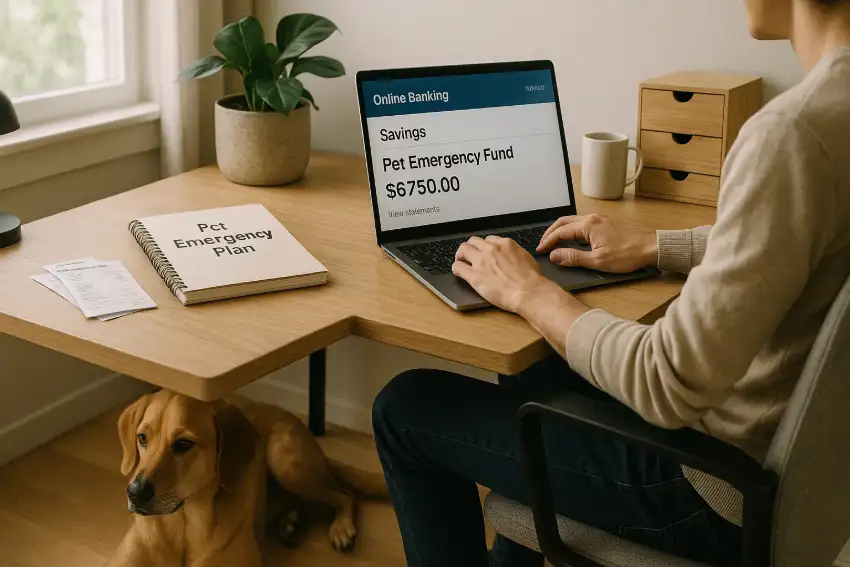
Name one “Pet Emergency Fund” so you always know what it’s for.
Interest rates may not be huge, but safety and clarity matter more here than high returns.
4.2 Avoid risky or hard-to-access investments
Stock market investments can go down right when you need the money.
Fixed-term deposits or locked accounts may penalize early withdrawals.
Crypto or highly volatile assets can lose value overnight.
Your pet emergency fund is not the place to chase big profits. It is your safety cushion.
4.3 Keep it separate from your human emergency fund (if possible)
If your budget allows, it’s ideal to have:
One fund for pet emergencies
One fund for your own life emergencies (job loss, car repairs, etc.)
If that’s not realistic yet, you can:
Start with one shared emergency fund, but track how much you consider “pet money”.
Move toward separate funds as your finances improve.
5. Pet Emergency Fund and Pet Insurance: How They Work Together
You don’t have to choose between savings and insurance. Many owners use a combination.
5.1 If you have pet insurance
Your fund can focus on:
Deductibles and co-pays
Treatments or items not covered by your policy
Smaller emergencies that you decide not to claim
Because insurance helps with large bills, you may not need as big a fund as someone with no coverage at all.
5.2 If you don’t have pet insurance
Your fund is your main safety net for both minor and major surprises.
You may want to aim for a larger target over time.
You need to be more cautious about how you would handle multiple big events close together.
5.3 The hybrid sweet spot for many people
A practical strategy:
Choose a pet insurance plan with a reasonable deductible and good coverage for accidents and illnesses.
Build a smaller emergency fund to handle deductibles, exclusions and routine care.
Use savings for small/medium issues and let insurance handle truly large bills.
6. Rules for Using Your Pet Emergency Fund
To protect your fund, treat it like a powerful but controlled tool.
6.1 Only for genuine medical needs
Good reasons to use your fund include:
Emergency vet visits (vomiting, accidents, breathing issues, severe pain, etc.)
Urgent surgery or hospitalization
Important diagnostics needed to diagnose a serious problem
Not-so-good reasons:
New toys or beds (unless your fund is very large and you have no other savings)
Non-essential treatments that can be safely postponed while you save separately
6.2 Combine it with clear communication at the clinic
Tell your vet you have a certain amount set aside and ask how to use it most effectively.
Ask for an estimate that fits within your budget, with priorities clearly explained.
6.3 Refill the fund after you use it
After an emergency:
Accept that the fund going down is normal – this is exactly what it’s for.
Restart your automatic transfers as soon as you can, even at a lower amount.
Use any “extra” money (bonuses, refunds, gifts) to rebuild faster.
7. Examples: Different Pet Emergency Fund Strategies
Here are a few simple fictional examples to show how this looks in real life.
7.1 Example A: Young indoor cat, low-risk lifestyle
Owner in a European city, cat lives indoors, insured early with accident-and-illness policy.
Target emergency fund: enough for deductible, co-pays and one small emergency beyond insurance limits.
Monthly plan: modest automatic transfer + occasional top-ups from extra income.
7.2 Example B: Large active dog, no insurance
Owner in the US suburbs with a large mixed-breed dog that loves outdoor adventures.
No insurance due to personal preference; owner self-insures with savings.
Target emergency fund: larger amount, aiming to cover at least one surgery or multi-day hospitalization.
Monthly plan: more aggressive savings plus directing a percentage of any bonuses straight into the fund.
7.3 Example C: Multi-pet household, hybrid strategy
Family with two dogs and one cat in a European country.
Basic insurance on all three pets + shared emergency fund for deductibles and uncovered costs.
They treat the fund like “family pet insurance backup” and rebuild it after each claim.
8. Common Mistakes to Avoid With Pet Emergency Funds
A few simple errors can weaken your safety net. Watch out for:
Using the fund for non-emergencies. “Just this once” for a gadget or holiday can become a habit.
Not saving because the target feels too big. Any amount is better than zero; start small and adjust.
Keeping the money where it’s hard to reach quickly. You don’t want to wait days to transfer funds while your pet is in crisis.
Building the fund but not budgeting for routine care. Ignoring vaccines or dental care can create preventable emergencies later.
9. Final Thoughts: Buying Yourself Choices When It Matters Most
A pet emergency fund doesn’t guarantee that every medical story will have a perfect outcome. But it does buy you:
More time to think instead of panicking
More treatment options from your vet
Less financial guilt and fear in the middle of a crisis
You don’t need to build it overnight. Start with a small, clear goal. Celebrate each milestone. Over months and years, this quiet, boring habit becomes one of the most loving things you ever do for your dog or cat.
When something scary happens at 2 a.m., you won’t wish you had bought more toys or takeout. You’ll be grateful for that slightly dull line in your bank app labeled “Pet Emergency Fund” – and for the decisions your past self made to protect your future self, and your best friend.