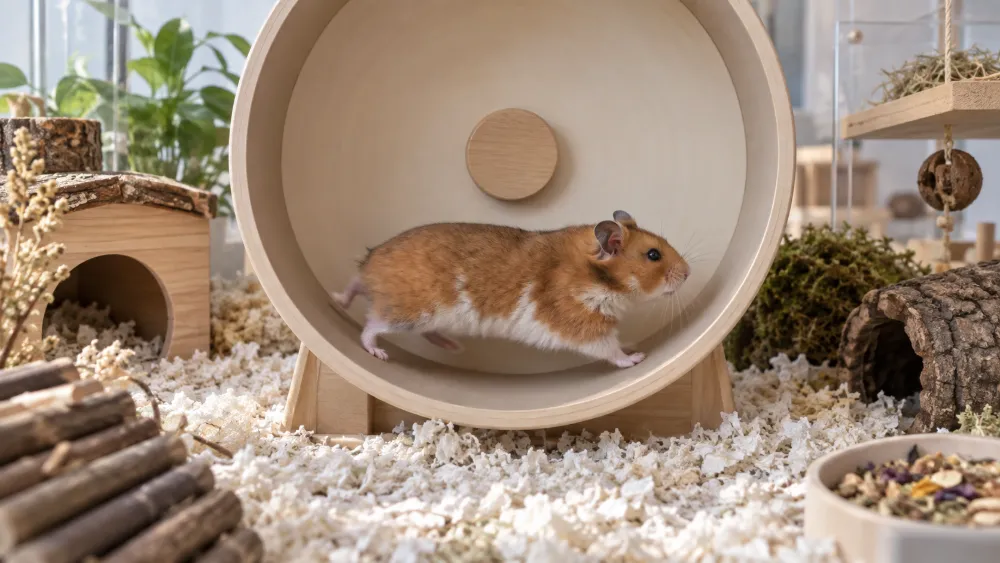
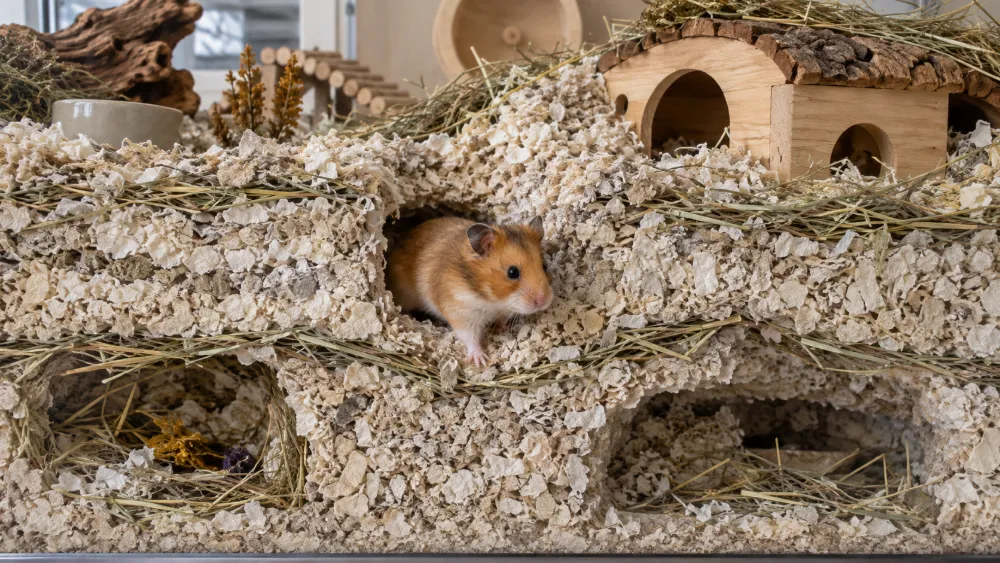
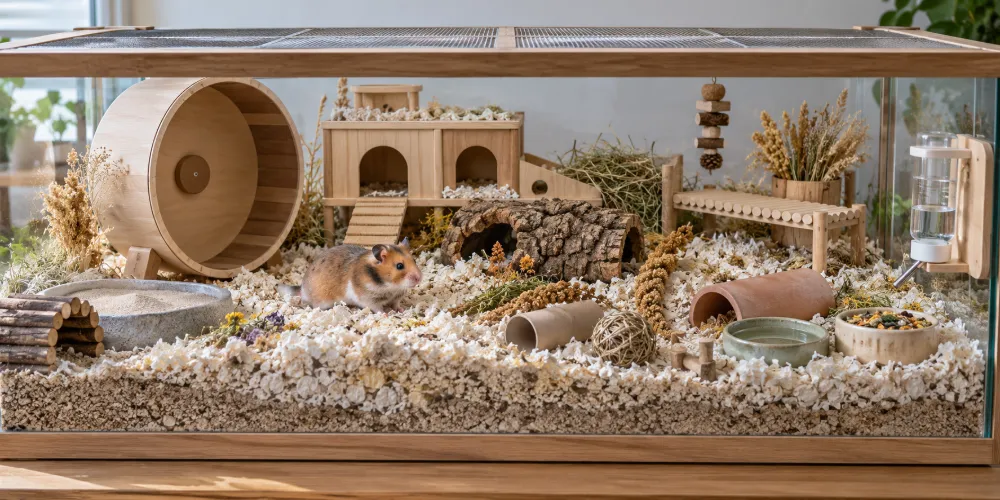
Good hamster care starts with a spacious enclosure, deep bedding for burrowing, a correctly sized solid wheel, balanced hamster food, fresh water, hiding places and plenty of enrichment. A hamster should not live in a tiny cage with a shallow layer of bedding and a small wheel. Current animal-welfare guidance recommends housing around 100 × 50 cm or larger, substantial digging depth, species-appropriate wheels and gentle cleaning that preserves some familiar scent. Hamsters are small pets, but their welfare needs are much larger than their body size suggests.
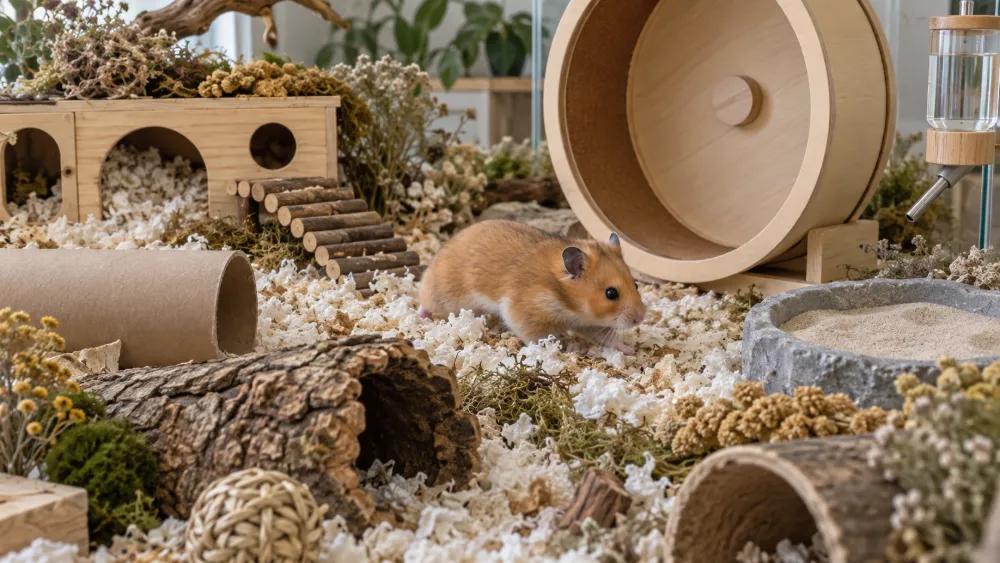
A good hamster enclosure provides enough floor space for exploring, deep bedding for natural burrowing, an appropriately sized wheel and several places to hide.
Hamster Care at a Glance
| Care Need | Practical Guideline |
|---|---|
| Enclosure | Aim for at least about 100 × 50 cm of floor space; larger is better |
| Bedding depth | Provide a deep burrowing area, ideally around 20–30 cm where practical |
| Wheel | Solid upright wheel large enough for the hamster to run with a straight back |
| Main food | Nutritionally complete hamster food |
| Fresh food | Small portions of suitable vegetables and occasional treats |
| Water | Fresh clean water available at all times |
| Cleaning | Spot clean every few days; deep clean only as needed, often around once or twice monthly |
| Housing companions | Syrian hamsters should live alone |
| Activity | Wheel, burrowing, digging, tunnels, foraging and supervised play |
How Much Space Does a Hamster Need?
Hamsters are tiny, but they are extremely active.
They need enough horizontal floor space to:
run;
forage;
dig;
build burrows;
create separate nesting and toilet areas;
use a wheel without crowding the rest of the enclosure.
Blue Cross currently recommends hamster housing no smaller than approximately 100 cm long × 50 cm wide × 50 cm high.
Woodgreen uses the same minimum for Syrian and Chinese hamsters and notes that particularly active animals, including some female Syrians, may benefit from more space.
This is much larger than many traditional pet-shop starter cages.
For a full breakdown of enclosure dimensions, bar spacing, tanks and setup, see Hamster Cage Size & Setup: How Big Should a Hamster Cage Be?.
Do Hamsters Need Deep Bedding?
Yes. Burrowing is one of the most important natural hamster behaviors.
Wild hamsters spend large amounts of time underground, and pet hamsters retain the instinct to dig complex tunnels and nesting chambers.
Blue Cross recommends at least about 20 cm of suitable digging bedding.
PDSA recommends no less than approximately 25 cm, while Woodgreen suggests deep sections reaching around 25–30 cm where possible.
The exact depth does not need to be identical across every centimeter of the enclosure.
A practical setup can include:
a large deep burrowing zone;
a shallower area supporting the wheel;
a platform for heavy objects;
a sand area or dig box.
The important point is that the hamster has enough substrate to create real tunnels rather than simply scratch at a thin layer.
See our detailed guide: Best Hamster Bedding: Safe Materials, Depth & What to Avoid.
What Is the Best Bedding for Hamsters?
Suitable bedding needs to be:
low in dust;
absorbent;
safe if chewed;
capable of supporting burrows.
Common suitable options include:
paper-based bedding;
hemp bedding;
aspen;
safe soft hay mixed into bedding for structure.
Paper-based bedding is particularly useful because compressed layers can hold tunnels well.
PDSA and Blue Cross both warn against fluffy cotton-like nesting materials because fibers can wrap around limbs or cause digestive problems if swallowed.
Dusty sawdust and unsuitable wood shavings are also poor choices for a hamster's respiratory system.
Do Hamsters Need a Wheel?
Yes. A suitable upright wheel is one of the most important pieces of hamster equipment.
Hamsters can travel substantial distances during their active period, and a wheel provides an important opportunity for sustained running.
The wheel should have:
a solid running surface;
no wire mesh;
no exposed rungs that can trap feet;
a diameter large enough for a straight running posture.
The hamster's back should not form a pronounced curve while running.
Typical Hamster Wheel Sizes
| Hamster | Approximate Wheel Guidance |
|---|---|
| Syrian hamster | About 27–32 cm; PDSA recommends at least 30 cm |
| Chinese hamster | About 25–30 cm |
| Campbell's dwarf | About 22–25 cm |
| Winter white | About 22–25 cm |
| Roborovski | About 20–22 cm |
Wheel recommendations differ slightly among welfare organizations, so the most useful rule is visual:
The hamster should be able to run naturally with its back straight.
See Hamster Wheel Size: Syrian, Dwarf, Roborovski & Chinese Hamsters for the complete guide.
Are Hamster Exercise Balls Safe?
Major UK animal-welfare organizations including Blue Cross and Woodgreen advise against hamster exercise balls.
Problems include:
poor control over where the hamster goes;
limited access to water;
limited opportunity to hide;
possible stress;
feet or toes becoming caught in ventilation openings.
A secure playpen or enriched enclosure is a better way to provide additional activity.
What Should Be Inside a Hamster Cage?
A good enclosure should contain more than food, water and a wheel.
Useful items include:
deep bedding;
one or more hides;
a multi-chamber hide;
a correctly sized wheel;
sand bath;
cardboard tunnels;
cork logs;
safe branches;
chew items;
foraging material;
seed sprays or safe dried plants;
water bottle or stable water bowl.
A hamster enclosure should encourage natural behavior rather than simply keep the animal contained.
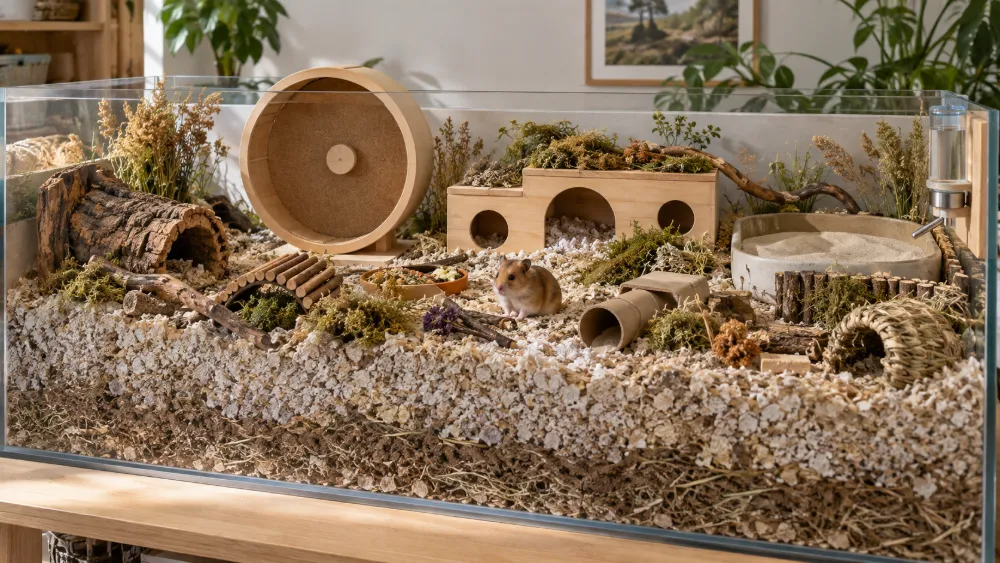
A well-designed enclosure combines deep bedding, a correctly sized wheel, hides, tunnels, sand and foraging opportunities.
Do Hamsters Need a Sand Bath?
Many hamsters benefit from access to a suitable sand bath.
Sand gives them another texture to dig and roll in and can help with coat maintenance.
Roborovski hamsters, which are naturally associated with dry and sandy habitats, often make particularly frequent use of sand areas.
Use hamster-safe sand rather than dusty powder.
Dusty products can irritate the respiratory system.
What Do Hamsters Eat?
A hamster's main diet should be a nutritionally complete hamster food.
Fresh extras can include very small amounts of:
broccoli;
cucumber;
bell pepper;
green beans;
leafy greens;
occasional fruit;
mealworms;
plain boiled egg.
Hamsters are omnivores, so their diet can include both plant and animal-derived foods.
However, treats should not replace a balanced staple diet.
For the complete diet guide, see What Can Hamsters Eat? Complete Safe Food List.
You can also use:
How Much Should a Hamster Eat?
The correct quantity depends on:
species;
body size;
age;
body condition;
the calorie density of the food.
Follow the feeding instructions supplied with a nutritionally complete hamster food and monitor body condition rather than continually filling a bowl whenever it looks empty.
Hamsters naturally hoard food.
An apparently empty dish may simply mean the food has been moved into a hidden store.
Do Hamsters Need Fresh Water?
Yes.
Fresh clean water should be available at all times.
Check bottles daily to ensure they have not:
blocked;
leaked;
become empty.
A stable water bowl can also work in an appropriately designed enclosure, but it should be positioned where bedding is unlikely to be kicked into it.
Should Hamsters Live Alone?
Syrian hamsters should live alone.
They are strongly solitary and can fight seriously if housed together.
For dwarf species, older care advice sometimes suggested keeping compatible pairs or groups.
However, fighting can develop suddenly even between animals that previously appeared tolerant.
For ordinary pet homes, separate housing removes the risk of serious fighting, unwanted breeding and the difficulty of identifying subtle social stress.
Do not assume that two hamsters need companionship simply because humans view solitary housing as lonely.
Can Hamsters Live With Other Pets?
A hamster should have its own secure enclosure protected from cats, dogs and other animals.
Even a calm cat or dog can frighten a hamster simply by staring at, pawing at or sitting beside the enclosure.
Do not allow direct interaction between hamsters and larger household pets.
When Are Hamsters Awake?
Hamsters are mainly active during the evening and night.
Activity patterns vary between individuals and species.
A hamster sleeping during the daytime should generally be left undisturbed.
Repeatedly waking a hamster for daytime handling can cause stress and may make defensive biting more likely.
Interact when the hamster wakes naturally.
How Do You Tame a Hamster?
Taming should be gradual.
After bringing a hamster home, allow time to settle into the new enclosure before expecting frequent handling.
A useful progression is:
Spend quiet time near the enclosure.
Allow the hamster to become familiar with your voice and scent.
Offer a small treat from your fingers.
Place a flat hand in the enclosure and allow the hamster to investigate.
Let the hamster climb onto your hand voluntarily.
Begin short handling sessions close to the floor.
Do not grab a sleeping hamster suddenly from above.
Predators often approach small rodents from above, so this can trigger fear.
Why Do Hamsters Bite?
Biting can happen when a hamster is:
frightened;
startled;
woken suddenly;
handled roughly;
in pain;
not yet accustomed to people.
No hamster species can honestly be guaranteed never to bite.
For temperament guidance, see Which Hamsters Don't Bite? Pet Hamster Types Compared.
How Often Should You Clean a Hamster Cage?
A hamster enclosure should be kept clean without repeatedly destroying all of the hamster's familiar scent.
Blue Cross and RSPCA recommend regular spot cleaning and less frequent deep cleaning.
A common schedule is:
Every few days: remove wet bedding, obvious waste and spoiled fresh food.
Regularly: clean the wheel, sand area and toilet spots as needed.
Approximately once or twice a month: deeper cleaning may be appropriate depending on enclosure size and hygiene.
A very large enclosure with deep bedding may not need complete substrate replacement frequently.
When deep cleaning, preserve some clean old bedding so the enclosure still smells familiar.
For the full routine, see How Often Should You Clean a Hamster Cage?.
Why You Should Not Replace All Bedding Every Week
Hamsters depend heavily on scent.
Removing every piece of bedding and washing every object too frequently can remove familiar territorial odors and create unnecessary stress.
It can also be expensive and wasteful when a large enclosure contains a deep substrate layer.
Spot cleaning is usually more practical.
Deep cleaning is still necessary when hygiene requires it, but it does not need to mean sterilizing the entire habitat on a rigid weekly schedule.
How Do You Clean a Hamster Cage?
Clean when the hamster is awake.
A practical process is:
Place the hamster safely in a secure carrier or playpen.
Remove soiled bedding and spoiled food.
Keep some clean old bedding aside.
Wash dirty surfaces and accessories with an appropriate pet-safe cleaner.
Rinse thoroughly where necessary.
Allow the enclosure to dry.
Add fresh bedding.
Mix some retained clean bedding back into the enclosure.
Replace hides, wheel and enrichment.
How Warm Should a Hamster's Room Be?
Hamsters should be kept indoors in a stable environment away from:
direct sunlight;
radiators;
cold draughts;
large temperature fluctuations.
Very cold conditions can trigger torpor, a dangerous state in which the hamster becomes unusually inactive and cold.
A hamster that appears unresponsive or unusually cold should not simply be assumed to be hibernating.
Seek veterinary advice.
Where Should You Put a Hamster Cage?
Choose a location that is:
indoors;
quiet during the hamster's daytime sleep;
away from direct sun;
away from heating vents and radiators;
protected from cats and dogs;
away from loud speakers and constant vibration.
A bedroom can work, but remember that hamster wheels and digging can be noisy at night.
What Enrichment Do Hamsters Need?
Enrichment should encourage behaviors the hamster is naturally motivated to perform.
Useful forms include:
deep burrowing substrate;
scatter feeding;
seed sprays;
cardboard tubes;
cork tunnels;
safe branches;
dig boxes;
sand baths;
multiple hides;
chew-safe materials.
Scatter feeding is especially useful because it makes the hamster search for food instead of simply eating everything from one bowl.
Do Hamsters Need Chew Toys?
Hamsters are rodents, and their incisors grow continuously.
Safe chewing materials help support normal gnawing behavior.
Suitable options can include:
safe untreated wood;
cardboard;
appropriate chew blocks;
safe branches.
Dental problems can still occur even when chew materials are available.
If a hamster is drooling, losing weight or struggling to eat, veterinary examination is appropriate.
How Long Do Hamsters Live?
Most common pet hamsters live only a few years.
Blue Cross describes a typical hamster lifespan of approximately two to three years, although individual lifespan varies by species, genetics, health and care.
The short lifespan is something families should consider before choosing a hamster.
How Can You Tell If a Hamster Is Sick?
Watch for changes rather than relying on one isolated sign.
Possible signs of illness include:
loss of appetite;
weight loss;
diarrhea;
a wet or dirty rear end;
difficulty breathing;
nasal or eye discharge;
persistent scratching;
skin lesions;
limping;
difficulty chewing;
abnormal inactivity;
swelling or lumps.
Small mammals can deteriorate quickly.
Contact a veterinarian experienced with small mammals if your hamster shows significant or persistent illness.
Do Hamsters Need Veterinary Care?
Yes.
Being small does not mean a hamster is a disposable or “no-vet” pet.
Before bringing one home, identify a veterinary clinic that is comfortable treating hamsters or exotic small mammals.
Potential reasons for veterinary visits include:
dental disease;
respiratory problems;
skin disease;
injuries;
tumors;
diarrhea;
weight loss.
Syrian vs Dwarf Hamster Care
| Care Point | Syrian Hamster | Dwarf Hamster |
|---|---|---|
| Adult size | Larger | Much smaller |
| Housing | Large enclosure; always solitary | Large enclosure relative to size; secure small gaps |
| Wheel | Usually around 27–32 cm | Usually around 20–25 cm depending on species |
| Fresh food portion | Small | Smaller |
| Handling | Often easier because of larger body size | Can be very fast and more difficult for beginners |
For species differences, see Popular Pet Hamster Types: Traits & Care.
Hamster Care Checklist
Large enclosure with generous floor area
Deep safe bedding for burrowing
Large solid upright wheel
Multiple hiding areas
Sand bath
Foraging enrichment
Chew-safe materials
Nutritionally complete hamster food
Small amounts of safe fresh food
Constant access to clean water
Spot cleaning without unnecessary full resets
Gentle handling when awake
Access to an appropriate veterinarian
Frequently Asked Questions
Are hamsters easy to care for?
Hamsters can be manageable pets, but they are not maintenance-free. They need much larger housing, deeper bedding and more enrichment than many traditional starter cages provide.
How big should a hamster cage be?
Current Blue Cross and Woodgreen guidance recommends housing around 100 × 50 cm of floor space or larger for common pet hamsters. More space can be beneficial, particularly for very active individuals.
How deep should hamster bedding be?
Aim for a substantial burrowing area. Major welfare organizations currently recommend approximately 20–30 cm of deep substrate where practical.
What bedding is safe for hamsters?
Suitable choices include low-dust paper bedding, hemp and appropriate aspen, often mixed to improve burrow stability. Avoid fluffy cotton-style nesting materials and dusty sawdust.
What size wheel does a Syrian hamster need?
A Syrian generally needs a large upright wheel around 27–32 cm in diameter, with many welfare organizations recommending approximately 30 cm or more. The hamster should run with a straight back.
What size wheel does a dwarf hamster need?
Depending on species, dwarf hamster wheels are commonly around 20–25 cm. The correct wheel allows natural running without a curved spine.
How often should you clean a hamster cage?
Spot clean every few days and deep clean only as necessary. Blue Cross and RSPCA indicate that many well-maintained enclosures need deeper cleaning only around once or twice a month.
Can two Syrian hamsters live together?
No. Syrian hamsters are solitary and should be housed individually.
Do hamsters need a sand bath?
A suitable sand bath can provide useful grooming and enrichment opportunities. Avoid very dusty powders.
Are hamster balls safe?
Blue Cross and Woodgreen advise against exercise balls because they can be stressful, restrict access to water and hiding places, and present risks to the feet.
What should hamsters eat?
A complete hamster food should form the basis of the diet. Suitable vegetables, tiny fruit portions and occasional protein treats can be added in moderation.
Do hamsters need attention every day?
They need daily monitoring, fresh water and care, but handling should happen when the hamster is naturally awake and comfortable interacting.
How long do hamsters live?
Typical pet hamster lifespan is around two to three years, although this varies between species and individuals.
Hamster Care Guides
Hamster Cage Size & Setup: How Big Should a Hamster Cage Be?
Hamster Wheel Size: Syrian, Dwarf, Roborovski & Chinese Hamsters
Animal-Welfare and Veterinary Sources
Blue Cross — Hamster Care
PDSA — Hamsters as Pets
RSPCA — Creating a Good Home for Hamsters
Woodgreen Pets Charity — Caring for Hamsters
Woodgreen Pets Charity — Hamster Habitat Guide