Rays are fascinating cartilaginous fish with flattened bodies that often look triangular or diamond-shaped when viewed from above. Instead of a bony skeleton, they have a cartilage framework, and many species are adapted for life on the seafloor, where they can glide, bury themselves in sand, and ambush prey. The word “ray” is commonly used for several groups, including eagle rays, stingrays, butterfly rays, and manta/devil rays. Below are 9 notable types of rays with easy-to-scan details on size, habitat, appearance, and behavior.

What Are Rays?
Rays belong to a broader group of cartilaginous fishes that includes sharks. Many rays have wide “wings” (their pectoral fins), a flattened body, and eyes positioned on top of the head. Several species feed on bottom-dwelling prey, while others filter-feed on plankton. Some rays carry venomous spines on the tail for defense, although not all rays use their tail as a weapon.
1) Bull Ray (Pteromylaeus bovinus)
Key traits
Size: up to about 2.5 m; can weigh around 100 kg
Teeth: seven rows of teeth in each jaw
Color: beige to gray with horizontal striping on the upper surface
Habitat and range
The bull ray favors muddy seafloor environments at roughly 10–150 meters deep. It is reported along parts of the Atlantic coasts, including areas near the Iberian Peninsula, and also in South Africa. Its thick, broad head helps explain the “bull” nickname, while the snout is elongated and can resemble a duck-like beak.

2) Munk’s Devil Ray (Mobula munkiana)
Also known as
Sometimes called the pygmy manta or “Munk’s manta.”
Key traits
Size: a little over 1 m; up to around 25 kg
Color: gray to violet-gray on the back, often with a darker band near the “neck” area
Habitat and behavior
This species occurs in tropical waters and is described from places such as the Gulf of California, Baja California Sur, Peru, and island regions including the Galápagos and Malpelo. It is especially famous for dramatic mating events where many individuals swirl together in a spiral “vortex” formation, creating a spectacle that can last for hours.

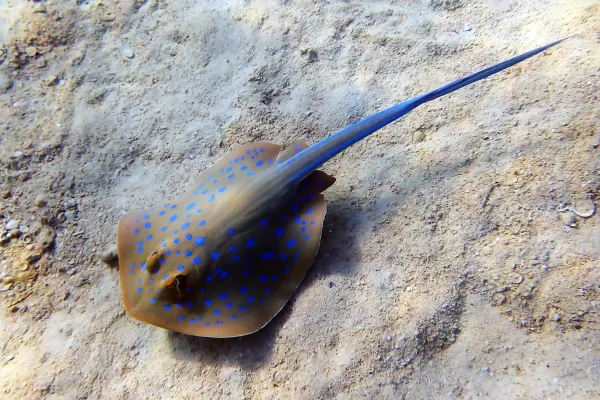
3) Blue-spotted Ribbontail Ray (Taeniura lymma)
Key traits
Look: bright round blue spots on a gray, greenish, or yellow-toned back
Body shape: more rounded than strongly triangular
Tail: long and slender, with a venomous spine used for defense
Habitat
Often called a reef ray because it is commonly found around coral reefs. Its vivid spotting makes it one of the easiest rays to identify at a glance.
4) Southern Stingray / American Whipray (Hypanus americanus)
Range
As the name suggests, this stingray lives in the Gulf of Mexico, the Caribbean Sea, and parts of the southern Atlantic.
Key traits and lifestyle
Body: diamond-shaped
Color: very light brown above; pale/whitish underside
Behavior: buries itself in sand during the day and forages more actively at night
Diet and reproduction
It feeds on large marine invertebrates and bottom-associated fish that often hide in sand. Females may produce 3–5 pups per litter, and pregnancy is often described as lasting roughly 6–9 months.

5) Spotted Eagle Ray (Aetobatus narinari)
Key traits
Look: dark blue to almost black “cape” with pale round spots
Tail: extremely long—often 2–3 times the body length—armed with venomous spines
Size: can reach about 3 m; can weigh around 230 kg
Habitat and lifespan
Often found in shallow coastal waters across a wide range, including parts of the Gulf of Mexico, areas near Venezuela and Ecuador, plus regions of the Indian Ocean, Oceania, and Southeast Asia. Lifespan is commonly described around 15 years in the wild and up to 20 years in captivity. Its whip-like tail is one of its most memorable features.

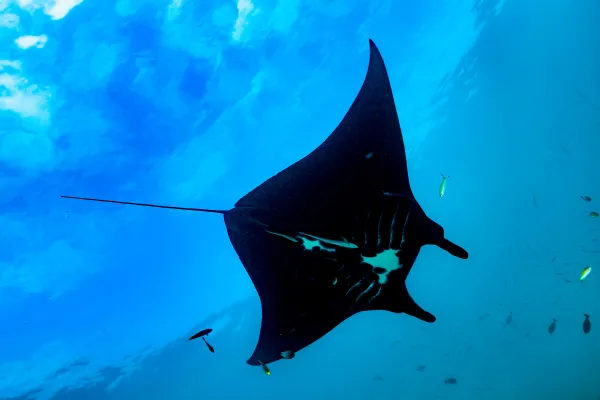
6) Oceanic Manta Ray / Giant Manta (Mobula birostris)
Key traits
Size: around 5.5 m across on average; up to 1.5–2 tons
Lifespan: often cited around 50 years
Tail spine: present but covered by skin and not typically used for defense
Behavior
Giant mantas are known for spectacular breaching—leaping out of the water and slapping the surface. The loud impact may help with communication, and the sound can carry over long distances in open ocean conditions.
7) Common Eagle Ray (Myliobatis aquila)
Key traits
Size: close to 2 m; about 15 kg (often reported)
Color: brown to dark gray above, pale underside
Tail: long and rodent-like, leading to nicknames such as “mouse ray”
Range and notes
Reported from parts of the Atlantic, including Ireland and the British Isles, and throughout the Mediterranean. In some coastal cultures, it has been valued as food. Its swimming style looks like slow wingbeats, resembling a bird “flying” underwater.

8) Butterfly Ray (Gymnura altavela)
Why it stands out
The butterfly ray earns its name from its wide fins and elegant outline, which can resemble a butterfly in motion. It can camouflage exceptionally well against sandy bottoms, and it has also been nicknamed the “paper ray” because its flat form can look like a patterned sheet.
Diet and threats
It eats a mix of plankton, fish, mollusks, and crustaceans. Like many bottom-associated species, it can be caught incidentally in bottom trawling, which is one reason it is considered threatened in some areas.

9) Chilean Devil Ray / Sicklefin Devil Ray (Mobula tarapacana)
Key traits
Nickname: “horned manta” because it appears to have two horn-like lobes on the head
Size: about 2–2.5 m; can weigh up to around 400 kg
Tail: very short, sometimes appearing almost absent
Lifespan: often described around 15 years
Behavior
This species may gather in large numbers under certain conditions, forming noticeable seasonal or feeding aggregations.

Rays vs Manta Rays: A Simple Takeaway
Bottom-feeding rays often have diamond or rounded bodies and may bury in sand (many stingrays, whiprays, butterfly rays).
Mantas and devil rays (Mobula) are built for open-water cruising and are famous for their wing-like “flight” and group behaviors.
Tail spines are common in many stingrays and eagle rays, but not all rays rely on them as their main defense.