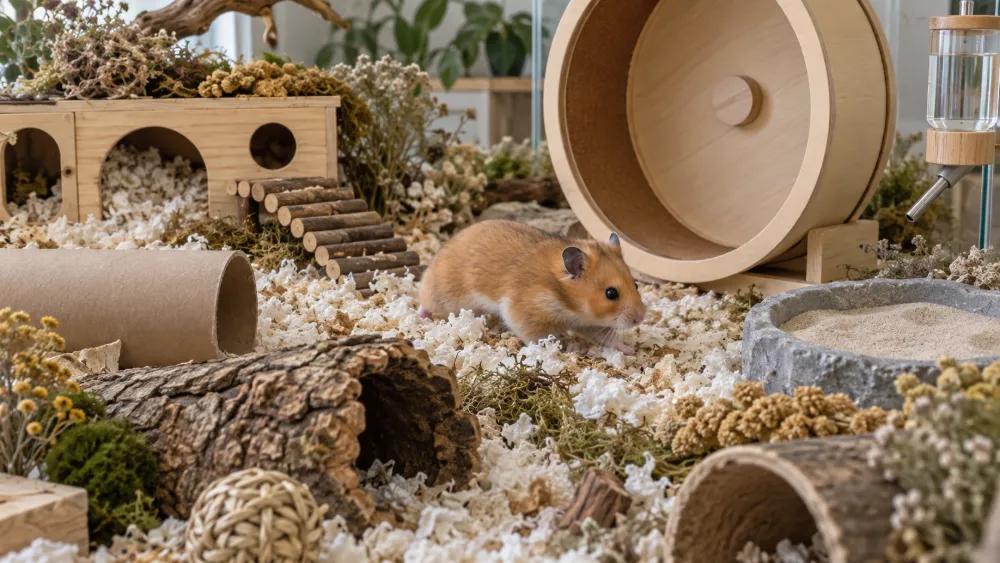
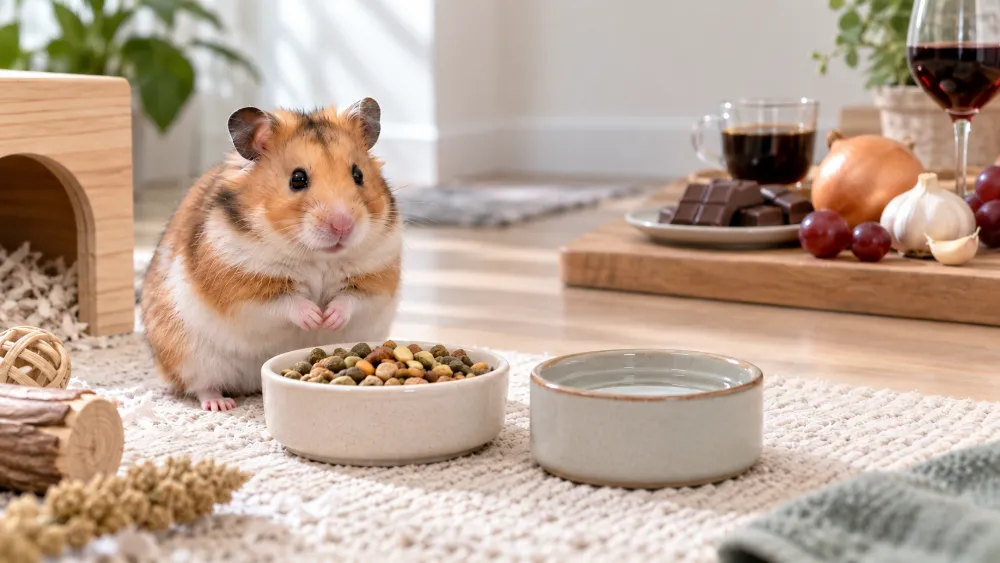
Hamsters can eat small amounts of many vegetables, including broccoli, cucumber, bell pepper, squash, courgette, green beans, peas, spinach, kale and small pieces of carrot. Vegetables should supplement a nutritionally complete hamster food rather than replace it. Wash produce thoroughly, cut it into hamster-sized pieces, introduce new foods gradually and remove uneaten fresh food before it spoils. Dwarf hamsters need even smaller portions than Syrian hamsters.
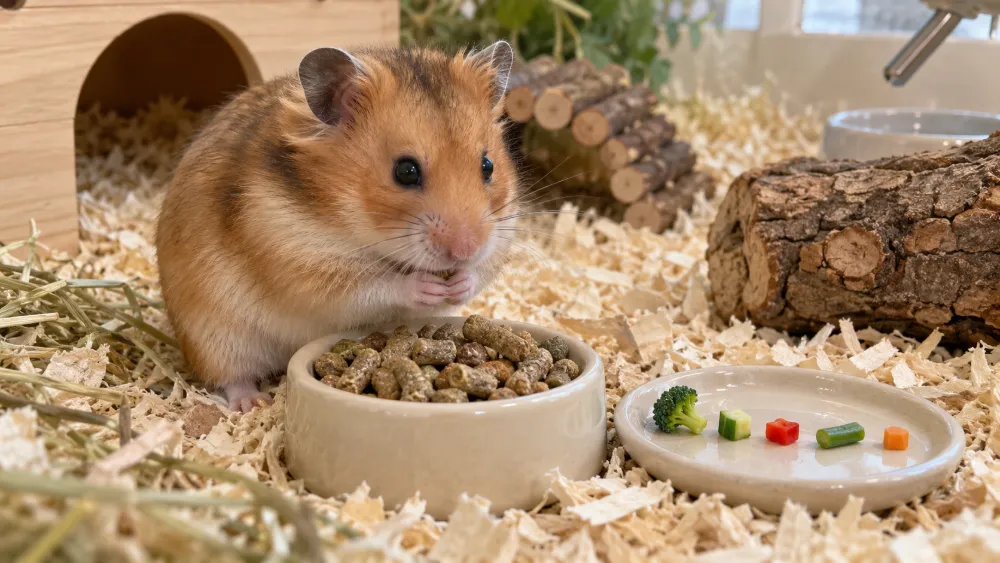
Vegetables can add variety to a hamster's diet, but portions should remain small and complete hamster food should still provide most daily nutrition.
Safe Vegetables for Hamsters at a Glance
| Vegetable | Can Hamsters Eat It? | How to Serve | Main Caution |
|---|---|---|---|
| Broccoli | Yes | Tiny washed floret | Do not overfeed |
| Cucumber | Yes | Small fresh piece | High water content |
| Bell pepper | Yes | Small seed-free piece | Serve plain |
| Courgette / zucchini | Yes | Small washed piece | Moderate portions |
| Green beans | Yes | Small chopped piece | Plain only |
| Pumpkin | Yes | Tiny piece of plain flesh | No sugar or seasoning |
| Squash | Yes | Small plain piece | Keep portions small |
| Peas | Yes | One or part of one pea | Contains more carbohydrate than leafy greens |
| Spinach | Yes | Small washed leaf | Use as part of a varied rotation |
| Kale | Yes | Small washed piece | Moderation |
| Carrot | Yes | Very small piece | Sweeter than many vegetables |
| Romaine lettuce | Yes | Small washed piece | Do not replace more nutritious foods |
| Iceberg lettuce | Better skipped | Choose another green | Mostly water and low in nutritional value |
How Much Vegetable Can a Hamster Eat?
Vegetables should remain a small part of the overall diet.
Veterinary recommendations vary slightly, but the consistent message is that a hamster's main food should be a nutritionally complete pelleted or formulated hamster diet.
Fresh vegetables are an extra.
PetMD recommends that vegetables, grains, fruit and treats together make up no more than a small fraction of the daily diet, while PDSA recommends only small daily portions of fresh fruit, vegetables and herbs.
A practical approach is to start with a piece that looks very small even by human standards.
For dwarf hamsters, make the portion smaller again.
Why Vegetables Should Not Replace Hamster Food
Vegetables contain useful water, fiber and micronutrients, but they do not provide all of the protein, fat, amino acids, vitamins and minerals a hamster requires in the correct proportions.
A hamster diet should therefore follow this basic structure:
| Food | Role |
|---|---|
| Complete hamster pellets or formulated food | Main daily nutrition |
| Vegetables | Small supplementary portions |
| Fruit | Tiny occasional treat |
| Protein treats | Occasional variety |
| Fresh water | Always available |
For the complete feeding structure, see What Can Hamsters Eat? Complete Safe Food List.
Can Hamsters Eat Broccoli?
Yes. Hamsters can eat broccoli in small amounts.
Broccoli appears on hamster-safe food lists from veterinary and animal-welfare sources.
Offer a tiny washed floret or a very small piece of stem.
There is no benefit to giving a hamster an entire large broccoli floret.
Introducing too much fresh vegetable at once can contribute to digestive upset, especially if the hamster is not accustomed to fresh food.
Can Hamsters Eat Cucumber?
Yes. A small piece of cucumber is suitable for most healthy hamsters.
Cucumber is mostly water, so keep the serving small.
A large serving provides unnecessary moisture and can make it easier for a hamster to stash wet food in the enclosure where it may spoil.
Wash the cucumber before serving and remove leftovers later.
Can Hamsters Eat Bell Peppers?
Yes.
Sweet bell peppers are included in reputable hamster feeding guidance.
Red, yellow, orange and green bell peppers can all be offered in small portions.
Serve them:
fresh;
washed;
plain;
without sauces or seasoning.
Hot chili peppers are a completely different food and should not be treated the same way as sweet bell peppers.
Can Hamsters Eat Carrots?
Yes, but carrots are best kept to small portions.
Carrots contain more natural sugar than many leafy greens.
That does not make carrot unsafe, but it makes portion control more important.
A small piece is plenty for a Syrian hamster, and a dwarf hamster needs even less.
Can Hamsters Eat Spinach?
Yes.
Fresh spinach appears on veterinary lists of vegetables suitable for hamsters.
Wash it thoroughly and offer only a small leaf or piece.
There is no need to feed spinach every day.
Rotating different safe vegetables provides more variety than relying heavily on one green.
Can Hamsters Eat Kale?
Yes.
Small amounts of washed kale can be offered as part of a varied fresh-food rotation.
Because the main diet should still come from complete hamster food, there is no nutritional need to give large servings of kale or any other leafy vegetable.
Can Hamsters Eat Lettuce?
Some types of lettuce are more useful than others.
Romaine lettuce can be offered in small amounts.
Iceberg lettuce is better skipped because it is largely water and provides relatively little nutritional value compared with darker leafy greens.
Iceberg lettuce is not useful enough to deserve a large place in a hamster's diet.
Can Hamsters Eat Courgette or Zucchini?
Yes.
Courgette, called zucchini in the United States, is listed as suitable in hamster feeding guidance.
Serve only a small washed piece.
Like cucumber, it contains substantial water, so there is no need to offer a large serving.
Can Hamsters Eat Green Beans?
Yes.
Green beans are included among vegetables suitable for hamsters.
Wash them and cut off a very small piece for serving.
They should be plain, without:
salt;
butter;
oil;
seasoning;
sauces.
Can Hamsters Eat Pumpkin?
Yes.
Plain pumpkin flesh can be offered in a small amount.
Do not confuse plain pumpkin with pumpkin pie filling, which may contain sugar and spices.
The same basic rule applies to squash: plain vegetable flesh in a small portion is very different from a seasoned human dish.
Can Hamsters Eat Squash?
Yes.
Plain squash is listed among hamster-safe vegetables by veterinary sources.
Offer a very small piece and remove leftovers before they spoil.
A hamster does not need a large portion simply because squash is considered safe.
Can Hamsters Eat Peas?
Yes.
A pea or part of a pea can be offered as a small vegetable treat.
Peas contain more starch and carbohydrate than many leafy greens, so they should be part of a varied diet rather than something fed in large quantities.
Can Hamsters Eat Cauliflower?
Yes.
PDSA lists cauliflower among vegetables suitable for hamsters.
Offer a very small washed piece.
As with broccoli and cabbage, large amounts of cruciferous vegetables are unnecessary and may not agree with every individual hamster.
Can Hamsters Eat Cabbage?
Yes, in small amounts.
PDSA includes cabbage among suitable vegetables.
Introduce it gradually and use a modest portion.
If a particular fresh food causes loose stools or digestive upset, stop feeding it.
Can Hamsters Eat Celery?
Small amounts of celery are listed as acceptable by some hamster-care sources, but it is mostly water and is not especially nutritionally valuable.
Other vegetables such as broccoli, peppers or leafy greens are usually more useful choices.
If celery is offered, cut it into a very small piece rather than giving a long fibrous stalk.
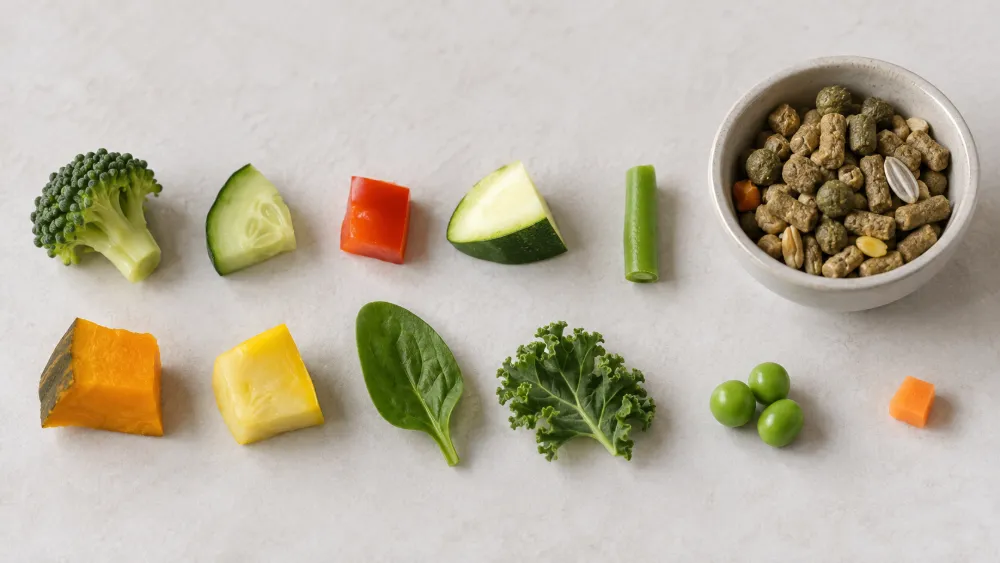
Variety is useful, but every fresh vegetable portion should remain small compared with the hamster's complete daily food.
Vegetables Hamsters Should Avoid
Most common vegetables are not automatically dangerous, but several foods are better excluded.
| Food | Recommendation | Why? |
|---|---|---|
| Garlic | Avoid | Veterinary hamster-care guides advise against it |
| Onion | Safest to avoid | Veterinary guidance is inconsistent; several veterinary hamster guides specifically advise against it |
| Raw beans | Avoid | Listed among unsuitable foods in veterinary hamster guidance |
| Raw potato | Avoid | Veterinary hamster guides advise against it |
| Unripe tomato | Avoid | Veterinary guidance specifically advises against unripe tomato |
| Iceberg lettuce | Better skipped | Mostly water with little nutritional benefit |
| Vegetables cooked with salt, oil or sauce | Avoid | Unnecessary salt, fat and seasoning |
What About Onion? Why Do Sources Disagree?
This is one area where hamster-care sources do not completely agree.
Some animal-welfare lists have included onion among acceptable vegetables, while several veterinarian-reviewed hamster care sheets specifically advise owners not to feed onion or garlic.
When reputable sources conflict and the food is not necessary for the hamster's diet, the simplest approach is:
Do not feed onion or garlic. Choose a better-established vegetable instead.
There is no nutritional reason to take an avoidable risk when broccoli, cucumber, peppers, squash and many leafy greens are available.
Can Hamsters Eat Tomatoes?
Tomato requires a little more precision.
Some hamster-care sources allow small amounts of ripe tomato fruit, while veterinarian-reviewed guidance warns against unripe tomatoes.
If tomato is offered at all, use only a tiny amount of ripe red fruit.
Do not offer:
green unripe tomatoes;
tomato leaves;
tomato stems;
seasoned tomato sauce.
Should Vegetables Be Raw or Cooked?
Most vegetables suitable for hamsters can be offered fresh and thoroughly washed.
There is usually no need to cook them.
If a vegetable is offered cooked, it should be completely plain:
no salt;
no oil;
no butter;
no garlic;
no onion;
no spices;
no sauces.
The goal is to offer the vegetable itself, not a portion of a human meal.
Should You Peel Vegetables for a Hamster?
Usually not, provided the produce is safe, fresh and thoroughly washed.
Peeling can be sensible if:
the outer surface is damaged;
the vegetable has been waxed;
it is difficult to clean adequately.
Always cut vegetables into small pieces before serving.
Wash Vegetables Before Feeding
Fresh produce should be washed thoroughly before it is given to a hamster.
This removes dirt and helps reduce residues on the surface.
After washing:
cut off damaged or spoiled areas;
prepare a very small serving;
offer it plain;
remove uneaten fresh food later.
Remove Uneaten Vegetables
Hamsters naturally hoard food in their cheek pouches and carry it to hidden storage areas.
That behavior is normal, but wet vegetables can spoil inside a food cache.
Check the enclosure for old fresh food and remove vegetables that are becoming soft, brown, mouldy or otherwise spoiled.
Dry staple food can be treated differently from moist fresh produce.
Introduce New Vegetables Slowly
Do not introduce five unfamiliar vegetables at the same time.
A better method is:
choose one safe vegetable;
give a tiny amount;
observe the hamster's droppings and appetite;
wait before introducing another new food.
Sudden dietary changes can cause gastrointestinal upset in small mammals.
If a hamster develops persistent diarrhea, lethargy, loss of appetite or a wet and soiled rear end, contact a veterinarian experienced with small mammals.
Vegetables for Syrian vs Dwarf Hamsters
| Issue | Syrian Hamster | Dwarf Hamster |
|---|---|---|
| Safe vegetable types | Broadly similar | Broadly similar |
| Portion size | Small | Smaller |
| Carrot and sweeter vegetables | Moderation | Extra moderation |
| Main food | Complete hamster diet | Complete hamster diet |
The biggest difference is portion size.
A dwarf hamster may weigh only a fraction as much as a Syrian hamster, so a piece that appears tiny can still represent a significant amount of food.
Best Vegetables for Dwarf Hamsters
Useful choices include tiny portions of:
broccoli;
cucumber;
bell pepper;
courgette;
spinach;
kale;
green beans;
squash.
Carrot and other naturally sweeter vegetables can still be used, but keep the portion especially small.
PDSA notes that Russian dwarf hamsters are particularly prone to diabetes, which is another reason to avoid turning sweet foods into daily treats.
Are Vegetables Better Than Fruit for Hamsters?
For regular fresh-food variety, many vegetables are more practical than sweet fruit.
Fruit contains more simple sugar and is generally better treated as an occasional treat.
Vegetables such as broccoli, peppers and leafy greens provide variety without making every fresh-food serving a sugary one.
That does not mean vegetables should be unlimited.
Both vegetables and fruit remain supplements to complete hamster food.
See our separate guide: What Fruits Can Hamsters Eat? Safe & Unsafe Fruit List.
Frequently Asked Questions
What vegetables can hamsters eat every day?
Small amounts of suitable vegetables such as broccoli, cucumber, bell pepper, squash or leafy greens can be included regularly. However, complete hamster food should still provide most of the diet, and fresh-food portions should remain small.
Can hamsters eat broccoli?
Yes. A tiny washed broccoli floret can be offered. Introduce it gradually and do not give a large portion.
Can hamsters eat cucumber?
Yes. Cucumber is suitable in small quantities. Because it contains a lot of water, a tiny piece is enough.
Can hamsters eat carrots?
Yes. Carrot is safe in small portions but is naturally sweeter than many green vegetables. Dwarf hamsters should receive particularly small servings.
Can hamsters eat spinach?
Yes. Small amounts of washed spinach can be offered as part of a varied vegetable rotation.
Can hamsters eat kale?
Yes. Kale can be offered in a small amount. It should supplement, not replace, nutritionally complete hamster food.
Can hamsters eat lettuce?
Romaine and other more nutritious leafy lettuces can be offered in small amounts. Iceberg lettuce is better skipped because it is mostly water and has relatively little nutritional value.
Can hamsters eat peppers?
Sweet bell peppers are suitable for hamsters in small portions. Serve them washed and plain. Do not confuse sweet peppers with hot chili peppers.
Can hamsters eat cabbage?
Yes. PDSA lists cabbage as a suitable vegetable. Start with a very small portion and stop feeding it if it causes digestive upset.
Can hamsters eat cauliflower?
Yes. A tiny amount of washed cauliflower can be offered occasionally as part of a varied diet.
Can hamsters eat celery?
Small amounts are listed as acceptable by some sources, but celery contains a lot of water and is not especially nutritious. Better-established vegetables such as broccoli or peppers are usually more useful.
Can hamsters eat onion?
Guidance conflicts, but several veterinarian-reviewed hamster-care resources specifically recommend avoiding onions. Since onion is unnecessary, the cautious choice is not to feed it.
Can hamsters eat garlic?
Veterinarian-reviewed hamster-care guidance recommends avoiding garlic. Choose one of the many better-established safe vegetables instead.
Can hamsters eat potatoes?
Veterinary hamster-care sources advise against raw potato. There is no need to include potato when safer vegetables are readily available.
Can hamsters eat peas?
Yes. A single pea or smaller portion can be offered. Peas are more starchy than leafy vegetables, so moderation is sensible.
How much vegetable should a hamster eat?
Only a small amount. Fresh vegetables should supplement a complete hamster diet rather than become the main meal. Dwarf hamsters require smaller portions than Syrian hamsters.
Related Hamster Feeding Guides
Veterinary and Animal-Welfare Sources
RSPCA — What to Feed a Pet Hamster
PDSA — Hamsters as Pets
VCA Animal Hospitals — Owning a Pet Hamster
VCA Animal Hospitals — Feeding Rodents
PetMD — Syrian Hamster Care Sheet
PetMD — Dwarf Hamster Care Sheet
PetMD — What Can Hamsters Eat?