Yes, pet insurance can be worth it, but not for every owner and not in every situation. It is usually most valuable when you want protection against large, unexpected veterinary bills such as surgery, emergency treatment, cancer care, or chronic disease management. It is usually less valuable if you can comfortably self-fund major vet costs, or if you expect it to cover every routine expense. The real question is not “Is it always worth it?” but “Does it match your risk, budget, and pet’s health profile?”
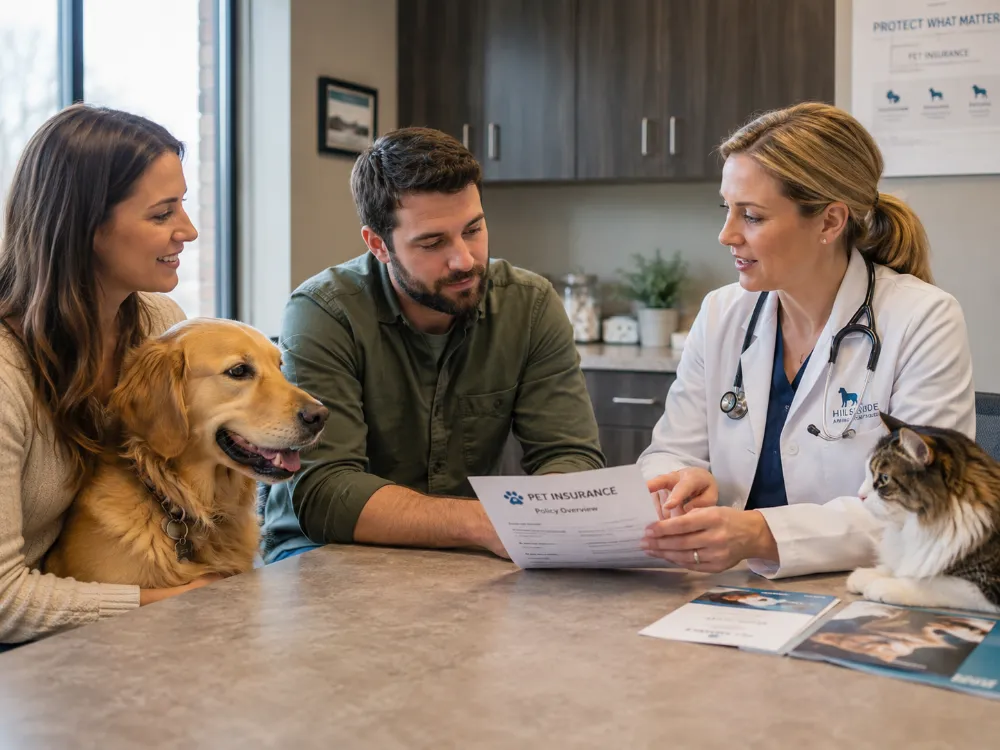
Pet insurance has become a major topic for dog and cat owners because veterinary medicine is more advanced than ever. Pets now receive imaging, specialist care, orthopedic surgery, chemotherapy, intensive care, and long-term treatment for chronic disease. That is good news for animal welfare, but it also means a single accident or diagnosis can become very expensive.
Some owners see pet insurance as peace of mind. Others see it as an extra monthly bill that may never pay off. Both views contain some truth. The value of pet insurance depends on what kind of owner you are, what kind of pet you have, how much financial risk you can absorb, and how well you understand the policy before you buy it.
In this guide, you will learn what pet insurance actually does, when it makes the most sense, when it may not be worth it, and how to decide more realistically for your own dog or cat.
Quick answer table
| Question | Short Answer |
|---|---|
| Is pet insurance worth it? | Often yes for unexpected major medical costs, but not always for routine care |
| Who benefits most? | Owners who want protection from large emergency or illness bills |
| Who may benefit less? | Owners who can easily self-fund expensive vet treatment |
| What does it usually help with? | Accidents, surgeries, hospital care, diagnostics, and many illnesses |
| What is often not covered? | Pre-existing conditions, some preventive care, and certain exclusions depending on the plan |
| Best time to buy? | When the pet is young and healthy, before problems appear |
| Main mistake owners make | Assuming pet insurance works like a wellness plan that covers everything |
| Best way to decide | Compare your financial risk tolerance, your pet’s likely needs, and the policy details |
What pet insurance actually is
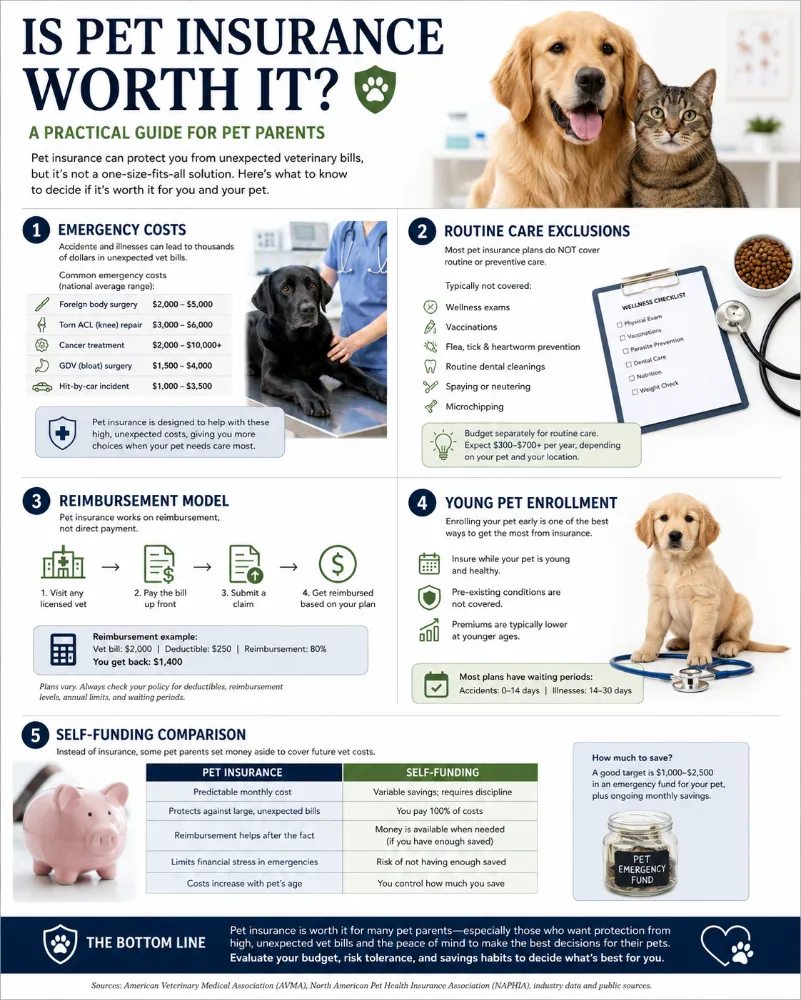
Pet insurance is usually a reimbursement-based system that helps cover eligible veterinary costs after your pet becomes sick or injured. In many cases, the owner pays the veterinary bill first, then submits a claim to the insurer, which reimburses part of the approved cost based on the policy terms.
This means pet insurance is not usually the same as a human health system where the clinic bills the insurer directly and the patient only pays a small portion at the visit. Some providers may offer more direct arrangements in certain cases, but the general model is still reimbursement after treatment.
That difference matters because many disappointed owners are not upset that the policy “failed.” They are upset because they expected it to work like something it was never designed to be.
What pet insurance usually covers
The strongest value of pet insurance is protection against expensive, unexpected medical care. Depending on the plan, this may include emergency exams, hospitalization, surgery, diagnostic imaging, bloodwork, prescription medication, specialist treatment, cancer care, and management of covered illnesses or injuries.
For many households, this is the real reason to buy it. A routine ear infection is annoying, but a torn cruciate ligament, intestinal blockage, emergency surgery, diabetic treatment, or complex cancer workup can become financially overwhelming very quickly.
In other words, pet insurance usually matters most when something serious happens, not when life stays simple.
What pet insurance often does not cover
One of the biggest reasons owners feel disappointed is that pet insurance often does not cover everything. Pre-existing conditions are commonly excluded. Routine wellness care such as vaccines, nail trims, dental cleanings, flea prevention, and regular checkups may not be included unless the owner buys an optional wellness add-on.
Some plans also limit or exclude breeding-related care, cosmetic procedures, elective services, or certain hereditary or bilateral conditions depending on the provider and the exact policy wording. Waiting periods can also apply, which means a newly purchased policy may not cover a problem that appears too soon after enrollment.
This is why reading the policy matters so much. Pet insurance is usually strongest as medical-risk protection, not as an all-purpose pet-expense subscription.
Why people think pet insurance is worth it
The main reason owners value pet insurance is simple: it changes the financial conversation during a crisis. When a dog breaks a leg, a cat gets a urinary blockage, or a young pet swallows a dangerous object, the owner may suddenly face a bill that is far above the normal monthly pet budget.
Insurance can reduce the chance that the owner has to choose between debt, delaying treatment, or declining care. For many families, that peace of mind alone is worth a lot. They are not trying to “beat the insurance company” in total dollars. They are trying to avoid one devastating bill.
That is an important mindset shift. Pet insurance is most useful as a shock absorber, not as a guaranteed money-making strategy.
Why some people think pet insurance is not worth it
The most common complaint is that owners pay monthly premiums for years and do not get back as much money as they expected. If the pet stays healthy or only needs routine care, the policy may feel like a loss. That feeling is understandable.
Other owners become frustrated by deductibles, reimbursement percentages, waiting periods, exclusions, annual limits, or premium increases over time. Some expected the plan to cover preventive care, dental work, or chronic conditions that were excluded. Others bought coverage too late, after a problem was already documented, and discovered that the condition counted as pre-existing.
So when owners say pet insurance was “not worth it,” they may mean very different things. Sometimes the policy truly was a poor fit. Sometimes the expectations were unrealistic from the beginning.
The biggest question is risk tolerance
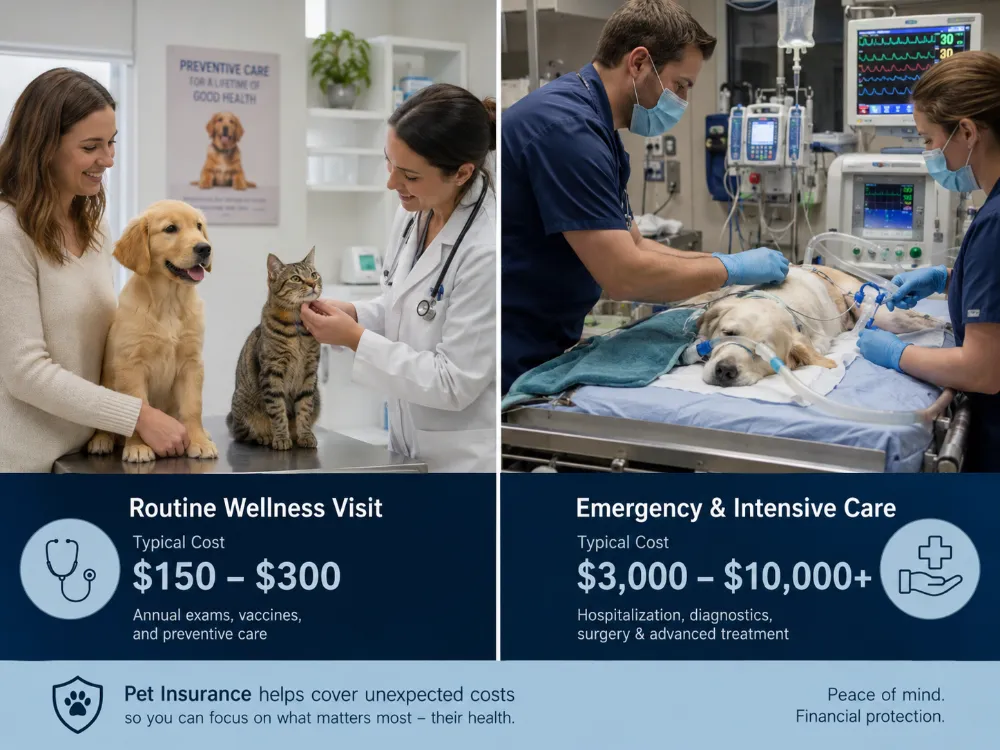
From a practical point of view, pet insurance is really a risk-management decision. Ask yourself this: if your pet suddenly needed a treatment that cost several thousand dollars, could you pay it without panic, debt, or delaying care?
If the answer is yes, you may prefer self-funding through savings. If the answer is no, pet insurance may be very valuable. In that sense, pet insurance works much like other forms of insurance. You are paying to transfer part of a financial risk from yourself to an insurer.
That does not mean every owner should buy it. It means the owner should first understand what problem the insurance is actually solving.
Pet insurance is often most valuable for emergencies
Emergency medicine is where pet insurance most often proves its worth. Trauma, poisoning, intestinal obstruction, pancreatitis, urinary blockage, serious infections, fractures, and emergency surgery can create bills far above what many households expect.
In those moments, the difference between “I have coverage” and “I have only what is in my checking account” can be emotionally and medically significant. Insurance does not make a crisis easy, but it may make the treatment decision clearer.
That is why many veterinarians and experienced pet owners do not evaluate pet insurance by routine expenses. They evaluate it by what happens on the worst day.
Young healthy pets are often the best candidates
Pet insurance usually makes the most sense when bought early, before medical problems appear. A young healthy dog or cat is less likely to have exclusions tied to past medical records, and premiums may start lower than they would for an older pet.
This matters because many owners wait until they become worried about a specific condition, then try to buy insurance after symptoms or diagnoses have already appeared. At that point, the insurer may not cover the condition that motivated the purchase in the first place.
So the best time to think about pet insurance is often before you feel like you need it.
Older pets create a more complicated decision
Insurance for older pets can still be worthwhile, but the calculation becomes harder. Premiums are often higher, and the pet may already have documented health issues that limit coverage. At the same time, older pets are exactly the animals most likely to need costly care.
That means there is no universal answer. For one owner, a high premium plus many exclusions may make self-funding more sensible. For another owner, even partial help with cancer treatment, heart disease, or emergency hospitalization may still make the policy worthwhile.
The right answer depends on the pet’s health history, the policy details, and the owner’s ability to pay for future problems without insurance.
Breed and species matter
Some pets are statistically more likely to develop orthopedic disease, breathing problems, allergies, heart disease, dental issues, or certain hereditary conditions. Large-breed dogs, brachycephalic dogs, and some purebred lines can create a different insurance calculation than a healthy mixed-breed cat with no major risk signals.
This does not mean every high-risk breed will generate massive costs or every low-risk pet will stay inexpensive. It means the likely pattern of veterinary spending is not identical across pets. A policy may make more sense for an owner who knows their breed carries meaningful medical risk.
So pet insurance should never be judged in the abstract. It should be judged in relation to the actual animal in front of you.
Accident-only plans and full coverage plans are not the same
Not all pet insurance works the same way. Some plans focus mainly on accidents, while broader accident-and-illness plans also cover many diseases and chronic conditions. These are very different products in practical value.
An accident-only plan may be affordable and useful if your biggest fear is trauma or emergency injury. A broader plan is usually more relevant if you want help with cancer, diabetes, chronic allergies, urinary disease, skin disease, digestive illness, or other non-accident problems.
So when asking whether pet insurance is worth it, you also have to ask which kind of insurance you mean.
Wellness add-ons are not the main point
Many owners get distracted by wellness add-ons that cover routine care such as vaccinations or preventive visits. These can be convenient, but they are usually not the core reason pet insurance matters. In many cases, they function more like a budgeting tool than a true risk-transfer product.
The deeper value of pet insurance usually lies in unexpected medical events, not in spreading predictable annual costs across monthly payments. Routine care is important, but routine care is also easier to plan for than a sudden surgical emergency.
So if you judge the whole idea of pet insurance only by whether it covers vaccines, you may miss its main purpose.
Self-funding can be a reasonable alternative
Some owners choose not to buy pet insurance and instead build a dedicated emergency savings fund for veterinary care. This approach can work well for disciplined households with strong savings habits and enough income to handle a major expense if it happens early.
The weakness of self-funding is timing. If your pet has an expensive emergency before your savings fund has grown, you may still be exposed. Insurance, by contrast, can protect against a high-cost event relatively early, as long as the condition is covered and waiting periods have passed.
So self-funding is not wrong. It is simply a different risk strategy.
Premium increases are part of the real calculation
One reason long-term pet insurance can feel less attractive over time is that premiums may rise. Age, inflation, veterinary pricing, region, and policy design can all affect what you pay later. An owner who was happy with the price for a one-year-old dog may feel very differently when that dog is ten.
This is important because some owners calculate value only from the starting premium. A more realistic approach is to imagine how you would feel if the monthly cost rose later, while the pet was also becoming more likely to need care.
That does not make insurance a bad idea. It simply means affordability must be judged over the likely life of the pet, not only in the first year.
Claims frustration often comes from misunderstanding policy mechanics
Deductibles, reimbursement rates, annual or lifetime limits, and exclusions can make owners feel that coverage is smaller than expected. For example, a policy that reimburses 70% after the deductible is not promising to erase the entire bill. A policy with exclusions for pre-existing disease is not promising to start fresh after symptoms appear.
From a scientific or veterinary communication point of view, this is where owner education matters most. Insurance disappointment often grows from a mismatch between the contract and the owner’s mental picture of what “insurance” should mean.
The better the owner understands the mechanics before buying, the more honest the value calculation becomes.
Pet insurance can protect decision quality
One overlooked benefit of pet insurance is that it may improve the quality of medical decision-making. When an owner knows part of a large bill may be reimbursed, they may be more willing to approve diagnostics, hospitalization, referral care, or surgery that they would otherwise decline immediately.
That does not mean insured owners should automatically choose the most aggressive treatment. It means financial pressure may distort medical choices less when coverage exists. From an animal welfare perspective, that can be meaningful.
Sometimes the value of insurance is not only in dollars recovered. It is in the medical options that remain open when something serious happens.
When pet insurance is often worth it
Pet insurance is often worth it when the owner wants protection from major surprise bills, cannot comfortably absorb several thousand dollars at short notice, has a young pet with no known health problems, or owns a breed with meaningful medical risk. It can also be worthwhile for owners who know they would otherwise struggle emotionally and financially during a veterinary emergency.
It is especially compelling for people who prefer predictable monthly budgeting over the possibility of a sudden high-cost event. For these owners, the peace of mind is not an extra feature. It is the main feature.
In that situation, pet insurance is not a luxury. It is a planning tool.
When pet insurance may not be worth it
Pet insurance may be less worthwhile if you have enough savings to comfortably self-fund major veterinary care, if the policy available to you is expensive and full of exclusions, or if your pet is older and already has multiple documented conditions that limit useful coverage. It may also be less attractive if you mainly want help with routine care, because insurance is usually not strongest there.
For some owners, a dedicated emergency fund plus realistic budgeting for preventive care is simpler and more satisfying than paying premiums over many years. That approach can be perfectly reasonable if the owner truly has the financial discipline and reserves to make it work.
So no honest answer should claim pet insurance is automatically right for everyone.
The best way to decide
Ask four questions. First, could I handle a very large emergency bill without panic? Second, is my pet young enough and healthy enough that the policy will still be broadly useful? Third, do I understand what the plan excludes, reimburses, and requires? Fourth, am I buying this for routine spending or for catastrophic risk?
If your honest answers point toward financial vulnerability during a pet medical crisis, insurance probably deserves serious consideration. If your answers point toward strong savings, high tolerance for risk, and poor policy fit, self-funding may be better.
The best decision is not the one that sounds smartest online. It is the one that still makes sense when your pet gets sick at the worst possible time.
Final takeaway
Pet insurance can absolutely be worth it, especially if you want protection against expensive emergencies, surgeries, and major illnesses that could otherwise strain your finances or change your treatment decisions. It is usually less about saving money on routine care and more about limiting the damage of rare but costly veterinary events. The best candidates are owners who want financial safety, have a young or healthy pet, and understand policy exclusions before buying. The wrong way to judge pet insurance is to ask whether it pays for everything. The right way is to ask whether it protects you and your pet when the stakes are highest.
FAQs
Is pet insurance worth it for indoor cats?
It can be. Indoor cats are usually safer from trauma than outdoor cats, but they can still develop urinary blockages, dental disease, cancer, diabetes, intestinal problems, and other expensive medical conditions. The value depends on your budget and risk tolerance, not just whether the cat stays indoors.
Is pet insurance worth it for young dogs?
Often yes. Young dogs are usually easier to insure before pre-existing problems appear, and they can still create major costs through accidents, swallowed objects, orthopedic injury, or inherited disease later.
Does pet insurance cover routine checkups and vaccines?
Usually not in the main policy. Some providers offer wellness add-ons, but the core value of pet insurance is usually accident and illness protection rather than routine preventive care.
What is the biggest reason pet insurance feels not worth it?
The most common reason is mismatched expectations. Owners often expect it to cover everything, but many plans focus mainly on eligible medical problems, not all routine or pre-existing expenses.