If “predict” means diagnose heart failure before a vet can, the honest answer is not yet.
If “predict” means spot early warning patterns (especially rising resting breathing rate) and nudge you to see a vet sooner, then yes—some collars can genuinely help, and the supporting science is getting stronger.
Here’s what’s real in 2026, what’s marketing, and how to use these collars without getting a false sense of security.
What heart failure looks like in dogs (and why breathing rate matters)
Most pet owners imagine heart failure as a sudden collapse.
In real life, many dogs slide into congestive heart failure (CHF) gradually.
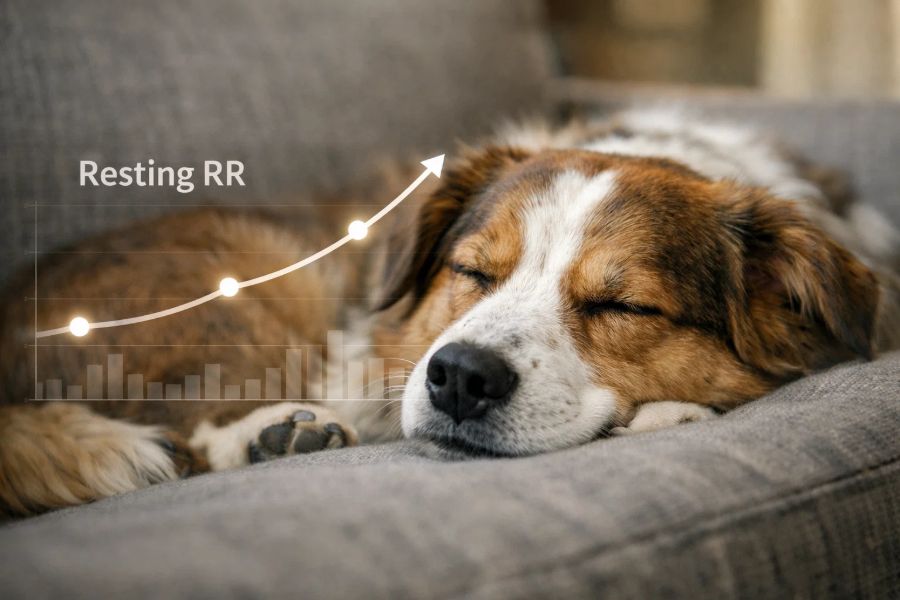
One of the earliest, most measurable changes is resting/sleeping respiratory rate.
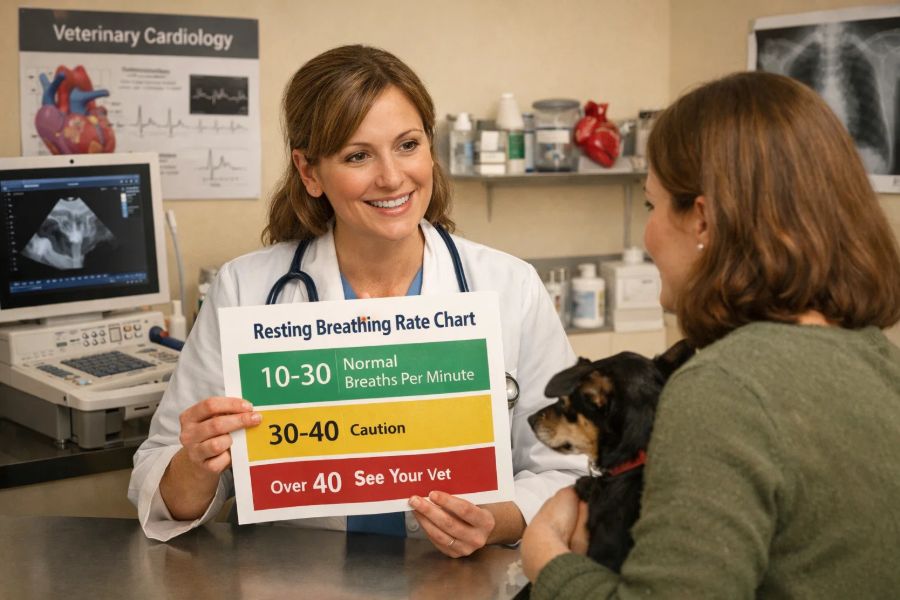
A normal resting/sleeping breathing rate is often 15–30 breaths/minute.
When CHF is well controlled with medication, many dogs still stay below ~32–35 breaths/minute at rest.
Several veterinary resources advise contacting your vet if your dog’s resting rate is consistently >35, or if it rises ~25%+ above baseline over repeated checks.
That’s why wearables focus so hard on resting respiratory rate (RR) and resting heart rate (HR).
Those are the signals most likely to change before you see obvious distress.
What 2026 “AI dog collars” can actually measure
There are two broad product categories in 2026:
1) GPS-first collars (health as a bonus)
These are great at location, activity, sleep, and routines.
Some are now adding resting HR/RR features as the category matures (and as companies consolidate).
2) Health-first collars (vitals are the point)
These aim to capture resting HR, resting RR, HRV, temperature, posture, sleep quality, and trend changes.
The key detail: vitals are only reliable when the dog is truly at rest.
That’s why some devices only record HR/RR when the dog is lying down and still for a minimum period (to reduce motion noise).
The strongest evidence: “Can it measure HR and RR accurately?”
Before you can “predict” anything, the collar has to measure basics well.
What the published research supports
A large real-world study (the “AI-COLLAR” study) followed 703 apparently healthy dogs and built reference data for resting HR/RR under normal home conditions.
In that study’s methods section, the device’s HR/RR measurement accuracy is described as validated against portable ECG (HR) and manual video counting (RR) with very high accuracy figures.
There’s also a veterinary cardiology paper comparing a smart collar’s 24-hour mean heart rate to 24-hour Holter monitoring, finding good agreement for the 24-h mean (but poorer agreement for short 2-minute snapshots during rest/activity).
Translation for owners:
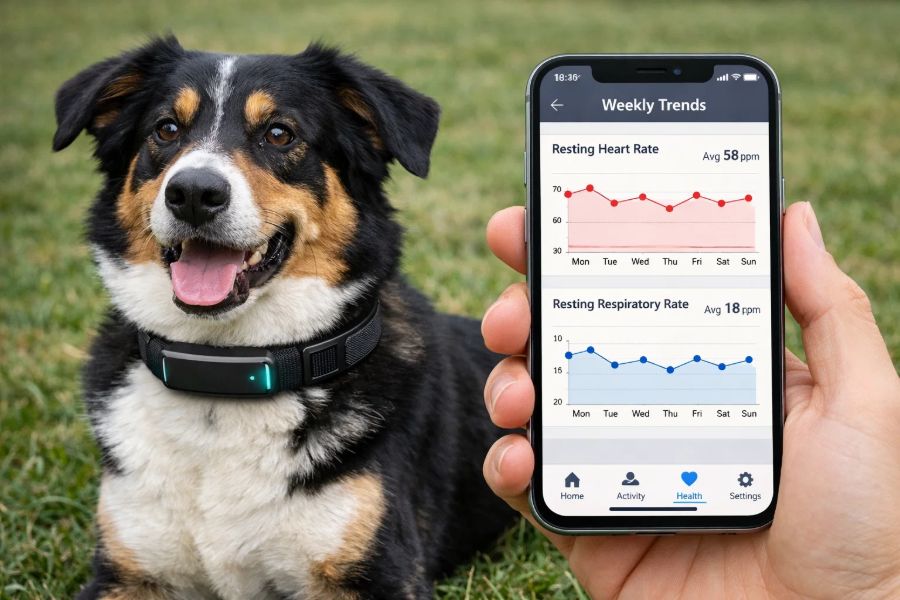
Trend-level signals (daily averages, multi-day trends) are where collars are most believable.
Minute-by-minute “your dog’s HR right now” can be unreliable, especially with movement.
So can these collars “predict heart failure” in 2026?
What they can do well
They can flag patterns consistent with worsening CHF risk, such as:
Resting RR creeping up
Resting HR trending upward
HRV trending down
Sleep disruption + lower activity tolerance
That’s exactly the type of “abnormal pattern detection” the large baseline datasets are intended to enable.
What they cannot do (and why)
They cannot confirm:
“Your dog has CHF.”
“Your dog will go into heart failure next week.”
Because CHF is a clinical diagnosis, usually involving:
Physical exam findings
Chest imaging
Sometimes echocardiography and lab markers
Context (coughing, exercise intolerance, fainting, appetite changes)
Collars don’t see lungs, don’t hear murmurs, and don’t measure blood pressure.
They can only say: “Something changed from baseline.”
The “evidence gap”
Some companies publish case-style reports claiming early detection of deterioration in dogs with heart disease.
Those are interesting, but they’re not the same as a large independent trial proving “prediction.”
Right now, the most defensible claim is:
AI collars can help detect early warning trends that should trigger a vet check, but they don’t replace diagnostics.
Why 2026 is different: the tech is finally built for resting vitals
Earlier pet trackers mostly guessed health from steps.
Newer devices use approaches designed to capture cardio-respiratory signals at the neck during rest.
For example, one collar described in the AI-COLLAR research uses seismocardiography and only records when the dog is lying down and immobile for at least ~40 seconds.
That “only when still” rule is boring marketing-wise.
But it’s exactly what makes the data usable.
The real “heart failure use case”: catching fluid build-up earlier
If you’ve ever had a dog with a murmur, you’ve heard the advice:
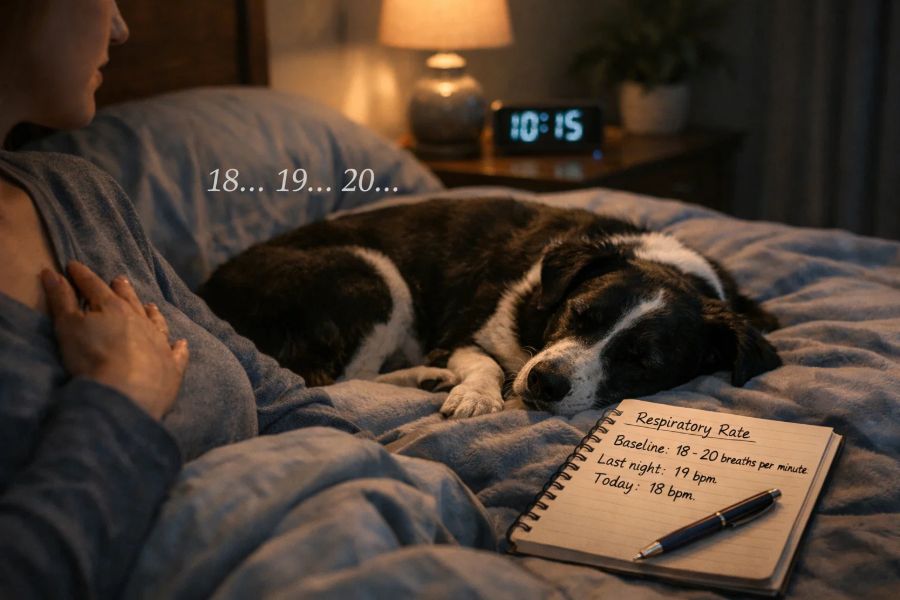
Track sleeping respiratory rate.
Veterinary guidance commonly frames:
15–30/min as normal for resting/sleeping pets
Consistent rises or >35/min as a reason to call your vet
The problem is compliance.
Owners stop counting when life gets busy.
A collar can do the boring part every day, and alert you when:
your dog’s resting RR is trending up, or
it crosses a personalized threshold.
That’s not “predicting heart failure” like a crystal ball.
It’s preventing you from missing the earliest measurable warning sign.
What about “abnormal heart rhythms” and sudden events?
Some devices market detection of irregular rhythms or “abnormal heart patterns.”
Media coverage of newer collars has highlighted “abnormal heart rhythms” as a feature direction.
Be careful here.
Even in humans, wearables are better at screening than diagnosing arrhythmias.
In dogs, motion, coat thickness, collar fit, and breed neck anatomy can all affect signal quality.
Treat rhythm alerts as:
a reason to book a vet visit, not
a reason to start or stop medication.
Buyer checklist: what matters if you care about CHF risk
If your goal is heart health—not just GPS—prioritize:
Resting RR tracking (not just activity)
Resting HR tracking with clear “rest-only” measurement logic
Baseline building (at least 2–4 weeks of normal data)
Trend alerts (multi-day, not single spikes)
Data export/share for your veterinarian
Fit + comfort (a collar that slips or is too tight will produce junk data)
Practical “do this tonight” protocol (works with or without a collar)
Set a baseline
Track resting/sleeping RR for 7 days (manual or collar).
Write down the range.
Know your trigger points
If RR is consistently >35, or ~25%+ above baseline for repeated checks, contact your vet.
Don’t count after excitement
Only measure when your dog is asleep or fully relaxed.
Treat alerts like smoke alarms
Most alarms are false.
You still check the house.
Who benefits most from an AI health collar in 2026?
These collars make the most sense for:
Dogs with a known heart murmur
Senior dogs (especially small breeds prone to valve disease)
Breeds at higher risk of DCM (e.g., Doberman-type risk profiles are commonly discussed in cardiology contexts)
Owners who travel or use dog sitters (you still get objective trend data)
Final verdict
Yes, the best 2026 health collars can help you detect early warning trends that correlate with worsening heart health.
No, they can’t truly “predict heart failure” as a stand-alone medical diagnosis.
Use them as a screening and monitoring tool, then confirm with a veterinarian.