Quick answer: Dragonflies sometimes fly lower before or during changing weather, but low-flying dragonflies are not a reliable sign that rain is definitely coming. Scientific studies show that dragonfly activity is strongly affected by temperature, sunlight, cloud cover and wind. Other insects can also change behavior when barometric pressure falls before storms. However, there is no good evidence that “dragonflies fly low = rain soon” works as a dependable weather forecast.
If you see many dragonflies flying close to the ground or water, they may be feeding on insects, patrolling territory, mating, laying eggs, avoiding stronger winds higher up, or simply responding to changing temperature and light. Weather can influence all of those behaviors, but the relationship is more complicated than the old proverb suggests.
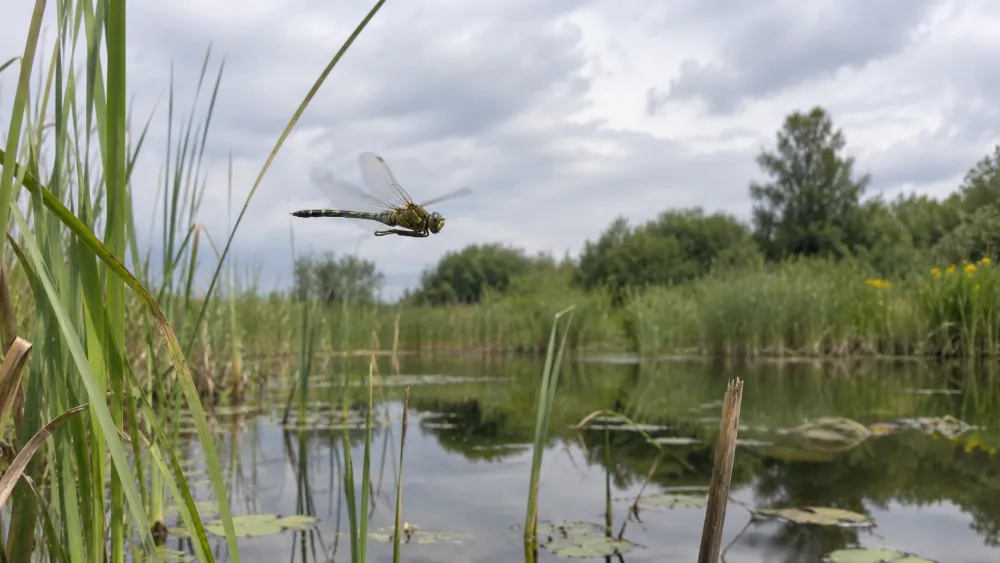
Dragonflies often fly low around water and vegetation while hunting, patrolling territory or breeding. Low flight alone does not prove that rain is imminent.
Do Dragonflies Really Fly Low Before Rain?
Sometimes they do, but the observation should not be treated as a universal rule.
Dragonflies are flying insects whose activity changes rapidly with environmental conditions. Temperature, sunlight, cloud cover, wind and rainfall can all affect whether they fly, perch, hunt or remain sheltered.
The British Dragonfly Society notes that adult dragonflies are generally most active in warm, sunny and calm weather. Field studies likewise show that local weather can change dragonfly flight intensity.
That makes it biologically plausible that people notice different flight patterns before a storm. But a plausible connection is not the same as a dependable weather forecast.
Why Might Dragonflies Fly Lower When the Weather Changes?
There is no single proven explanation that applies to all dragonflies. Several factors can change at the same time before rain.
Wind Speed and Direction
Wind has a direct effect on flying insects.
Strong wind makes controlled flight more difficult and can increase the energetic cost of staying airborne. Studies of dragonfly migration show that wind direction helps predict movement intensity, and some species select favorable winds during migration.
Near the ground, reeds, shrubs and other vegetation can create more sheltered air. A dragonfly flying lower may therefore encounter less turbulent conditions than it would higher above the landscape.
However, this does not mean every low-flying dragonfly is deliberately “escaping a storm.” Low flight is also normal behavior in many species.
Temperature
Dragonflies are ectothermic insects, so body temperature strongly affects flight performance.
Research on species such as the green darner (Anax junius) and twelve-spotted skimmer (Libellula pulchella) shows that dragonflies regulate or respond strongly to thoracic temperature during flight.
Cooler air can reduce activity, while suitable warmth allows more sustained flight. Weather systems that bring cooling can therefore change the amount and style of dragonfly activity before the rain actually begins.
Cloud Cover and Sunlight
Many dragonflies use solar radiation to help warm the flight muscles.
A 2021 study of migrating dragonflies along the Baltic coast found that temperature, cloud cover and wind direction were important predictors of dragonfly abundance in flight. Higher temperature generally increased activity, while increased cloud cover reduced it.
As a storm approaches, sunlight may decline even before rainfall starts. That can cause some dragonflies to reduce long, exposed flights and spend more time close to vegetation or on perches.
Prey Availability
Adult dragonflies are aerial predators. They hunt mosquitoes, midges, flies and many other small insects.
If the height, abundance or movement of prey changes, dragonflies may follow.
It is often suggested that small insects remain closer to the ground before rain and that dragonflies then follow them downward. That is a reasonable hypothesis, but the simple chain “humidity makes insects fly low, therefore dragonflies fly low” is repeated much more confidently online than the scientific evidence supports.
Weather affects many insect species differently. A dragonfly may be responding to prey, temperature, wind, light or several factors at once.
Can Insects Sense a Storm Coming?
Some insects can change behavior when atmospheric pressure changes.
A 2013 study published in PLOS ONE tested three unrelated insect species and found that changes in barometric pressure altered mating and locomotor behavior. Falling pressure—which often precedes storms—reduced some activities.
Other research has found that Asian citrus psyllids change flight behavior with temperature, wind and barometric pressure.
These studies show that insects can respond to atmospheric conditions before severe weather arrives.
But they do not prove that dragonflies specifically use falling pressure to fly closer to the ground. That distinction is important.
Does Low Air Pressure Make Dragonflies Fly Low?
There is not enough direct evidence to say that falling air pressure makes dragonflies lower their flight altitude in a predictable way.
Low atmospheric pressure often accompanies a larger weather system involving changes in:
wind
temperature
cloud cover
humidity
precipitation
A dragonfly observed flying lower during that period may therefore be responding to one factor or several of them.
For other insects, pressure-related behavioral changes have been experimentally demonstrated, but the exact response varies greatly among species.
Do Dragonflies Fly in the Rain?
Adult dragonflies generally reduce flight during significant rain.
A study on dragonfly responses to climate conditions noted that adult dragonflies do not typically fly during rain and that rainy, cooler conditions can reduce foraging opportunities and affect survival or breeding success.
That does not mean one raindrop immediately grounds every dragonfly. Light rain may still allow some movement, and newly emerging dragonflies can sometimes withstand wet conditions.
The British Dragonfly Society describes dragonflies as surprisingly robust during rain, especially during emergence, but adults are normally much easier to observe flying on calm, sunny days.
Where Do Dragonflies Go When It Rains?
During poor weather, adult dragonflies often perch in sheltered vegetation.
Depending on the species and habitat, they may rest:
among reeds or grasses
inside shrubs
on the sheltered side of vegetation
under leaves or branches
in other places protected from strong wind and heavy rainfall
Perching reduces the need to spend energy flying when conditions are unfavorable.
Why Do Dragonflies Normally Fly Low Over Water?
Low flight is completely normal around ponds, lakes, canals, streams and wetlands.
Adult dragonflies may fly close to the water while:
hunting small insects
defending territories
searching for mates
guarding a mate
laying eggs
moving between favorite perches
So if you see a dragonfly flying one or two meters above a pond, that behavior may have nothing to do with weather.
Do All Dragonflies Fly at the Same Height?
No.
Dragonflies have very different lifestyles and flight strategies.
Some species spend much of the day perching and making short hunting flights. Others patrol continuously over ponds or rivers. Migratory species may travel much farther and at very different heights.
Even within one species, flight height can change with feeding, reproduction, migration, wind and habitat.
Research near wetland roads has shown that some dragonfly species routinely fly at relatively low heights, sometimes under about two meters, regardless of whether rain is approaching.
Does Humidity Make Dragonflies Fly Lower?
Humidity may influence insect physiology and flight indirectly, but there is not strong evidence for a simple rule that high humidity forces dragonflies downward.
A recent review of insect flight science notes that temperature, humidity, wind, rain and solar radiation can interact in complex ways. The review also emphasizes that humidity has been studied much less than temperature.
That means statements such as “humid air makes dragonfly wings too heavy, so they fly low” should be treated skeptically.
Dragonfly wings do not simply become too heavy to fly whenever humidity rises.
Does Rain Push Flying Insects Toward the Ground?
Rain generally reduces the number of insects flying aloft, but it does not always stop insect flight completely.
Radar-based research on insect migration has shown that mild to moderate rainfall can reduce the density of insects in the air while some continue flying.
That again supports the idea that changing weather modifies insect flight behavior—but not the stronger claim that every insect descends to ground level before rain.
Can Dragonflies Predict the Weather?
Not in the human sense of making a forecast.
Dragonflies respond to conditions they experience:
heat
sunlight
wind
rain
prey availability
Some environmental changes occur before a storm, so dragonfly behavior can change before a person feels the first raindrop.
But that does not mean dragonflies possess a special weather-prediction system that reliably tells us when rain will begin.
Why Did People Start Saying “Dragonflies Fly Low Before Rain”?
Traditional weather sayings often come from repeated observations of animals and plants.
People may genuinely have noticed that insects behave differently during warm, humid or stormy conditions.
The problem is that humans remember successful predictions more easily than failed ones.
If dragonflies fly low and rain follows, the connection is memorable. If dragonflies fly low because they are feeding over a pond and the weather stays dry, the event is less likely to become part of a proverb.
Modern science therefore tests the underlying variables separately rather than assuming the proverb is always correct.
What Weather Is Best for Seeing Dragonflies?
If you want to observe adult dragonflies, the best conditions are usually:
warm temperatures
sunshine
low to moderate wind
dry weather
wetland habitat nearby
The British Dragonfly Society specifically advises that dragonflies are more active in warm, sunny and calm weather.
A sunny pond edge on a warm summer day is therefore far more reliable for dragonfly watching than waiting for an approaching rainstorm.
Can Dragonflies Fly in Strong Wind?
Yes, especially large and powerful species, but wind changes flight behavior.
Some migratory dragonflies can take advantage of favorable wind directions. At the same time, strong or unfavorable winds can reduce local activity, increase flight costs or cause insects to seek more sheltered air.
Species differ substantially, so “dragonflies hate wind” is too broad.
Do Dragonflies Fly Higher in Good Weather?
Sometimes, but not as a universal rule.
Migrating dragonflies and feeding individuals can travel through open air under favorable conditions, while many territorial or breeding dragonflies naturally stay low around water even on perfect sunny days.
Flight height is therefore influenced by the purpose of the flight as much as by the weather.
What Does a Sudden Drop in Dragonfly Activity Mean?
If many dragonflies suddenly stop flying, changing weather is one possible explanation.
A rapid increase in cloud cover, falling temperature, stronger wind or the start of rain can all reduce flight activity.
Other possibilities include:
time of day
predator disturbance
changes in prey abundance
the end of a territorial or mating period
normal species-specific behavior
One brief observation is therefore not enough to diagnose the cause.
Dragonfly Behavior vs Weather Forecast: What Can You Actually Trust?
| Observation | What science supports | Can it predict rain? |
|---|---|---|
| Dragonflies are more active in warm, sunny, calm weather | Well supported | No, but it describes favorable flight conditions |
| Cloud, temperature and wind affect dragonfly movement | Supported by field studies | Not by themselves |
| Some insects respond to changing barometric pressure | Supported experimentally | Suggests insects can respond before storms |
| All dragonflies fly low before rain | Not supported | No |
| Low-flying dragonflies guarantee rain soon | Not supported | No |
| Heavy rain reduces adult dragonfly flight | Generally supported | Describes response to rain, not a forecast |
Frequently Asked Questions
Do dragonflies fly low when it is going to rain?
They sometimes fly low during changing weather, but low flight is not a reliable rain forecast. Dragonflies also fly low while hunting, breeding and patrolling near water.
Why are dragonflies flying close to the ground?
Possible reasons include feeding on low-flying insects, avoiding strong winds, following sheltered air near vegetation, territorial behavior or normal movement between perches.
Can dragonflies sense low air pressure?
Some insects clearly change behavior when barometric pressure changes, but direct evidence that dragonflies use falling pressure specifically to lower their flight height is limited.
Do dragonflies fly in rain?
Adult dragonflies usually reduce flight during significant rain, although light rain does not necessarily stop every individual immediately.
Where do dragonflies hide during rain?
They commonly perch in sheltered vegetation, including grasses, reeds, shrubs and protected branches.
Do dragonflies come out before storms?
Dragonflies may remain active during the changing conditions before a storm, but their activity can also decrease as wind rises, clouds increase or temperatures fall.
Does humidity affect dragonfly flight?
Humidity may interact with temperature and other weather factors, but there is no simple scientific rule that high humidity automatically makes dragonflies fly low.
What weather do dragonflies prefer?
Adult dragonflies are generally easiest to observe in warm, sunny, relatively calm and dry weather.
Why are there suddenly many dragonflies before rain?
A sudden aggregation may involve prey abundance, migration, breeding behavior or favorable short-term conditions. Rain may follow, but the aggregation itself does not prove the rain caused it.
Are dragonflies good weather predictors?
No. Their behavior can reflect environmental changes, but modern weather forecasts are much more reliable than using dragonfly flight height.
Scientific and Reference Sources
British Dragonfly Society — Dragonflies Are More Active in Warm, Sunny and Calm Weather
Journal of Experimental Biology — Green Darner Flight and Air Temperature
Journal of Experimental Biology — Dragonfly Body Temperature and Activity
Journal of Insect Behavior — Temperature, Wind, Pressure and Insect Flight
Integrative and Comparative Biology — Environmental Influences on Insect Flight
Methods in Ecology and Evolution — Rainfall and Migratory Insect Flight
Final Takeaway
Seeing dragonflies fly low does not mean rain is guaranteed. The old saying has a plausible biological background because weather affects insect flight, and some insects respond to atmospheric changes before storms. Dragonflies themselves are strongly influenced by temperature, sunlight, cloud cover and wind.
But low flight can also be completely normal hunting, territorial or breeding behavior. The scientifically accurate conclusion is therefore: dragonfly behavior may change with the weather, but flight height alone is not a reliable rain forecast.