The water strider—often called a pond skater or river skater—is a common insect in freshwater habitats. Many species belong to the family Gerridae, famous for their ability to glide across the surface of water using long legs and the physics of surface tension. In this article, you’ll learn what water striders are, where they live, what they eat, how they reproduce, and a few fun facts that explain why they’re so successful.
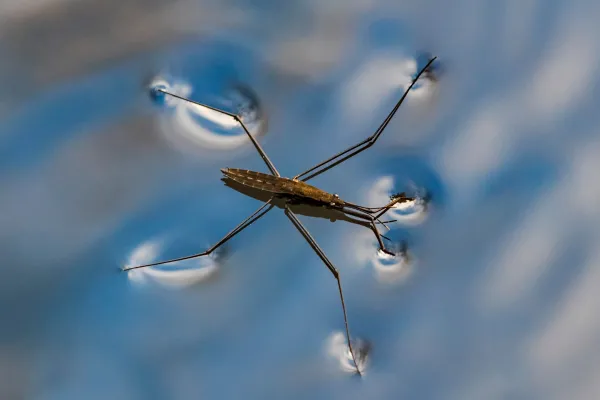
Table of Contents
Characteristics of Water Striders
True bugs (Hemiptera): Water striders are hemipterans—“true bugs”—and many have wings with a characteristic structure (often described as partly hardened and partly membranous).
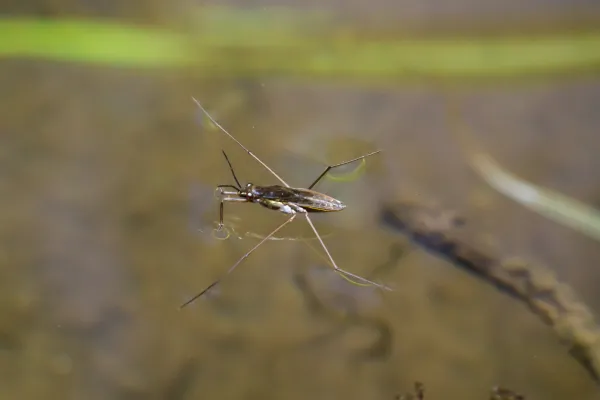
Surface gliders: They’re usually seen on top of the water, skating primarily with their long hind legs. The legs help spread body weight and keep the insect from breaking the surface film.
Special claws and sensing hairs: Their feet and leg tips include structures that aid movement and gripping. Many also have tiny hairs (microhairs) that improve sensitivity—helping them detect vibrations when prey falls into the water or when a predator approaches.
Size: Depending on species, they range from about 2 mm to nearly 3 cm long.
Body features: They typically have large eyes and long, segmented antennae.
Sex differences: Females are often slightly larger than males.
Where Water Striders Live
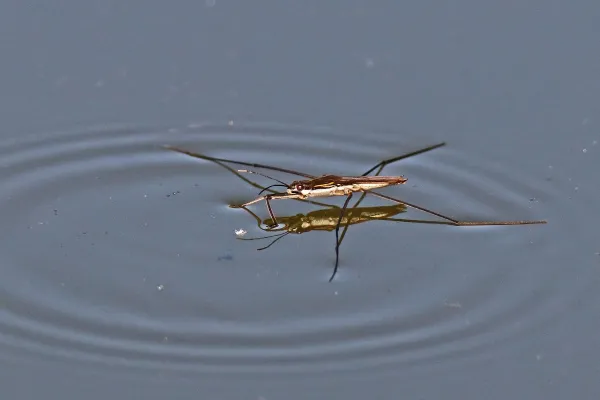
Water striders live on the surface of freshwater bodies, especially places with relatively calm water such as:
lagoons and ponds
lakes
marshes and wetlands
slow-moving rivers and quiet backwaters
They often prefer areas with aquatic plants, floating vegetation, or rocks, because these provide shelter and are common places for egg-laying. In parts of Europe, one of the most familiar species is Gerris lacustris.
Winter strategy
In colder seasons, many water striders overwinter (hibernate) and become active again in spring—often around April or May, depending on local climate.
Behavior of Water Striders
Water striders are strongly tied to water throughout their lives. Their eggs are laid on or near water, and the young develop in association with aquatic habitats from the start.
Calm appearance, fast predator
They may look peaceful as they glide, but they are quick, efficient hunters. When they detect prey on the surface, they can strike rapidly and use their mouthparts to feed. Like many true bugs, they use a piercing-and-sucking feeding method: they puncture prey and consume internal fluids.
Territorial and defensive
Territorial signals: They can communicate and mark space through surface vibrations.
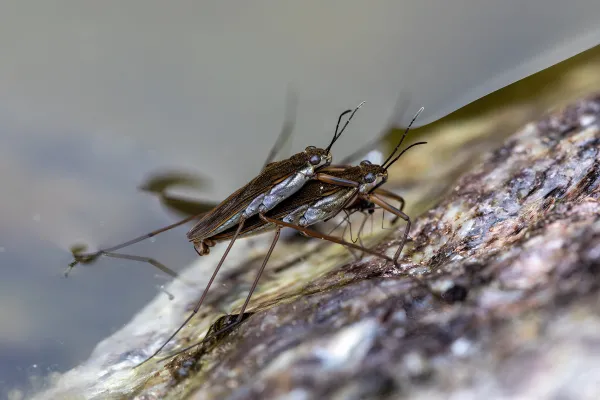
Protective during breeding: During reproduction, a pair may remain in a defined area and show defensive behavior toward threats.
More solitary later: After breeding season, many return to a more independent, less social lifestyle.
Small groups (but not huge “societies”)
They can form loose groups, but these tend not to become very large. When a habitat becomes crowded, competition increases and individuals may disperse to reduce density.
Why they migrate to new areas
Water striders may leave an area and “travel” when conditions change, for example:
Predator pressure: If predatory aquatic insects (including certain nymphs) become common, water striders may move away.
Rising salinity: They prefer freshwater. If water becomes more salty—such as after seawater influence or increased salinity—many will seek new habitat.
Do water striders bite or are they dangerous to humans?
In general, water striders are not dangerous to people and they typically do not bite humans. Their grasping legs are mainly used for catching prey and for defense against natural predators, not for attacking people.

What Water Striders Eat
Water striders have a fairly focused diet. Most species feed mainly on:
smaller insects that land on or fall into the water
other small invertebrates at the surface
In very productive waters, they may also take advantage of tiny organisms associated with rich surface activity. To eat, they pierce prey and suck out internal juices—a common strategy among true bugs.
Reproduction and Life Cycle
After winter dormancy, males and females can communicate using ripples created by body vibrations on the water surface.
Egg-laying
The female lays eggs on rocks or aquatic vegetation and may cover them with a gel-like substance that helps protect the eggs from predators and environmental stress.
Development
Once eggs hatch, the young develop through immature stages for roughly 60–70 days (this can vary by species and temperature). As they mature and conditions become suitable, they continue their life at the water surface, where they hunt, avoid predators, and eventually reproduce.
Threats and Conservation
Water striders are generally not listed as endangered in many regions, and they are not typically considered at high risk of extinction. However, like many freshwater insects, they can be affected by:
water pollution
habitat loss (wetland drainage, altered shorelines)
changes in water chemistry (including salinity shifts)
Interesting Facts
They can skate on calm water and sometimes even on water with stronger movement.
Surface tension is the secret: They rely on the water’s surface film to stay afloat.
Three pairs of legs: Like other insects, they have six legs.
Cannibalism can occur: In crowded conditions, some may feed on smaller members of their own species.
Hunting posture: They often use hind legs for propulsion, leaving the front legs freer to grab prey.
Water-repellent microhairs: The tiny hair-like structures (often called setae) help repel water and improve flotation and stability.
Bibliography
Escolástico León, C., & Claramunt Vallespí, T. (2013). Ecología I: Introducción. Organismos y poblaciones. UNED (Spain).
Madera, P. G. (2022). Todo lo que hay que saber sobre ciencia: 173 curiosidades científicas. Pinolia (Spain).