Seeing a genuinely green butterfly can be surprisingly confusing.
Some species are almost completely leaf-green when resting. Others have bright green spots, metallic emerald bands or green-and-white marbling on otherwise dark or pale wings.
The fastest way to identify a green butterfly is to look at four things: where the green appears, whether the wings have tails, the butterfly's size and where in the world you saw it.
Quick Green Butterfly Identification Guide
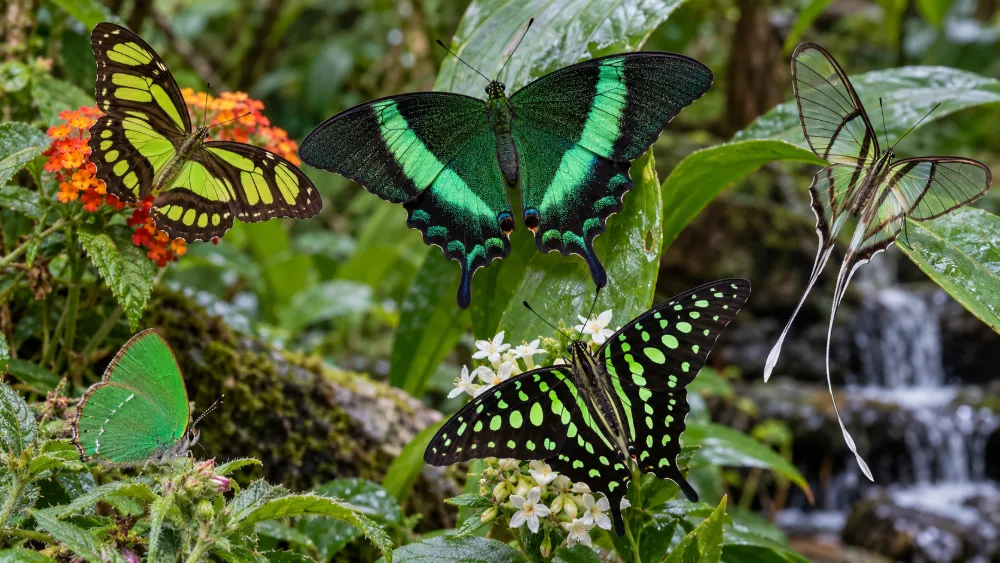
| Butterfly | Best Identification Clue | Region |
|---|---|---|
| Green Hairstreak | Nearly solid green underside, brown upper wings | Europe and parts of Asia |
| Malachite | Large lime-green patches on dark brown wings | Florida to South America |
| Emerald Swallowtail | Metallic emerald band across black wings | Southeast Asia |
| Tailed Jay | Many apple-green spots on black wings | South and Southeast Asia |
| Green Dragontail | Transparent wings, green bands and extremely long tails | Tropical Asia |
| Orange-tip | Green marbled underside; male has orange forewing tips | Europe and western Asia |
| Falcate Orangetip | Fine green marbling below, hooked forewing tips | Eastern North America |
| Green-banded Swallowtail | Bright blue-green bands on large black swallowtail | Sub-Saharan Africa |
1. Green Hairstreak
Scientific name: Callophrys rubi
If you are in Britain or much of Europe and see a tiny butterfly that looks almost completely green while resting, the Green Hairstreak is one of the strongest possibilities.
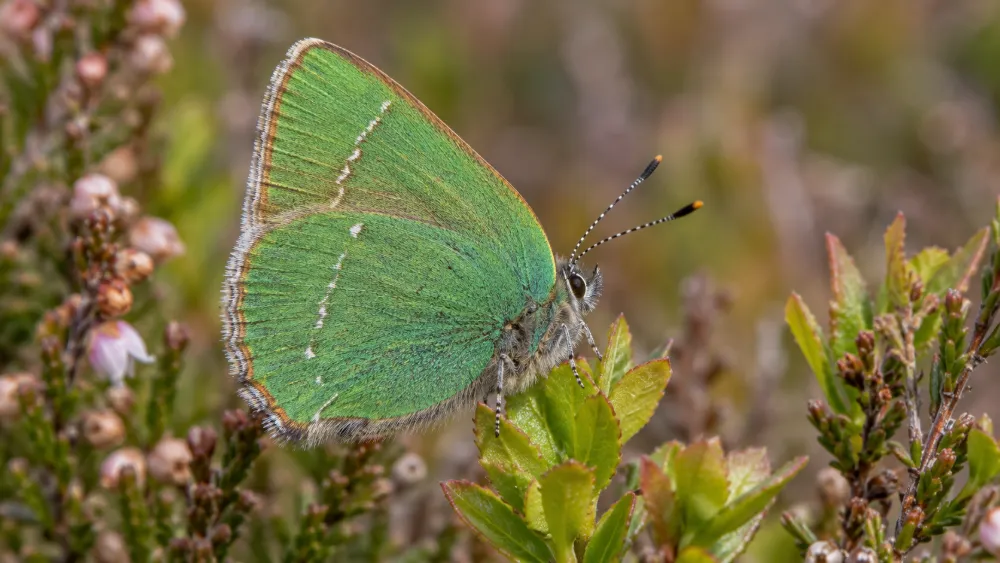
The identification trick is understanding that only the underside is brilliant green.
The upper surface of the wings is actually dull brown.
Green Hairstreaks normally rest with their wings tightly closed, so the green underside is what people usually see.
A broken white line or series of small white marks may cross the hindwing, although this marking can be weak or almost absent.
They are small butterflies, with a wingspan roughly around 27 to 34 millimeters.
Best ID clues
small butterfly;
bright leaf-green underside;
wings normally closed while perched;
little or no obvious black pattern;
often seen around heathland, scrub and woodland edges.
2. Malachite Butterfly
Scientific name: Siproeta stelenes
The Malachite looks completely different from the Green Hairstreak.
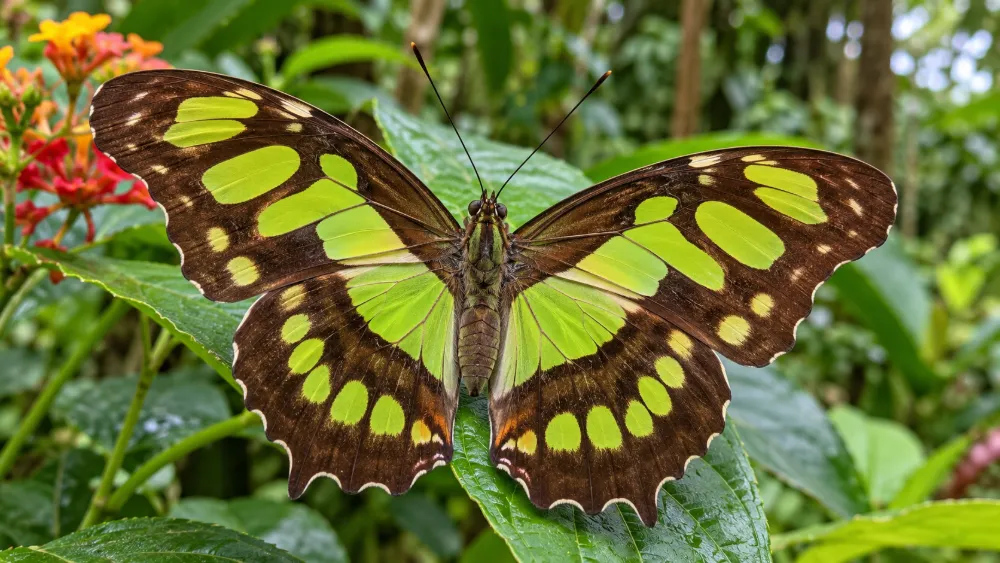
Instead of being uniformly green, it has large pale green to yellow-green patches surrounded by broad dark brown or almost black borders.
It is also far larger.
The Florida Museum gives the Malachite a wingspan of approximately 3.2 to 4 inches.
Its range includes tropical and subtropical parts of the Americas, including Central America and South America, with the species also occurring in southeastern Florida.
Best ID clues
large butterfly;
strong green-and-dark-brown mosaic;
scalloped wing edges;
tropical or subtropical American location.
3. Emerald Swallowtail
Scientific name: Papilio palinurus
The Emerald Swallowtail is one of the most spectacular green butterflies.
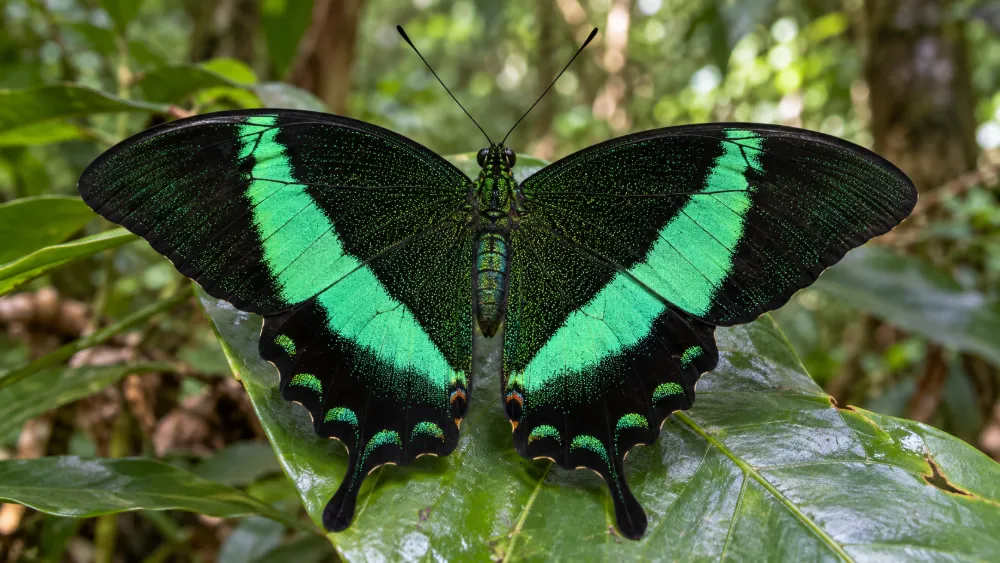
Its wings are predominantly very dark brown to black, but a brilliant metallic green band crosses both the forewings and hindwings.
The green may appear turquoise or blue-green when the viewing angle changes.
This is an example of structural coloration: microscopic wing-scale structures manipulate reflected light to produce the metallic appearance.
The species is native to Southeast Asia.
Florida Museum material lists a very large wingspan of approximately 6 to 6.5 inches for specimens displayed in its Butterfly Rainforest.
Best ID clues
very large swallowtail;
dark wings;
one broad metallic emerald band;
short tails on the hindwings;
Southeast Asian origin.
4. Tailed Jay
Scientific name: Graphium agamemnon
The Tailed Jay is another black-and-green Asian butterfly, but its pattern separates it from the Emerald Swallowtail.
Instead of a single broad emerald band, the Tailed Jay has numerous apple-green spots and patches scattered over a dark background.
Its hindwings have relatively short tails.
ButterflyCircle records a wingspan of roughly 80 to 90 millimeters for the Singapore subspecies.
Tailed Jays are also fast, active butterflies and may spend only brief periods feeding at each flower.
Best ID clues
black wings covered in many green spots;
not a solid metallic green band;
short hindwing tails;
fast flight;
South or Southeast Asian location.
5. Green Dragontail
Scientific name: Lamproptera meges
The Green Dragontail is one of the strangest butterflies on this list.
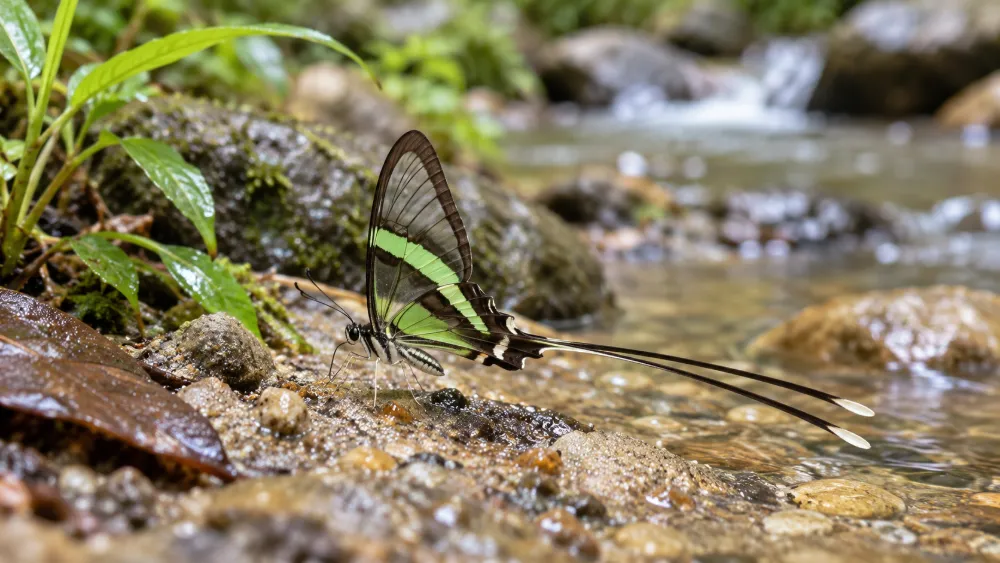
It belongs to the swallowtail family, yet it is exceptionally small.
The National Museum of Natural Science reports a wingspan of only around 2 to 3 centimeters.
Its black-edged forewings contain transparent areas, while pale green bands cross the center of the wings.
The most obvious feature is the pair of extremely long, narrow extensions projecting from the hindwings.
This gives the insect a shape unlike a typical broad-winged swallowtail.
Best ID clues
very small;
partly transparent wings;
thin green bands;
exceptionally long hindwing tails;
often associated with wet areas in tropical Asia.
6. Orange-Tip
Scientific name: Anthocharis cardamines
An Orange-tip may not look green while flying.
Adult males are white with unmistakable orange tips on the forewings, while females have darker gray-black tips instead.
Fold the wings, however, and both sexes reveal a beautiful green-and-white marbled underside.
This camouflage can make a resting Orange-tip almost disappear against vegetation and flower heads.
Best ID clues
mostly white upper wings;
male has bright orange tips;
underside strongly marbled green and white;
usually seen during spring in Europe.
7. Falcate Orangetip
Scientific name: Anthocharis midea
North America has its own butterfly that may appear green when resting.
The Falcate Orangetip occurs mainly in the eastern United States.
Males have orange forewing tips, while females lack the orange.
Both sexes have an intricate green-marbled pattern on the underside of the hindwings.
The forewing tips are also distinctly hooked or falcate, helping separate the species from many ordinary white butterflies.
Best ID clues
white butterfly;
green-marble patterned hindwing underside;
hooked forewing tip;
orange tip on males;
eastern North America.
8. Green-Banded Swallowtail
Scientific name: Papilio nireus
A large black butterfly with brilliant green to blue-green bands in Africa may belong to the Papilio nireus group.
The green areas form distinct bands and spots against a dark background.
Depending on lighting, these markings can appear more turquoise or bluish than pure green.
This is one reason photographs alone can sometimes be misleading when identifying structurally colored butterflies.
Green Butterfly vs. Green Moth
Not every green insect with broad wings is a butterfly.
Many moths are naturally green, including:
emerald moths;
luna moths;
some hawk moths;
and numerous tropical moth species.
One useful clue is the antennae.
Most butterflies have antennae ending in a distinct club, while moth antennae usually lack this classic butterfly-style club and may be threadlike, feathery or otherwise shaped.
This rule is useful but not perfect, so wing shape, posture and species range should also be considered.
Are There Really Green Butterflies?
Yes.
However, “green” can be created in several different ways.
Some butterflies appear green because pigments absorb other wavelengths of light.
Others produce green through microscopic structures in their wing scales.
Structural coloration can produce especially vivid metallic and iridescent effects.
This is why an Emerald Swallowtail may appear emerald from one angle and more turquoise from another.
Why Are Green Butterflies Green?
Green coloration frequently provides camouflage.
A Green Hairstreak sitting motionless with its green underside exposed can blend into young leaves surprisingly well.
The marbled underside of an Orange-tip serves a similar function.
But color can also play a role in:
species recognition;
mate signaling;
warning or mimicry;
and interactions with light.
So there is no single evolutionary reason every green butterfly has green wings.
What Green Butterfly Is Found in Florida?
The Malachite is one of the most distinctive possibilities in southern Florida.
It has large pale-green patches bordered by dark brown wings and is much larger than a tiny hairstreak.
Its broader natural distribution extends through Central America, the Caribbean and South America.
What Green Butterfly Is Found in Britain?
The strongest answer is the Green Hairstreak.
Its emerald-green wing undersides make it highly distinctive when perched.
Because its upper wings are brown, however, it may look surprisingly dark while flying.
How to Identify a Green Butterfly Quickly
Ask these five questions:
Is almost the entire underside green? Think Green Hairstreak.
Are there large green patches surrounded by brown? Think Malachite.
Is there one brilliant metallic green band on a black swallowtail? Think Emerald Swallowtail.
Are there many small green spots on black wings? Think Tailed Jay.
Are the wings partly transparent with extremely long tails? Think Green Dragontail.
Then confirm your identification using geographic range, wing size and additional markings.
FAQ
What is a green butterfly called?
There is no single species called “the green butterfly.” Green Hairstreak, Malachite, Emerald Swallowtail, Tailed Jay and Green Dragontail are examples of genuinely green-looking butterflies.
What is the small bright green butterfly?
In Britain and much of Europe, a tiny butterfly with a nearly solid bright-green underside is likely to be a Green Hairstreak (Callophrys rubi).
What is the large green and black butterfly?
In tropical America, it may be a Malachite. In Southeast Asia, a large black butterfly with metallic green bands may be an Emerald Swallowtail.
Are green butterflies rare?
Some species are local or uncommon, but green coloration itself does not mean a butterfly is rare. Green Hairstreaks, for example, remain widespread across much of Britain even though individual colonies can be localized.
Are there green swallowtail butterflies?
Yes. Emerald Swallowtails, Tailed Jays, Green Dragontails and several other swallowtails show green bands or markings.
Why does a green butterfly look brown when it flies?
A Green Hairstreak has green undersides but brown upper wings. It rests with the wings closed, exposing green, but flashes the darker upper surfaces during flight.
Is a Luna Moth a green butterfly?
No. The Luna Moth is a large green moth native to North America, not a butterfly.
Final Answer
The identity of a green butterfly depends strongly on its pattern and location.
A tiny nearly solid-green butterfly in Europe may be a Green Hairstreak. A large green-and-brown butterfly in tropical America may be a Malachite. A large black Asian swallowtail crossed by a metallic emerald band may be an Emerald Swallowtail, while apple-green spots suggest a Tailed Jay.
Do not rely on green color alone. Check the underside and upperside separately, look for tails or transparent areas, estimate the wingspan and compare the sighting with species known from your region.
Those four clues usually narrow a mysterious green butterfly down much faster than color alone.
Related Reading
Sources Used for Fact Checking
Butterfly Conservation — Green Hairstreak identification resources
Florida Museum of Natural History — Malachite
Florida Museum of Natural History — Emerald Swallowtail
National Museum of Natural Science — Green Dragontail
ButterflyCircle — Tailed Jay
Butterflies and Moths of North America — Falcate Orangetip