Sea snails are marine gastropods found from shallow tide pools to coral reefs and deeper coastal waters. Their shells come in countless shapes and colors, but they’re more than beautiful “ocean ornaments.” Many graze on algae and help keep reefs balanced, while others are active predators that shape food webs by controlling populations of starfish, sponges, or other invertebrates.
Below are 10 well-known types of sea snails.
1) Textile Cone Snail (Conus textile)
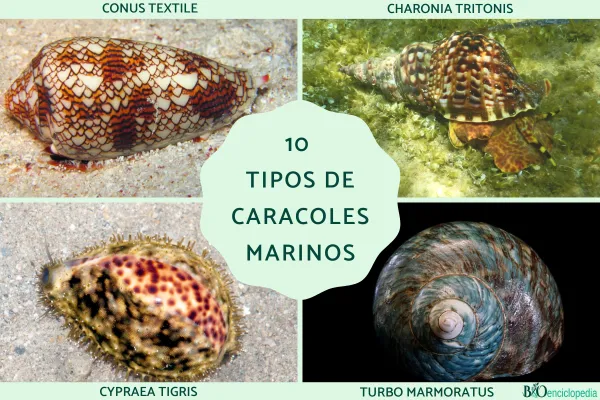
The textile cone snail lives in tropical waters of the Indian and Pacific Oceans. It’s famous for its striking cone-shaped shell, often decorated with intricate “woven” patterns. Unlike many snails that graze, this species is a specialized predator. It hunts by firing a venomous harpoon-like tooth that can quickly immobilize prey. The venom contains multiple toxins, helping it target different food sources depending on what’s available.

2) Triton’s Trumpet (Charonia tritonis)
This large sea snail occurs in tropical and subtropical seas. Its heavy, spiral shell is usually yellow to brown with swirling markings, and adults commonly reach around 20 cm, with much larger individuals known. It’s a strong predator that feeds mainly on echinoderms, especially sea stars, using an extendable feeding tube to reach and subdue prey. Its impressive shell has long been valued for decoration and traditional uses.

3) Queen Conch / Pink Conch (Lobatus gigas)
Once widely known as Strombus gigas, the queen conch is iconic for its large shell with warm tones—often pink, orange, and brown. It lives in Caribbean and western Atlantic waters. Ecologically, it helps coastal habitats by feeding on algae and organic debris, supporting healthier seagrass beds and shallow reef systems. Because it’s also harvested for food and souvenirs, it has faced conservation concerns in some areas.

4) European Abalone / Sea Ear (Haliotis tuberculata)
Often called “sea ear” because of its ear-shaped shell, this abalone lives in cool to temperate waters. The shell surface is rough and can show green, blue, brown, or reddish tones, while the inside is typically iridescent. Abalones are herbivores that cling tightly to rocks and feed on algae, making them important grazers in rocky coastal ecosystems. Some populations have declined where harvesting pressure and habitat changes are intense.

5) Granular Sea Snail (Dulcerana granularis)
Dulcerana granularis is a smaller, reef-associated sea snail found in warm coastal waters. Its shell tends to have fine ridges and textured bumps that give it a detailed, sculpted look. Many individuals are more active at night, moving across the seafloor to feed. It commonly targets small reef organisms such as sponges and microscopic life on hard surfaces, contributing to natural recycling processes on reefs.

6) Tiger Cowrie (Cypraea tigris)
The tiger cowrie is one of the easiest sea snails to recognize. Its shell is smooth, glossy, and oval, typically patterned with dark spots and bold markings that resemble a “tiger” design. It lives in tropical to subtropical waters and often shelters in crevices during the day. Ecologically, it helps regulate reef communities by feeding on sponges and other encrusting organisms. Its popularity in collecting and jewelry has caused pressure in places where harvesting is uncontrolled.

7) Green Turbo / Marble Turbo (Turbo marmoratus)
This Indo-Pacific snail is known for its thick, rounded shell with a distinctive marbled pattern. It’s typically found on reefs and rocky substrates where it grazes on algae and organic material. Like many turban snails, it can attach strongly to rocks using a muscular foot, helping it survive in wave-washed zones. In some areas, collection and habitat damage can reduce local numbers.

8) Tessellated Nerite (Nerita tessellata)
Nerita tessellata is a hardy coastal snail found in many tropical and subtropical shorelines. Its rounded shell often looks like a mosaic, with mixed color blocks and textured patterns. It lives in places such as rocky shores and mangrove edges, where it scrapes algae and organic film from surfaces. Because it thrives in challenging intertidal conditions, it’s a common species in tide-pool ecosystems.

9) Chilean Abalone / Loco (Concholepas concholepas)
Known as “loco” in many coastal communities, this species is native to the Pacific coast of South America. Its shell is sturdy and cone-like, usually gray to brown. Unlike herbivores, it’s a powerful predator that can significantly influence rocky-shore ecosystems by feeding on other marine invertebrates. It is also widely used in local cuisine and fisheries, which makes sustainable management important where harvest pressure is high.

10) Australian Trumpet / False Trumpet (Syrinx aruanus)
One of the world’s largest sea snails, the Australian trumpet lives in tropical Indo-Pacific waters. Its elongated spiral shell can reach extraordinary lengths—often cited up to 91 cm. The shell is usually beige to brown with subtle banding. This species feeds on other mollusks and small marine animals. Because of its remarkable size and collectible shell, heavy harvesting can affect populations in certain regions.