A new 2026 study suggests that Goffin's cockatoos can recognize when their own bodies are physically preventing them from completing a task. In an experiment involving 15 birds, the cockatoos usually stepped off a mat when their own weight was stopping them from handing over an attached object. The result provides evidence of body awareness, but it does not prove that cockatoos have human-like self-awareness or that they recognize themselves in mirrors.
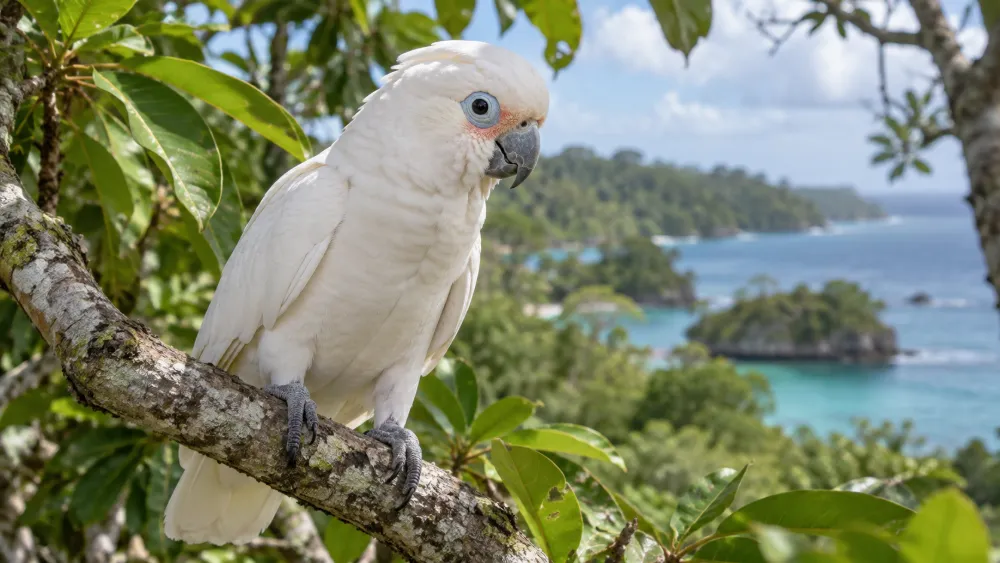
Goffin's cockatoos are small white cockatoos known for unusually flexible problem-solving and tool use.
Are Cockatoos Self-Aware?
The best current answer is: Goffin's cockatoos show evidence of one important form of self-related cognition called body awareness, but scientists have not demonstrated that they possess every form of self-awareness seen in humans.
A study published in Scientific Reports on September 17, 2026 tested whether Goffin's cockatoos could understand that their own bodies were creating a physical obstacle.
The birds performed remarkably well.
When standing on a mat that was attached to an object they needed to hand to a researcher, the cockatoos usually stepped off the mat before completing the task.
In other words, they behaved as though they understood:
“My own body is part of the reason this object cannot move.”
That ability is called body awareness or body-related self-representation.
What Did the 2026 Cockatoo Study Test?
Researchers from the Messerli Research Institute at the University of Veterinary Medicine Vienna adapted an experiment known as the body-as-obstacle task.
The task was originally developed for studying self-awareness in young children and has also been used with some nonhuman mammals.
This was the first time researchers adapted the paradigm for birds.
The Basic Experiment
Fifteen Goffin's cockatoos participated.
Each bird was trained to pick up a small object and pass it to an experimenter following a “give me” request.
During the critical test, however, the object was attached to a mat.
The cockatoo was standing on that same mat.
This created a simple physical problem:
the bird picked up the object;
the object was connected to the mat;
the bird's own weight held the mat down;
the object therefore could not be freely handed over;
the bird had to step off the mat to solve the problem.
If the cockatoo understood that its own body was contributing to the obstruction, stepping off the mat was the appropriate solution.
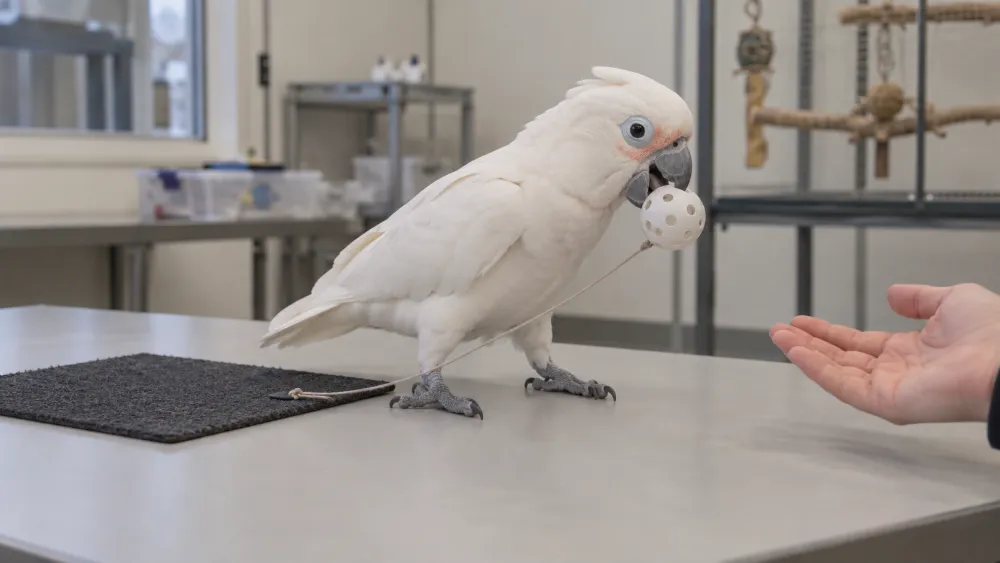
In the body-as-obstacle experiment, the cockatoos had to step away from a mat when their own weight prevented an attached object from moving freely.
How Well Did the Cockatoos Perform?
The difference between the experimental conditions was striking.
| Condition | What Happened? | How Often Birds Stepped Off |
|---|---|---|
| Body-as-obstacle test | The object was attached to the mat the bird was standing on | 97.8% |
| Unattached control | The object was not attached, so the bird's body caused no obstruction | 0.7% |
| External-obstacle control | The object was fixed externally rather than being blocked by the bird's own weight | 39.1% |
Across the full experiment, the birds stepped off the mat in 528 of 540 body-as-obstacle trials.
When the object was simply unattached, they stepped off in only four of 540 trials.
This suggests the birds were not merely developing a general habit of stepping away whenever they picked up the object.
Could the Cockatoos Simply Have Disliked the Moving Mat?
The researchers specifically tested this possibility.
Before the main experiment, they carried out a pre-test in which movement under the birds' feet could occur without requiring them to step away.
Across 180 pre-test trials, the cockatoos successfully stayed on the mat in 179.
That was a success rate of about 99.4%.
This makes a simple explanation such as “the birds stepped away because they disliked feeling the mat move” much less convincing.
What Does Body Awareness Mean?
Body awareness is the ability to represent your own body as something that occupies space and can affect what happens around you.
A simple human example is walking through a narrow doorway while carrying a large backpack.
You need to account not only for the width of the doorway, but also for the space occupied by your body and what you are carrying.
Another example is realizing that you cannot lift a blanket while standing on top of it.
In a body-as-obstacle task, an animal must recognize that its own body is not merely present in the situation. Its body is actually causing the problem.
Is Body Awareness the Same as Self-Awareness?
No.
This distinction is extremely important.
“Self-awareness” is a broad concept containing several potentially different abilities.
They may include:
recognizing one's own body;
distinguishing oneself from the external environment;
recognizing one's reflection;
understanding one's own actions;
remembering personal experiences;
monitoring one's own knowledge or uncertainty.
Success in one type of experiment does not automatically demonstrate every one of these abilities.
The new cockatoo study specifically provides evidence related to body awareness.
Do Goffin's Cockatoos Recognize Themselves in Mirrors?
There is currently no strong evidence that Goffin's cockatoos pass the classic mirror self-recognition test.
Previous attempts with Goffin's cockatoos and other parrots have not produced the same kind of convincing mirror-mark-test success reported in a small number of other animals.
But failing a mirror test does not necessarily mean an animal has no representation of itself.
That is one reason researchers are interested in alternative experiments such as the body-as-obstacle task.
What Is the Mirror Test?
The mirror self-recognition test usually gives an animal access to a mirror and later places a mark on a part of its body that cannot be seen without the reflection.
If the animal uses the mirror to inspect or touch the mark on its own body, researchers may interpret this as evidence that it understands the reflection represents itself.
Great apes are among the best-known animals to show mirror-directed responses under suitable experimental conditions.
However, the test strongly depends on vision and on whether the tested species naturally considers visual marks important.
An animal whose perception relies heavily on smell, touch, sound or other information may have sophisticated self-related cognition without responding to a visual mirror in the expected way.
Why Use a Body-as-Obstacle Test Instead?
The body-as-obstacle task asks a different question.
Instead of:
“Does this animal understand that the image in the mirror is itself?”
the task asks:
“Does this animal understand when its own physical body is causing a problem?”
This can provide a useful additional measure because it does not depend on recognizing a visual reflection.
Researchers increasingly argue that studying animal self-representation may require several different tests rather than treating one mirror experiment as a universal measure of consciousness.
Why Were Goffin's Cockatoos Chosen?
Goffin's cockatoos, Cacatua goffiniana, have become important animals in research on physical cognition.
They are known for:
inventive problem-solving;
tool manufacture;
using multiple tools;
choosing tools according to a task;
exploring unfamiliar objects;
flexibly modifying objects to reach food.
Some of these abilities have been discovered experimentally, while tool-related behavior has also been investigated in wild Goffin's cockatoos.
This makes them especially interesting for testing whether flexible physical problem-solving also extends to representing their own bodies.
Did Every Cockatoo Understand the Task?
All 15 cockatoos passed the preliminary test and participated in the main experiment.
The overall pattern was strong across individuals rather than depending on a single unusually successful bird.
Importantly, the researchers reported that the condition-dependent behavior was already visible during the first experimental session.
This reduces the possibility that the result was simply created by extensive trial-and-error learning over many repeated sessions.
Why Did the Birds Step Off 39% of the Time in One Control?
One result deserves careful interpretation.
When the object was attached to an external point rather than being blocked by the bird's own body, the cockatoos still stepped off the mat in about 39.1% of trials.
This is much higher than the 0.7% seen when the object was completely free.
The likely reason is that resistance while pulling the object could itself encourage some birds to change position.
However, the rate remained dramatically below the 97.8% observed when stepping off actually removed the bird's own body as the obstacle.
That difference is central to the researchers' interpretation.
Does the Study Prove Cockatoos Know Who They Are?
No.
The study should not be interpreted as proof that a cockatoo has a human-like concept of personal identity.
The researchers tested a narrower ability: whether birds could distinguish a problem caused by their own body from an external obstruction.
The findings support body-related self-representation.
Questions about subjective consciousness, personal identity or what an animal experiences internally cannot be answered by this experiment alone.
Are Goffin's Cockatoos Intelligent?
Yes, by many behavioral measures Goffin's cockatoos show exceptionally flexible cognition.
Their reputation does not come from one experiment.
Researchers have studied their ability to manufacture tools, solve multi-step problems and evaluate whether objects are functional for particular tasks.
In another study published in 2026, researchers found that Goffin's cockatoos could learn that particular touchscreen elements had become permanently non-functional after experiencing a negative event.
Together, these studies make Goffin's cockatoos valuable models for investigating how sophisticated cognition can evolve outside primates.
Are Parrots as Smart as Apes?
It is not scientifically useful to place all parrots and all apes on one simple intelligence scale.
Different species evolved cognitive abilities suited to different ecological and social problems.
Some parrots perform impressively on tasks involving tools, memory, object relationships or social learning.
Great apes may outperform them on other tasks.
Brain organization is also very different between birds and mammals, meaning similar behavioral abilities can evolve through different neural structures.
The better question is usually:
Which cognitive abilities does this species possess, and how does it solve a particular problem?
What Other Animals Show Body Awareness?
Body-as-obstacle experiments originated with human infants and have subsequently been adapted for several nonhuman animals.
The exact experimental design varies between species because an action appropriate for a child may not be meaningful to an elephant, dog or bird.
The Goffin's cockatoo experiment is particularly significant because it extends this approach into birds.
That allows researchers to compare self-related cognition between animals with very different brains, bodies and evolutionary histories.
When Does Body Awareness Develop in Humans?
In human developmental research, success in body-as-obstacle tasks develops during early childhood.
The new cockatoo paper notes that performance on these tasks emerges at approximately the same broad developmental period as mirror self-recognition, around 18 to 24 months in children.
The two abilities are related but are not considered identical.
Research across human cultures has also shown that performance on different self-recognition tasks can vary depending on children's experiences and social environments.
What Does This Tell Us About Bird Intelligence?
The study adds to evidence that bird cognition cannot be judged simply by comparing brain size or assuming that mammal-like brain anatomy is required for sophisticated behavior.
Birds have very different brain organization from mammals, yet several bird groups show:
complex problem-solving;
long-term memory;
flexible tool use;
social learning;
planning-like behavior;
sophisticated communication.
The new cockatoo experiment adds body awareness to the questions researchers can now investigate comparatively in birds.
What the Study Does Not Show
There are several important limitations.
It Tested One Species
The experiment involved Goffin's cockatoos. The result should not automatically be applied to every parrot or every bird.
It Tested 15 Individuals
Fifteen birds produced a strong behavioral pattern, but this is still a relatively small experimental population.
Body Awareness Is Not Full Human Self-Awareness
The experiment tested whether the birds represented their bodies as physical obstacles. It did not test language-based identity, autobiographical self-knowledge or human-like consciousness.
It Does Not Make the Mirror Test Irrelevant
Mirror tests and body-as-obstacle tasks measure different aspects of self-related behavior. Using several methods may provide a more informative picture than relying on either one alone.
Why This Study Matters
Animal cognition research has historically relied heavily on tests designed around human senses and human behavior.
That creates a problem.
A species may fail a task not because it lacks the cognitive ability researchers are interested in, but because the experimental design does not match how that animal naturally perceives or interacts with the world.
The cockatoo experiment demonstrates one way to broaden the study of animal self-representation beyond mirrors.
Instead of asking whether an animal behaves like a human looking at its reflection, researchers can ask whether it understands its own body's role during a practical physical problem.
Frequently Asked Questions
Are cockatoos self-aware?
A 2026 study found strong evidence that Goffin's cockatoos possess body awareness: they recognized when their own bodies were physically preventing them from completing a task. This does not prove every form of self-awareness or human-like consciousness.
Do cockatoos recognize themselves in mirrors?
Goffin's cockatoos have not shown convincing success in traditional mirror self-recognition tests. However, failing a mirror test does not necessarily mean an animal lacks other forms of self-related cognition.
What is body awareness in animals?
Body awareness is the ability to represent one's own body as something that occupies space and can influence actions or create physical obstacles.
What was the Goffin's cockatoo body-awareness experiment?
Researchers asked cockatoos to hand over an object while the birds stood on a mat attached to that object. To succeed, the bird needed to step off the mat so that its own body weight no longer prevented the object from moving.
How many cockatoos were tested?
The 2026 study tested 15 Goffin's cockatoos.
How often did the cockatoos solve the body-as-obstacle task?
Across the experimental sessions, they stepped off the mat in approximately 97.8% of trials when their own body was causing the obstruction.
Are Goffin's cockatoos smart?
Goffin's cockatoos have demonstrated flexible problem-solving, innovative tool manufacture and sophisticated physical cognition in multiple scientific studies. The new body-awareness study adds another ability researchers can investigate in this species.
Are parrots self-aware?
There is no single answer for all parrots. Different species have performed differently on cognitive tests, and self-awareness itself includes several distinct abilities. Evidence from Goffin's cockatoos now supports body awareness even though they have not convincingly passed the classic mirror test.
Does passing a body-awareness test prove consciousness?
No. Behavioral experiments can provide evidence about specific cognitive abilities, but they cannot by themselves reveal exactly what an animal subjectively experiences.
Why are Goffin's cockatoos used in intelligence studies?
They are highly exploratory and unusually flexible problem-solvers. Both captive and field research has shown sophisticated interactions with objects and tools, making them useful for studying the evolution of technical cognition.
Scientific and Official Sources
Hundegger P., Folkertsma R., Dale R., Auersperg A. M. I., Osuna-Mascaró A. J. — “Body awareness in Goffin's cockatoos (Cacatua goffiniana),” Scientific Reports, published September 17, 2026.
University of Veterinary Medicine Vienna, Messerli Research Institute — research announcement on body awareness in Goffin's cockatoos, September 18, 2026.
Osuna-Mascaró A. J. and colleagues — research on physical cognition, tool functionality and problem-solving in Goffin's cockatoos.
Animal Innovation Research Unit, University of Veterinary Medicine Vienna — ongoing research on Goffin's cockatoo cognition and tool use.